
17 min read
A boy was ordered to sweep a chimney at Wandsworth, south-west of London, some time before 1817, and each time he tried to climb the flue he came back down. At last the journeyman in charge of him, a witness told a committee of the House of Commons that year, “took some straw or hay, and lighted it under him to drive him up.” The boy climbed until he met a bar across the chimney that he could not pass, and when he came down again the journeyman beat him so cruelly, the witness said, “that he could not stand for a fortnight.” The boy’s name is not in the record.
He was one of the climbing boys of Britain, the children who were apprenticed, sold or simply handed over to master chimney sweeps and sent up flues too narrow for a man. Parliament passed laws against the practice in 1788, 1834, 1840 and 1864, and each one was evaded by the sweeps, by the householders who hired them and by the magistrates who were supposed to punish them. What finally changed it was the death of an eleven-year-old boy in a boiler flue at a Cambridgeshire asylum, on a Thursday in February 1875, and an old earl who would not let the House of Lords forget it.
Boys of six, bought for a crown
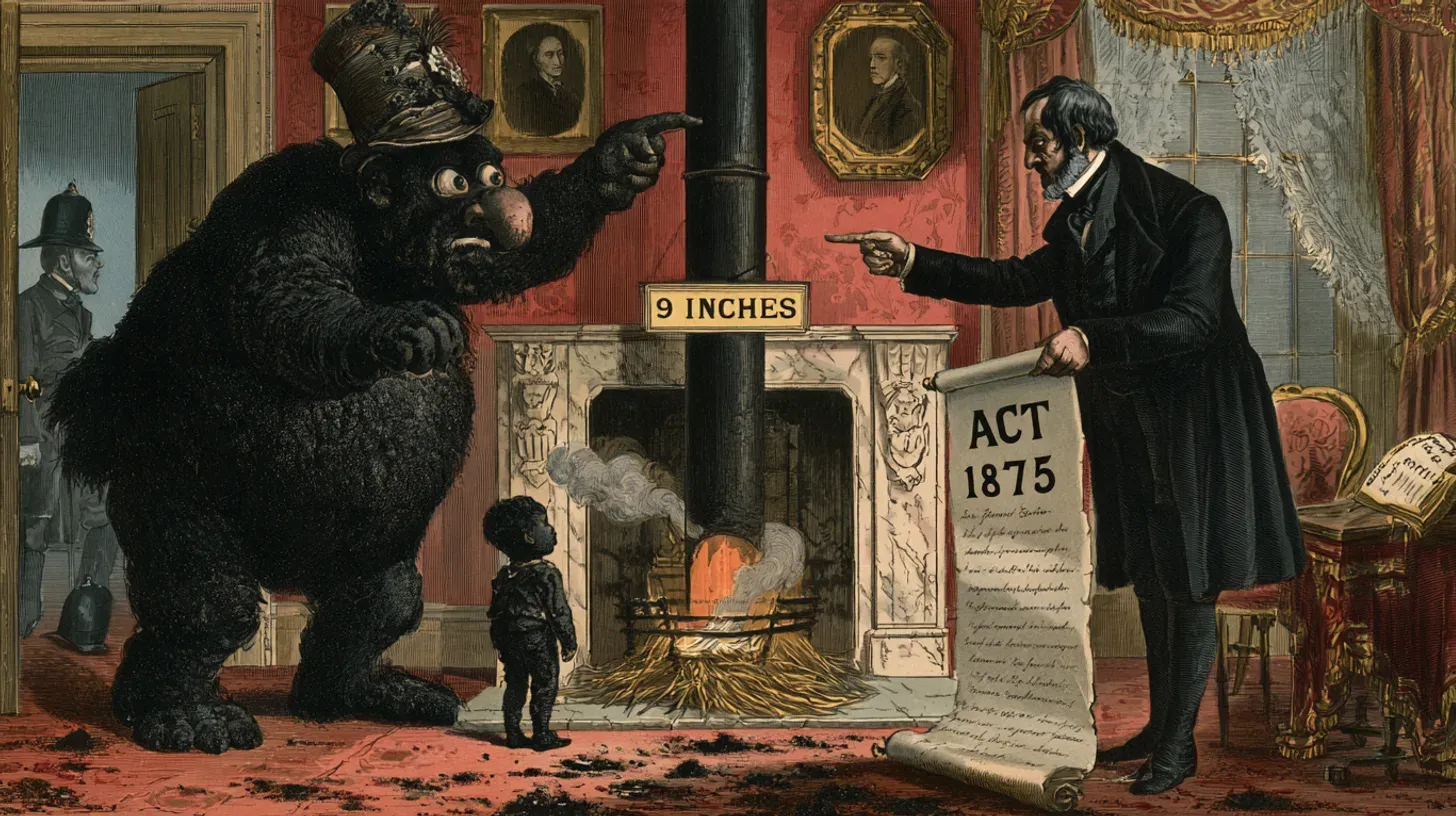
The trade wanted small boys because the flues were small. A master sweep in Nottingham named George Ruff told a government commissioner in 1862 that many flues in his town, especially in houses lately built, were nine inches by twelve, smaller than the law required. “But some are as small as 9 x 9 inches,” he said, and a lad of his, about eight years old, had once been sent up for a wager to the top of one that its bricklayer said was seven and a half inches square in the upper part.
The best age to start a boy, he said, was “about 6, that is thought a nice trainable age.” A committee of the House of Commons had found in 1817 that infants of four, five and six were being employed, “it being the practice for parents to sell their children to this trade,” and that others were “stolen from their parents and inveigled out of workhouses.”
The price was low. Another Nottingham sweep, Thomas Clarke, who had climbed himself as a child, told the same commissioner that “A crown or so is paid down to the parent” (a crown was five shillings), with sometimes a pound or so a year afterward. One sweep in Clarke’s town had taken about 24 boys between six and nine out of the workhouse over the years.
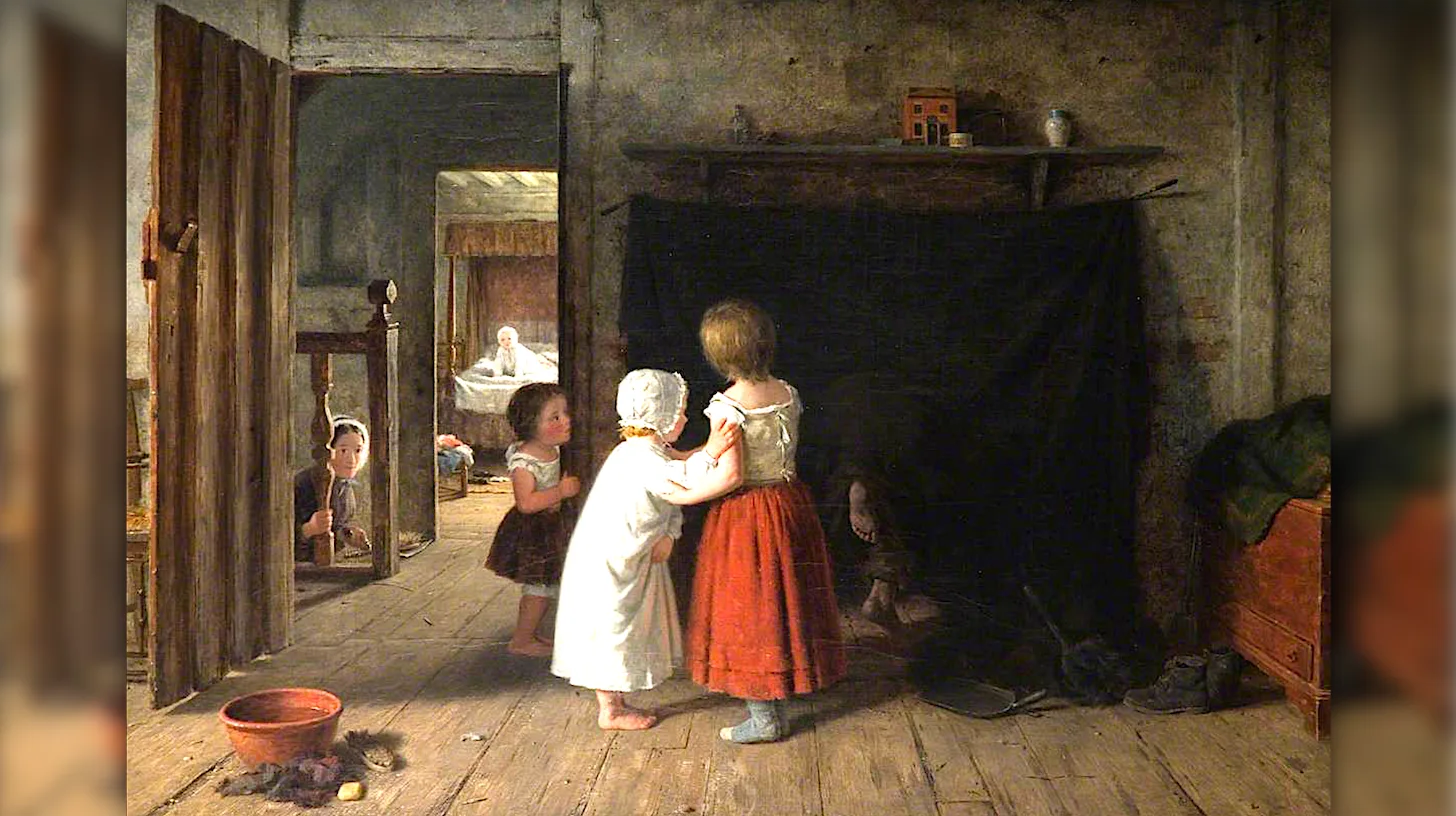
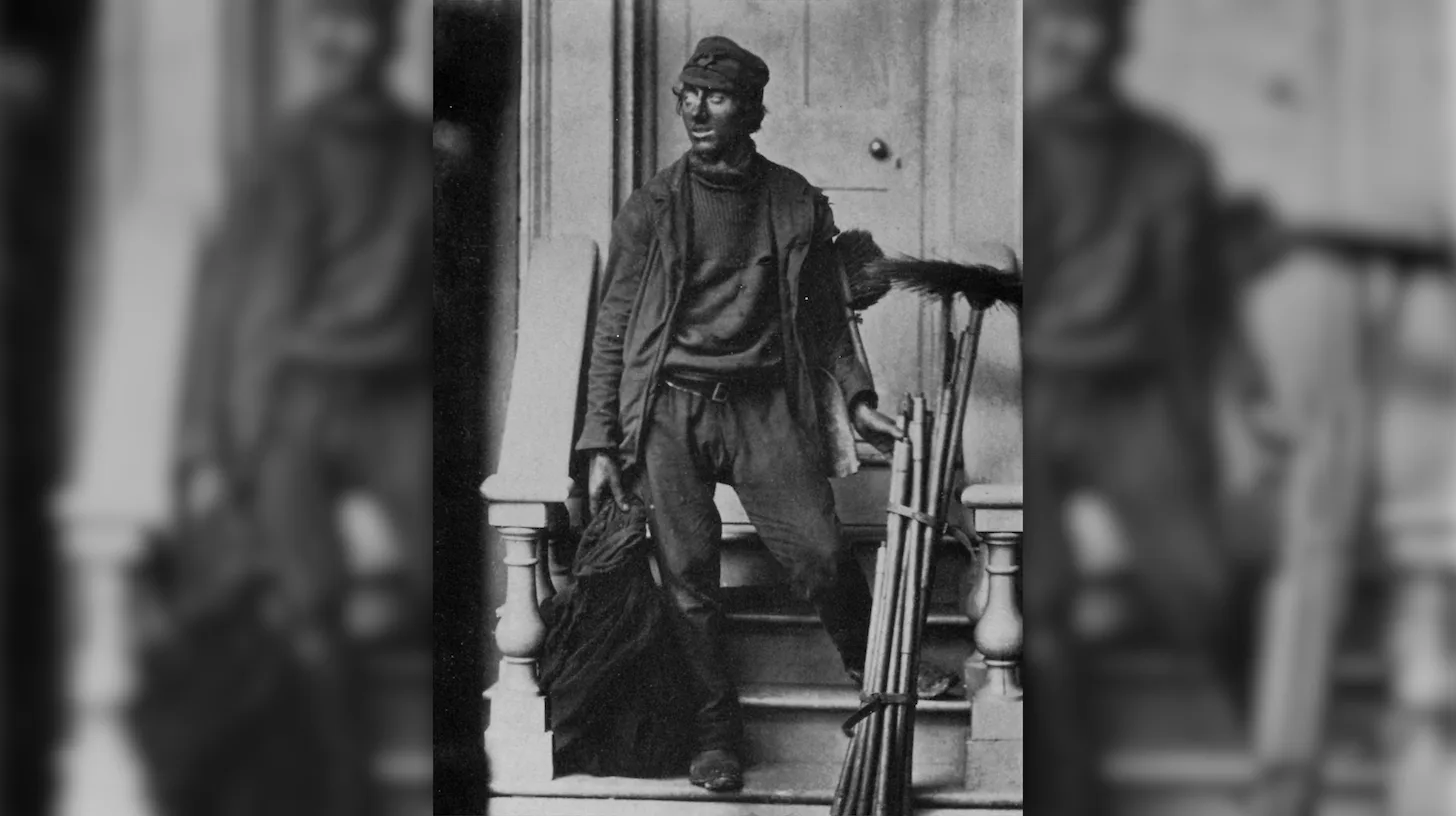
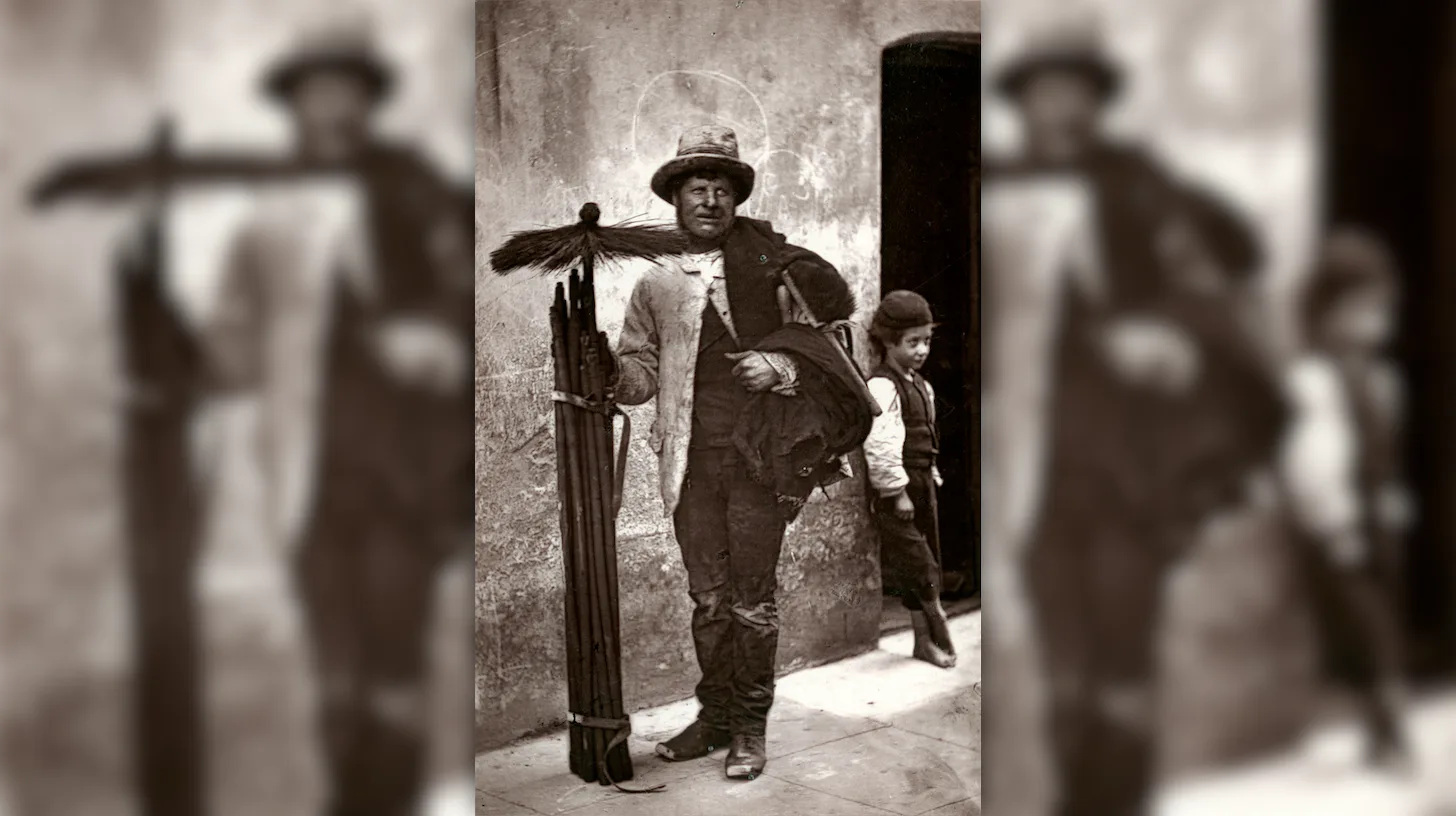
A boy climbed with his knees and his elbows, pressing them against the sides of the flue and working upward, with a cap pulled over his eyes and mouth against the soot, his arms, legs and feet bare, and an older boy below him to see that he kept moving. Clarke remembered his first chimney well. “I was told that there was a pork pie at the top.” The skin had to toughen before a boy could do the work at all, and Ruff described how it was done.
“No one knows the cruelty which a boy has to undergo in learning. The flesh must be hardened. This is done by rubbing it, chiefly on the elbows and knees, with the strongest brine, close by a hot fire.”
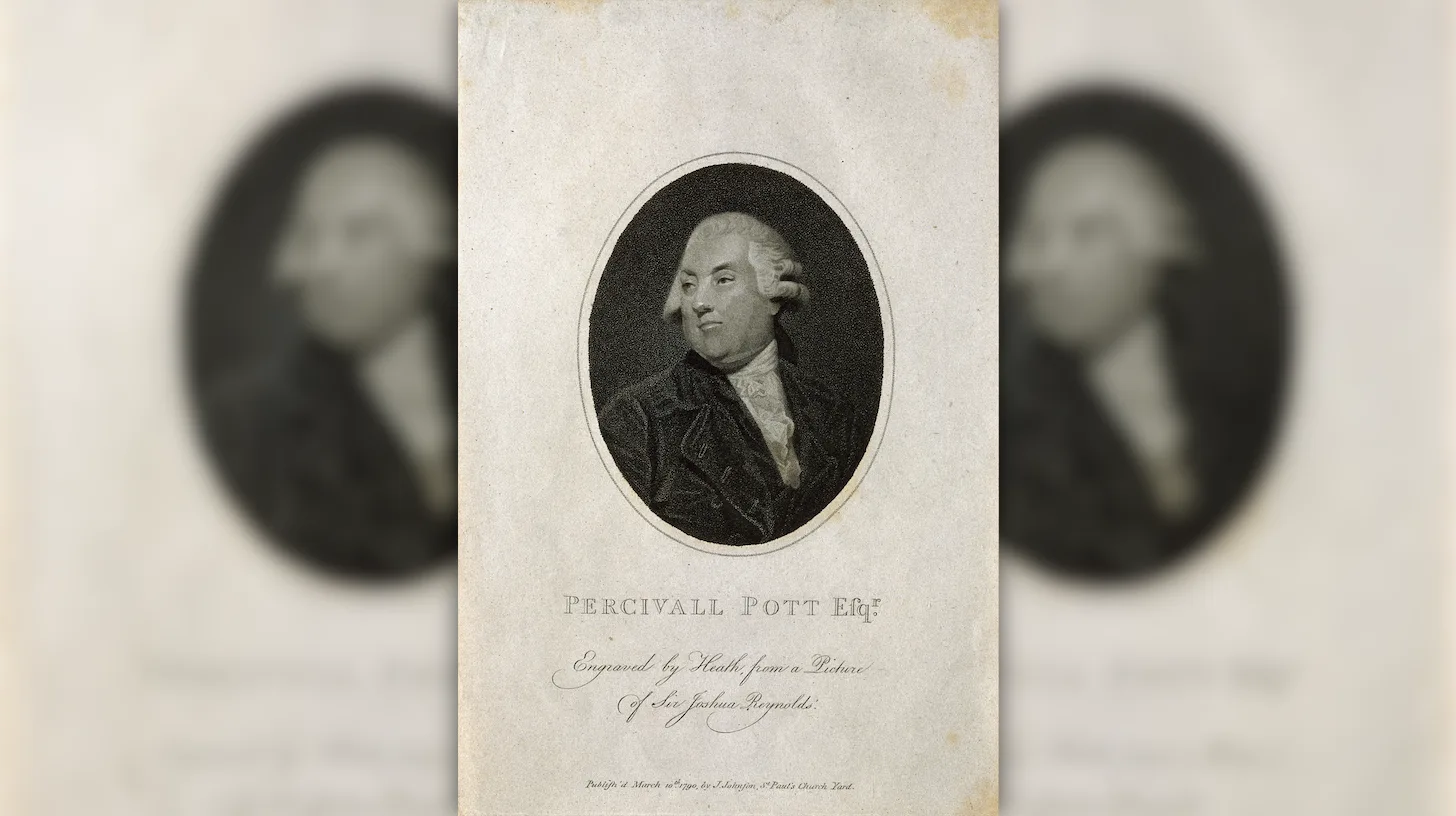
The boys slept on straw with their soot bags thrown over them for blankets, which the trade called sleeping black. The soot did more than blacken them. In 1775 Percivall Pott, a surgeon at St Bartholomew’s Hospital in London, described the chimney sweeps’ cancer, a cancer of the scrotum that grown sweeps suffered, which the trade, he wrote, called the soot-wart, and traced it to soot lodged in the skin. It is the first known report of a cancer caused by a man’s work. Pott wrote of the boys too, who were “thrust up narrow, and sometimes hot chimnies, where they are bruised, burned, and almost suffocated.” Clarke, nearly ninety years later, had known eight or nine sweeps who died of what he called “the sooty cancer.”
Straw, pins and a dead letter
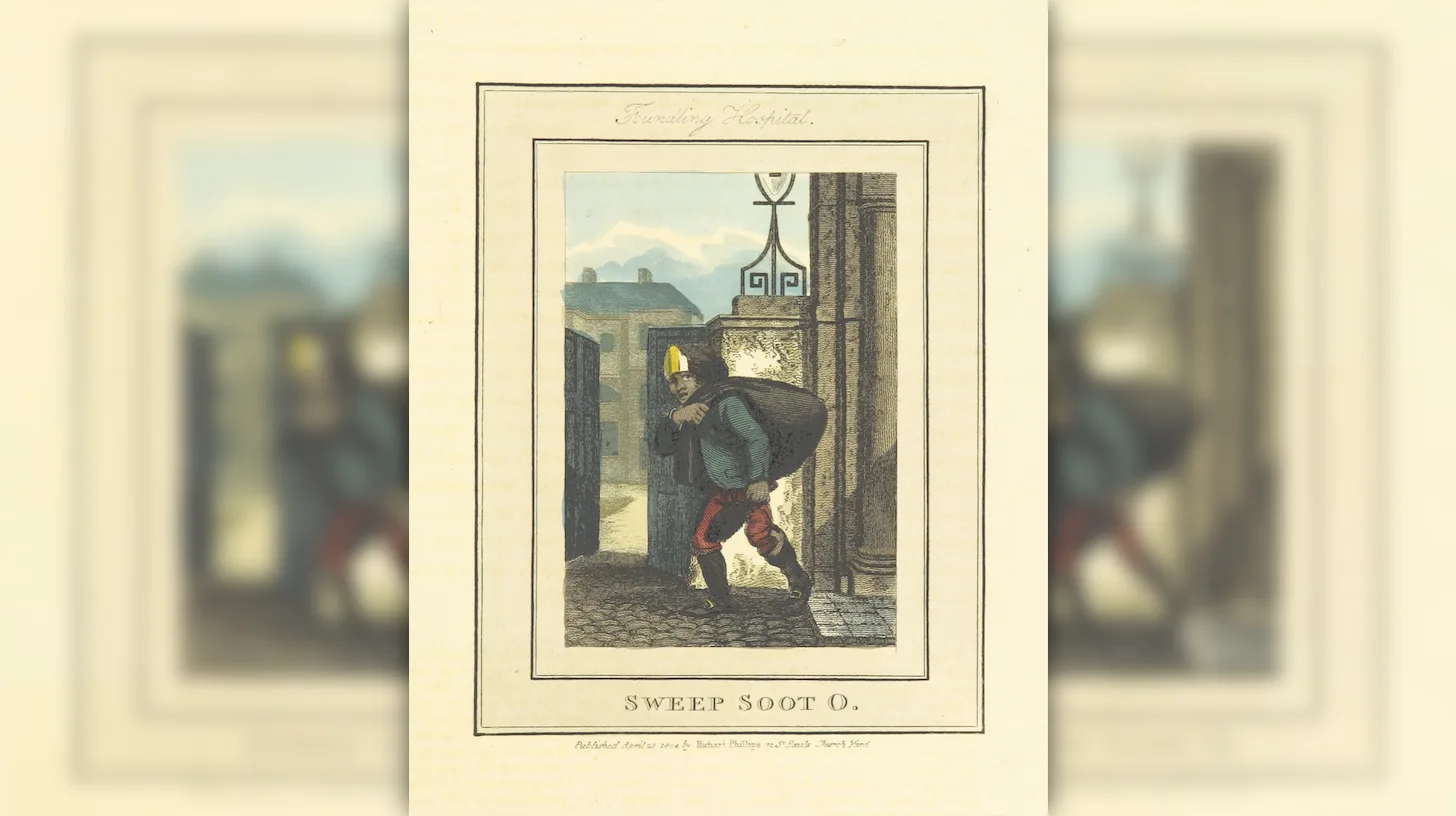
The first law, passed in 1788, forbade a master to take an apprentice under the age of eight, and it was weakened in the House of Lords before it passed. The committee of 1817 heard how boys who would not climb were made to, and found “that pins are forced into their feet by the boy who follows up the chimney, in order to compel them to ascend it, and that lighted straw has been applied for that purpose.” Not every master admitted it. One, asked whether he had ever heard of straw being lit under a boy, said he never had. Asked whether masters forced small boys up flues they were unwilling to climb, he said, “Yes; I have forced up many a one myself.” The bill that followed the committee’s report was lost in the Lords.
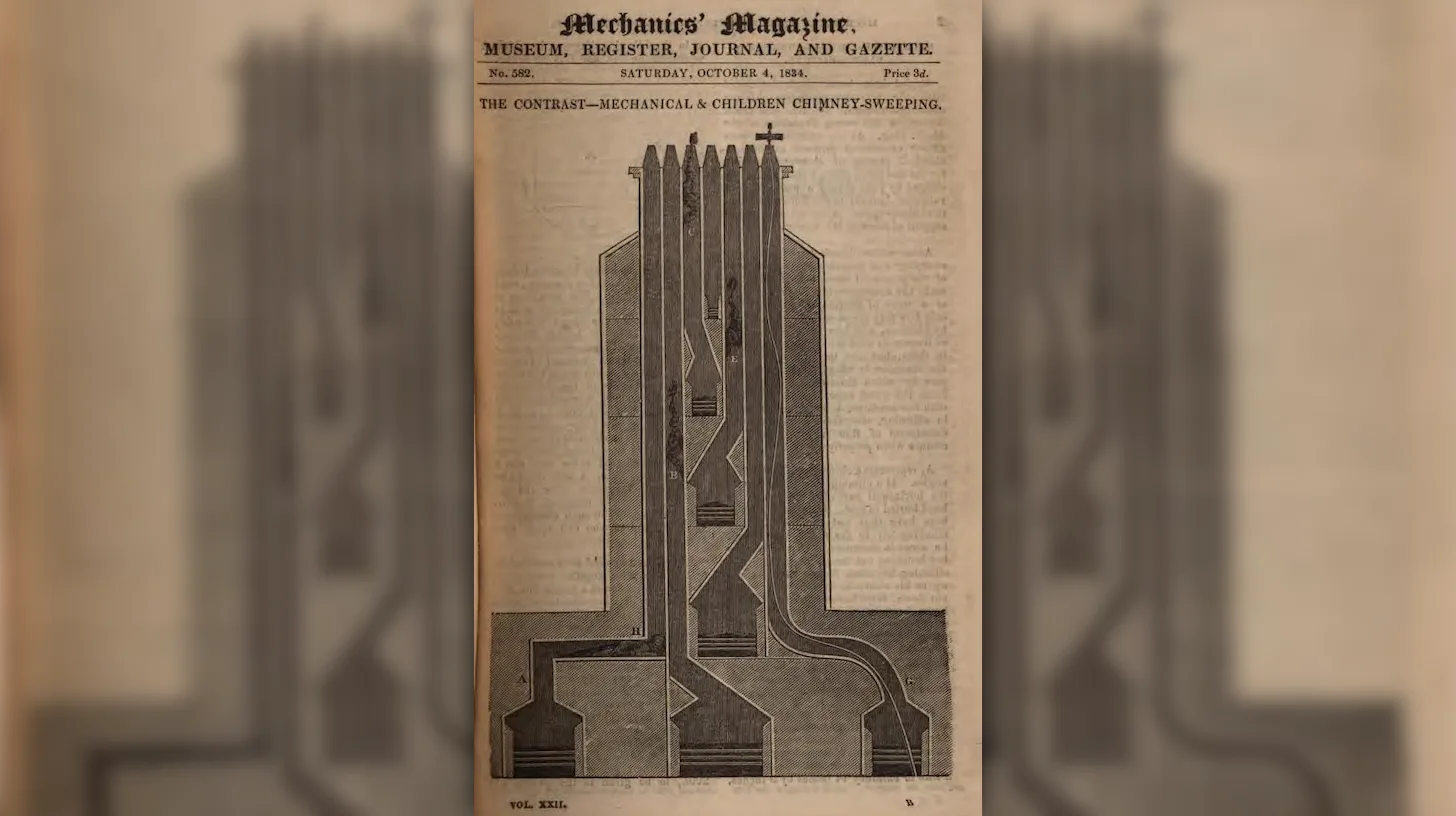
An act of 1834 set the age at ten, and an act of 1840 went further: no one under twenty-one was to enter a chimney or a flue at all. Twenty years later a royal commission on the employment of children sent its men to the Victorian chimney sweeps of Nottingham, Manchester, Sheffield and the Potteries, and they found the act “inoperative in most parts of England, the metropolis and some other towns excepted.” Ruff put it in seven words: “The law against climbing boys is a dead letter here.”
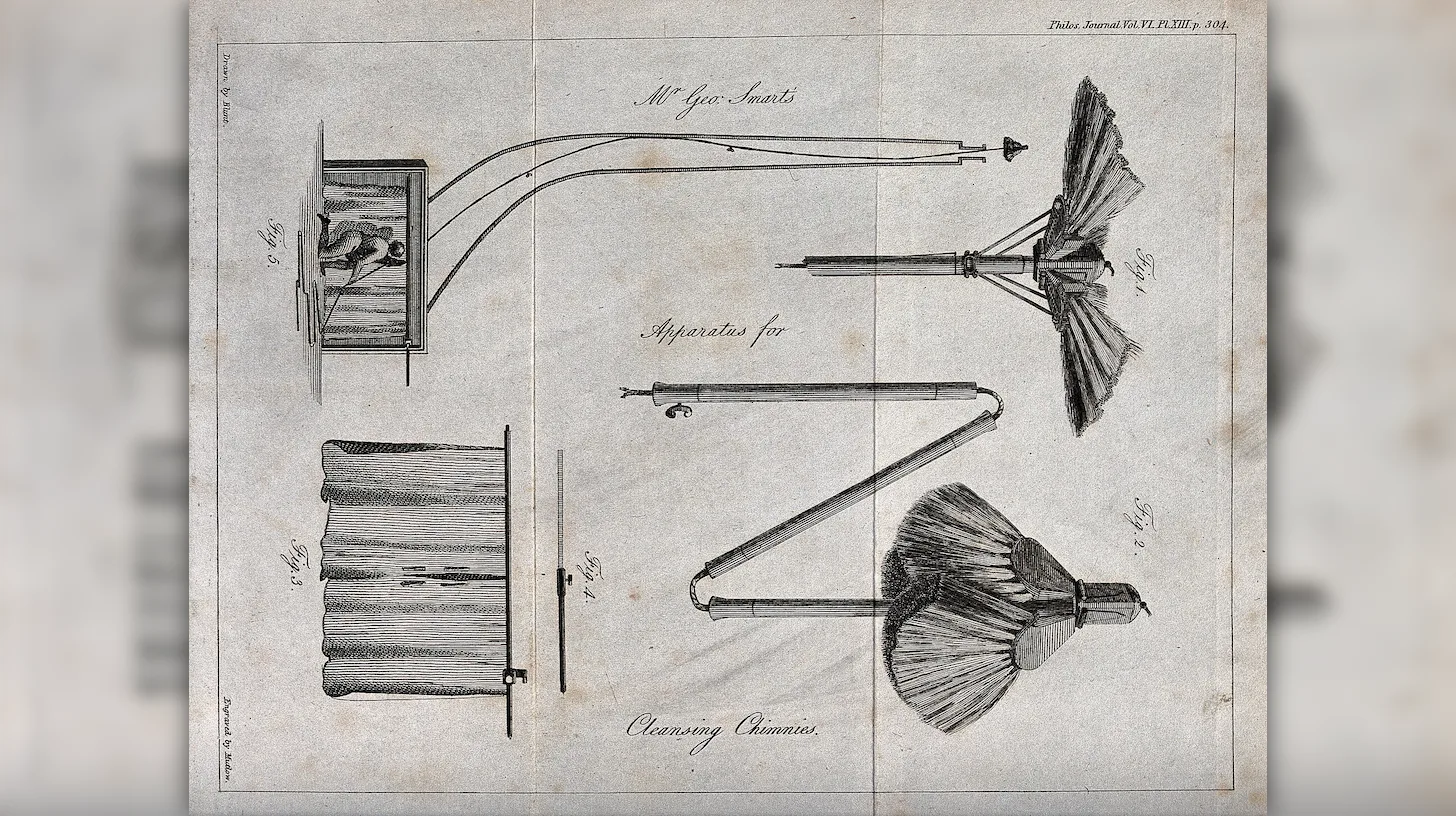
The coroner of Nottingham, Michael Browne, gave the commission the two inquests he had held on boys who died in chimneys. In one, a hole had to be broken in the wall to get the boy out. In the other, he said, “the master had lit straw under the chimney to bring the boy down, as he (the master) thought the boy was asleep, when in reality he was dead.” A man in Leicester had collected 23 cases of boys stifled in chimneys since the act of 1840, and Richard Stansfield, a master sweep in Manchester who had climbed as a boy, told the commission what he himself had done.
“Why, I myself have kept a lad four hours up a chimney, when he was so sore that he could scarcely move; but I wouldn’t let him come down till he had finished; it has often made my heart ache to hear them wail, even when I was what you may call a party to it.”
The commission’s report came out in 1863, and the next year Parliament passed another act, forbidding a sweep to bring any assistant under sixteen into the house where he was working. It was evaded like the others.
A boiler flue at Fulbourn
George Brewster was born in Shadwell, in the East End of London, in May 1863, “the May after the Prince of Wales was married,” as his elder brother Barnard later put it in court. Their mother was ill, and another brother, William, who had no children of his own, took the baby and said he would bring him up as one of his own. William settled in Cambridge, where he worked as a sawyer, and George grew up there. No description of the boy’s looks survives in the record. In November 1874 he went to work for William Wyer, a master sweep of Cambridge, fifty-five years old, who had swept some of the town’s chimneys for more than twenty years and who promised the family that George “should not do brush work for two years.”
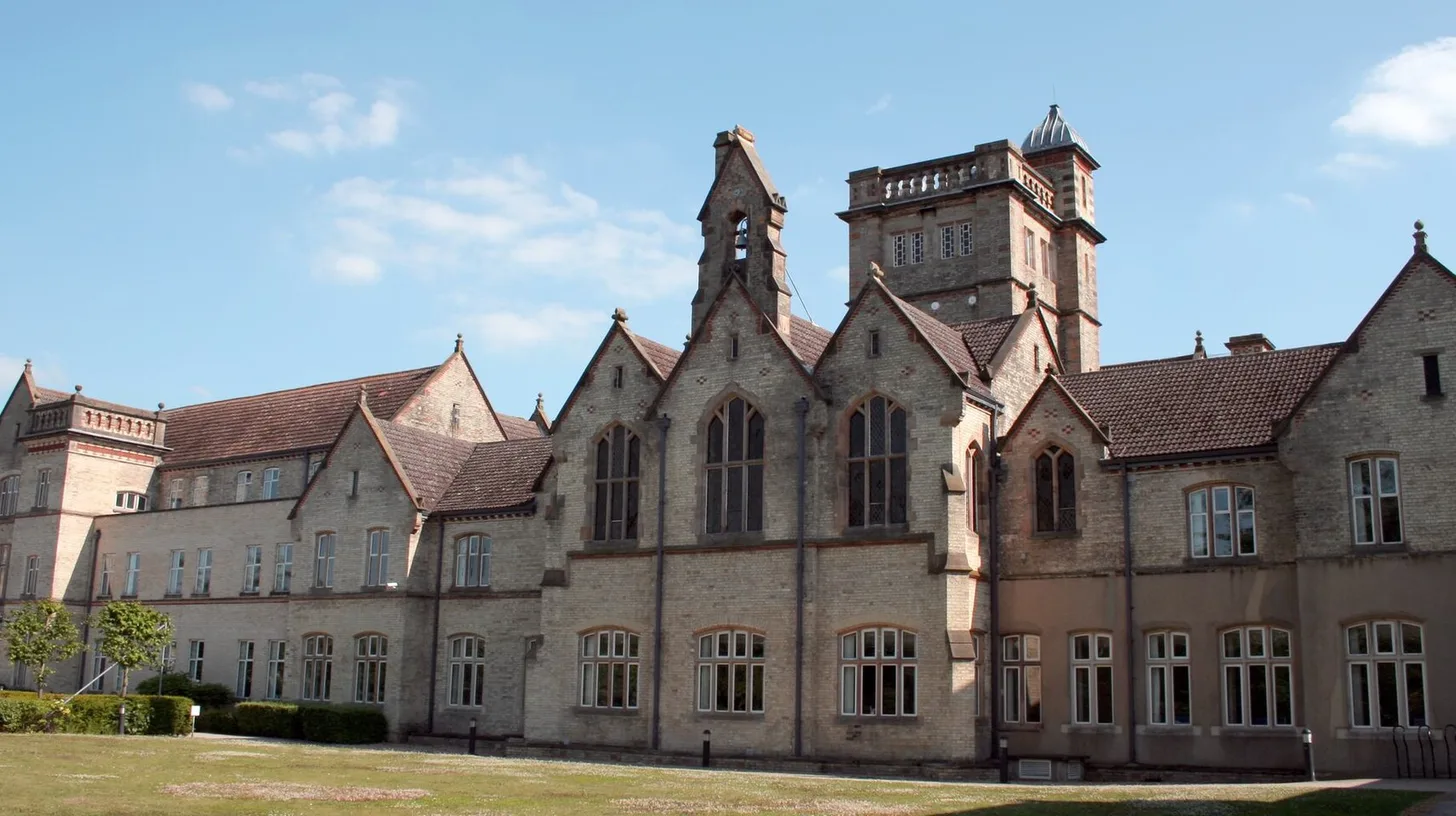
The work at the Cambridgeshire pauper lunatic asylum at Fulbourn, a few miles east of the town, was the cleaning of the flues under its boilers, a job done about three times a year. The flues were tunnels of brick that ran ten or twelve feet along the boilers. The sweeping had begun that week with the boilers on the left, and the fires under the right-hand boilers were let out so that their flues would be cool by Thursday. On Thursday, February 11, 1875, Wyer was there with his grown son and with George.
Wyer raked out as much soot as he could reach from the bottom flue. Then, by the account the stoker, Francis Mason, gave at the trial, he told the boy to get in and to take his clothes off. George pulled off his jacket and his waistcoat and put on a cap that came down over his chin, with a handkerchief tied round it to hold it on, and he climbed into a flue whose door was twelve inches by six. An architect who measured it afterward found the flue itself twelve inches by seven and a half, and eleven feet two inches long.
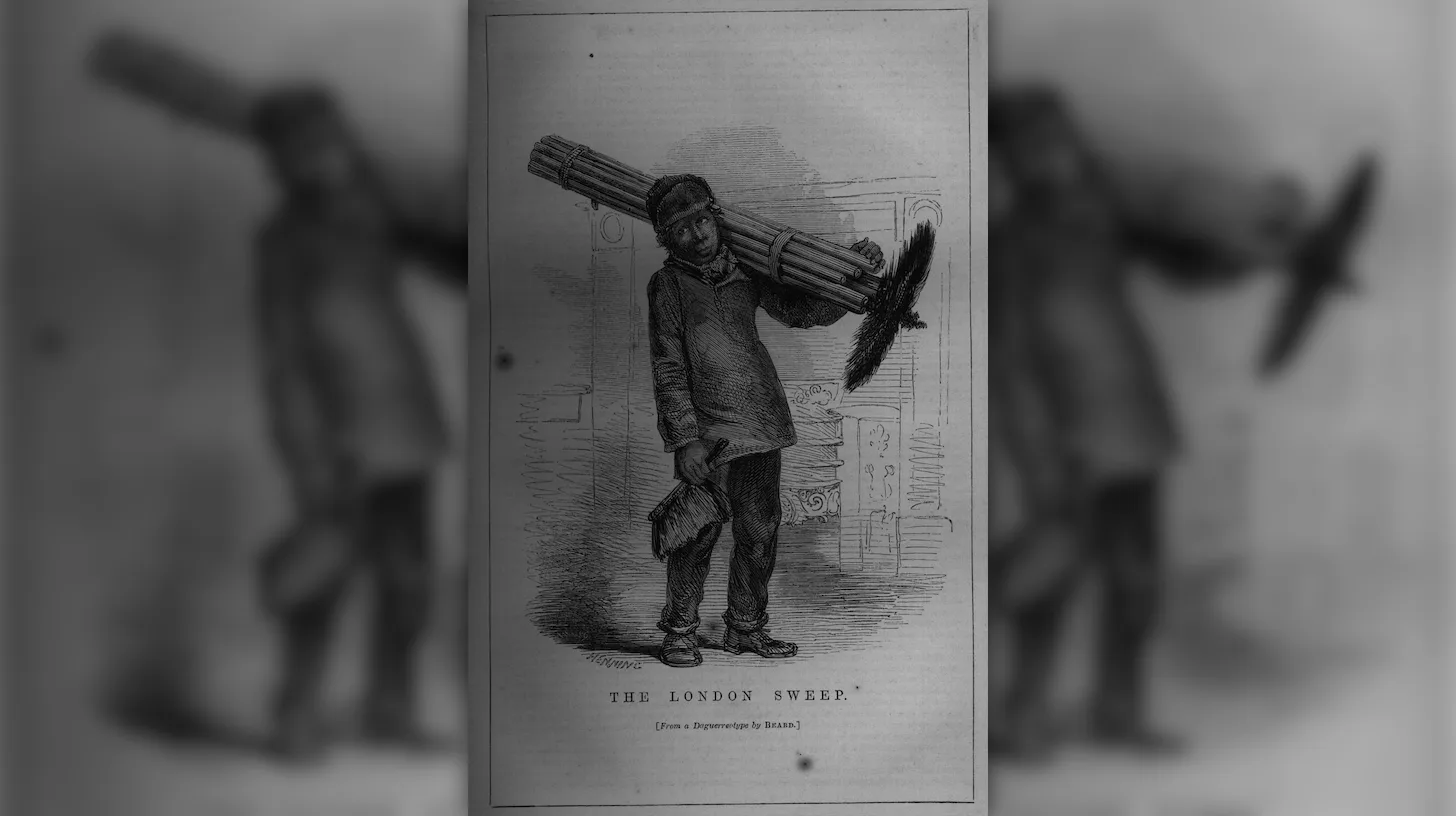
The second stoker, Frederick Patten, watched him go. The boy worked his way along and came back, and Wyer told him, as the paper printed it, to put his hoe “up to the flue above.” “It is up,” George answered. About a minute and a half later Wyer called to him, and there was no answer. He called again, and when there was still no answer he reached in and pulled the boy out. Patten reckoned George had been out of sight a quarter of an hour, perhaps twenty minutes. When Mason came back from the next room he found the boy lying in Wyer’s arms, and Wyer untying the handkerchief that held the cap on. “Wyer said he was very sorry,” Patten told the court.
Soot that could be scraped off
The asylum’s superintendent, Dr. Bacon, came down to the boiler house and found the boy alive, held in Wyer’s arms. He opened George’s mouth and cleared out the soot, a second doctor arrived, and they washed out his mouth and gave him water and then brandy. When he did not come round they had him carried into the asylum and put in a bath, and he died there in about half an hour. At the examination the coroner ordered, Bacon found black powder down into the smallest tubes of the lungs, and in the windpipe “a considerable layer of it,” he said, “so much that it could be scraped off.”
The coroner’s jury, sitting at the asylum, returned a verdict of manslaughter against Wyer and gave George’s age as between fourteen and fifteen. The papers reported the inquest, and five days after the death the Earl of Shaftesbury rose in the House of Lords to ask the government about it.
“From the evidence at the inquest it would appear that the deceased boy was suffocated. Having been only a few minutes up the flue, he was taken out in a dying condition.”
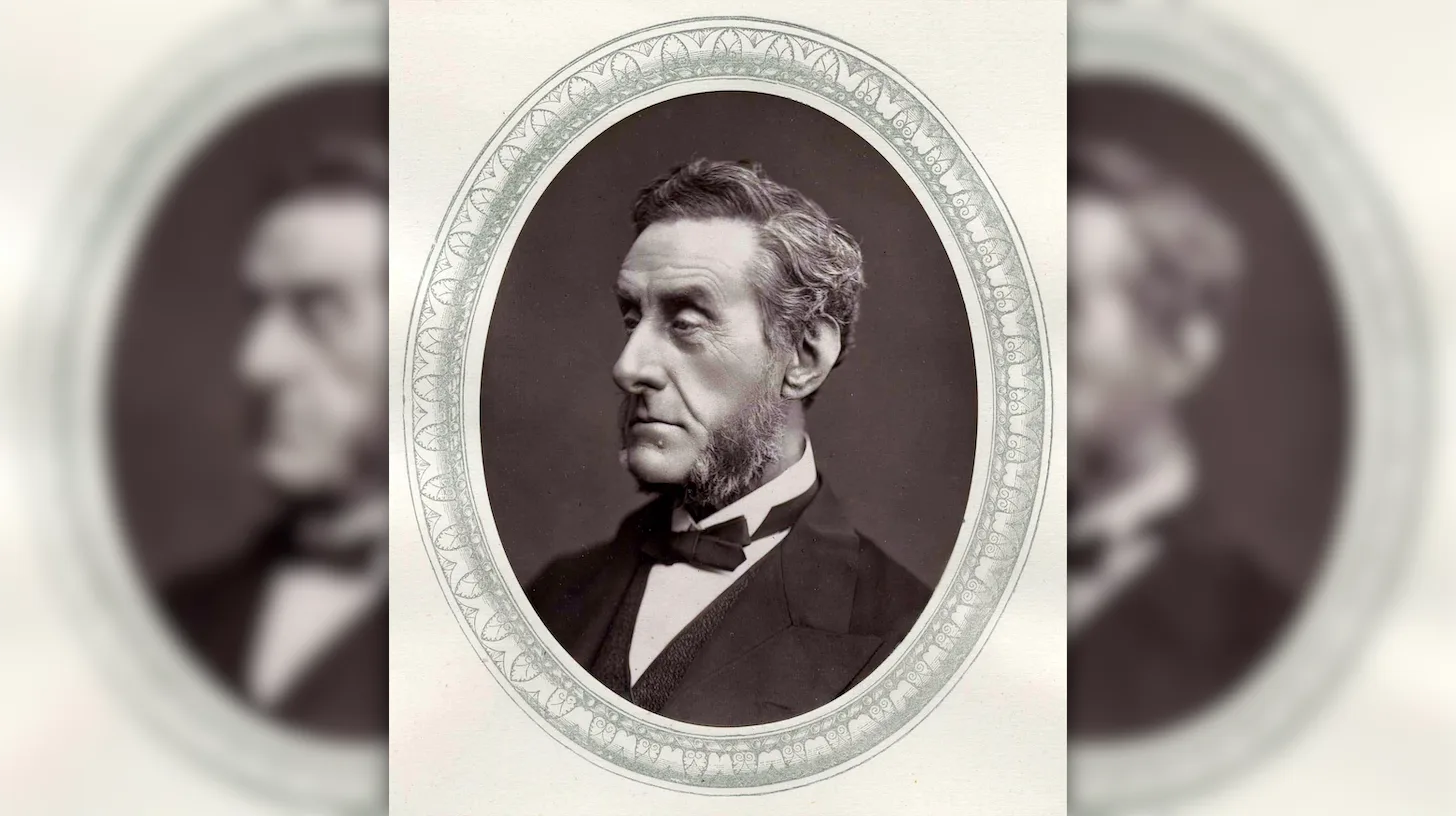
Shaftesbury was seventy-three. He had spoken for the climbing boys in the Lords in 1853 and again in 1864. At seventy he had described himself in his diary as “tolerably erect,” with “very few grey hairs,” eyes that needed glasses only for reading, and hearing that had grown somewhat deaf. He could overstate a case in the heat of debate, his biographer admitted. “It was perfectly scandalous and abominable,” he told the Lords, “that any case such as the one at Cambridge should occur in this country.”
Scarcely one minute
William Wyer came to trial at the Cambridge assizes the next month and pleaded not guilty. The prosecution’s first business was the boy’s age. Barnard Brewster told the court that his brother “would have been 12 of age next May.” George had been eleven, not fourteen. Barnard had also seen the body, and he had asked Wyer a question about it.
“He spoke to Wyer about the state of the body and asked how it was that the skin was rubbed off the hands, the ears and face?”
“It rotted off,” Wyer answered, by the paper’s report, and when Barnard told him it could not have done so in eight days, Wyer swore at him. Wyer’s counsel, a Mr. Naylor, argued that the flue itself was illegal, smaller than the act allowed, so that Wyer could not send his own son, “a full grown man,” in to clean it, and that the boy had gone in of his own will. The judge answered that he was not trying the builder.
Three Cambridge men spoke to his character, one of whom had used him for more than twenty years and never seen anything but kindly conduct. Then the judge summed up, and the jury, the Cambridge Chronicle reported, “deliberated for scarcely one minute and found the prisoner guilty.”
The judge said that nobody supposed Wyer had meant the boy to die, but that “a reasonable man would never have sent lad into such a flue as that,” and that the cap tied over George’s mouth to keep out the soot had itself made it harder for him to breathe. He gave Wyer six calendar months at hard labour. It was, Shaftesbury later told the Lords, the same sentence a sweep had received for a boy’s death at Gateshead.
A certificate from the police
The Times thought six months too little and said so. Shaftesbury had already begun. “One hundred and two years have elapsed since the good Jonas Hanway brought the brutal iniquity before the public,” he wrote in his diary late in April, “yet in many parts of England and Ireland it still prevails.” He had prepared a bill, and in May he moved its second reading and told the Lords that it concerned “some thousands of children, the most oppressed, degraded, and tortured creatures on the face of the earth.” The next day he wrote that the House had been “very inattentive,” and that he had twice had to implore its “condescension to hear me.” Within a month it had passed through committee, he wrote, “in the twinkling of an eye,” and the Home Secretary took it up in the Commons.
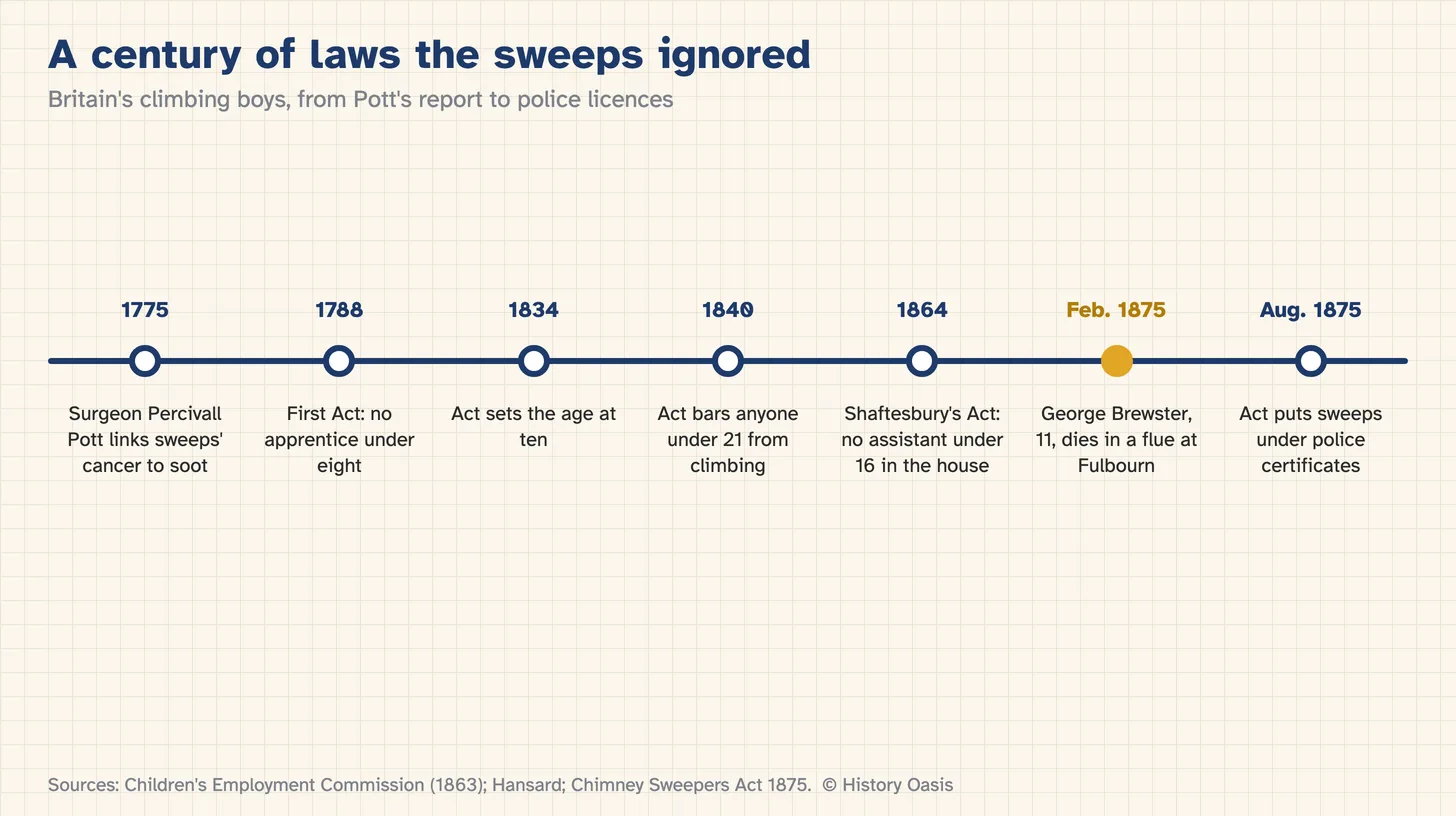
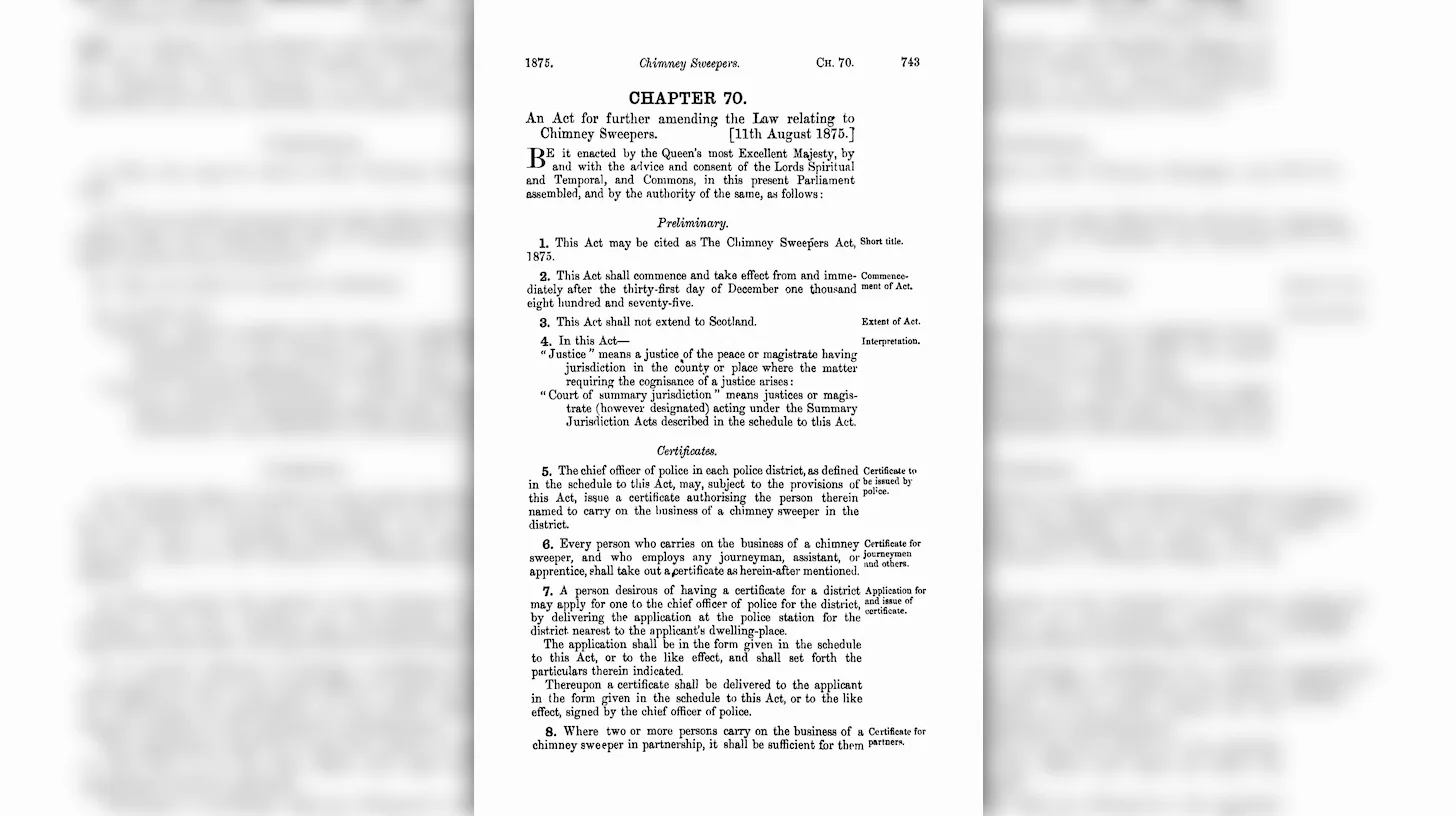
The Chimney Sweepers Act received the royal assent on August 11, 1875. It did not set a new age, since the act of 1840 already forbade any boy to climb. What it did was put the old law in the hands of the police. From the first day of 1876 every master sweep who employed a journeyman, an assistant or an apprentice had to take out a certificate from the chief officer of police in his district, renewed each year for a fee of half a crown, and the police were ordered to enforce the acts of 1840 and 1864 themselves.
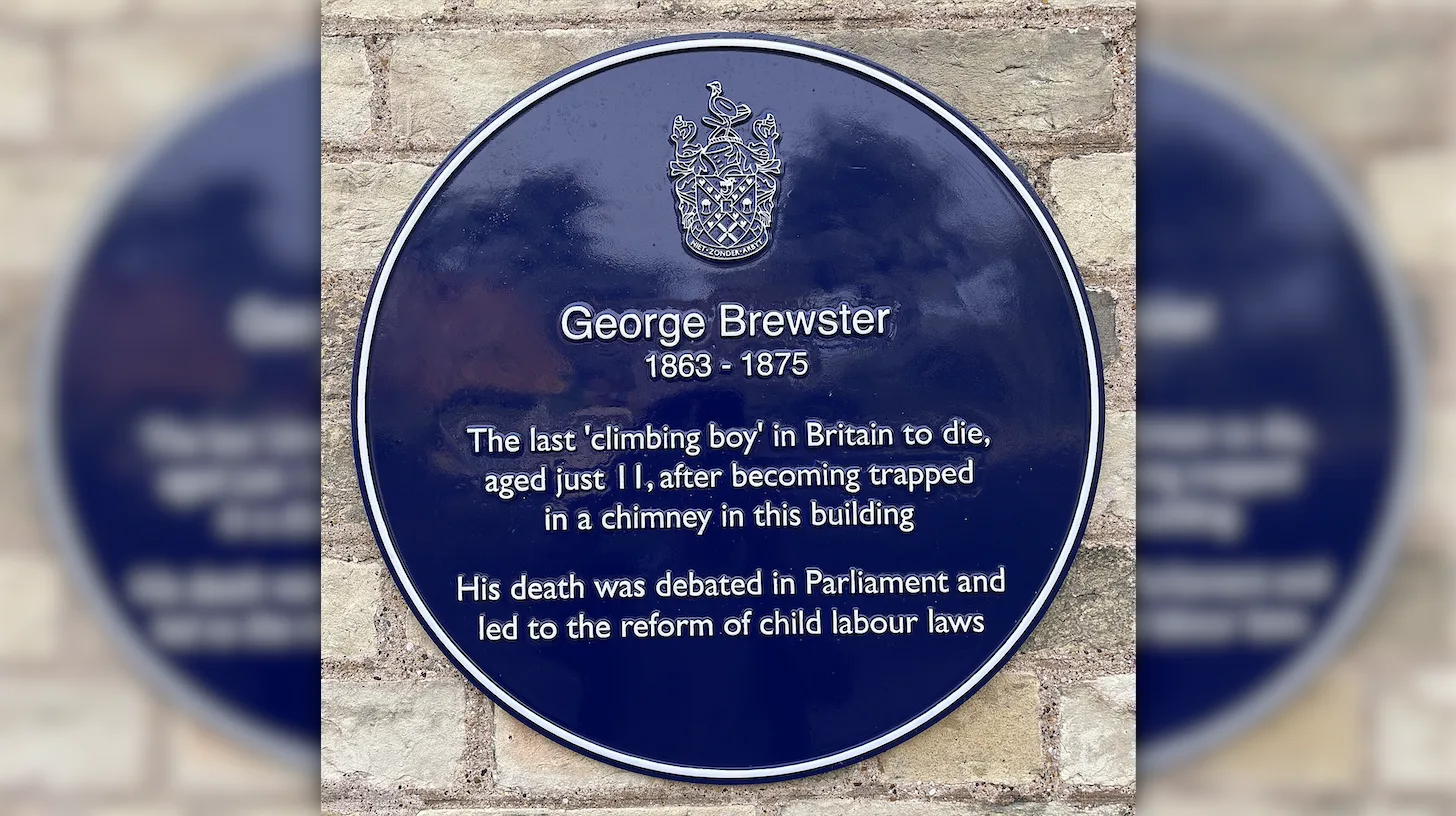
George Brewster was buried in an unmarked grave in Mill Road Cemetery in Cambridge, and the exact spot is not known. He is often called the last climbing boy to die in England, which no record can prove. In February 2025, on the hundred and fiftieth anniversary of his death, a blue plaque was unveiled on the old asylum building at Fulbourn, which now houses laboratories and offices. The flue he went into was twelve inches by seven and a half.
In May he would have been twelve.