
18 min read
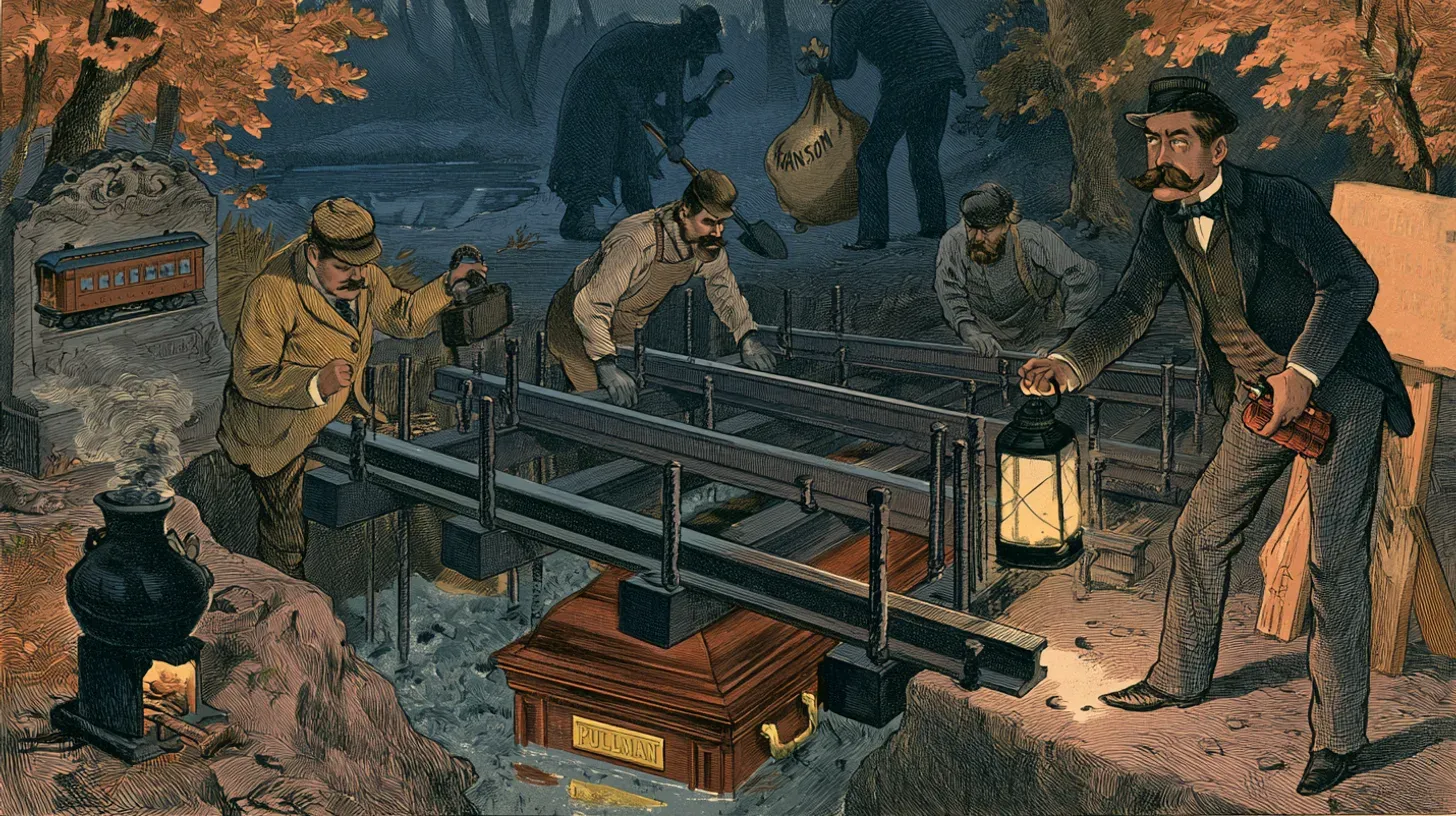
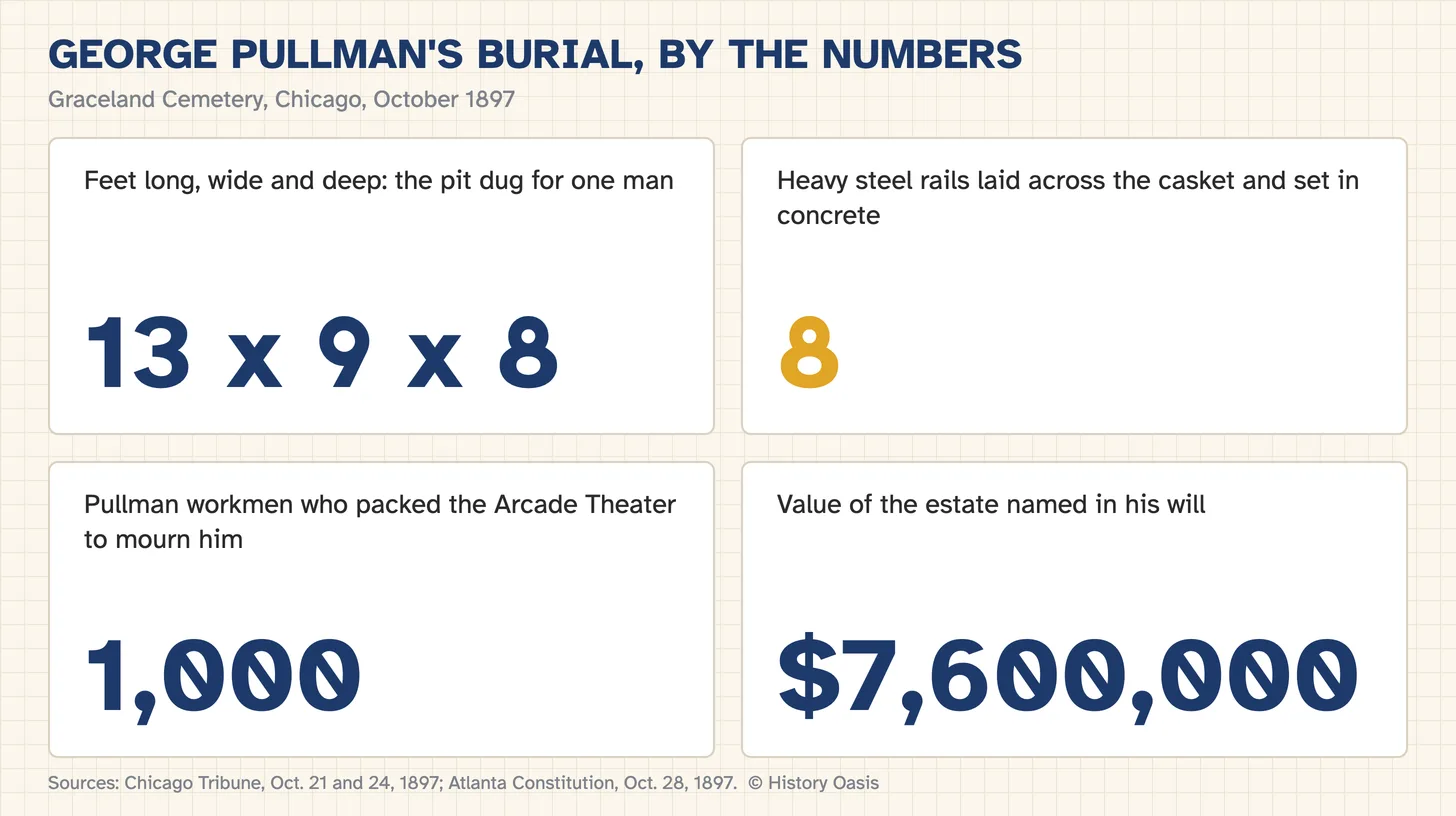
On Friday morning, October 22, 1897, the contractors who had been hired to make a grave in Chicago’s Graceland Cemetery carried their furnaces, their cement and their asphalt into the seclusion of the bushes, at some distance from the lot where they were to work. The lot looked out over a small lake. The pit that was dug in it was thirteen feet long, nine feet wide and eight feet deep, and it was meant for one man.
George Mortimer Pullman had died three days before, at the age of sixty-six. He had made the railroad sleeping car a business, built a town south of Chicago and given it his own name, and three summers earlier he had refused to bargain with the people who lived in it, in a dispute that ended with the Army in the streets of the city. Now his family had decided that his body must be protected. It has been said ever since that they were protecting it from his own workmen. But the newspapers printed that week, and the workmen themselves, tell another story.
A man who was not given to mirth
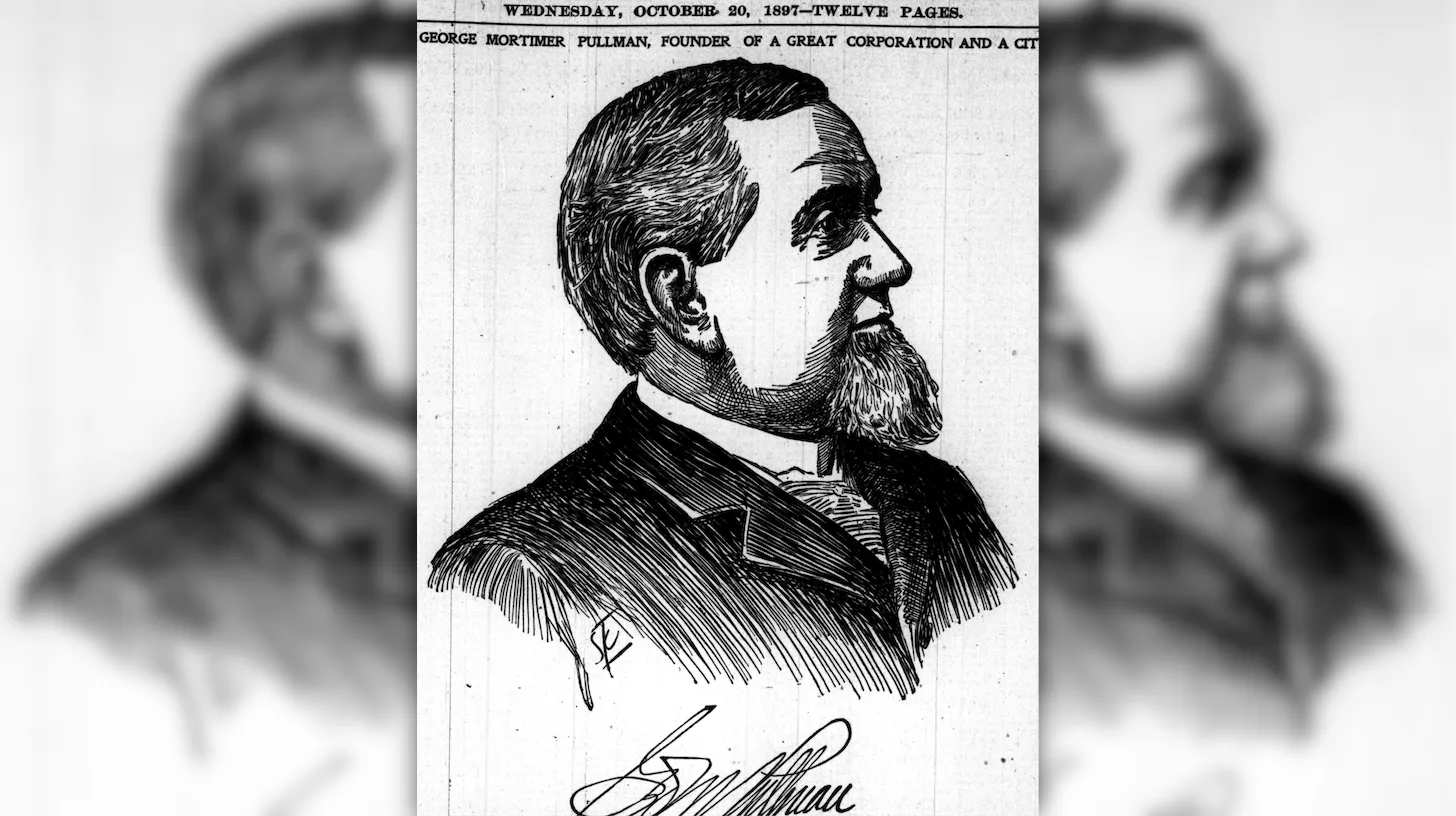
He was a serious man. In the engraving the Chicago Tribune printed the day after his death he is shown in profile, a broad face under hair brushed straight back, with a white beard on his chin and none on his lip. William G. Beale, a Chicago lawyer who knew him well, told the paper that “He was not given to mirth,” though he was sociable enough at home and liked to talk about his early struggles. He had a long memory for them, as Beale had reason to know.
“Not long ago he pointed out to me an old-time business-man passing along the street who had years ago refused him credit for a barrel of flour.”
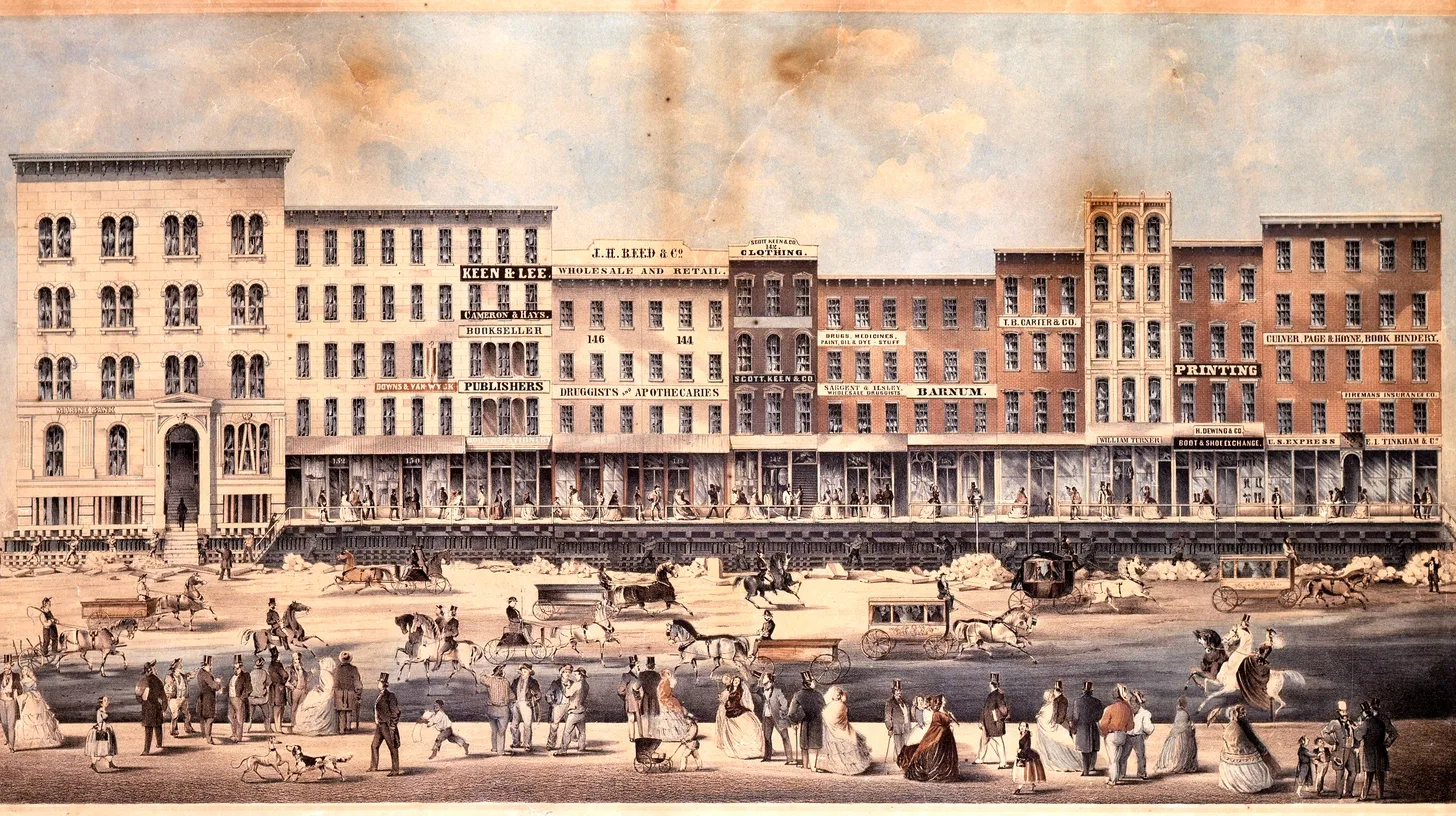
The struggles had begun in western New York, where he left school at fourteen to help his father move houses while the Erie Canal was being widened, and where he afterward learned cabinetmaking in his brother’s shop. In March 1859 he set himself up in Chicago, a city then lifting its buildings on jackscrews, sometimes a whole block at a time, and he went into that trade.
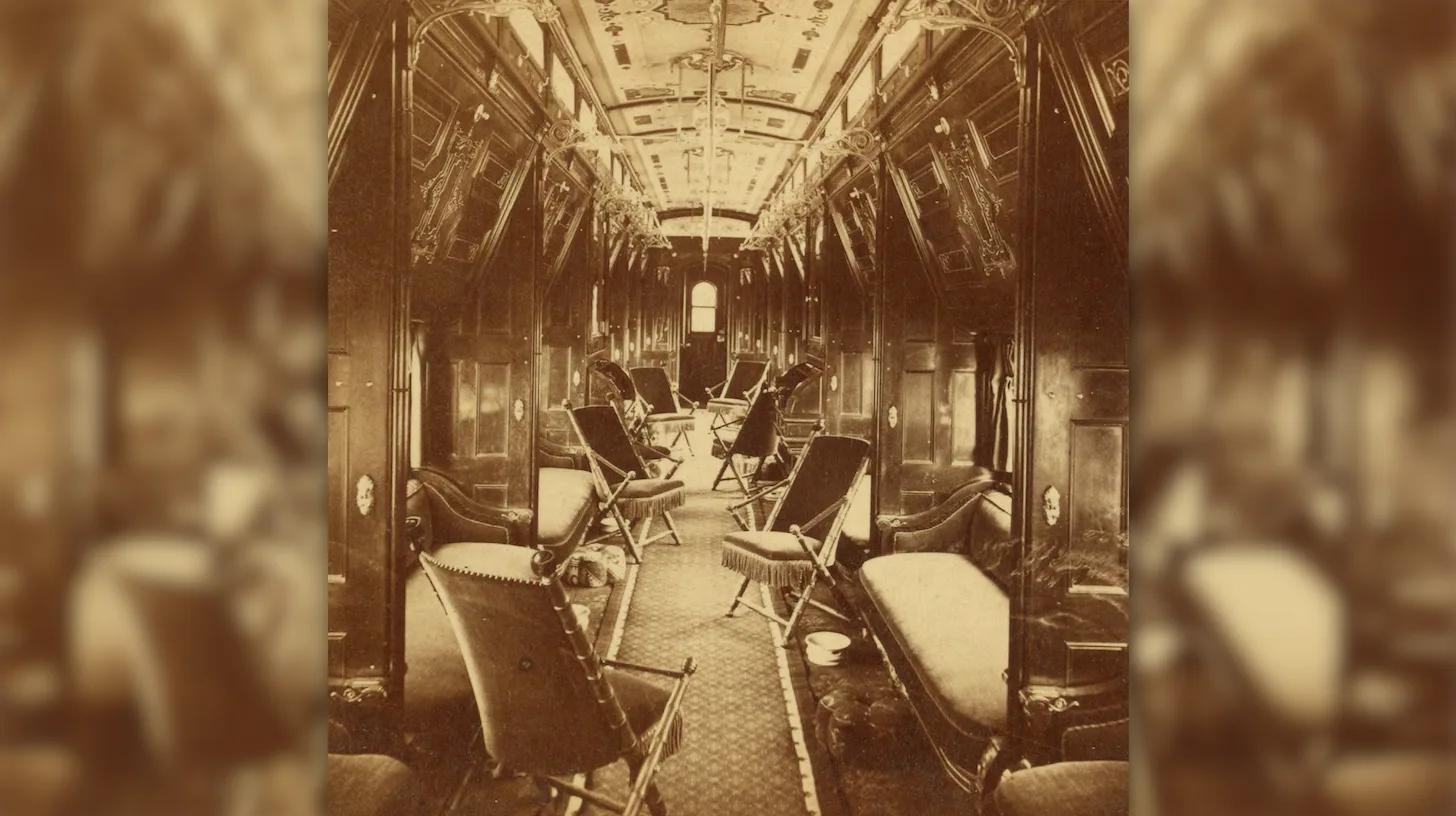
But it was a railroad car that made him. After many months of labor and an outlay of $18,000 he had a sleeping car ready for service, which he called the Pioneer, and by the early 1890s the company that grew from it employed 14,000 people.
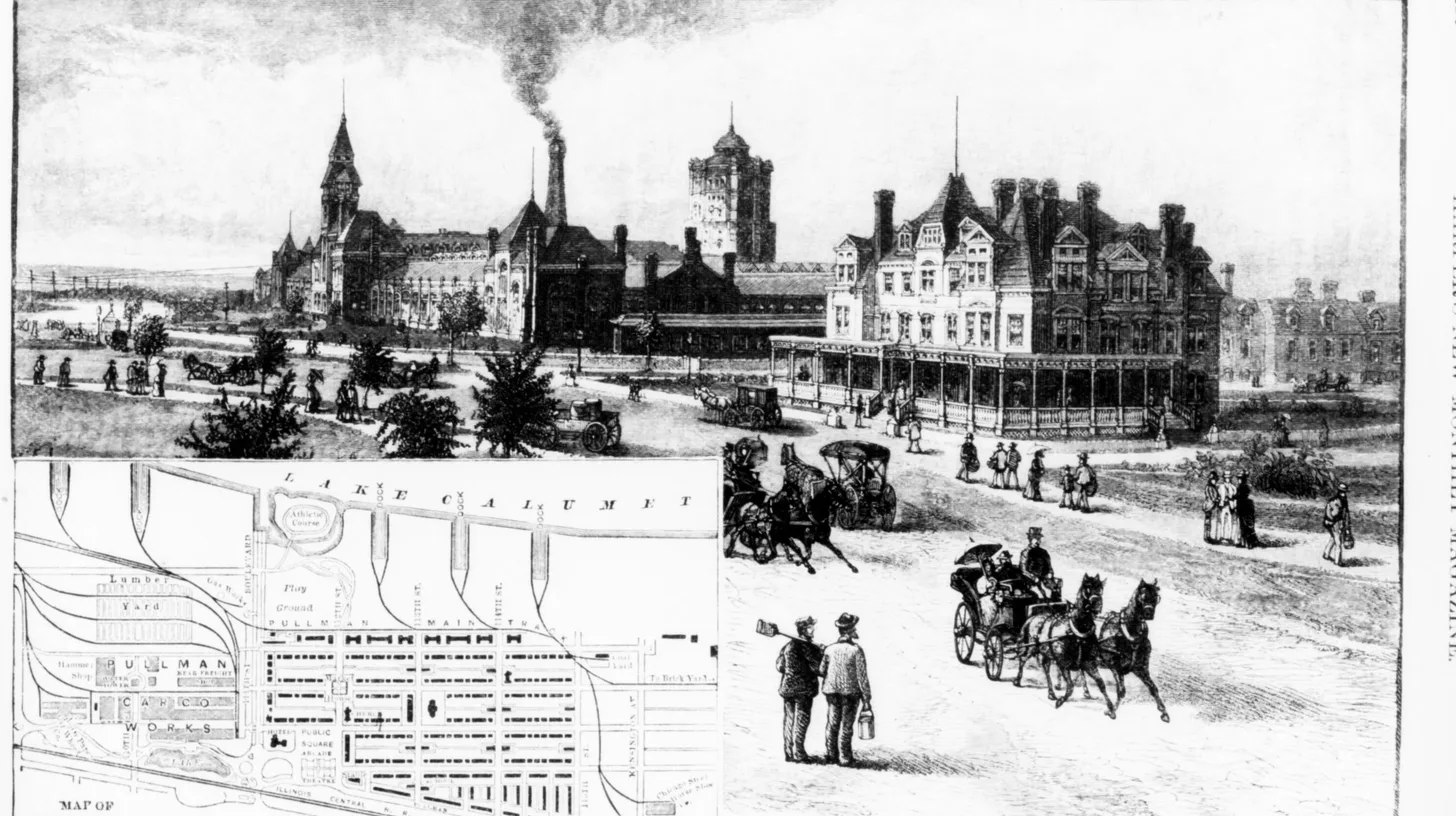
Nearly 6,000 of them worked in a town he had built on open land near Lake Calumet, with parks, a market, an arcade of shops and a hotel named for his eldest daughter, all of it drawn by the architect Solon S. Beman. It was called Pullman, and it was run as a business. Rents were set to return six percent. The library, whose books were Pullman’s gift, cost three dollars a year to use, “for nothing in Pullman is free,” as an economist wrote in Harper’s Monthly, and the one church stood empty because no denomination could pay the rent. Capital, Pullman said, “will not invest in sentiment.”
Forty-six workers go down to the company’s offices
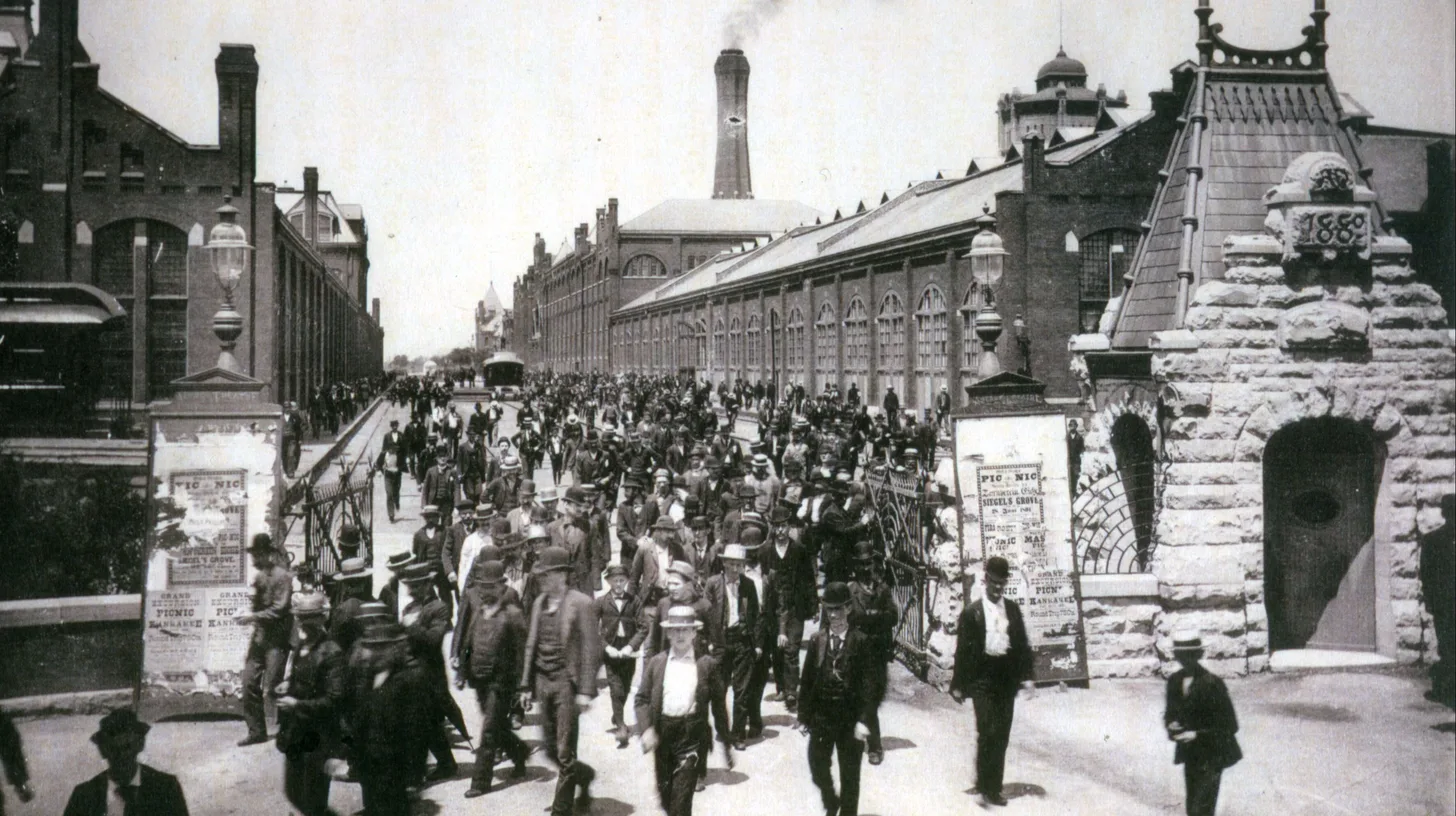
Hard times came in 1893. Over the months that followed the company cut wages by about a quarter, on the later reckoning of a federal commission, and left the rents where they were, though the same commission found them 20 to 25 percent above the rents for like houses in and around Chicago. No officer’s salary was reduced. The dividends, which had been $2.52 million the year before, were $2.88 million that year, while the wages paid out fell from $7.2 million to $4.5 million.
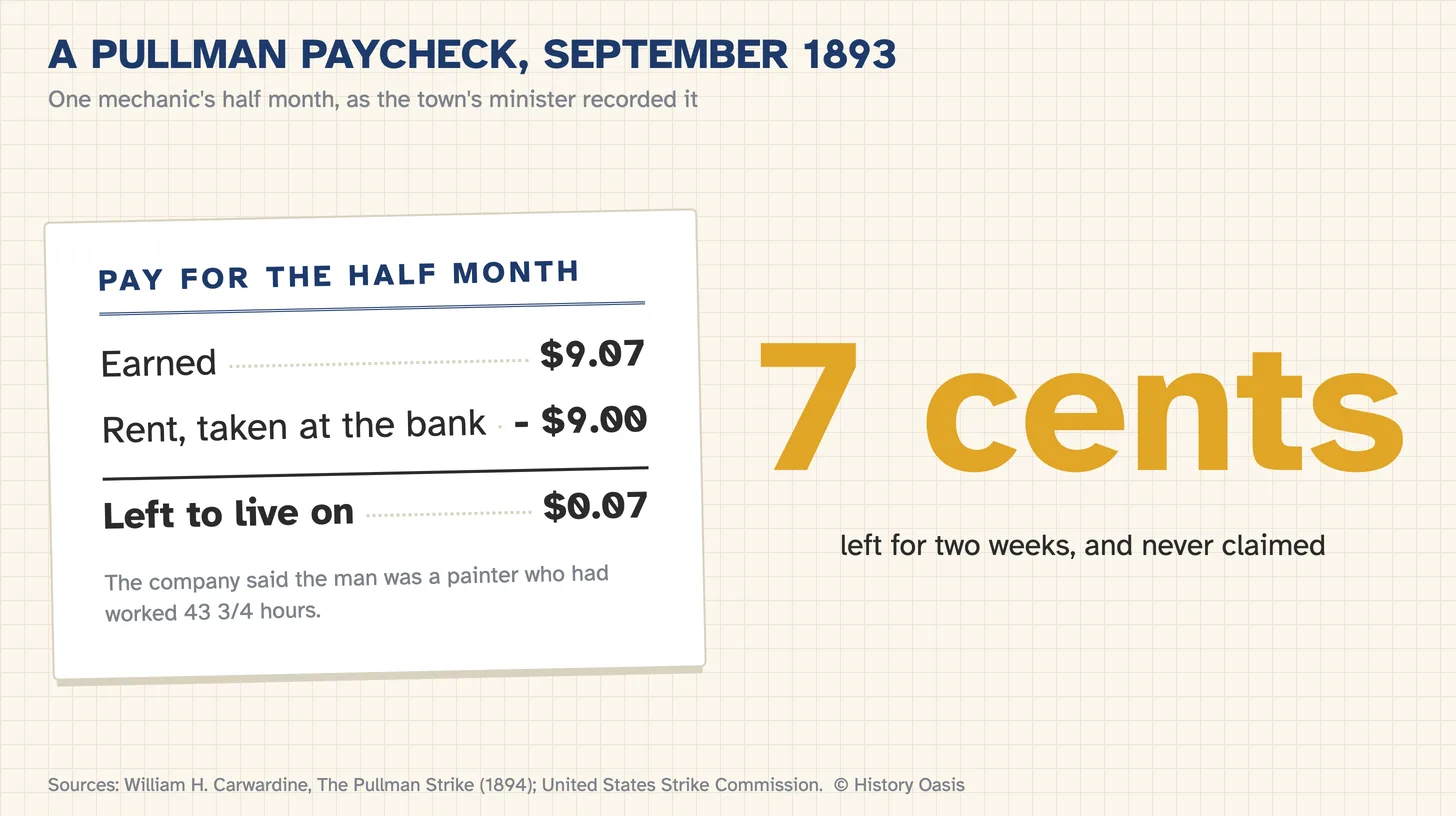
Rent was taken out at the bank when a man came for his pay, and the town’s Methodist minister wrote down what was left. One mechanic, he wrote, had earned $9.07 in a half month and owed $9.00 of it for his house. “The seven cents was his, but he has never claimed it.” (The company answered that the man was a painter who had worked 43¾ hours.) Another, asked to put his last 47 cents toward what he owed, said, “If Mr. Pullman needs that 47 cents worse than I do, let him have it,” and left it.
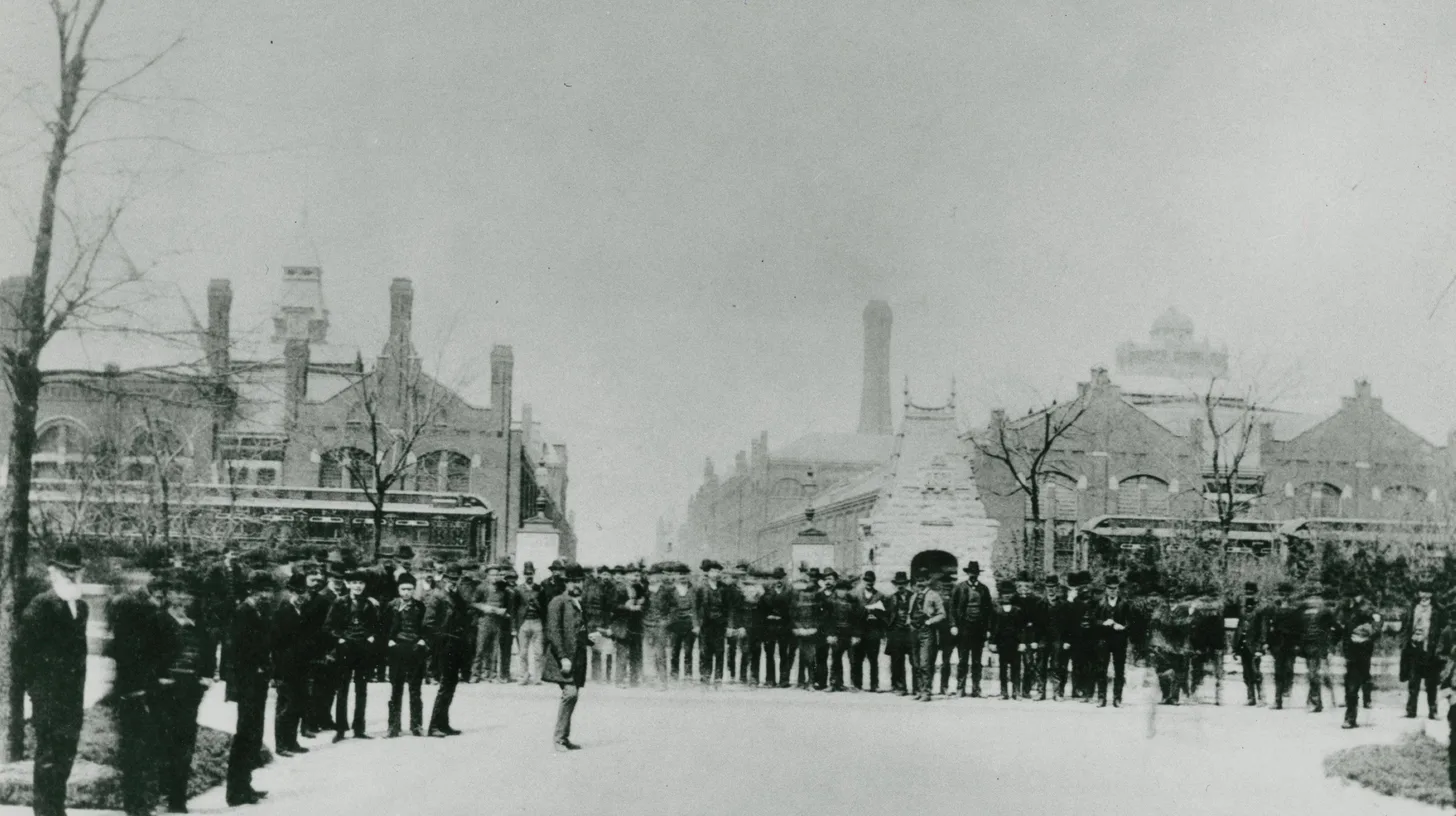
On May 7, 1894, a committee of forty-six, drawn from every department of the works, went down to the company’s offices to ask for the wages of the summer before. Among them was a seamstress named Jennie Curtis, who had made $2.25 a day at the old prices and was making about eighty cents at the new, and who had a reason of her own for going, which she set down that year in a letter.
“My father worked for the Pullman Company for ten years. Last summer he was sick for three months, and in September he died.”
He had left about sixty dollars owing in rent, and the company, she wrote, told her “I would have to pay that rent, give what I could every pay-day, until it was paid.”
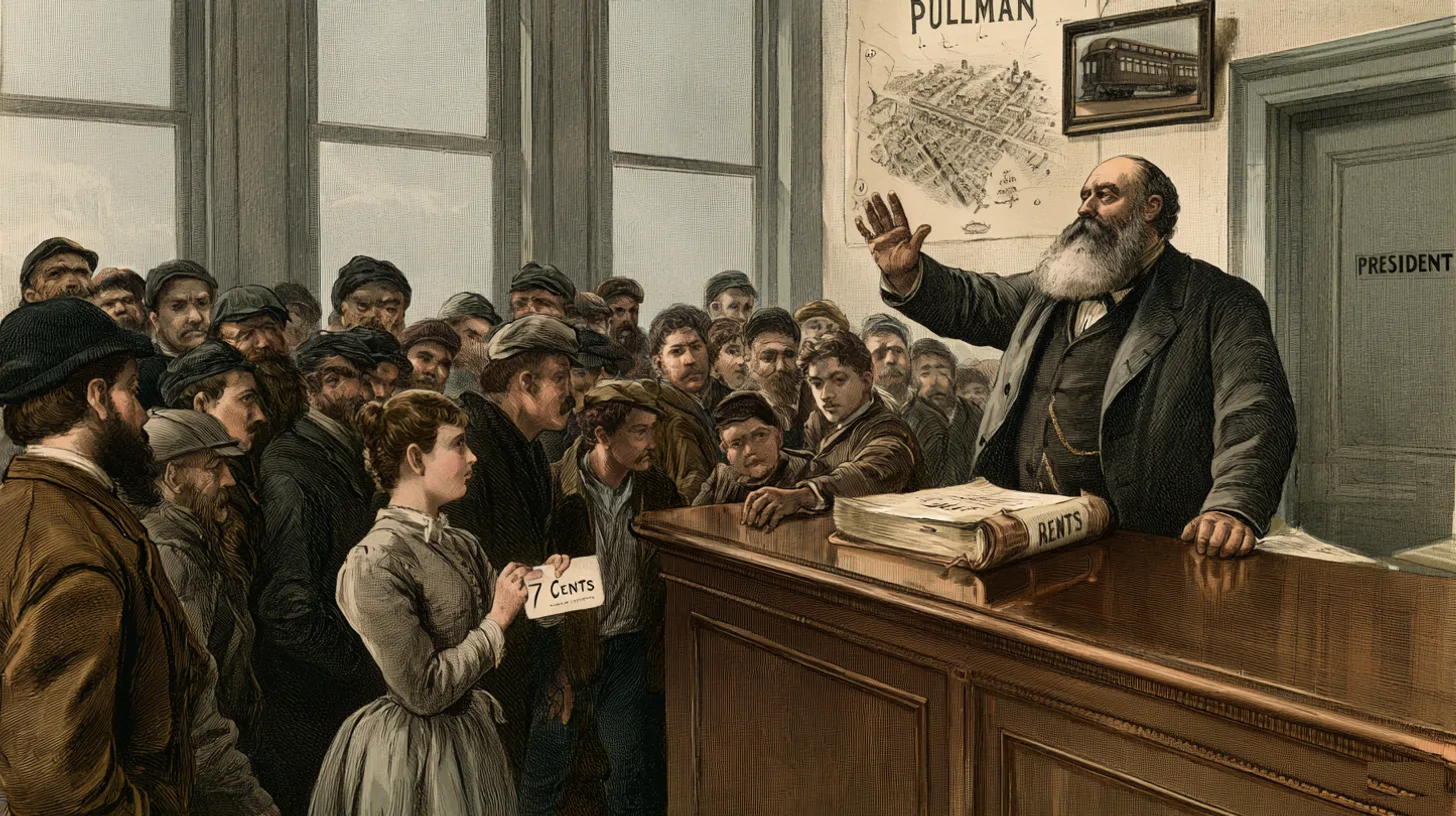
The vice president, Thomas H. Wickes, told them that the company was losing money on its contracts to keep the men at work, and that it was “utterly impossible to lower the rents one penny.” The company offered to show its books. Then Wickes named another meeting for the following Wednesday, and on Wednesday they went down again and saw Pullman himself.
Pullman told them what Wickes had told them. He would not, as Curtis remembered it, “raise our wages nor lower the rents.” The next day three members of the committee were laid off, and their foremen said there was no work for them. That evening the local unions met and voted to strike. The day after that the workers walked out, and the company laid off the 600 who had stayed and closed the shops.
The summer the Army came to Chicago
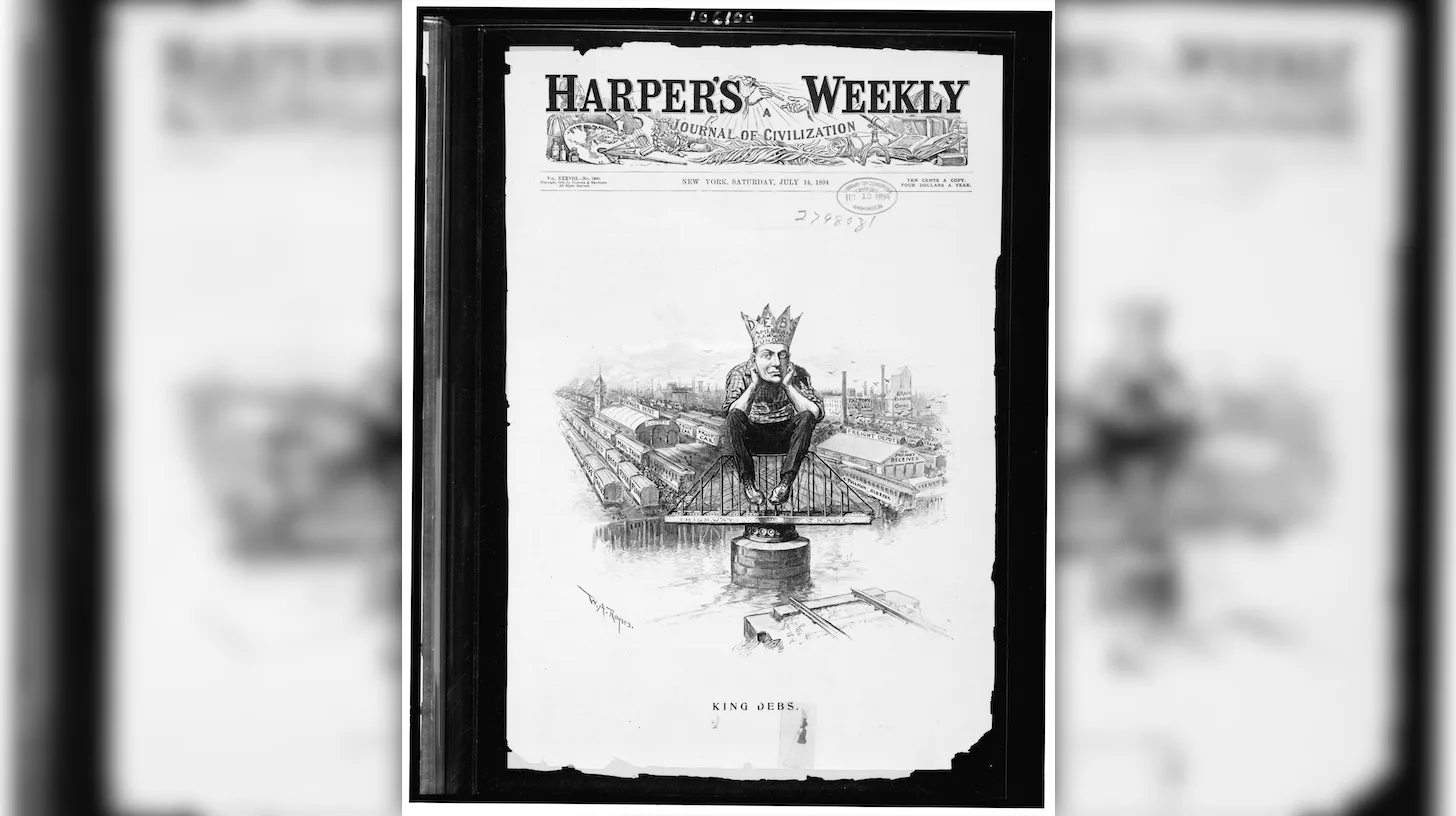
The strikers had joined the American Railway Union, whose president was Eugene V. Debs, and in June the union asked the company to put the dispute before an arbitrator. Pullman was in New York. It was Wickes who gave the answer, “No, we have nothing to arbitrate,” and when Pullman was asked about those words under oath that August he would say only, “I do not know that I made use of just that term.” Late that month the union’s members stopped working any train that carried a Pullman car.
Two days later Congress passed, and President Grover Cleveland signed, a bill making the first Monday in September a national holiday called Labor Day. Within the week federal attorneys had gone to court against the union, and on the Fourth of July soldiers of the regular Army were in Chicago. The governor of Illinois, John P. Altgeld, had not asked for them, and he wrote to tell the president so.
“Surely the facts have not been correctly presented to you in this case or you would not have taken the step; for it is entirely unnecessary and, as it seems to me, unjustifiable.”
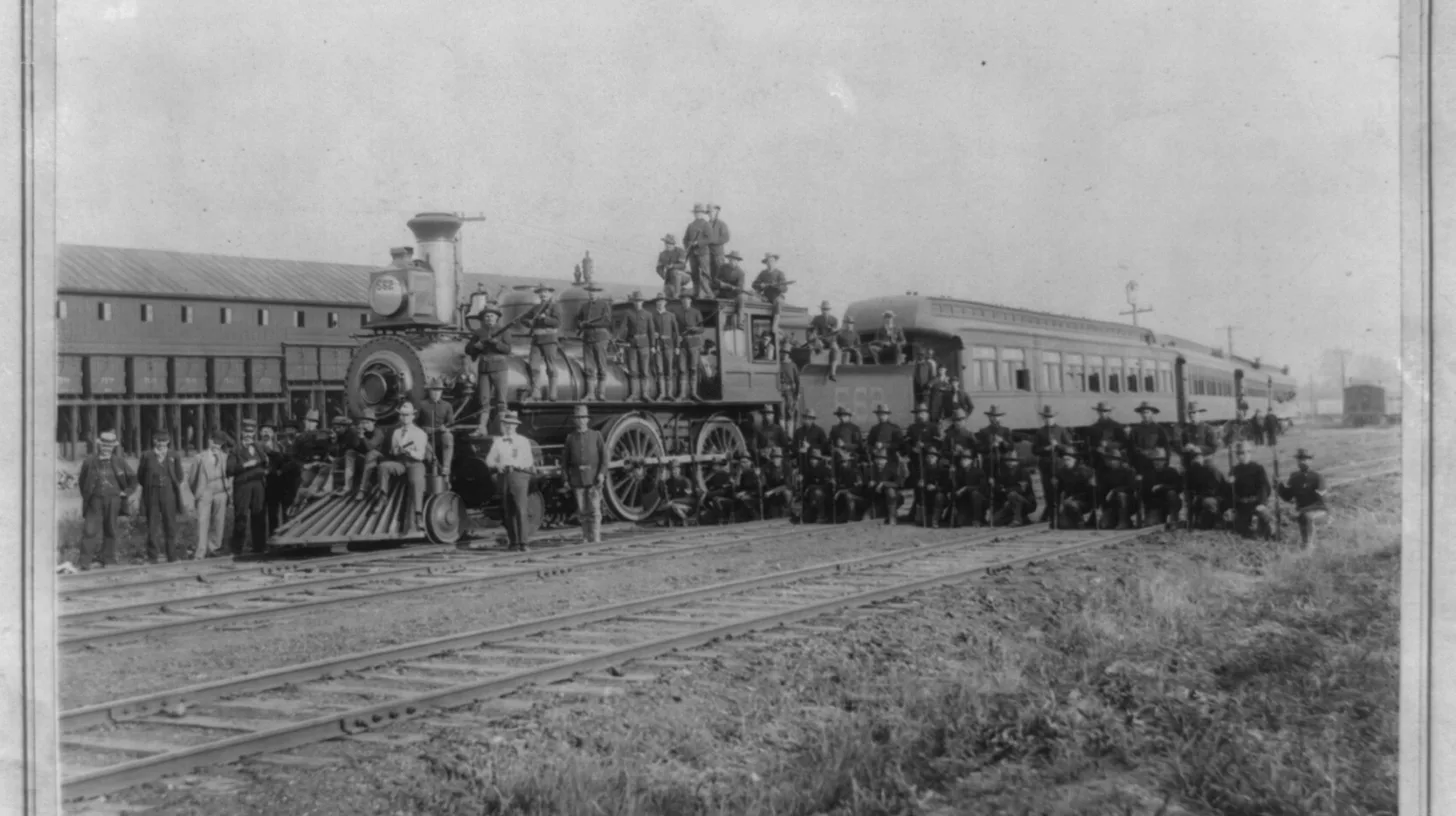
Nearly two thousand regulars were put to use in the city in a single week, among some fourteen thousand soldiers, militiamen, deputies and police, and twelve people were shot and fatally wounded. At Pullman itself the strikers kept such order that the commission called their conduct “dignified, manly, and conservative.” But Debs was arrested, and the boycott collapsed, and he gave the reason afterward in plain words.
“As soon as the employees found that we were arrested, and taken from the scene of action, they became demoralized, and that ended the strike. It was not the soldiers that ended the strike. It was not the old brotherhoods that ended the strike. It was simply the United States courts that ended the strike.”
In August the shops at Pullman reopened. The commission’s judgment on the town was short: its beauties, the commissioners wrote, “are admired by visitors, but have little money value to employees, especially when they lack bread.”
Five o’clock on Prairie Avenue
Pullman had three years left, and he kept the company and the town through all of them. In October 1897 he came home from his summer house on the New Jersey shore and told his friends that he had never been in better health in his life. But he had come back into a spell of unusual heat, and it told on him.
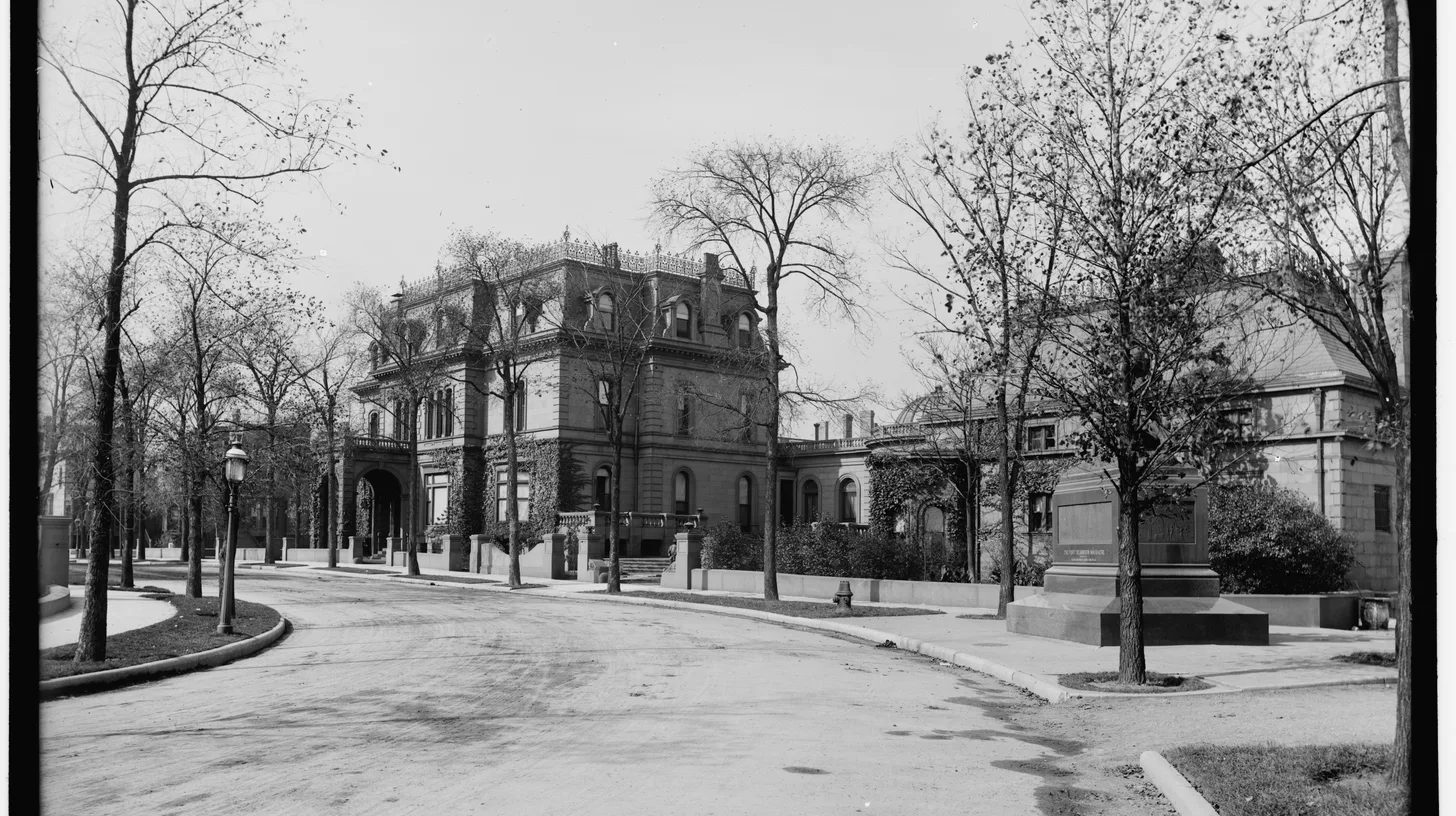
Before dawn on Tuesday, October 19, in his bedroom at 1729 Prairie Avenue, the pain came. Those who saw the room afterward concluded that he had borne it alone for an hour and perhaps more, moving helplessly back and forth, because the furniture had been pushed into odd positions and he had not been able to strike a light. At last he thought of the half-filled glass of water on the stand by his bed. He found a spoon and rapped on the glass, and the sound woke a guest in the house, who brought help.
It was too late. He died at about five o’clock, of what the doctors called angina pectoris, and the Tribune said that many would lay his death to “the strain of the big Debs strike.”
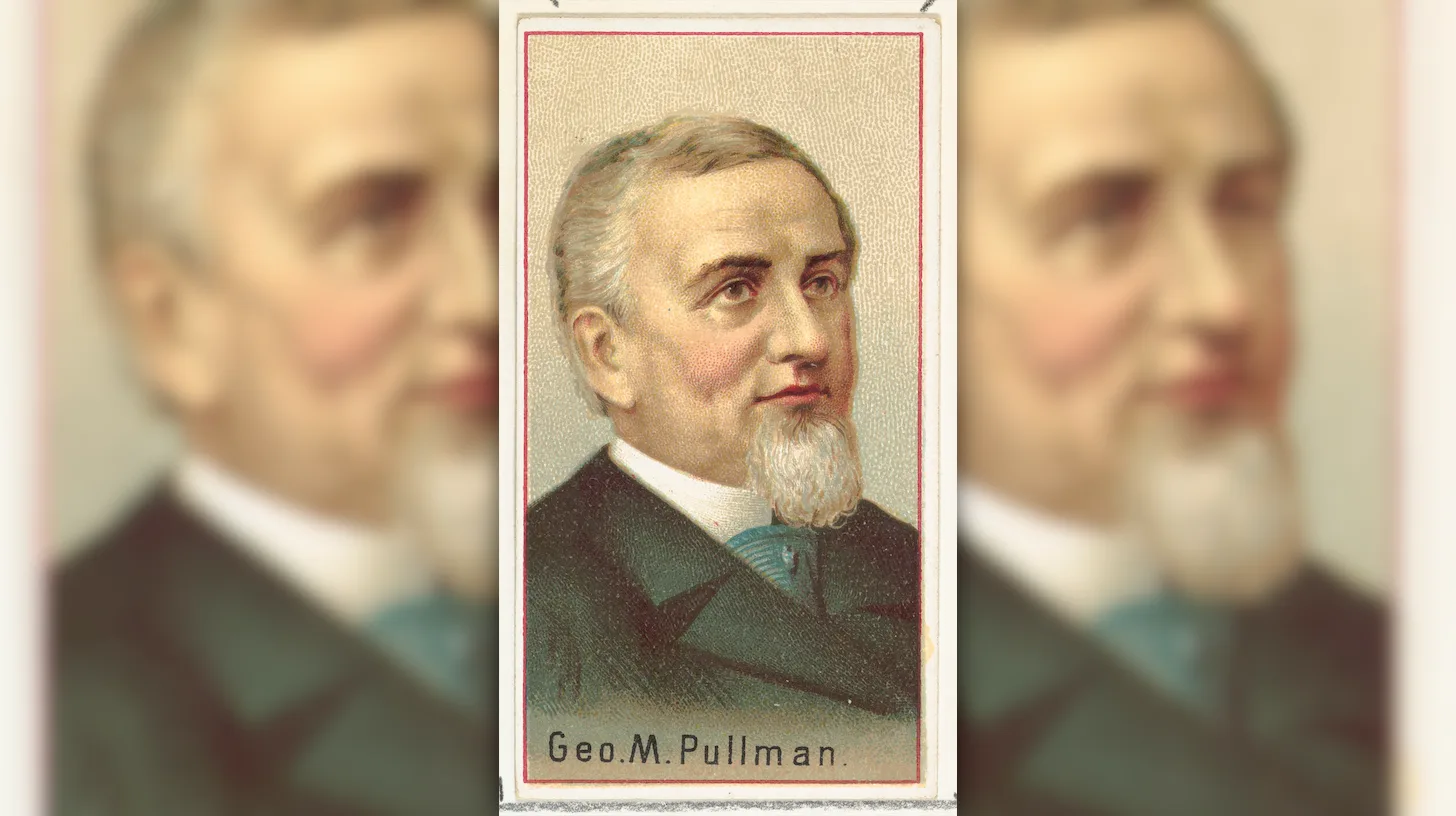
His will was thirty-two days old. It disposed of an estate of $7,600,000. To each of his two daughters it gave a million dollars and a share of what remained, and to his widow the house on Prairie Avenue. To his twin sons it gave trusts that would pay each of them $3,000 a year, and a paragraph of explanation.
“Inasmuch as neither of my sons has developed such a sense of responsibility as in my judgment is requisite for the wise use of large properties and considerable sums of money, I am painfully compelled, as I have explicitly stated to them, to limit my testamentary provisions for their benefit to trusts producing only such income as I deem reasonable for their support.”
A thousand workmen in the Arcade Theater
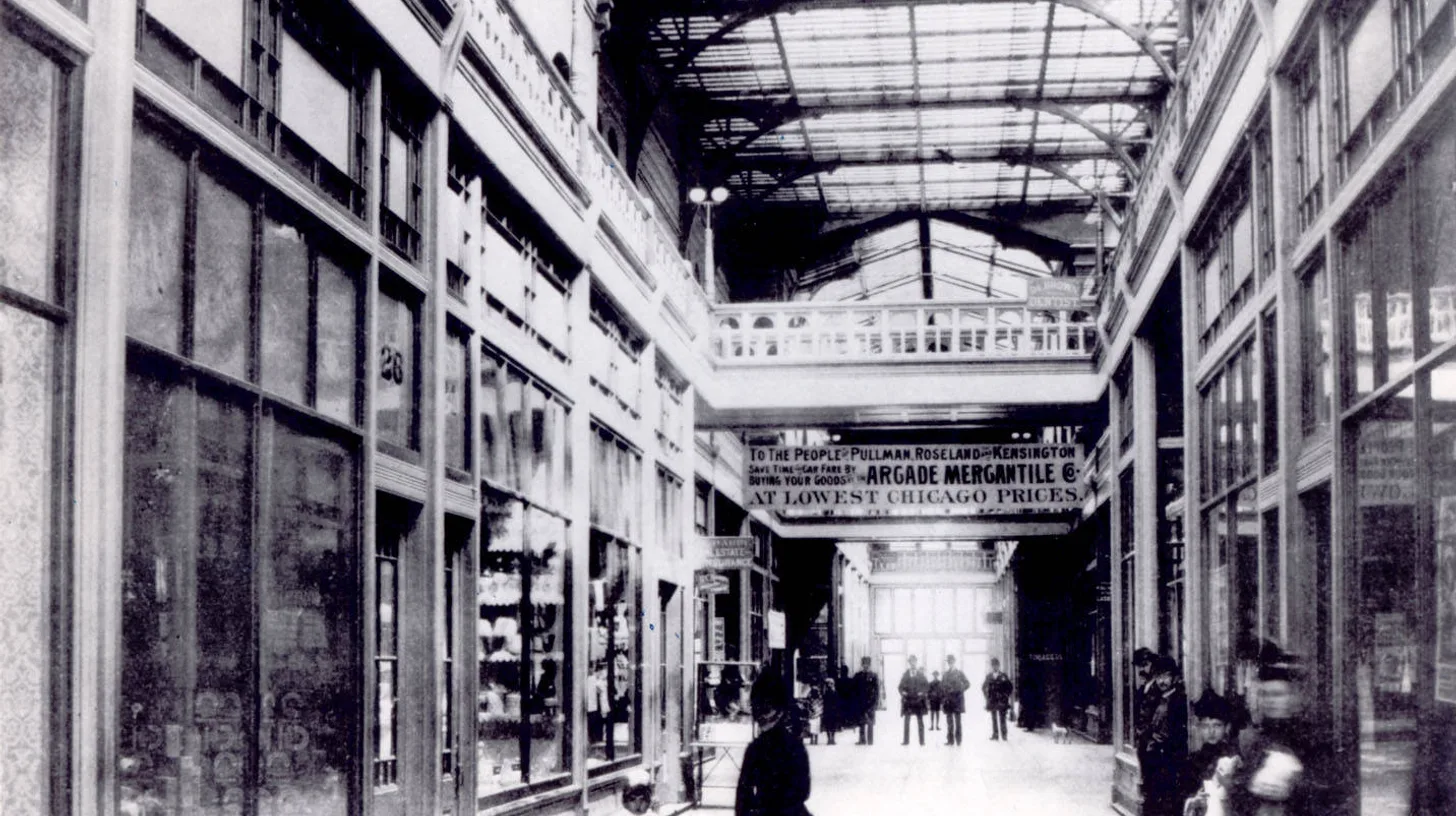
On Wednesday evening the Arcade Theater at Pullman was packed. A thousand workmen had come, and it was their meeting: the Tribune’s reporter noticed that the company’s officials, superintendents and foremen kept to the background, while the men from the shops filled the front of the house and chose a car trimmer to preside. A mechanic from the iron and steel shops stood up to say that he had never known Mr. Pullman personally, but that he knew what Pullman’s management had done for the men in his department.
The meeting voted, with no one against, to send the widow a piece of flowers made in the shape of a palace car. And it adopted resolutions that called the dead man “one of the world’s benefactors.”
A workman had told the paper much the same thing the day before. “Say what you will about injustice to workingmen,” he said, “Mr. Pullman was the kindest landlord I ever knew,” and he gave his reason, which was that no family had been put out of a Pullman house for owing rent.
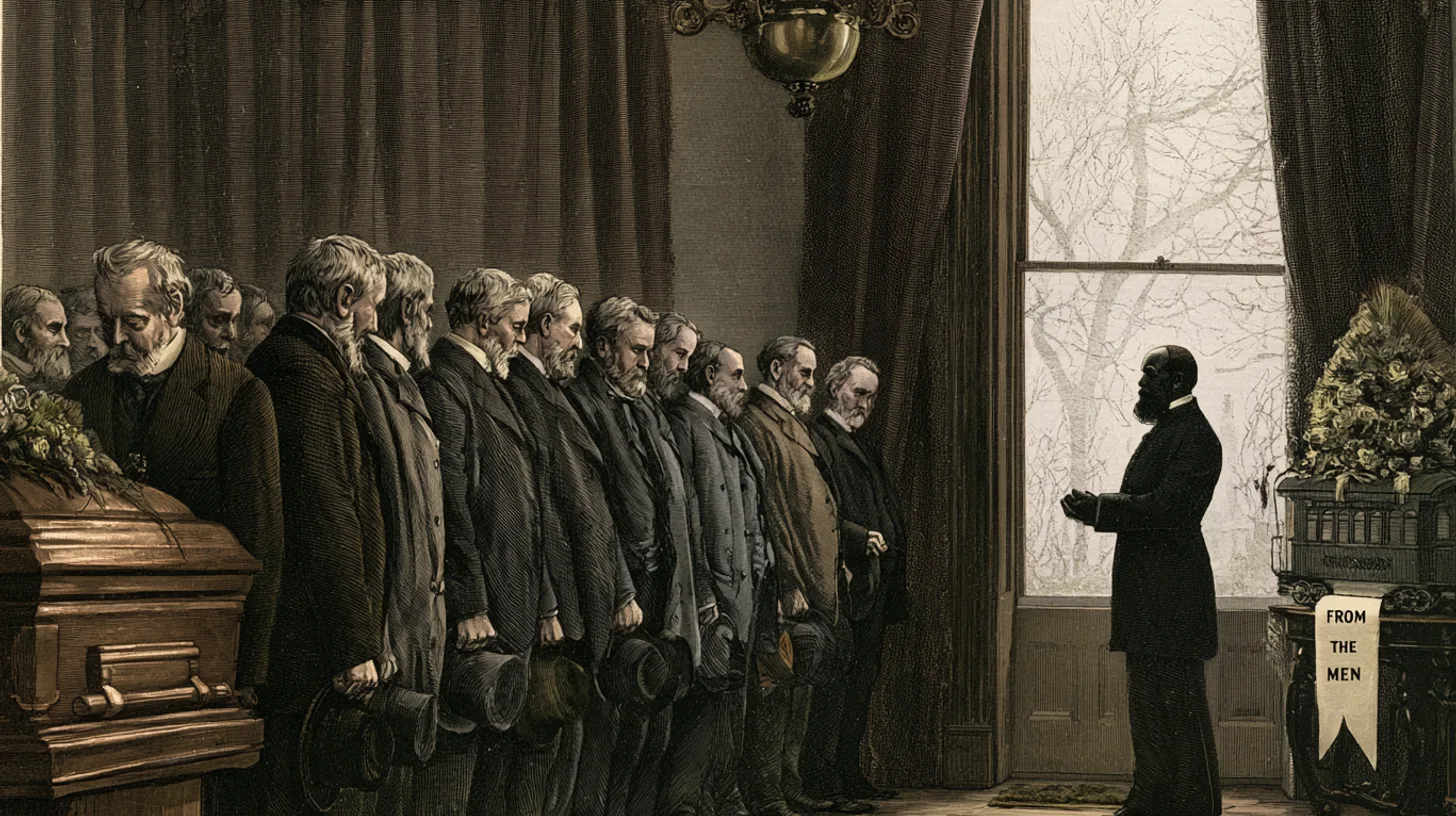
On Friday about 250 of the oldest hands, men who had worked for him ten years and in some cases twenty-five, gathered in front of the house on Prairie Avenue shortly before noon and waited. Two hundred of them had come up from the works in special coaches. When Arthur W. Wells, the Black custodian of Pullman’s private car, appeared at the door and beckoned, they went in and passed the casket “hat in hand,” each man stopping for an instant to look at the face.
It was that same Friday morning, on the other side of the city, that the contractors were carrying their furnaces into the bushes at Graceland.
Graceland at nightfall
The funeral was held at the house at two o’clock on Saturday afternoon, with the shops at Pullman closed for the day. The ceremony at the grave, for relatives and close friends only, was held at nightfall. A simple prayer was offered while those around the grave stood bareheaded, and the service ended. Then the workmen went down into the pit.
Its floor was already laid, a mass of concrete “eighteen inches thick,” strengthened with bands of metal. Now they moved the lead-lined mahogany box until it lay within a fraction of an inch of the center, wrapped it in tar paper, and spread an inch of asphalt on it, about it and under it, which hardened quickly. They filled the space at the head and sides with concrete. They brought eight heavy steel rails and laid them across the top, with the ends resting on the concrete on either side and a little room left beneath, so that the weight above would not crush the box, and they bolted the rails together with two long iron rods and buried them in more concrete.
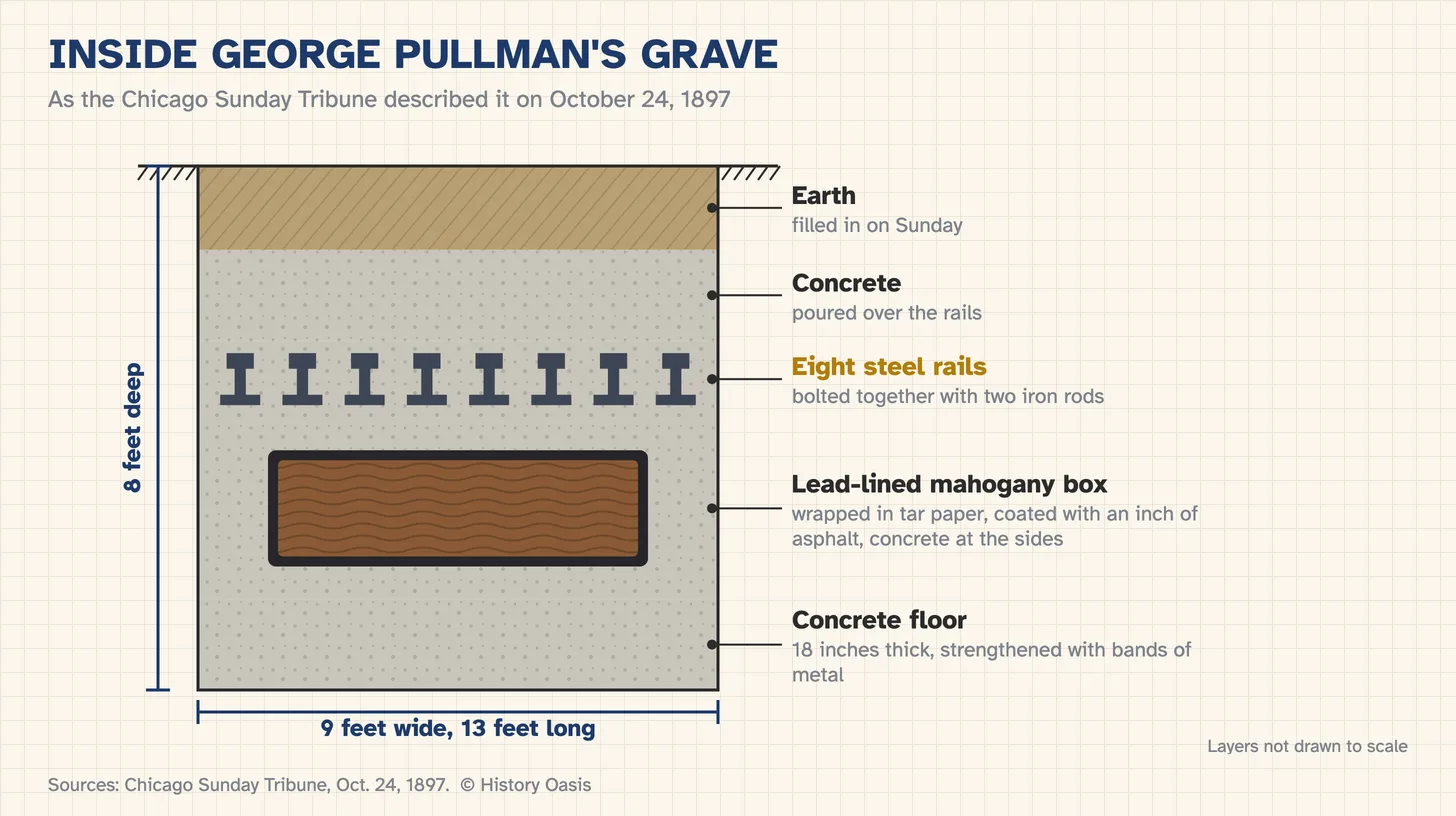
The foreman said that nothing “short of dynamite could shatter the base,” and that it would take many tons of dynamite to do it. It was late at night before the last of the work was done. While it went on, the Chicago Orchestra, playing at the Auditorium, added Chopin’s Funeral March to its program.
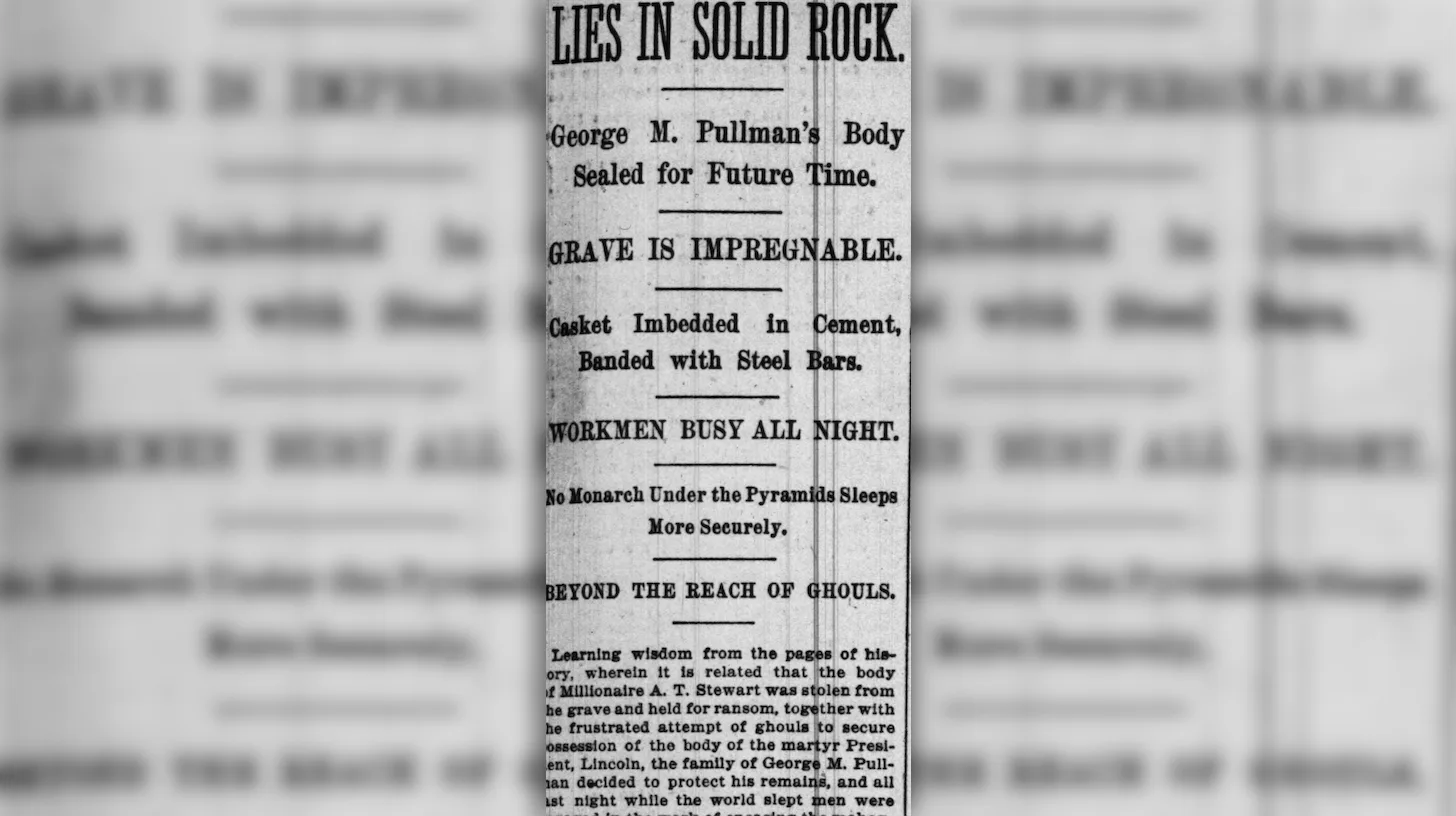
The Sunday Tribune put the story on its front page under the words “GRAVE IS IMPREGNABLE,” and in its first sentence it gave the family’s reason. The body of the millionaire A. T. Stewart, the paper reminded its readers, had been “stolen from the grave and held for ransom,” and there had been an attempt on the body of Abraham Lincoln. No king under the pyramids, it said, slept more securely. The article did not mention the strike, and it did not mention a single workman of Pullman’s.
What was added afterward
The angry workers came into the story later. Graceland Cemetery’s own account now says that the family feared them, while the reports of 1897 say grave robbers and ransom, and the National Park Service, which keeps the town of Pullman as a national historical park, says that “nothing in Pullman’s own words requesting a reinforced burial has been found to date.”
A remark credited to the writer Ambrose Bierce, to the effect that the family was making sure Pullman would not get up and come back, travels with the legend. The research for this article found it in no text of Bierce’s and in no newspaper of that week.
The year after he died the Illinois Supreme Court ordered the company to sell its houses in Pullman, and other manufacturers went on to build towns of their own, Milton Hershey’s in Pennsylvania among them.
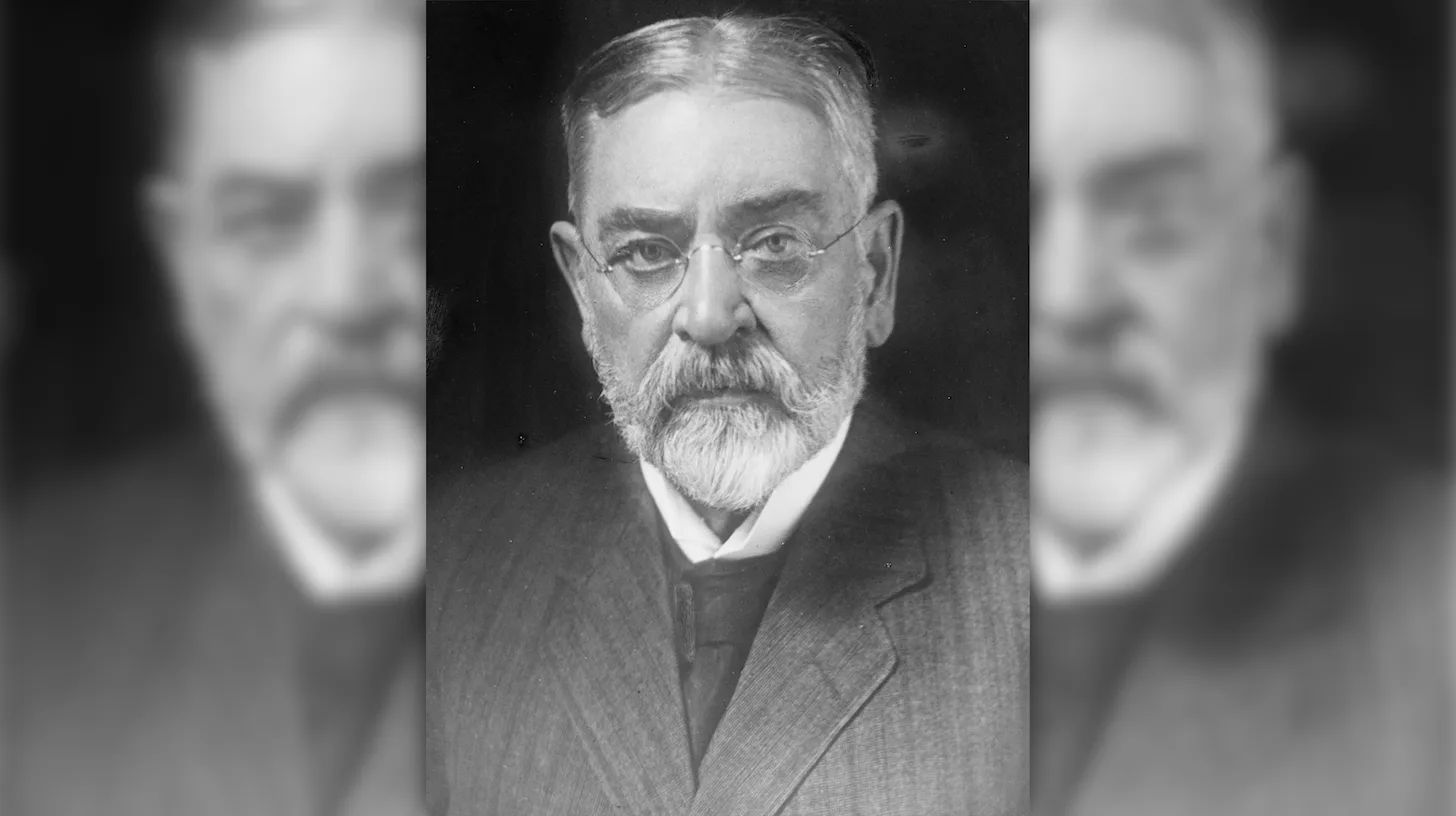
Robert Todd Lincoln, the president’s son, had been an honorary pallbearer and an executor of the will, and he led the company after Pullman. Thieves had tried to steal his father’s body in 1876. In June 1901, when Illinois was restoring the tomb in Springfield, he wrote to the governor that he had consulted the Chicago architect S. S. Beman, who had experience in burying a coffin in concrete so that it could not be stolen.
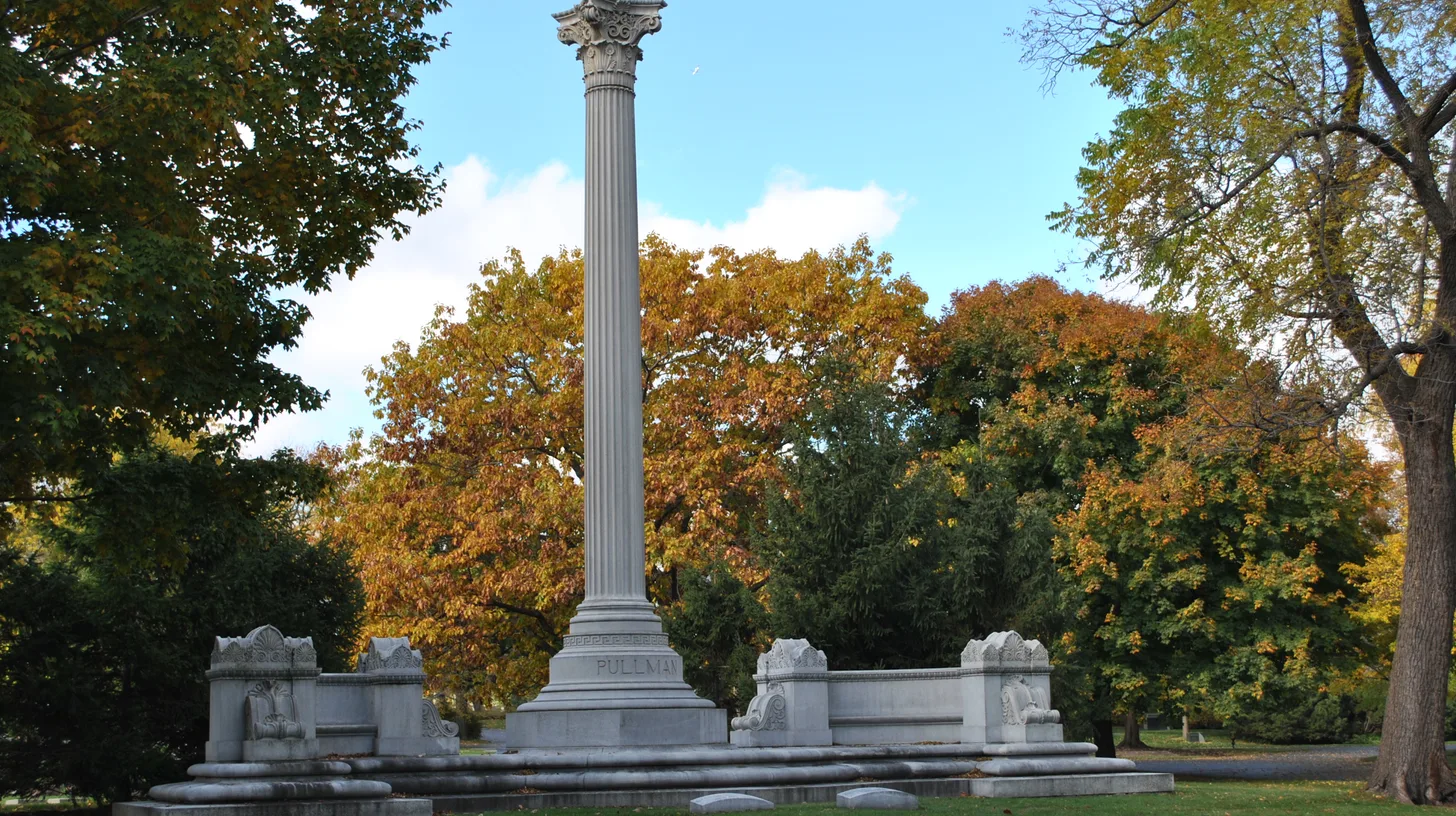
Beman had designed the town of Pullman. He designed the column over the grave at Graceland, too. There is a stone bench on either side of it.


