14 min read
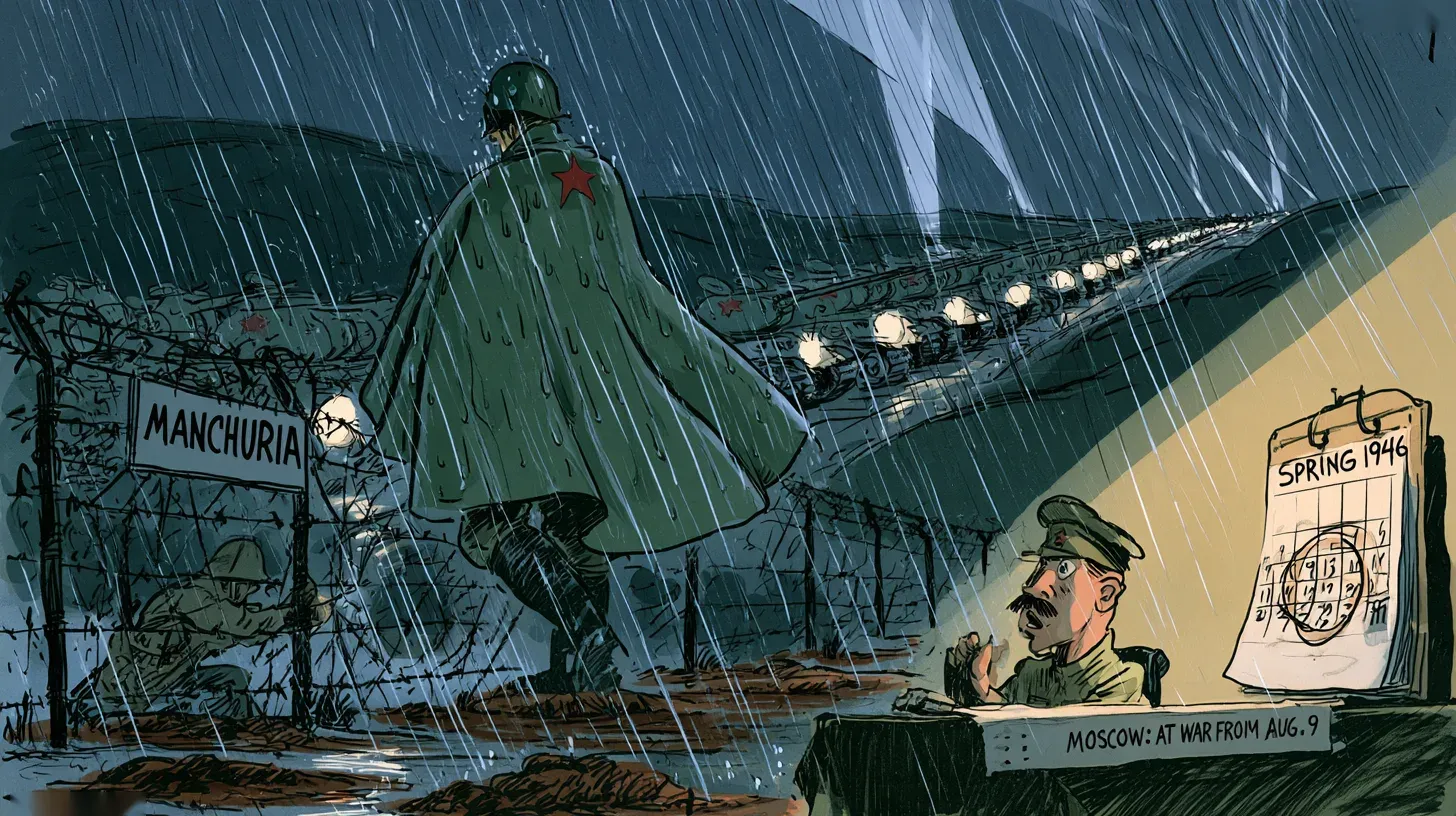
Just after midnight on Thursday, August 9, 1945, on the eastern border of Manchuria, Soviet assault parties who had moved up to the line at half past eleven, “just as light rain began to fall,” watched their sappers cut through the Japanese barbed wire as the rain grew heavier. Far to the west, at ten minutes after midnight, the forward units of another Soviet army crossed out of Mongolia into Inner Mongolia and Manchuria without a shot of artillery to announce them. More than a million and a half men were moving.
Six hours earlier, in Moscow, the Soviet foreign minister had read a declaration of war to the Japanese ambassador. By the morning of August 9 a second atomic bomb had fallen on Japan, and the men in Tokyo who had to decide whether to go on fighting were sitting in a room together with the news of both. What the Soviet invasion did to the Kwantung Army, to the Japanese living in Manchuria and to the decision in Tokyo is the subject of an argument among historians that has not stopped since 1945.
A declaration at five o’clock
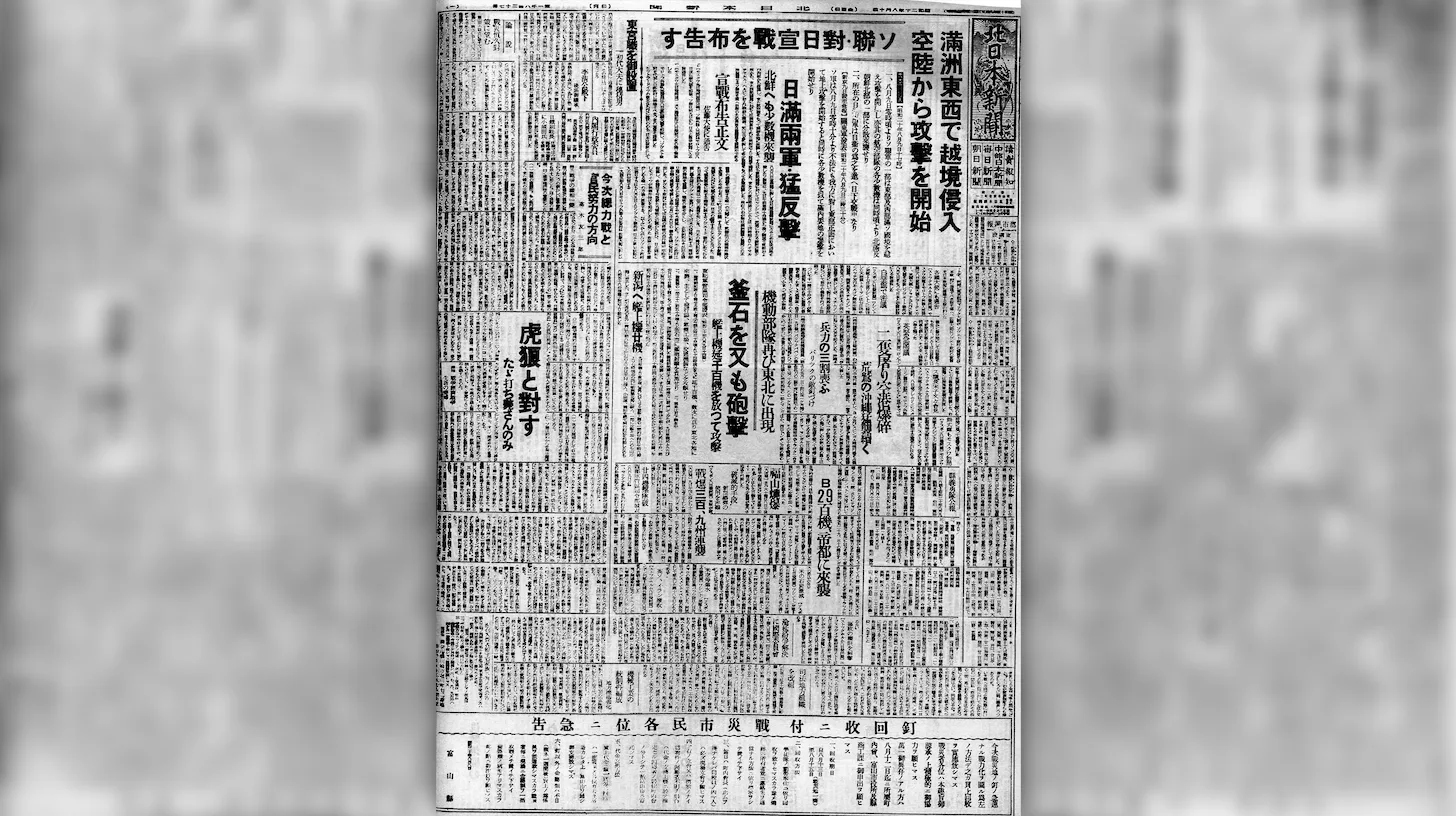
All that summer Japan had been asking the Soviet Union, which was still neutral in the Pacific war, to help it arrange a peace. The ambassador in Moscow, Naotake Sato, had been telling Tokyo by cable that the idea was hopeless. He wrote that it was “absolutely unthinkable that Russia would ignore the Three Power Proclamation and then engage in conversations with our special envoy,” and that if the government and the military went on delaying, “all Japan will be reduced to ashes.”
On August 8, at five o’clock in the afternoon by Moscow time, the foreign minister, Vyacheslav Molotov, received Sato in the Kremlin and read him a statement. Japan’s request for mediation, it said, “loses all basis.” It ended with a sentence that took effect within hours.
“In view of the above, the Soviet Government declares that from tomorrow, that is from Aug. 9, the Soviet Government will consider itself to be at war with Japan.”
Sato, the historian Tsuyoshi Hasegawa writes, assumed that the deadline meant midnight in Moscow. It meant midnight on the Manchurian border. The Soviet tanks rolled at midnight Trans-Baikal time, which was six in the evening in Moscow, “less than an hour” after Sato left the room. Joseph Stalin had moved the date forward after the bomb fell on Hiroshima on August 6. At half past eight that evening, an Associated Press man reported, Molotov called in the foreign correspondents in a jovial mood, leaned across a birch table and lit a long Russian cigarette. In Washington, at three o’clock on the afternoon of the same Wednesday, President Harry S. Truman called the reporters who covered the White House into his office to give them a single piece of news, and told them he could not stay to answer questions.
“I can’t hold a regular press conference today; but this announcement is so important I thought I would call you in. Russia has declared war on Japan! That is all!”
The White House transcript adds, in brackets, “Much applause and laughter, as the reporters raced out.”
Ten minutes after midnight
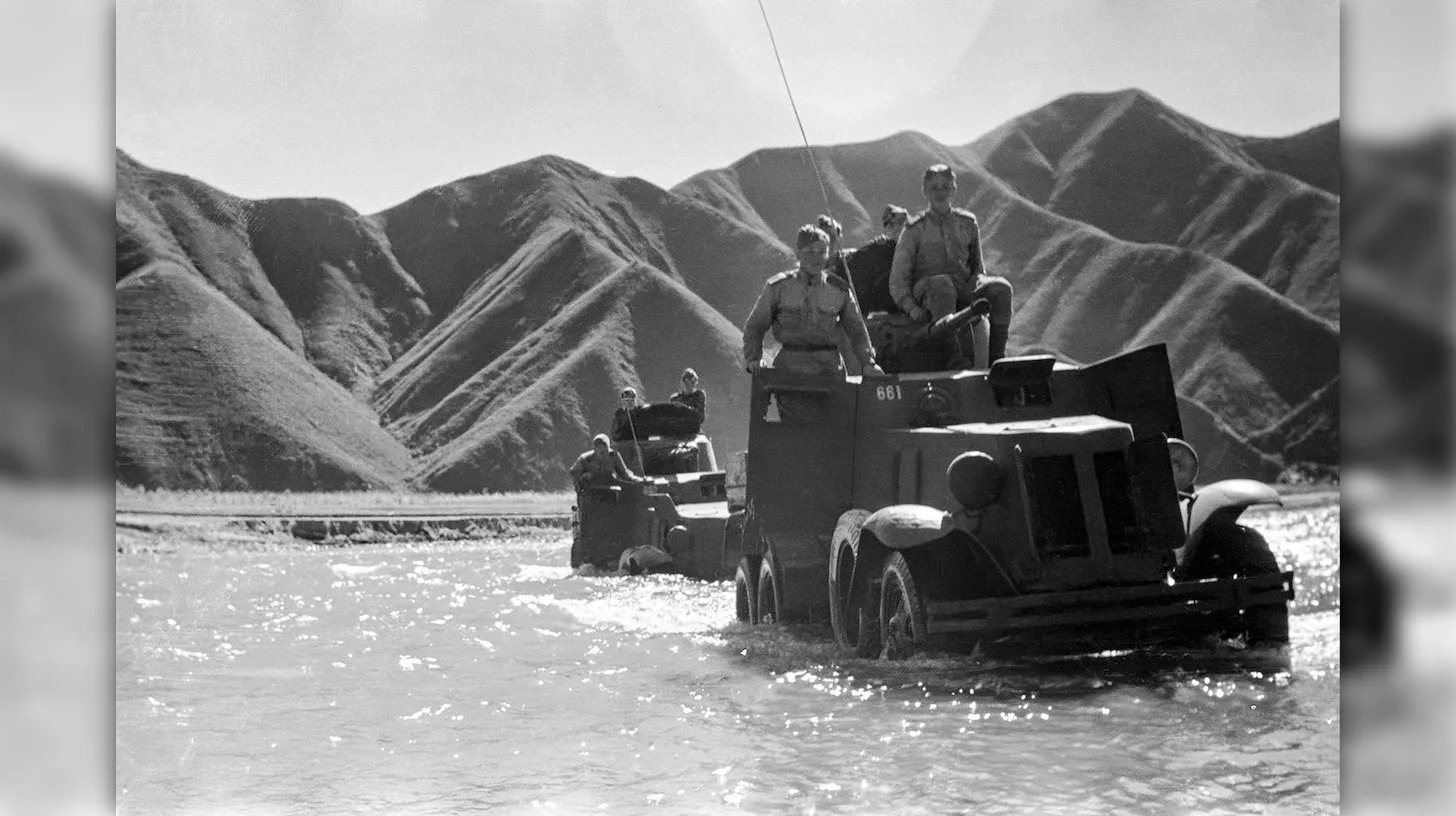
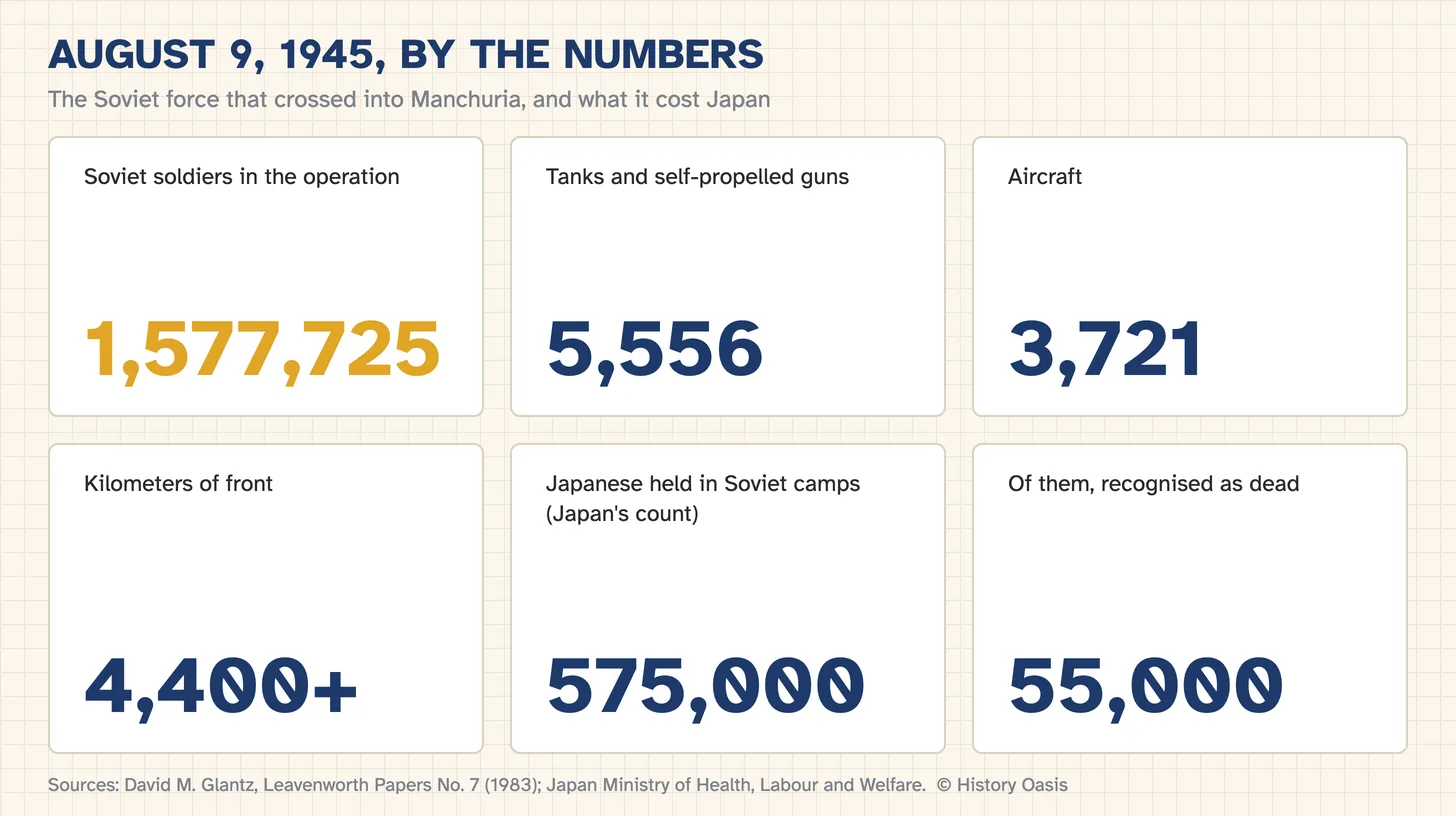
The figures for the force that crossed come from the American Army historian David M. Glantz, who worked from Soviet sources in 1983: 1,577,725 men, 5,556 tanks and self-propelled guns, 3,721 aircraft, on a front of more than 4,400 kilometers. Between May and June, thirty divisions, about a million men, had been moved into new positions for it, three months after the war in Europe ended.
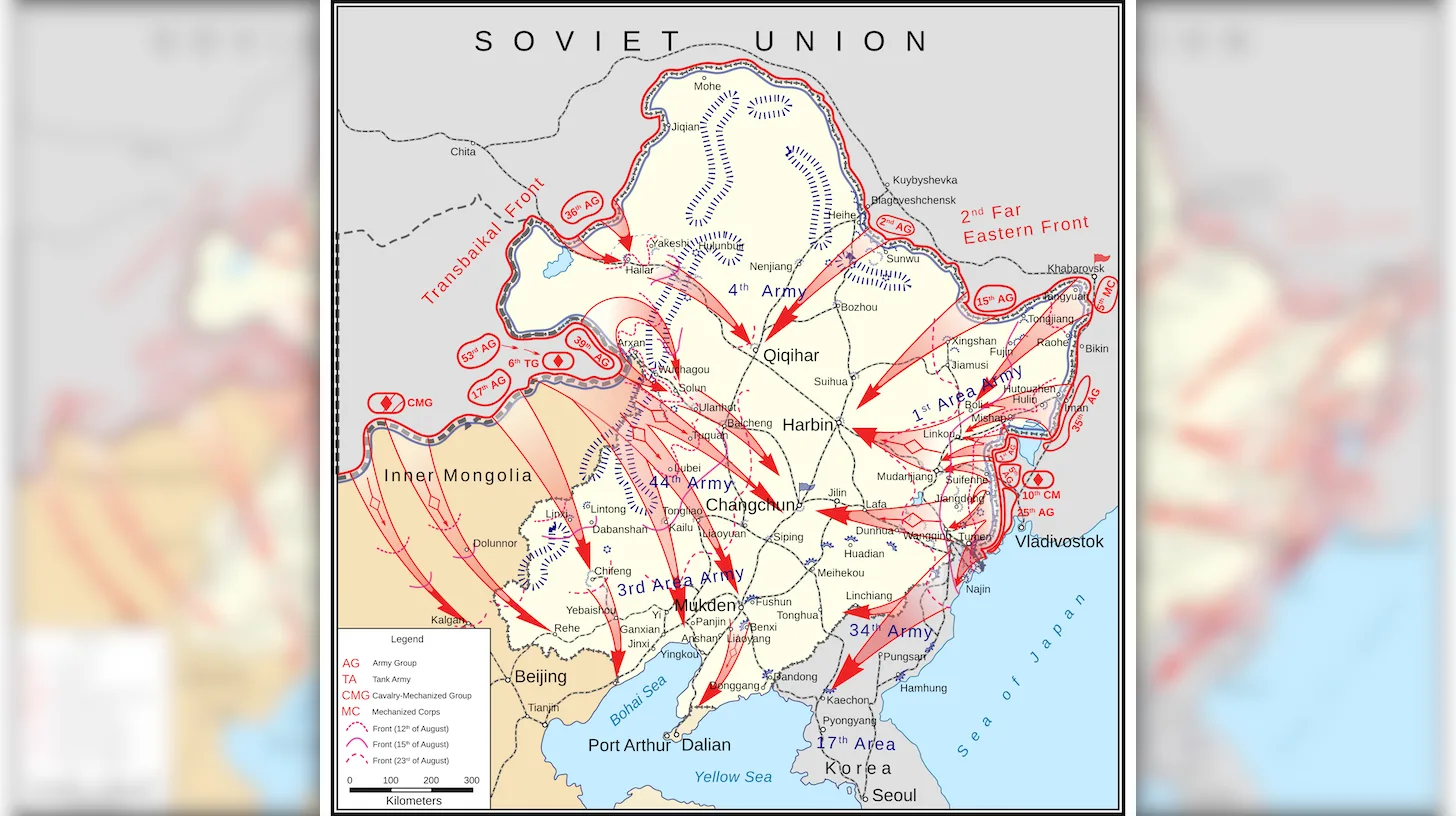
Three fronts came in from three sides. From Mongolia in the west came the Trans-Baikal Front of Marshal Rodion Malinovsky, with a tank army in the lead that had orders to cross the Greater Khingan mountains. From the Soviet Maritime Province in the east came the 1st Far Eastern Front of Marshal Kirill Meretskov. From the north, across the Amur, came the 2nd Far Eastern Front. Over all three, as commander of the whole Far East, stood Marshal Aleksandr Vasilevsky.
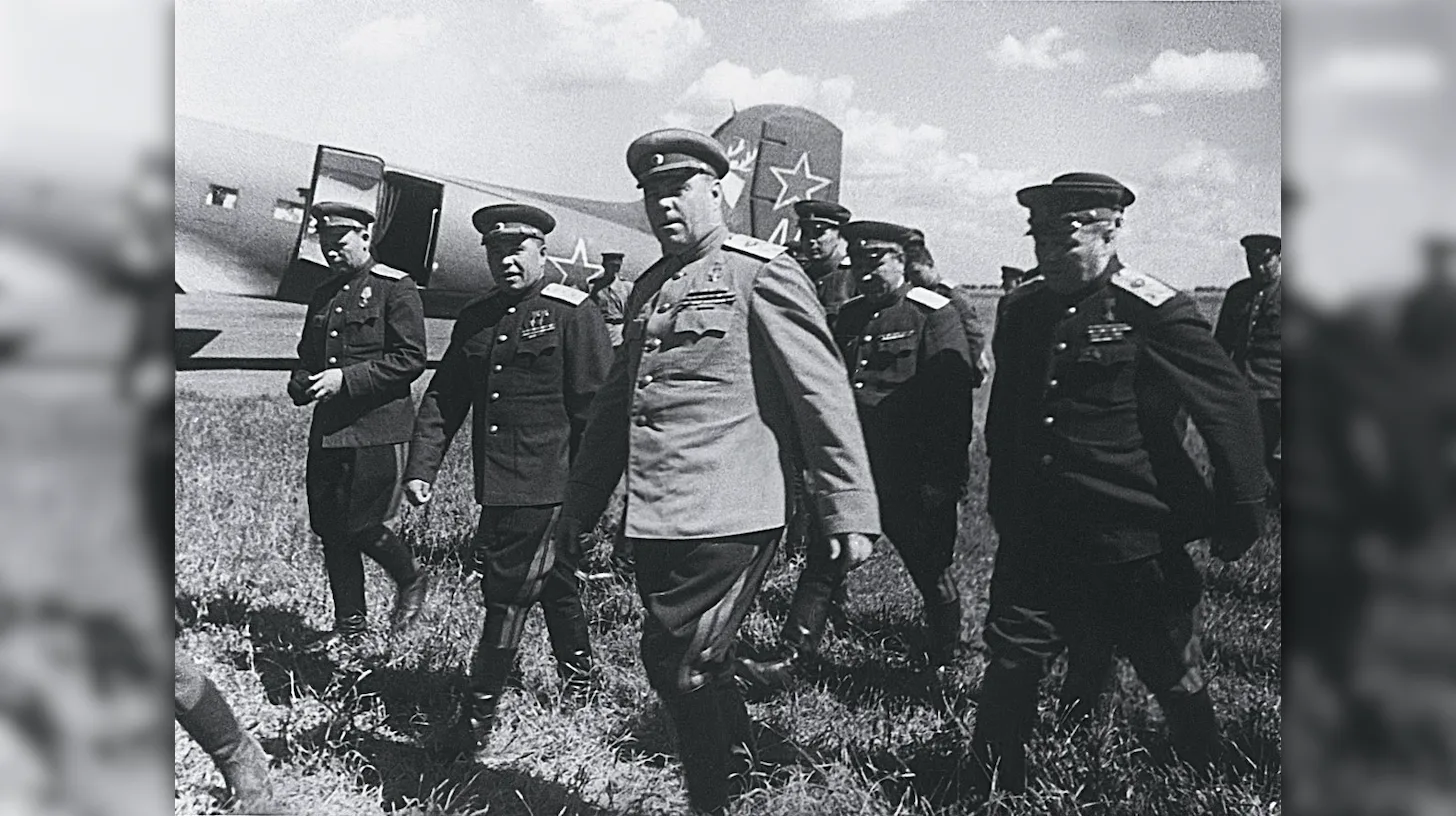
Vasilevsky, who was forty-nine, was a priest’s son who had joined the Russian Army in 1915, in the war against Germany. In the photographs taken that summer he wears a light field tunic among generals in dark ones, and no one who met him in Manchuria left a description of him in any source that can be read today. In the east, where Meretskov’s men went in, the rain fell hard all night. Meretskov gave the order to go ahead “despite the torrential rains,” and his reconnaissance units crossed at half past midnight in heavy thunderstorms. The rain, Glantz writes, “persisted from after midnight till about 0600 on the ninth,” and the attack in such miserable conditions led, he writes, to the “quick reduction of many unsuspecting Japanese border posts.”
The Kwantung Army waits for spring
By the summer of 1945 the Imperial High Command had transferred most of the veteran divisions of Japan’s army in Manchuria, the Kwantung Army, to other fronts, and the able-bodied men among the Japanese settlers in Manchuria had been called up to replace them. The Japanese, Glantz writes, “considered none of the Kwantung Army divisions combat ready and some divisions only 15 percent ready.” Their tanks carried 57-millimeter guns against the Soviet T-34s. The army’s chief of staff said after the war that the command had believed it could count on Soviet neutrality until the spring of 1946. Its commander, Gen. Otozo Yamada, was sixty-three.
The news reached the Fourth Army’s headquarters at two in the morning: the Soviets had broken through on four fronts. An hour later a few Soviet planes raided the capital of Manchukuo, the empire Japan had built in Manchuria, “but inflicted no damage.” Along the border lived as many as 300,000 Japanese civilians, many of them settlers sent out to farm. No one had evacuated them, because the policy was to avoid provoking the Soviets, and most of their able-bodied men had already been drafted. One of them, Yoshie Fukushima, was at home in the border town of Tungning. Decades later she told two historians how the day began.
“The ninth of August dawned a beautiful morning. I was giving breakfast to my dog, Esu, when I heard the sound of airplanes. It must be a drill, I thought.”
At about seven, when the radio came on, she heard the bulletin. “News Bulletin! News Bulletin!” the announcer read. “The Soviet Union has broken diplomatic relations and declared war.” She put her son on her back.
The same morning in Tokyo
The chief cabinet secretary in Tokyo, Hisatsune Sakomizu, was woken by a telephone call at three or four in the morning and told of the Soviet declaration. The deputy chief of the Army General Staff, Lt. Gen. Torashiro Kawabe, wrote in his diary that morning, in Hasegawa’s translation, “The Soviets have finally risen!” Then he wrote down what he thought should follow.
“My judgment has proven wrong. But now that the situation has come to this, we should not consider seeking peace.”
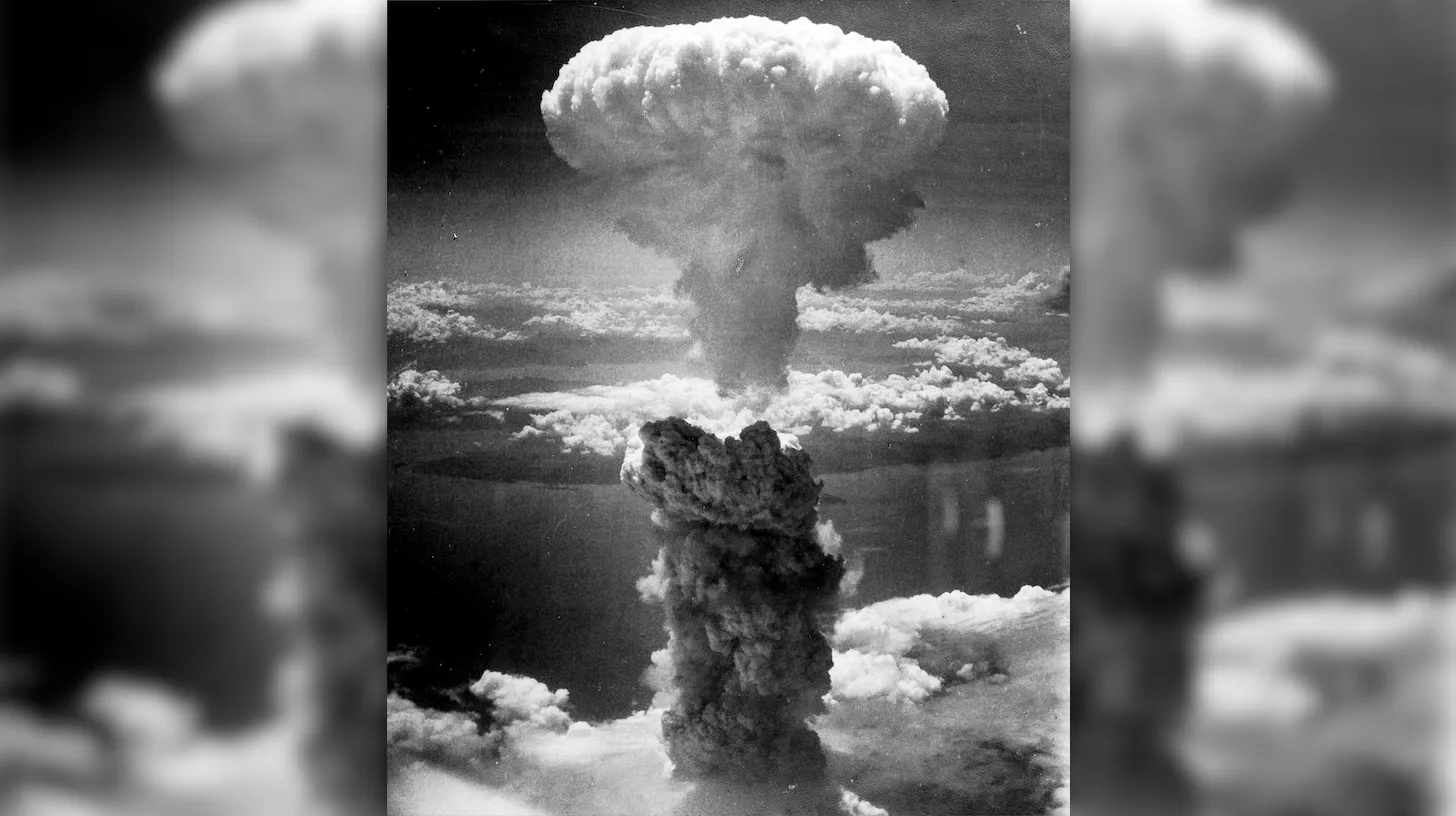
The prime minister, Adm. Kantaro Suzuki, saw the Emperor early in the morning. Suzuki’s biography says that the Soviet invasion was what at last convinced him “that the moment had at last arrived to end the war, since what we had been afraid of and tried to avoid at any cost had finally come about.” The six men of the Supreme War Council met at half past nine or ten. They were still deadlocked, three to three over the terms on which Japan could accept surrender, when word came that a second atomic bomb had exploded over Nagasaki at 11:02. It changed no one’s vote.
They met again that night in the shelter beneath the palace, with the Emperor present. At about three in the morning on August 10 Suzuki asked Hirohito to decide. The Emperor said, in the words of the chief cabinet secretary as the American bombing survey recorded them, that “to continue the war means nothing but the destruction of the whole nation.” The secretary told American officials later that “tears flowed freely.” In Manchuria the Soviet columns were still coming.
Through the Khingan in the rain
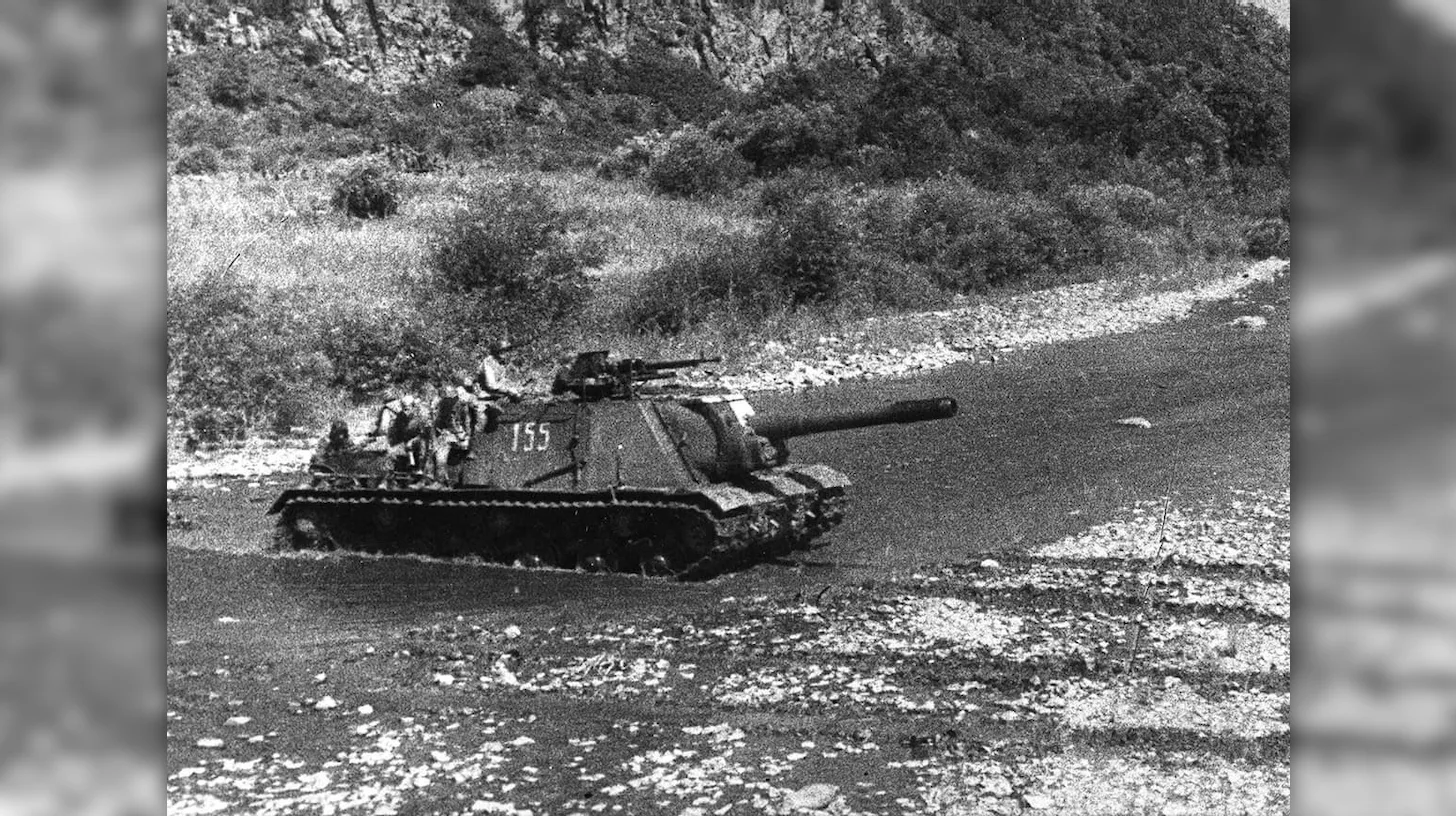
In the west the 6th Guards Tank Army of Col. Gen. A. G. Kravchenko went into Inner Mongolia in two columns and climbed toward the Greater Khingan range. One of its corps was equipped with American Sherman tanks, which burned more fuel than the T-34s, and Kravchenko pulled it out of the mountain crossing. At eleven o’clock on the night of August 10 the 5th Guards Tank Corps reached Tsagondabo, the highest point of the pass, and went on down the eastern side “in darkness and rain,” having covered forty kilometers of the pass in seven hours, and the tank army reached both of its objectives on the fourth day of an operation that had been planned for five.
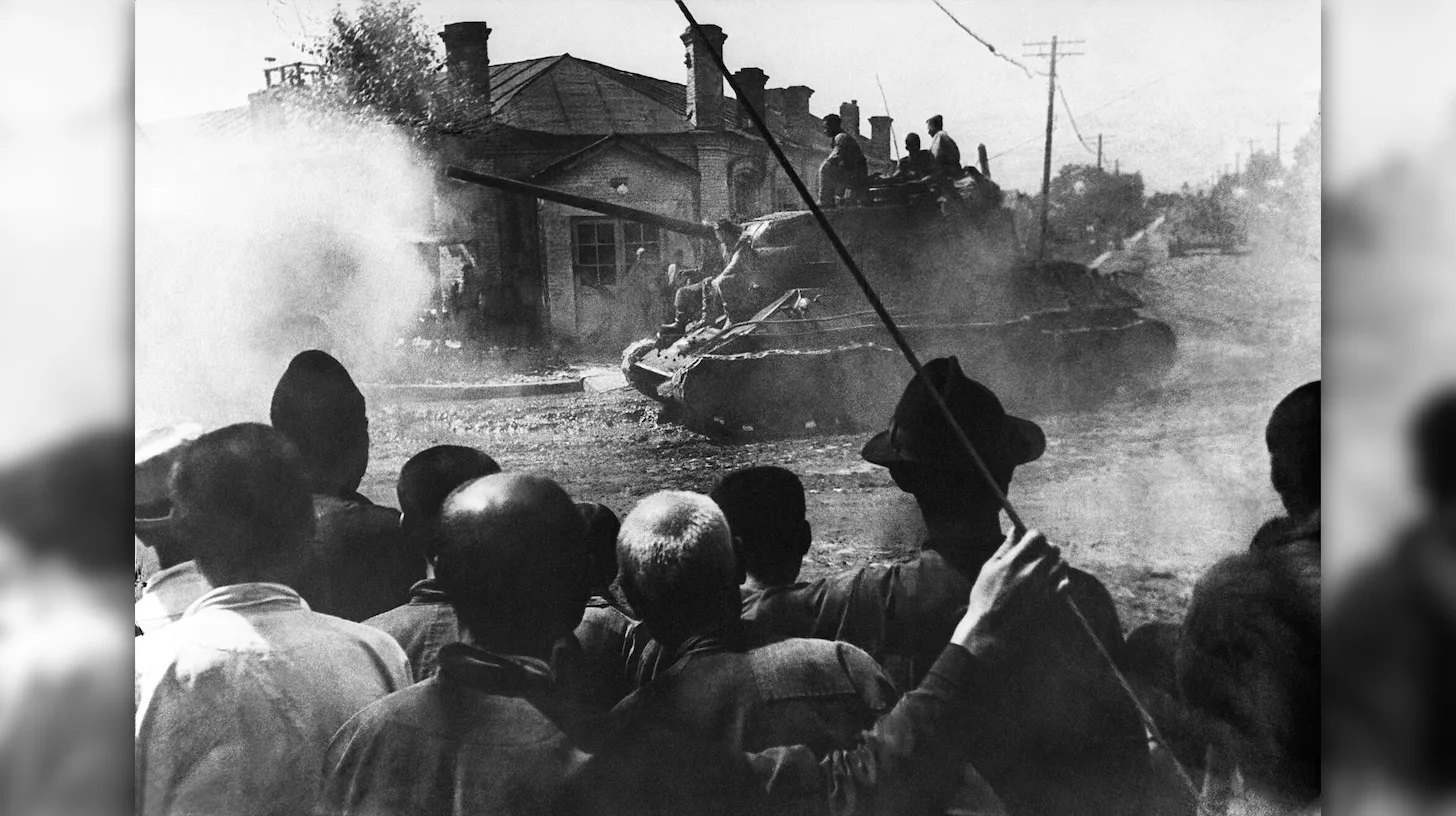
In the east the Japanese held on longer. At Mutanchiang, which fell on August 16, the Japanese 278th Infantry Regiment “was destroyed almost to a man.” At Hailar the defenders held out until August 18. At Hutou, Glantz writes, the garrison “never received word of the emperor’s radio broadcast ending hostilities,” and fought on.
Two messages from the Emperor
On August 15 the Emperor spoke to his people by radio and told them they must endure the unendurable. He gave as a reason that “the enemy has begun to employ a new and most cruel bomb,” and he did not mention the Soviet Union. Two days later a second rescript went out to the Army and Navy alone, and the Associated Press printed its text. It gave a different reason: “Now that the soviet union has entered the war against us.”
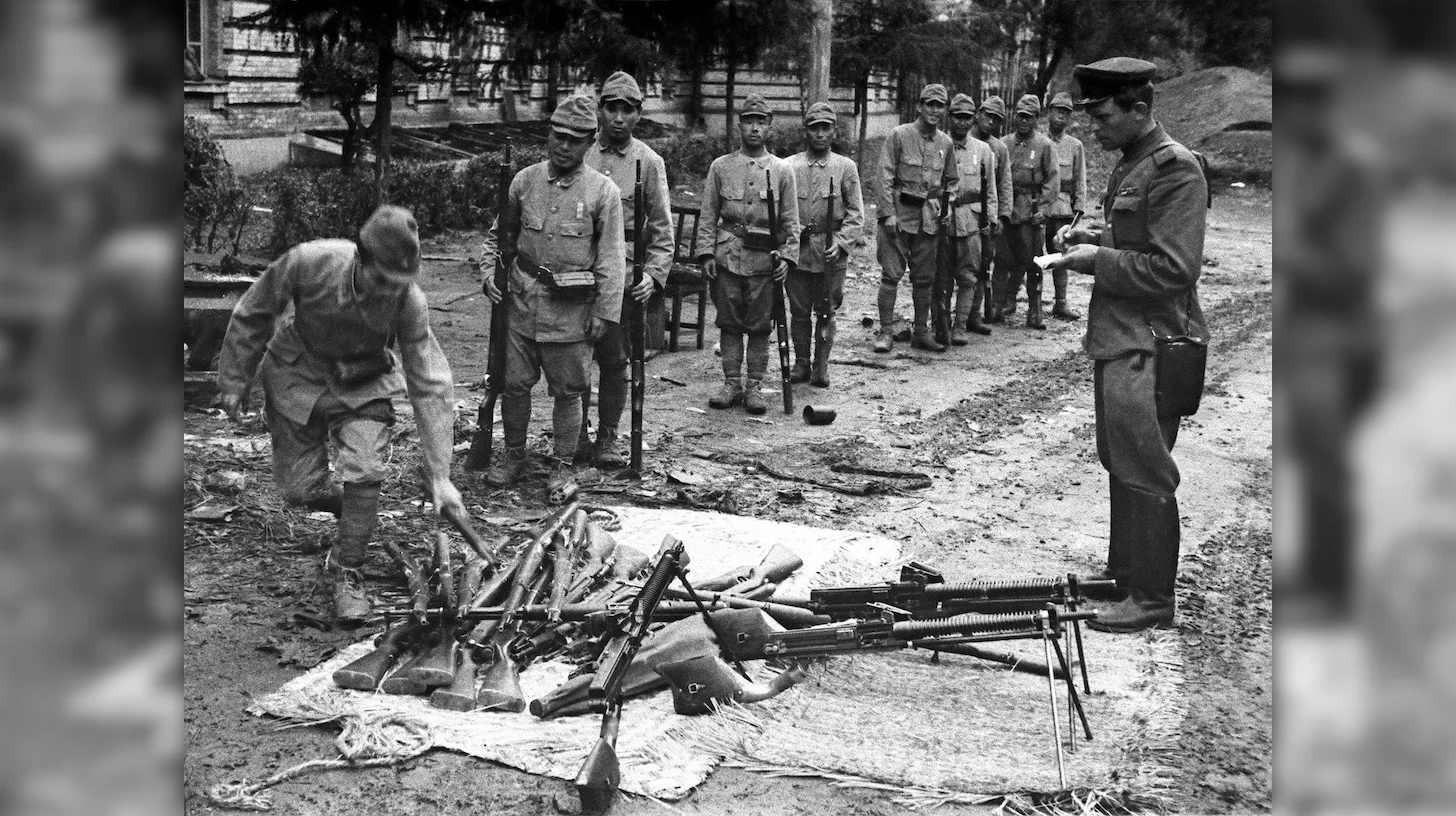
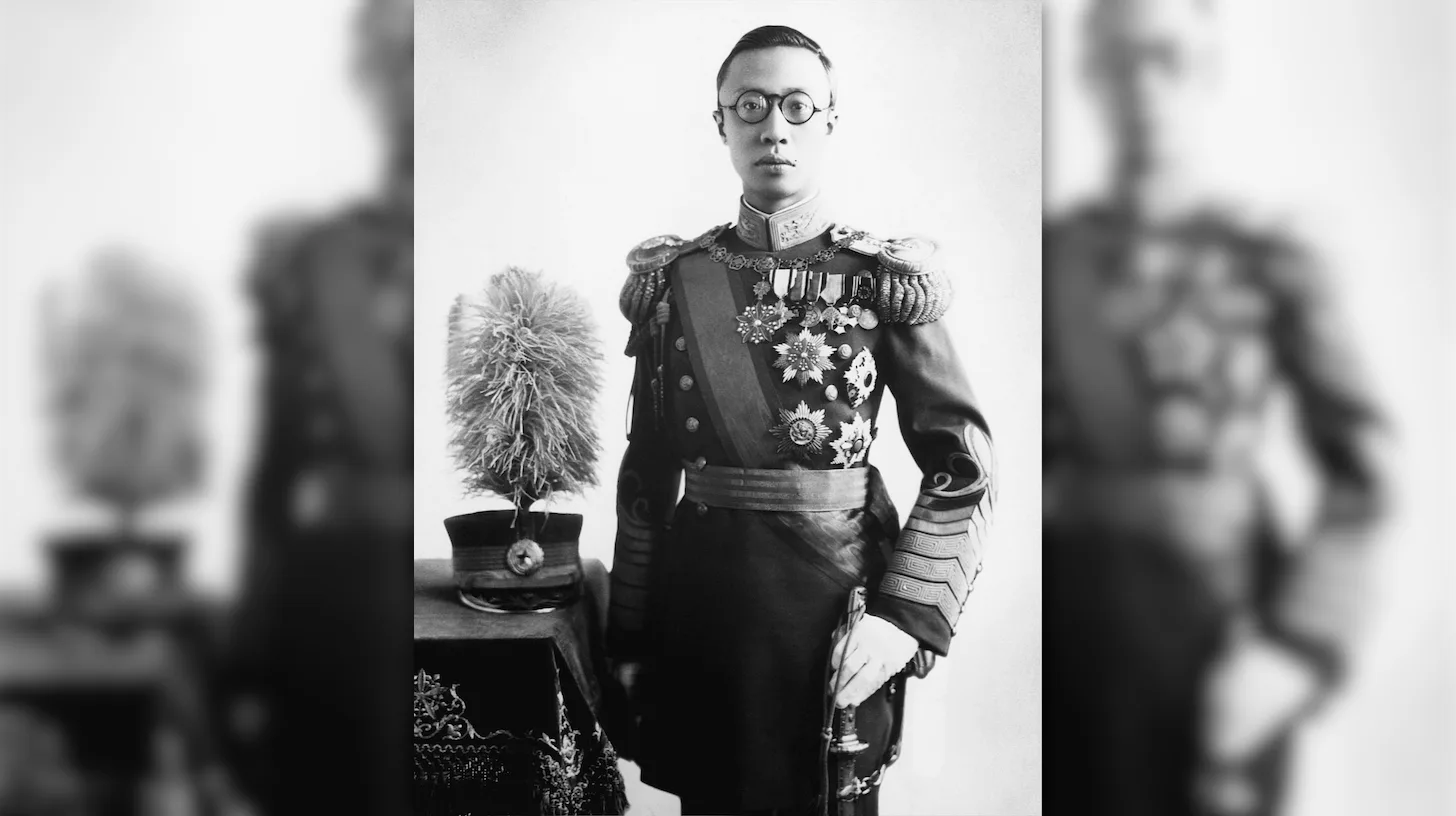
In Manchuria General Yamada had left the capital for a mountain headquarters to the south, and on the afternoon of August 14 he hurried back. A premature order to cease fire had already gone out. Yamada, according to the Japanese Army’s own record, ordered operations resumed, because he had not issued a cease-fire order. The terms reached the Kwantung Army about August 17: each unit would stay where it was and be disarmed by the Soviet Army. On August 19 Soviet airborne units dropped into Mukden, Harbin, Hsinking and Kirin. At the Mukden airport, by a Russian account, they found Puyi, the last emperor of China and Japan’s emperor of Manchukuo, waiting with his ministers for a plane to Japan.
Soviet troops landed in the Kuril Islands and on southern Sakhalin, and by the end of August they had come down through northern Korea to the 38th parallel, the line agreed with the Americans to separate their occupation forces. On August 23 Stalin proclaimed complete victory over Japan. At Tungning the last Japanese strongpoint did not fall until August 25.
Prisoners and settlers
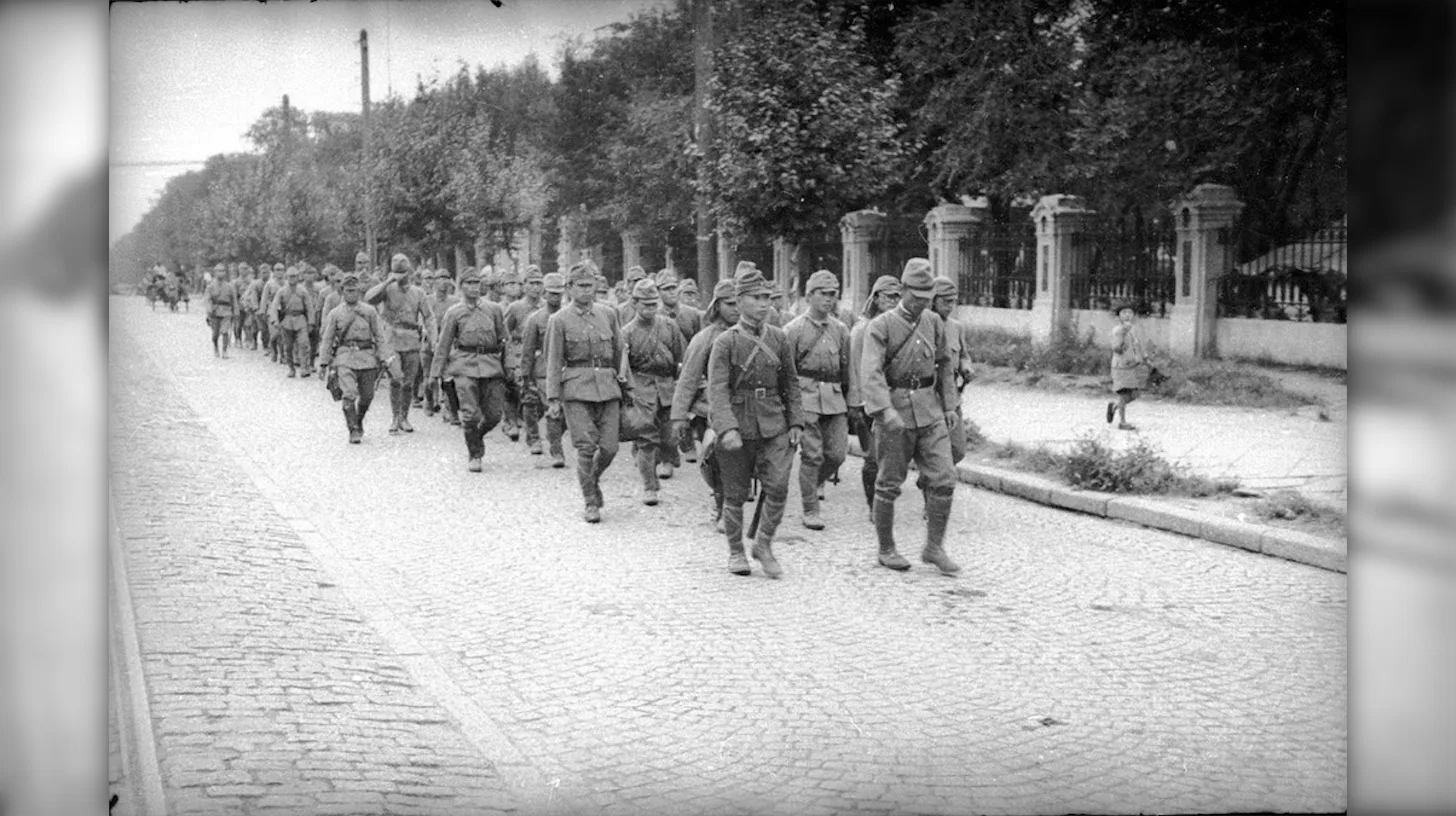
The war in Manchuria lasted about two weeks, and Glantz puts the Soviet losses at 8,000 killed and 24,000 wounded. By the Soviet count, 84,000 Japanese soldiers were killed and 594,000 were taken prisoner. Japan’s own Ministry of Health, Labour and Welfare counts about 575,000 people held in the Soviet Union and Mongolia after the war, and about 55,000 of them recognised as dead.
About 1.55 million Japanese lived in Manchuria when the Soviets came, and some 245,000 of them died there, in the fighting, in suicides and mass suicides, drowned at river crossings, or of disease and starvation. Yoshie Fukushima remembered that soldiers gave the women on the road cyanide. In December 1949 a Soviet military court at Khabarovsk, trying Japanese officers for preparing bacteriological weapons, sentenced him to twenty-five years in a labour camp.
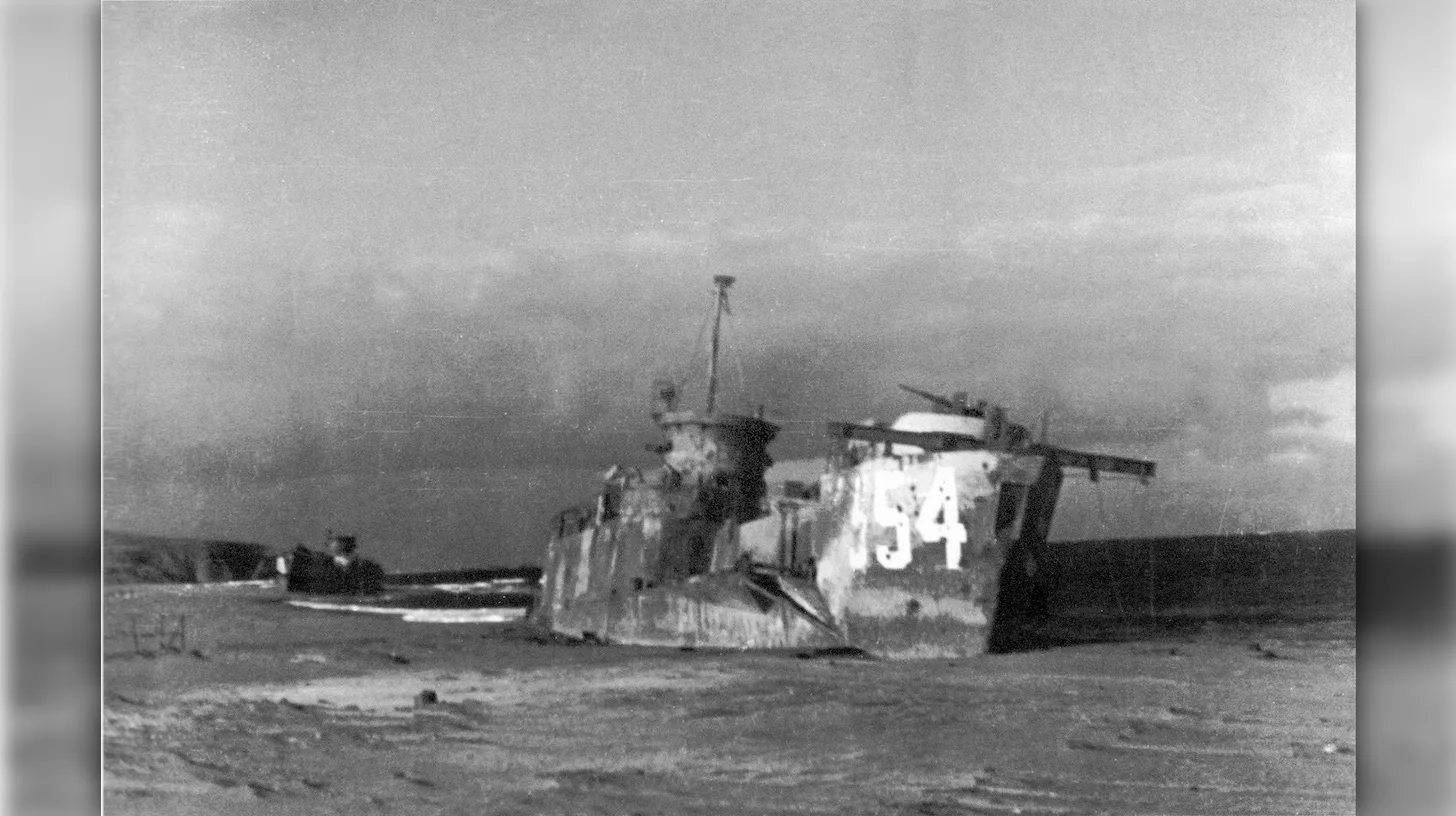
The argument over what ended the war began in 1946, when the American bombing survey concluded that the Soviet entry “neither defeated Japan nor materially hastened the acceptance of surrender.” Hasegawa has argued that the invasion had “a more important effect on Japan’s decision to surrender” than the bombs. The historian Richard Frank has called it “significant but not decisive.” The two messages of the Emperor, sent two days apart, gave one reason to his people and another to his soldiers.
On the eastern border the rain had stopped at about six that morning.