

4 min read
The early development of airships, spanning from 1670 to 1910, saw a gradual evolution from theoretical concepts to practical, powered vessels capable of controlled flight.
This period was marked by key milestones, including the first descriptions of airship design elements, initial attempts at powered flight, and the construction of the first rigid airships.
By the end of this era, airships had transitioned from experimental craft to viable modes of transportation, setting the stage for their widespread use in the early 20th century.
EARLY AIRSHIP DEVELOPMENT (1670-1910)

1670 — The Aerial Ship
Father Francesco Lana de Terzi publishes a description of an “Aerial Ship” supported by copper spheres with evacuated air, a theoretical precursor to the vacuum airship.
However, such a craft was unrealizable at the time.
1709 — Bartolomeu de Gusmão
Brazilian-Portuguese priest Bartolomeu de Gusmão demonstrates a hot air balloon before the Portuguese court.
1783 — Elements of an Airship
French Academy is presented with a memorandum by Jean Baptiste Marie Meusnier describing an elongated balloon with internal ballonets for regulating lift.
This is considered the first description of the basic elements of an airship.
1784 — English Channel Crossing
First recorded use of a hand-powered propeller for propulsion, when Jean-Pierre Blanchard fitted one to a balloon.
In 1785 he crossed the English Channel in a balloon equipped with flapping wings for propulsion.
1851 — Atmotic Airship
British engineer William Bland sends design for his “Atmotic Airship” to the Great Exhibition in London.
It featured an elongated balloon with a steam engine driving twin propellers suspended underneath.
1852 — Steam-Powered Airship
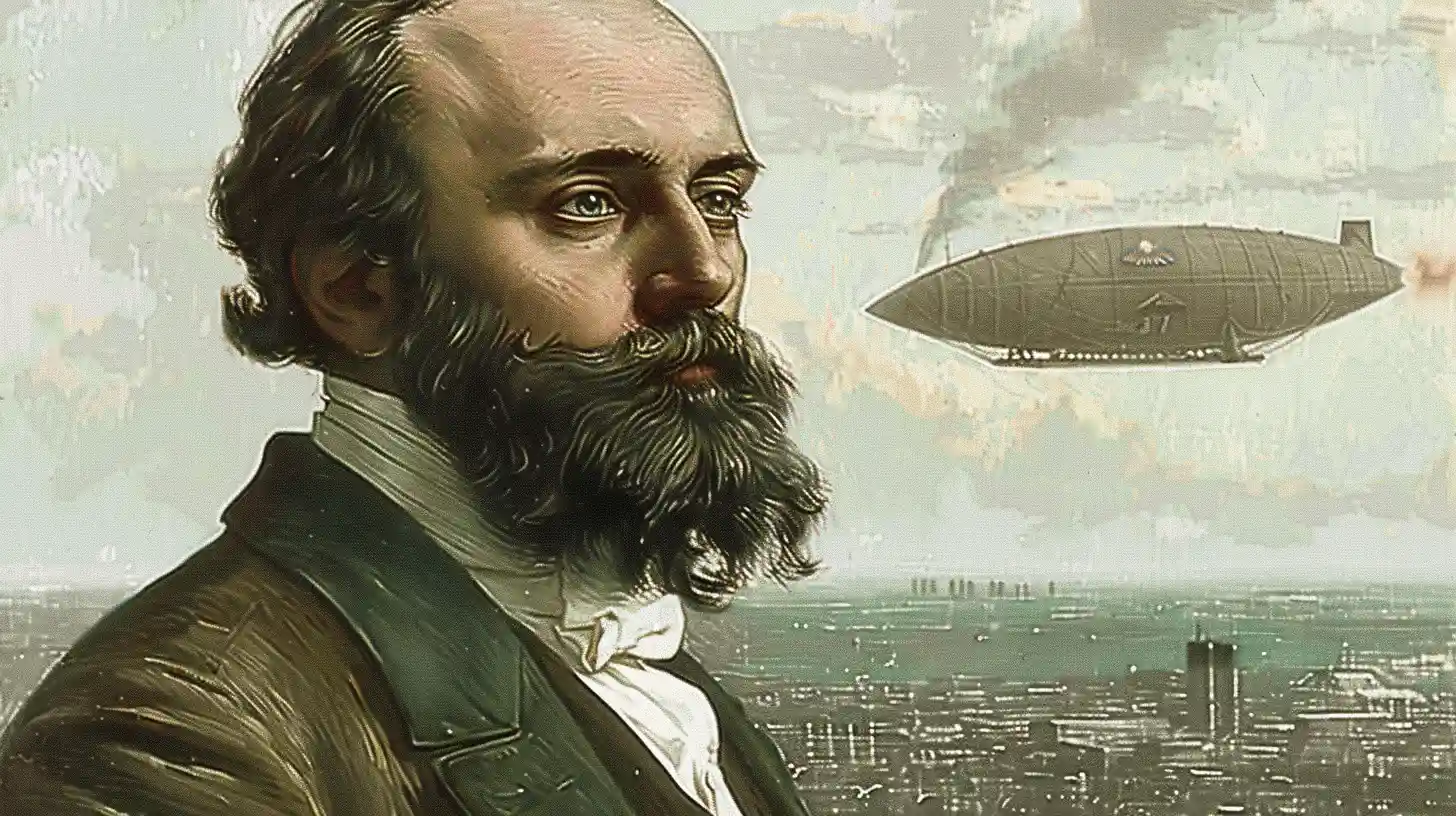
Henri Giffard becomes the first person to make an engine-powered flight, flying 17 miles (27 km) in a steam-powered airship.
1863 — Aereon
Solomon Andrews flies his “Aereon”, one of the first dirigible airships in the United States.
1872 — Dupuy de Lome
French naval architect Dupuy de Lome launches a large navigable balloon, driven by a propeller turned by eight men.
1883 — First Electric-Powered Flight
First electric-powered flight made by Gaston Tissandier who fitted a Siemens electric motor to an airship.
1884 — Controllable Free-Flight
First fully controllable free-flight made by Charles Renard and Arthur Constantin Krebs in the French Army airship La France.
1895 — Rigid Airship
David Schwarz makes the first flight of a rigid airship, using an aluminum frame.
1897 — Count Zeppelin
First flight of a rigid airship by Count Zeppelin.
1900 — LZ-1 Graf Zeppelin

The Graf Zeppelin airship LZ-1 makes first flight.
1901 — Number 6
Alberto Santos-Dumont flies his airship “Number 6” around the Eiffel Tower.
1902 — Leonardo Torres Quevedo
Spanish engineer Leonardo Torres Quevedo flies his airship, which features an innovative internal-bracing system.
1910 — First Commercial Passenger-Carrying Airship
The Zeppelin LZ7 Deutschland, the world’s first commercial passenger-carrying airship, is launched.
THE GOLDEN AGE OF AIRSHIPS (1914-1937)

1914-1918 — WW1

During World War I, many European countries utilize airships for reconnaissance, surveillance and bombing missions.
Germany, France, Italy and Britain all operate airships.
1919 — First Transatlantic Crossing
British R34 airship makes first transatlantic crossing, taking 108 hours to fly from Scotland to New York.
1923-1924 — US Army Airships
US Army TC-3 and TC-7 non-rigid airships used for parasite fighter trials.
1928 — First Transatlantic Passenger Flights
First transatlantic passenger flights made by the Graf Zeppelin airship.
1936 — Flights to Africa
The Zeppelin Hindenburg inaugurates passenger service between Germany and North America.
1937 — The Hindenburg Disaster

The Hindenburg disaster occurs, the airship crash marks an abrupt end to the era of passenger-carrying rigid airships.
DECLINE & MODERN USE (1940S-PRESENT)

1940s-1950s — Blimps
Blimps are widely used by the US Navy for reconnaissance, surveillance and anti-submarine warfare during World War II and the early Cold War era.
Classes of blimps used include the K-class and M-class.
1960s-Present — Advertising and Futuristic Designs
Blimps continue to be used for advertising, sightseeing, surveillance, and research purposes, with companies like Goodyear operating iconic advertising blimps.
New technologies and designs are experimented with, but airships do not regain the prominence they held in the early 20th century.