6 min read
Shark attacks through time have captivated public imagination, inspiring both fear and fascination with these powerful ocean predators.
THE JERSEY SHORE ATTACKS (1916)
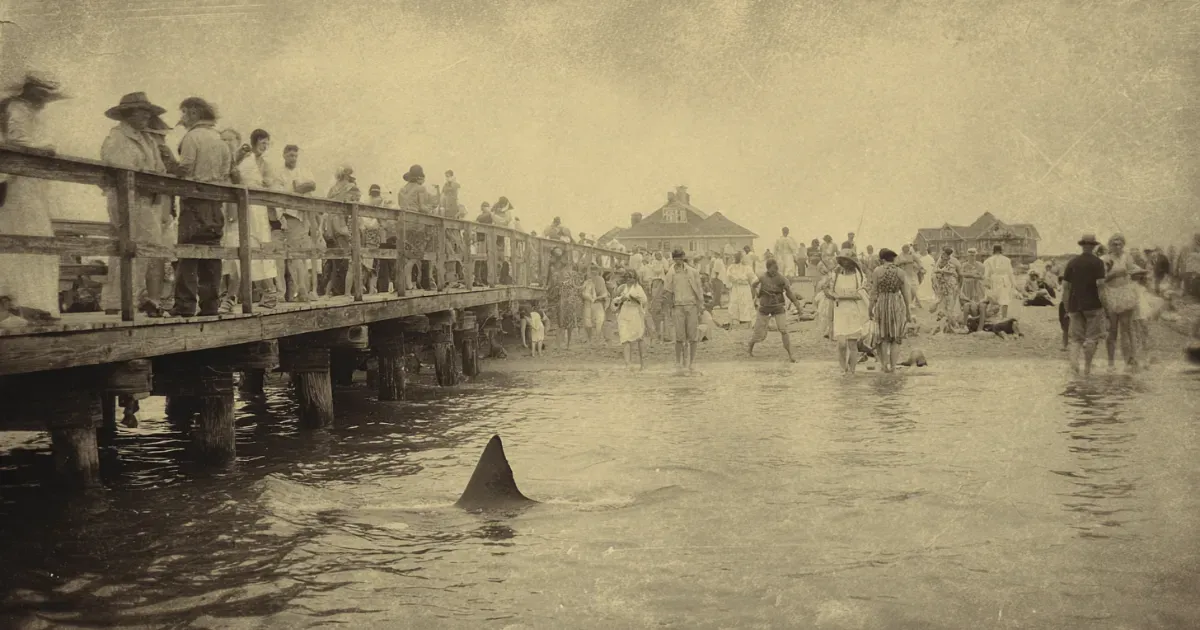
In the summer of 1916, a series of shark attacks along the New Jersey coast killed four people and injured one, sparking widespread panic and the largest shark hunt in history.
The fatal attacks occurred in Matawan Creek, a freshwater creek 16 miles inland, leading some experts to believe a bull shark may have been responsible rather than the great white shark initially blamed for the attacks.
USS INDIANAPOLIS INCIDENT (1945)
The USS Indianapolis, after delivering components of the first atomic bomb in 1945, was sunk by a Japanese submarine, leading to one of the worst maritime disasters in U.S. naval history.
In a horrifying ordeal lasting four days, hundreds of sailors who survived the sinking faced relentless shark attacks in the open ocean, with estimates of shark-related casualties ranging from dozens to nearly 150.
While many others succumbed to exposure, dehydration, and salt water-induced hallucinations before rescue finally arrived.
RODNEY FOX ATTACK (1963)
In 1963, Australian spearfisher Rodney Fox survived a horrific great white shark attack that left him with 462 stitches, exposed lungs, and broken ribs—yet he miraculously lived to tell the tale.
Fox not only survived but went on to become a shark conservationist, pioneering cage diving experiences to study and film great whites, effectively transforming his near-death experience into a lifelong passion for protecting the very creatures that almost killed him.
BROOK WATSON ATTACK (1749)
In 1749, 14-year-old Brook Watson was viciously attacked by a shark while swimming alone in Havana harbor, resulting in the loss of his right foot and part of his leg below the knee.
Remarkably, Watson not only survived this horrific ordeal but went on to become a successful merchant, politician, and even served as the Lord Mayor of London.
His shark attack was later immortalized in John Singleton Copley’s famous painting “Watson and the Shark.”
BETHANY HAMILTON ATTACK (2003)
In 2003, 13-year-old surfing prodigy Bethany Hamilton lost her left arm in a shocking shark attack off the coast of Kauai, Hawaii.
Despite the traumatic incident—which involved a clean amputation by a suspected 15-foot tiger shark—Hamilton’s athletic conditioning helped her survive the massive blood loss and she remarkably considered returning to surfing.
SHIRLEY ANN DURDIN ATTACK (1985)
In 1985, Shirley Ann Durdin was tragically killed by a massive 20-foot great white shark while snorkeling for scallops off the coast of South Australia.
The attack was particularly horrifying as the shark ripped her in half with a single bite in front of her family, then returned to devour her floating torso.
Leaving only a swim fin behind.
MICK FANNING INCIDENT (2015)
In July 2015, professional surfer Mick Fanning survived a dramatic shark attack during a live televised surfing competition in South Africa, managing to fend off the shark by punching it in the back.
The incident, which occurred during the J-Bay Open finals in Eastern Cape—was so shocking that it led to the immediate cancellation of the competition.
Fanning and his fellow finalist Julian Wilson ended up splitting the second-place points and prize money.
BARRY WILSON ATTACK (1952)
On December 7, 1952, 17-year-old Barry Wilson was tragically killed by a large tiger shark just 25 yards from shore at Lover’s Point, California, in an attack that lasted a harrowing 20 minutes.
Despite the heroic efforts of his friend and nearby swimmers who braved 8-foot waves and the circling shark to rescue Wilson using a rubber tube.
The teenager succumbed to his injuries before reaching safety.
HENRI BOURCE ATTACK (1964)
In 1964, Henri Bource, a 29-year-old Dutch-Australian scuba diver and musician, survived a horrific attack by a 2.4-meter great white shark off Lady Julia Percy Island, Australia.
Which resulted in the loss of his left leg.
Bource not only continued diving after the incident by using a modified fin on his leg stump, but also recreated the shark attack scene in his 1969 documentary film “Savage Shadows”.
ACHMAT HASSIEM ATTACK (2006)
Achmat Hassiem, a South African lifeguard, survived a great white shark attack in 2006 that cost him his right leg below the knee—went on to become a medal-winning Paralympic swimmer and marine conservationist advocating for shark protection.
Hassiem credits the shark attack for setting him on a new path that allowed him to fulfill his childhood dream of representing South Africa internationally, while also giving him a platform to speak up for the very creatures that nearly killed him.
LLOYD SKINNER ATTACK (2010)
In 2010, a tourist was tragically killed by a massive shark described as “longer than a minibus” off a South African beach.
This incident occurred in South Africa’s most popular holiday destination.
JANA LUTTEROPP ATTACK (2013)
In August 2013, a tragic shark attack in Maui, Hawaii claimed the life of Jana Lutteropp, a 20-year-old German tourist, who died a week after losing her arm while snorkeling.
A California high school teacher named Rick Moore heroically jumped into bloody waters to rescue Lutteropp, who was repeating that she was going to die. Making it the only the second fatal shark attack in Hawaii since 1992.
STEVEN ROBLES ATTACK (2014)
In July 2014, distance swimmer Steve Robles survived a harrowing encounter with a great white shark off the Manhattan Beach Pier in California, leaving him with dramatic “Freddy Krueger scars” along his right side.
Robles remarkably returned to open water swimming just months later.