13 min read
On Wednesday, September 7, 1977, at Fort Myer, Virginia, across the river from Washington, the Army unveiled its new utility helicopter and gave the floor to a son of the Olympic champion Jim Thorpe. Carl Thorpe was a Sauk and Fox, and a descendant of the war leader Black Hawk, whose name the Army had given the machine. He ended his speech with a blessing from his tribe’s tradition: “Go to the sky, to the clouds and challenge the Thunder.”
By then the Army had been naming its aircraft for Native nations for twenty years. It is usually said that the custom began with a general named Hamilton Howze in 1947, that he chose the Plains tribes because their warriors were fast and hard to catch, and that he picked the very tribes that had beaten the cavalry. The Army’s own magazine tells a plainer story. The names arrived in July 1957, most of them were not Plains nations at all, and no paper of the time says why.
A cavalryman’s son
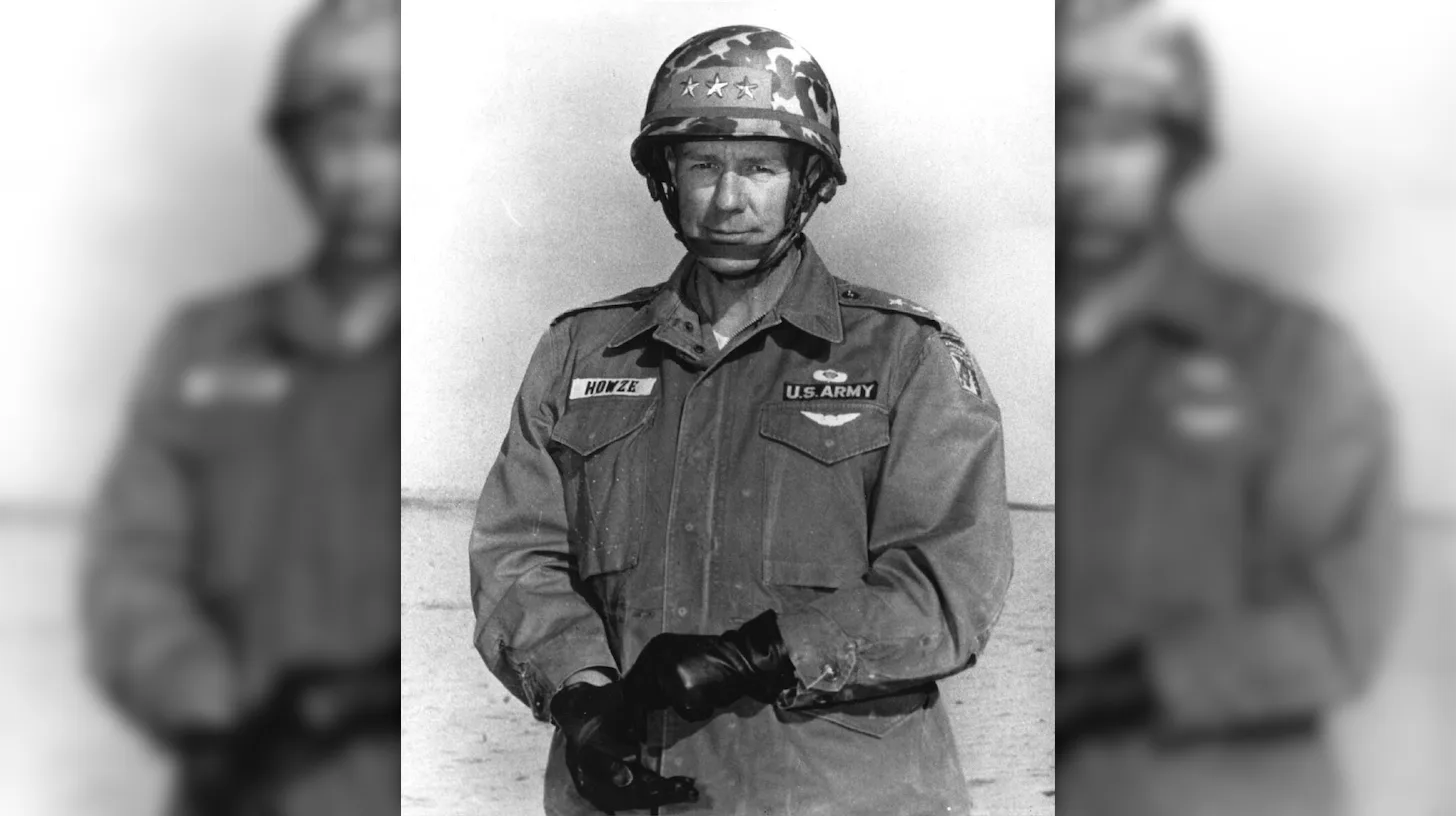
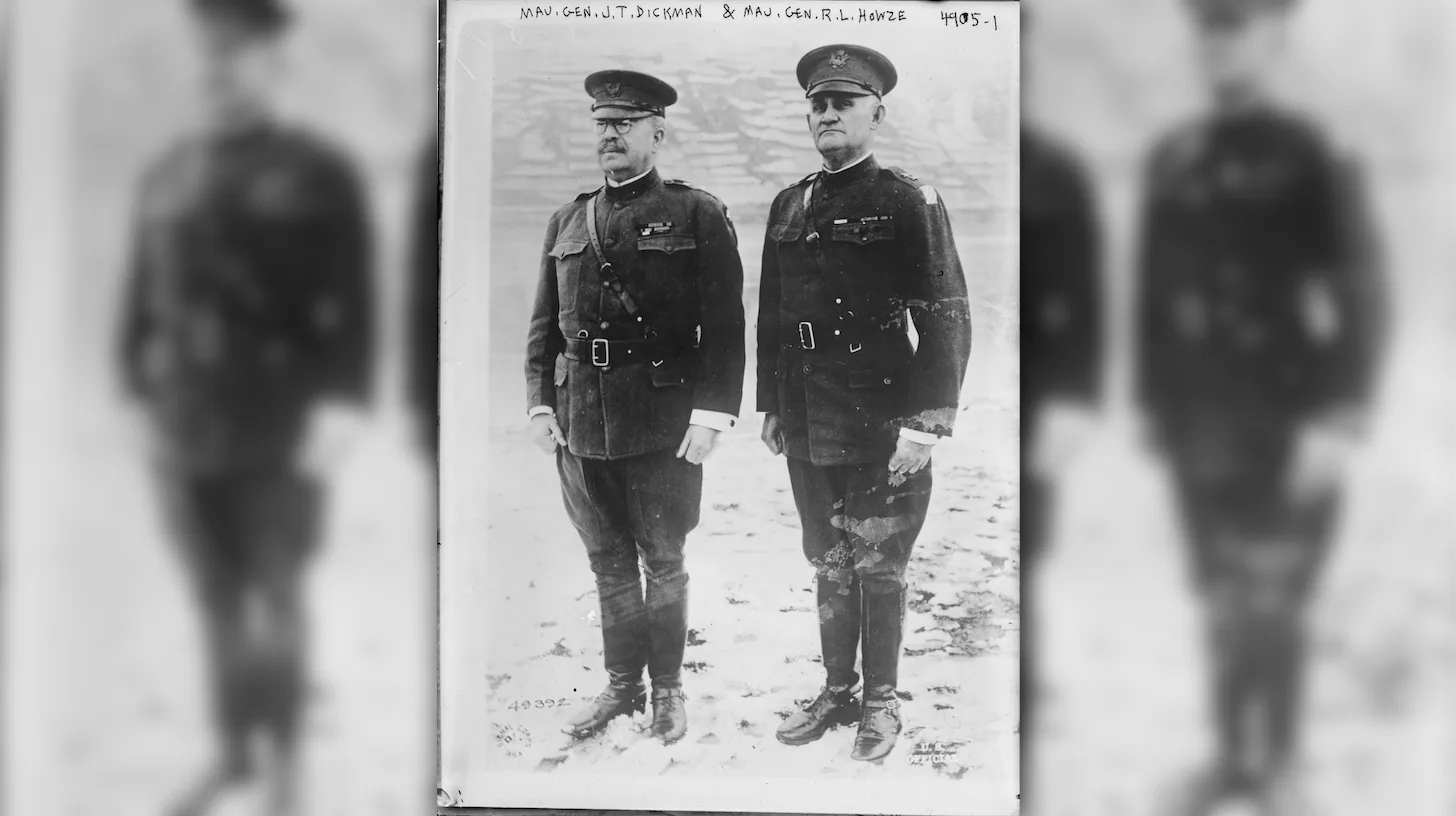
Hamilton Howze was born on December 21, 1908, in the commandant’s quarters at West Point, where his father, Robert Lee Howze, was commandant of cadets. The father had won the Medal of Honor as a young lieutenant of the 6th Cavalry on New Year’s Day of 1891, at the White River in South Dakota, in the campaign after Wounded Knee. His troop commander’s own citation for that day describes a fight against “300 Brule Sioux warriors.” The son went to West Point himself, graduated in 1930 and joined the cavalry, where, his obituary in the Los Angeles Times said, he honed his polo.
No account of his appearance by anyone who knew him has been found. What survives is the record of a man who kept learning new ways to move troops. He earned his parachute wings at forty-two, at a three-week jump school, and in Germany in his mid-forties he took flying lessons in a light Army spotter plane. In February 1955 the Army set up an aviation division on its operations staff in the Pentagon, and Howze, then a brigadier general, became its first general-officer chief, the first Director of Army Aviation. He won his own Army aviator’s wings that year.
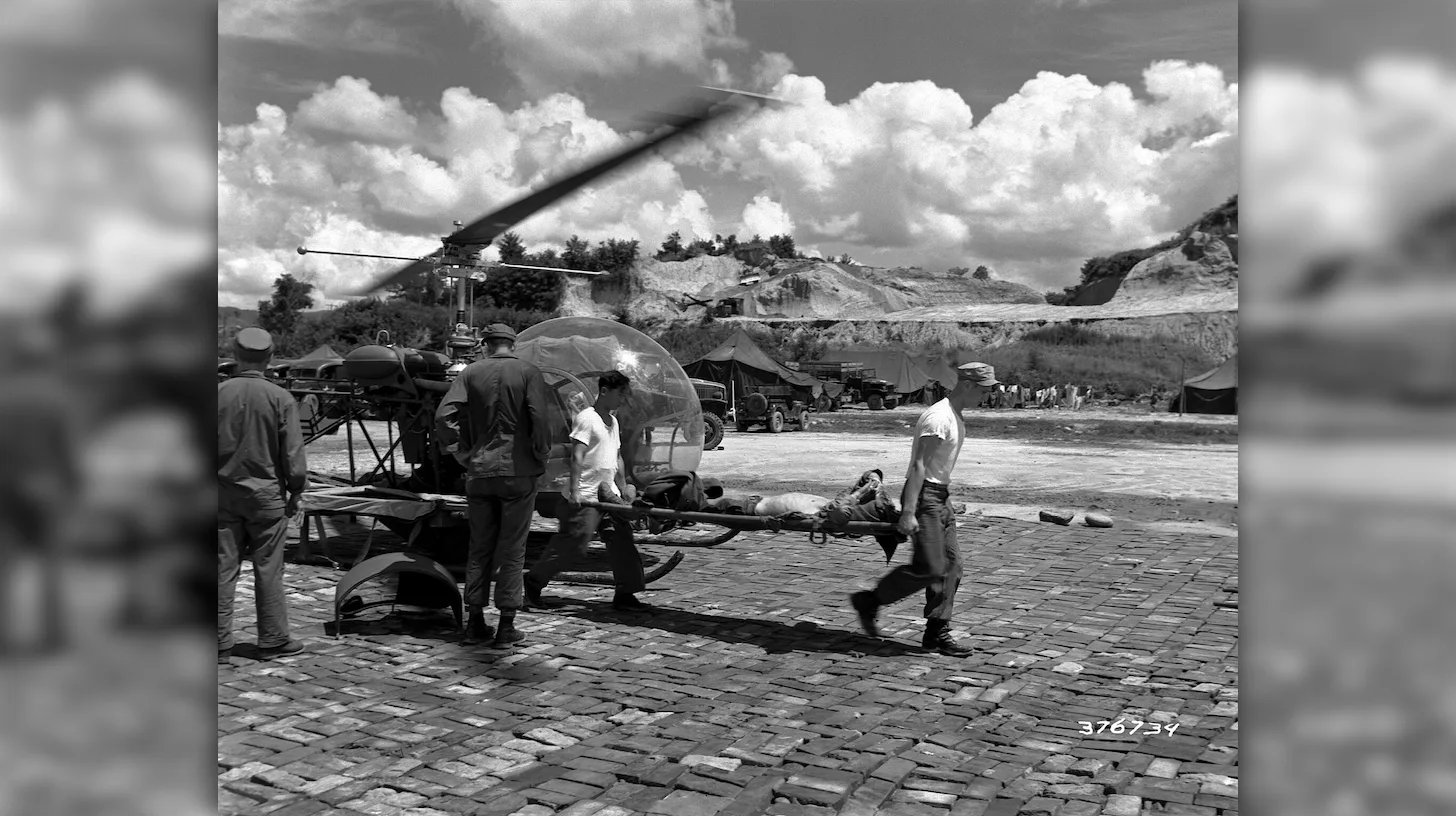
The Army’s aircraft had no common style of name. The big twin-rotor H-21 was called the “Army Work Horse,” and, by the men who flew it, the Flying Banana.
Two Chickasaw, one Choctaw
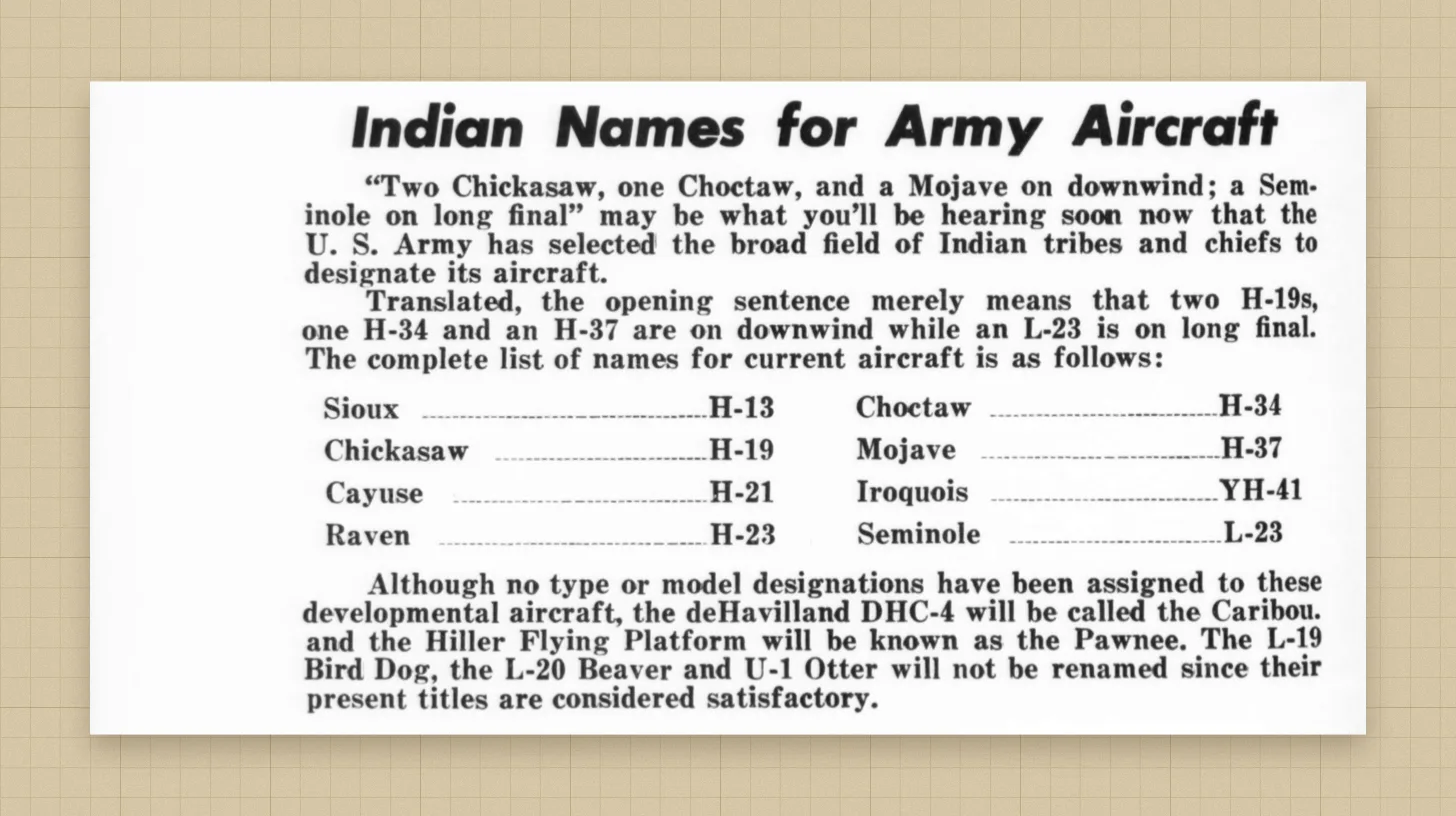
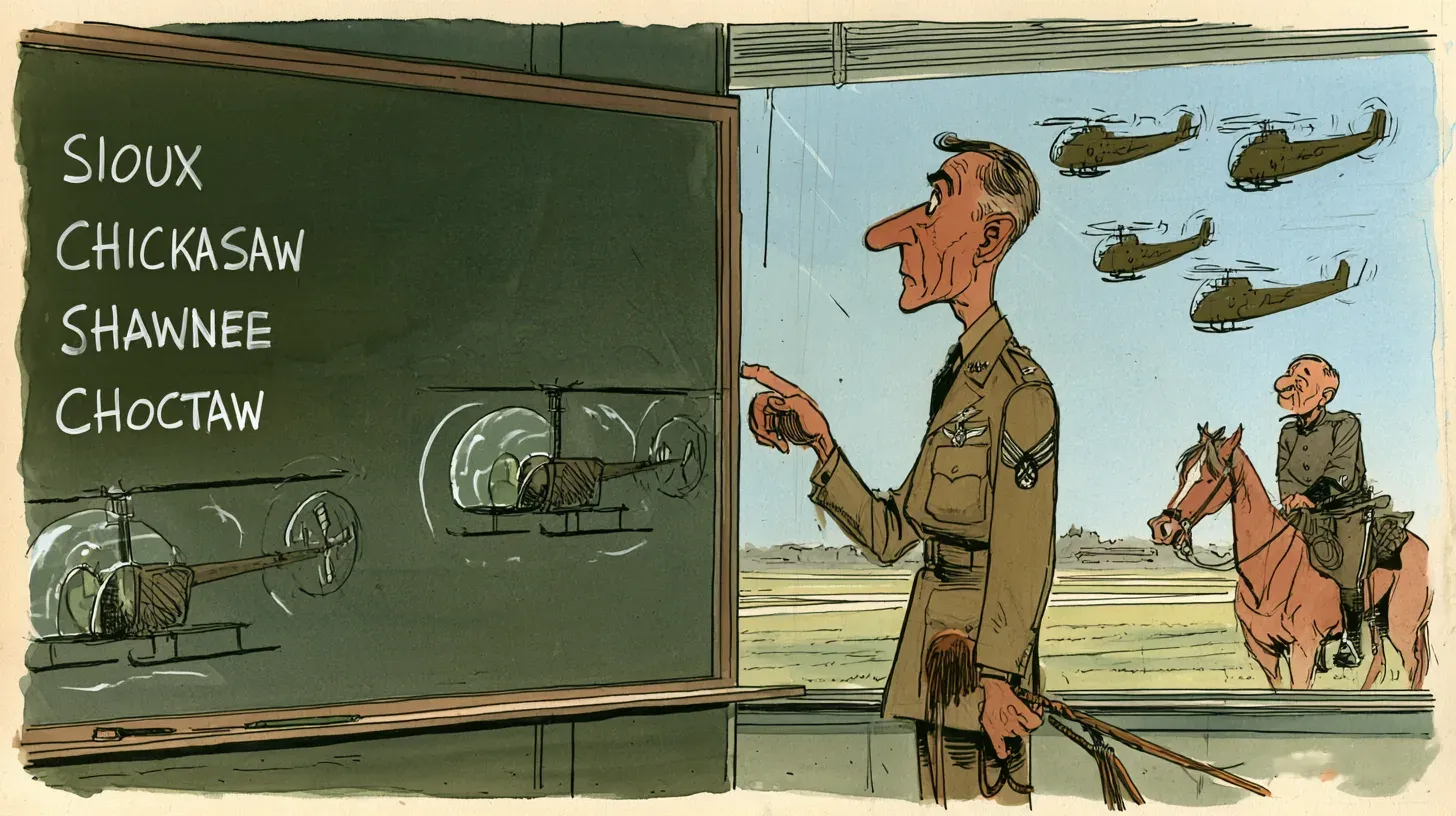
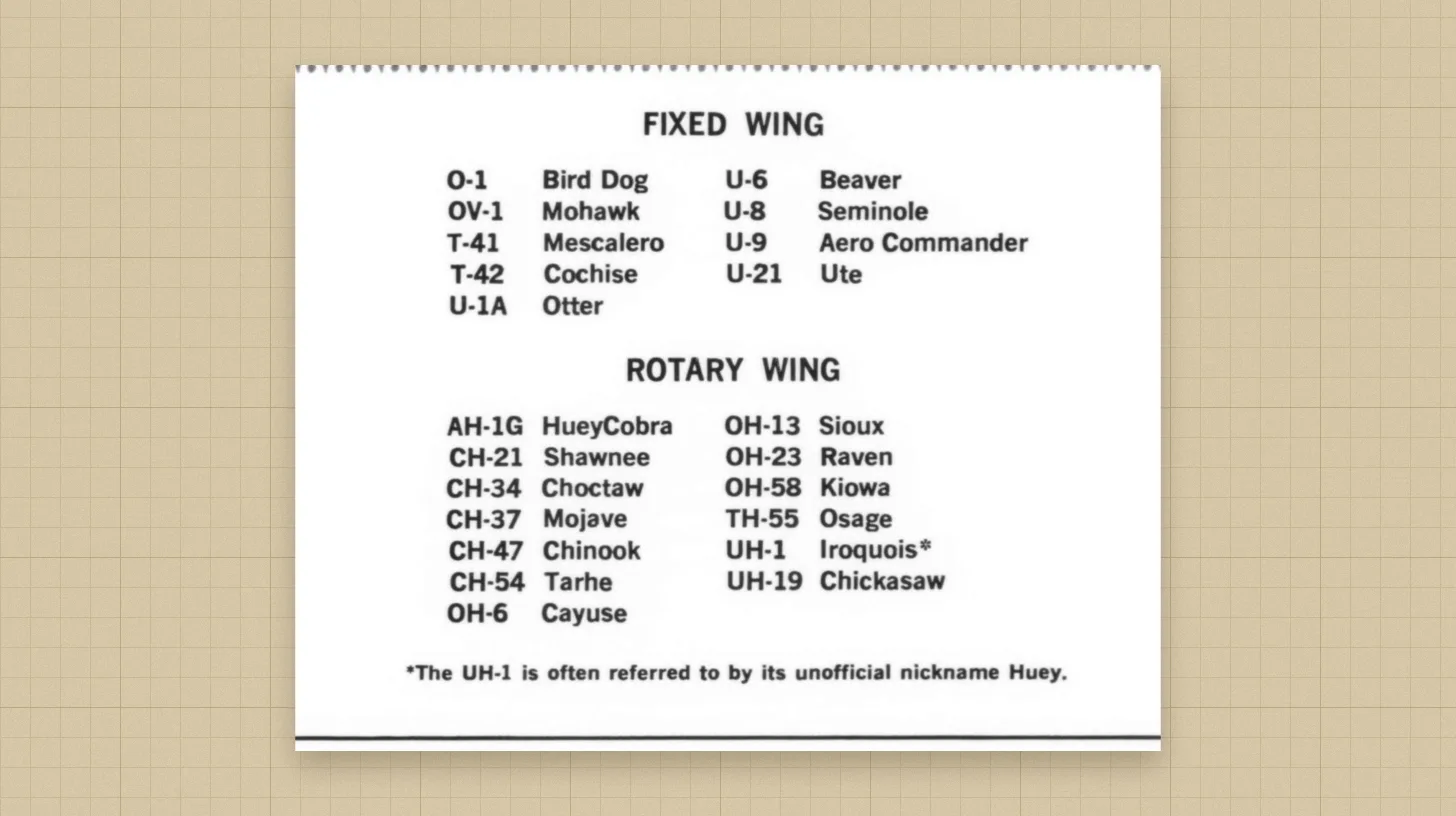
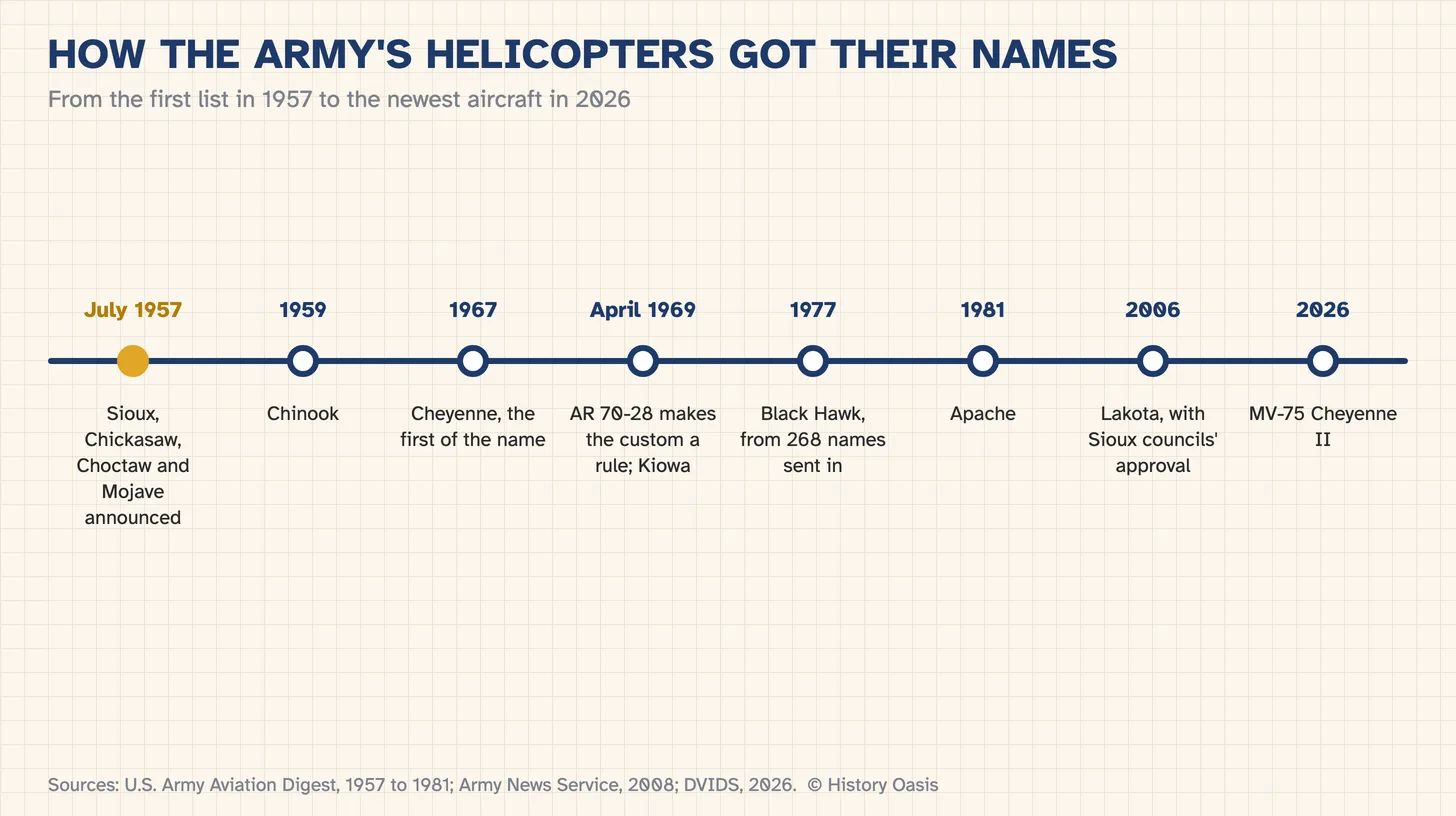
In July 1957 the U.S. Army Aviation Digest, the service’s monthly magazine for its flyers, printed a short notice headed “Indian Names for Army Aircraft.” It began with a radio call that no one outside the Army would have understood, “Two Chickasaw, one Choctaw, and a Mojave on downwind,” and then explained it. The Army, it said, “has selected the broad field of Indian tribes and chiefs to designate its aircraft.” The little Bell H-13 was now the Sioux. The H-19 was the Chickasaw, the H-21 the Cayuse, the H-34 the Choctaw and the big H-37 the Mojave, and an experimental machine, the YH-41, was to be the Iroquois. Neither of those two stuck. Within two months the H-21 was the Shawnee, and within a year the name Iroquois had passed to Bell’s new H-40, the helicopter soldiers would call the Huey.
Not everything changed. A de Havilland transport became the Caribou, the H-23 became the Raven, and the Bird Dog, the Beaver and the Otter kept their names, which were considered satisfactory.
The notice did not say who had chosen the names or why. Howze used them two months later in his own column in the magazine, “Notes from the Pentagon,” reporting that machine guns, rockets and bombs had been tried out on the Sioux, Chickasaw, Shawnee and Choctaw. He added a footnote “for the unenlightened” to say that these were the H-13, H-19, H-21 and H-34. The Sioux, he reported, reacted most readily to the recoil, because of its weight.
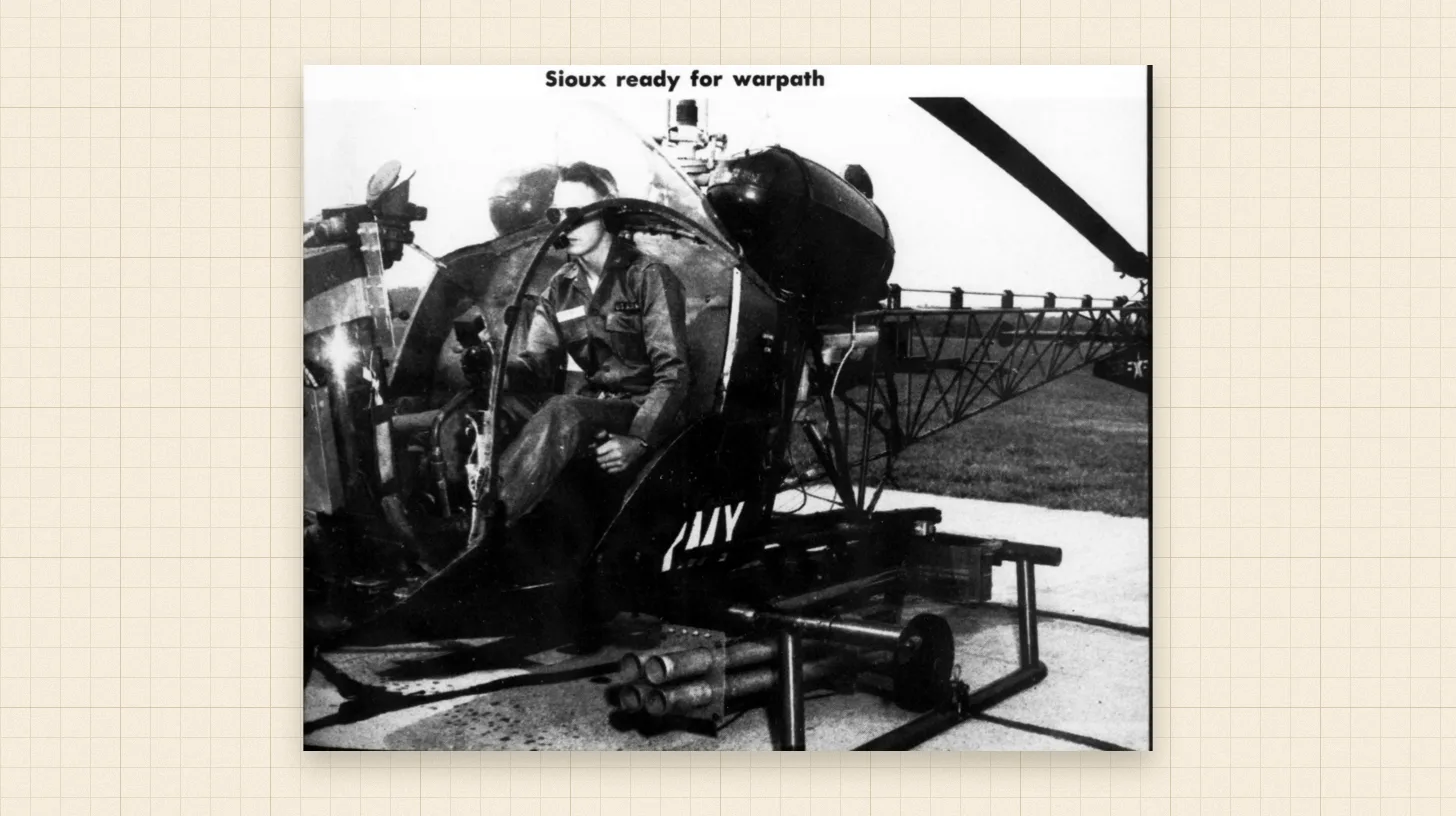
When Howze explained what the helicopter was for, he reached for the horse. The aircraft would give a reconnaissance unit an edge in mobility “comparable to that which the horse cavalry in the old days had over foot troops.” His obituary, forty years later, quoted him on the Huey in the same terms: “The Huey [helicopter] was to our rifleman roughly what the horse was to the cavalryman, close by and ready.”
He left the aviation post that December to command the 82nd Airborne Division. In 1947, the year the popular story gives, he had been Director of Instruction at the Cavalry School at Fort Riley and had nothing to do with aircraft.
Nothing but Indians
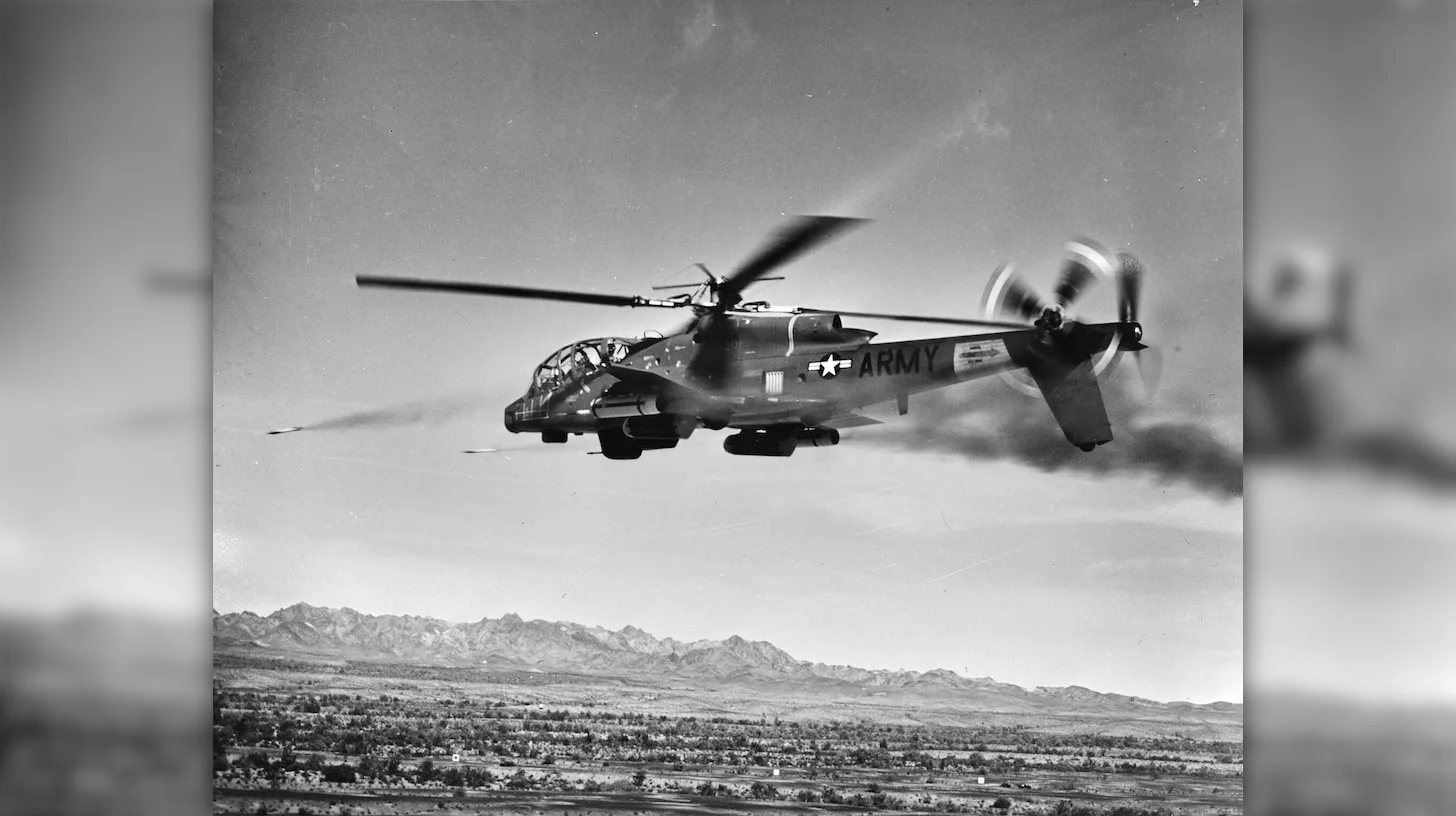
The custom held through the next decade and a half. The Vertol transport helicopter the Army chose in 1959 became the Chinook, the Lockheed attack helicopter of 1967 the Cheyenne, the Bell scout of 1969 the Kiowa. On April 4, 1969, the Army wrote the custom down. An article in the Digest the next year, titled “Nothing But Indians,” described how a name was now made under Army Regulation 70-28. The Army Materiel Command worked from a list of possible names obtained from the Bureau of Indian Affairs, its commanding general picked five, the trademark division of the Patent Office checked them, and the chief of research and development chose one. The name had to appeal to the imagination “without sacrificing dignity.” The only new helicopter without such a name was the AH-1 HueyCobra, which had come with its maker’s.
The Army ran the next naming as a contest. For the Army’s new utility helicopter, the magazine’s “Name That Bird” drew 268 names from 600 people. The losers included Aleut, Cree, Frog, Hopi, Kickapoo, Puma and Sachem. Comanche and Apache were dropped because other Army aircraft already had them. A Bureau of Indian Affairs official was asked whether the finalists were genuine Indian terms acceptable to the tribes, and a Smithsonian linguist was consulted. The short list was Black Hawk, Tecumseh and Shoshoni. The Sikorsky company held the rights to Black Hawk and let the Army have it, and on August 25, 1977, the name was settled, the magazine reported, because it “provokes one’s imagination, brings to mind effectiveness, and is easy to pronounce and recall.”
A spirit is reborn at Fort Myer
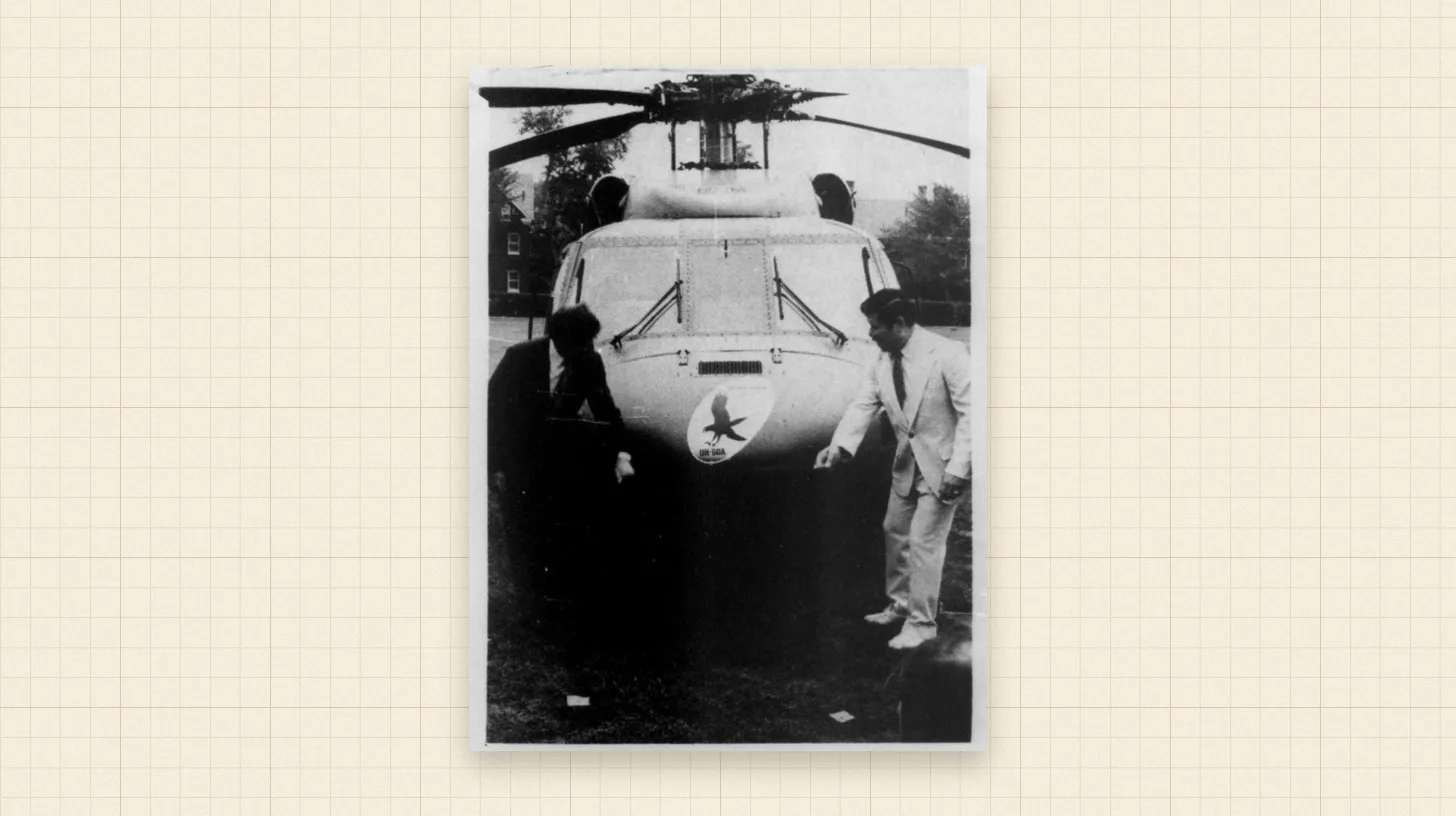
Thirteen days later the helicopter was unveiled at Fort Myer. Gen. John R. Guthrie spoke, and so did the president of Sikorsky, who called the project the most demanding challenge in his company’s history. A project officer served as master of ceremonies. The magazine’s photograph showed the new UH-60A carrying a Gamma Goat, a small Army cargo vehicle, on a sling.
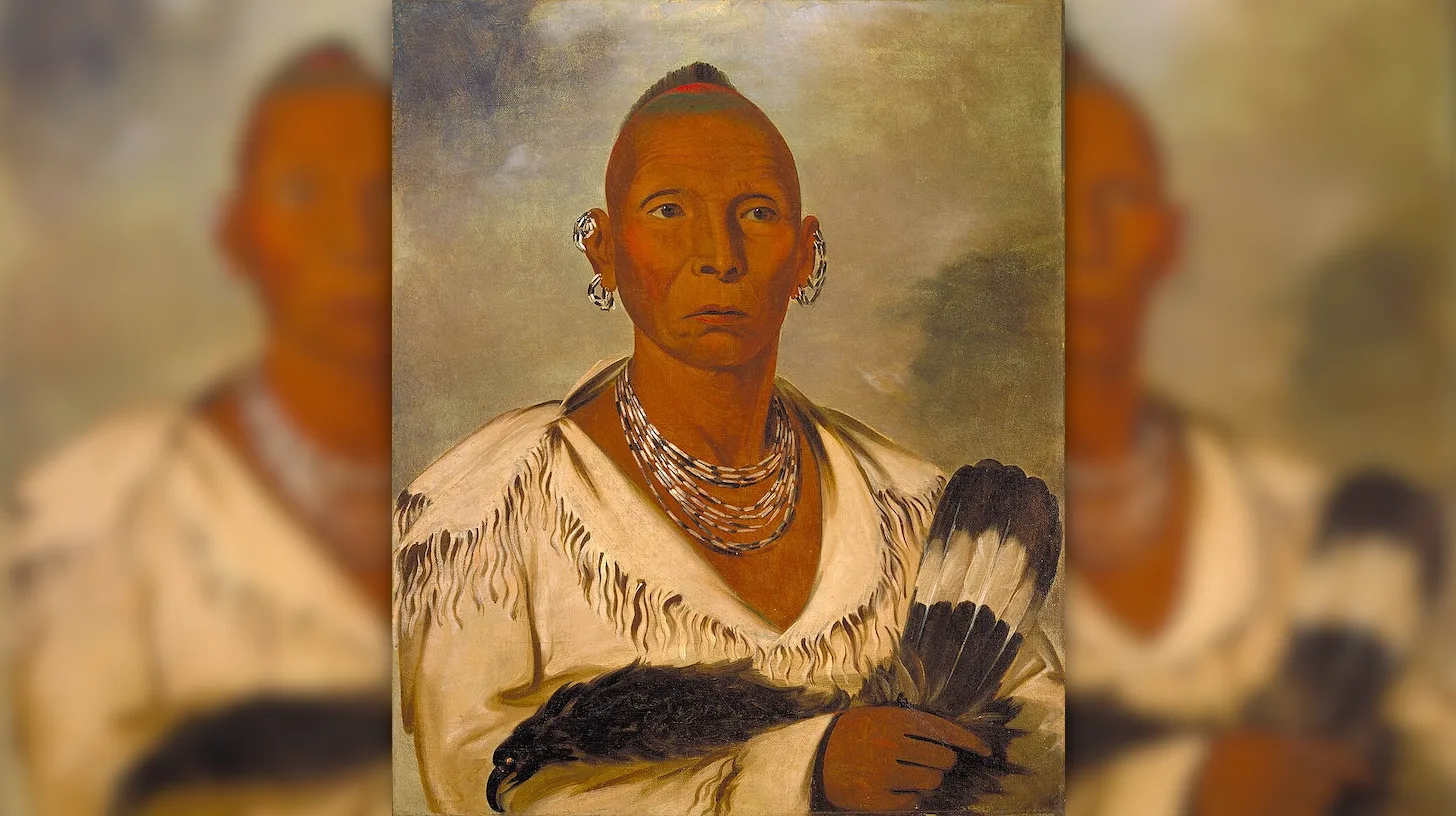
Black Hawk himself had led the Sauk in the war of 1832 that bears his name, and he had been, as the Army’s own sketch of him that year put it, “defeated and captured at the end of this futile campaign.” Carl Thorpe spoke for his descendants. He told the officers that among his people names were derived from the sky, the clouds and the birds that flew there, and that to some Americans his ancestor’s name still called up a fierce, painted warrior. Then he spoke of the machine.
“The UH-60A helicopter today receives a proud Indian name and in the sense that a spirit is reborn, it now casts its shadow on the face of the land.”
Then, keeping to the naming custom of his tribe as he had described it, he gave the helicopter a blessing of its own, and the Army’s magazine printed his closing words in full that November. They were two sentences long.
“Go to the sky, to the clouds and challenge the Thunder. Bring upon your strong wings the peace of Black Hawk.”
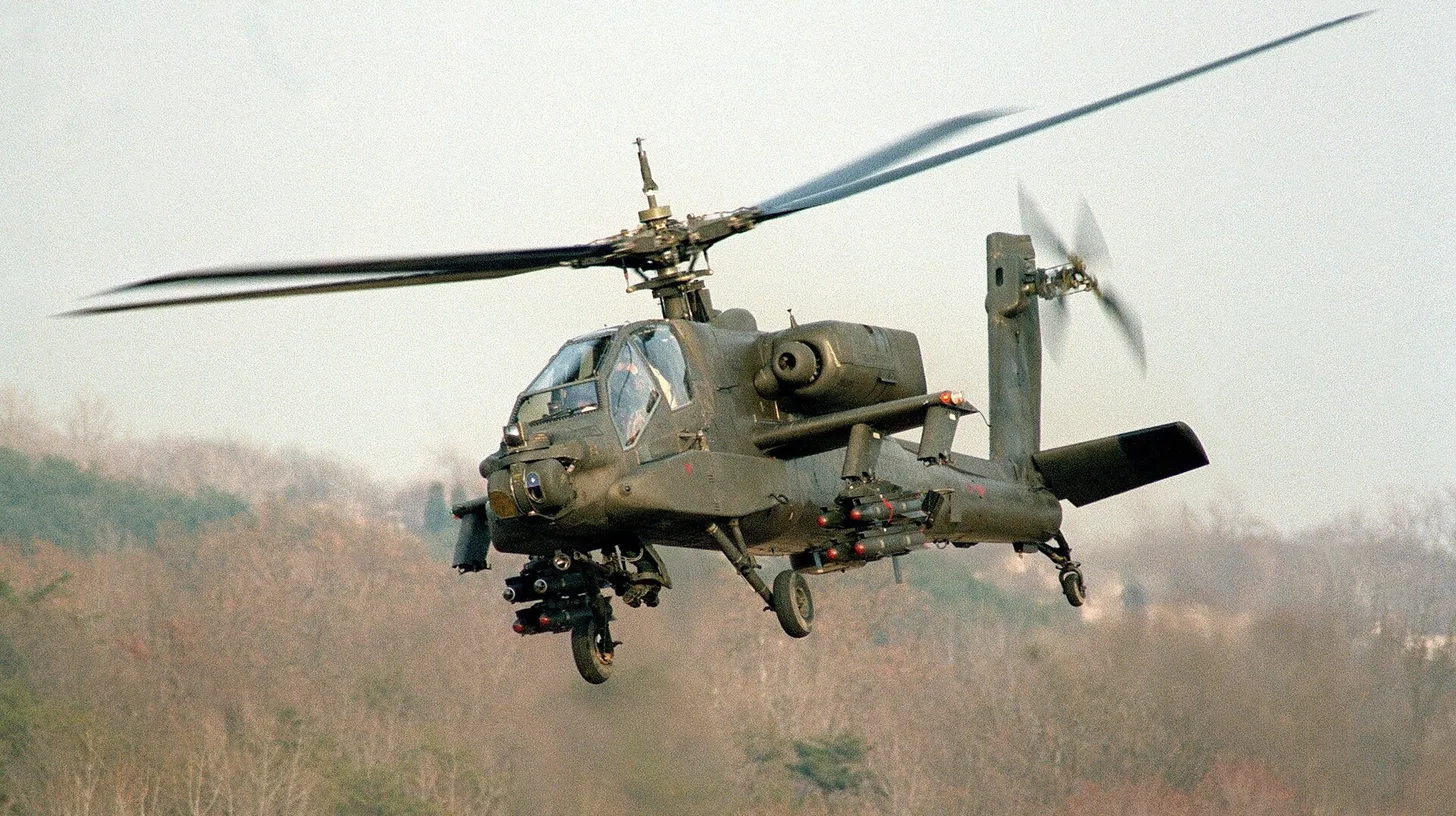
Four years later the Army’s new attack helicopter, the AH-64, was named Apache. The notice gave the reason in the Army’s own words: like the tribe, it would “travel in small bands or singly in order to remain concealed within the forward battle area.” The light helicopter of 1991 became the Comanche, a people that, the magazine wrote, had ruled the southern plains from 1725 until 1875.
We are still here
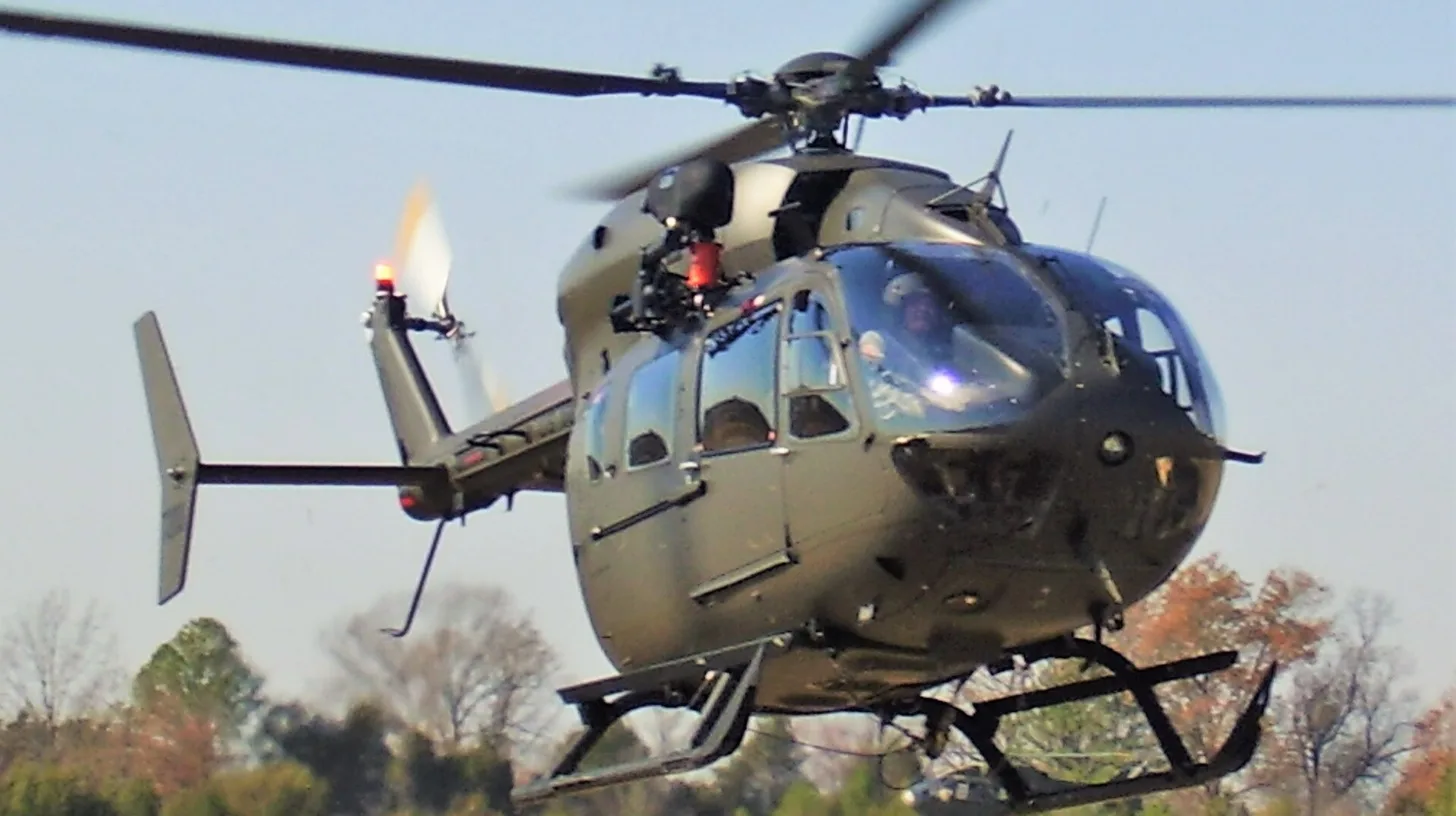
The regulation itself was revised in 1976 and was gone by 1989, when the Digest called it former Army Regulation 70-28 and admitted that aviators gave diverse answers when asked why their helicopters had Indian names. The custom outlived it. In 2006, for a light utility helicopter built in Mississippi, the Army narrowed its choices to Crow, Lakota and Cherokee, and to use Lakota it had to win the approval of a majority of the councils of the Sioux Nation. That usually took a year or more. It took six months. The Army said the name suited an unarmed helicopter for missions at home because the Lakota had been known as a peaceful, non-aggressive people.
On Monday, December 11, 2006, at the plant beside the airport in Columbus, Mississippi, the Army’s vice chief of staff and Joe RedCloud, a chief of the Oglala Sioux, accepted the first UH-72A Lakota together, and RedCloud spoke to the crowd.
“We’re pleased that you honor our tribe by naming this helicopter Lakota. You are not only honoring our past, you are recognizing that we are still here, joint partners in the heritage of the promise of America”
The blessings went on after the name. On June 10, 2012, Lakota elders ritually blessed two new UH-72A Lakotas of the South Dakota Army National Guard at a traditional ceremony on the Standing Rock Reservation, and a chairman of the White Mountain Apache led a blessing of a new model of the Apache.
Not everyone agrees. In 2014 the writer Simon Waxman asked in the Washington Post, “Why do we name our battles and weapons after people we have vanquished?” and answered that it was worse than denial, “it is propaganda.” In 2021 the Tulalip Tribes’ veterans department wrote that the names honored a long tradition of protecting families and homelands.
Cheyenne II
The story of the Plains warriors came late. It appears in an Army article of 2020, credited to an unnamed museum official, who said Howze chose the names because the helicopters, fast and agile, would strike the enemy’s flanks and fade away as the Plains tribes had. Of the first seven names in 1957, only the Sioux were a Plains people. The Choctaw, the namesake of the H-34, had fought alongside Andrew Jackson in the War of 1812. The Kiowa, Cheyenne, Apache and Comanche names came long after Howze had gone. And while the Lakota, Cheyenne and Arapaho destroyed Custer’s command at the Little Bighorn, the Sioux, the Comanche, the Kiowa, the Apache and Black Hawk’s Sauk all lost their wars in the end.
Howze retired in 1965 after commanding the United Nations forces in Korea, went to work for Bell Helicopter in Fort Worth and died there in December 1998, at eighty-nine. On Wednesday, April 15, 2026, at an Army aviation meeting in Nashville, the Army named its next assault aircraft the MV-75 Cheyenne II, after reviewing more than 500 tribes. Representatives of the Northern Cheyenne Tribe and the Cheyenne and Arapaho Tribes gave it their blessing. The Army’s announcement called it the continuation of a 79-year tradition, counting from 1947. The Medal of Honor citation of the general’s father, from the White River, is three words long.
“Bravery in action.”