14 min read
On Tuesday, March 23, 1847, a meeting for the relief of the starving poor of Ireland was held at the Choctaw Agency, the government post in the Choctaw Nation in what is now eastern Oklahoma. Major William Armstrong, the federal agent to the Choctaw, was called to the chair, and he read the meeting a circular from a relief committee in Memphis, Tennessee. Then the people in the room gave what they could. The agents, missionaries and traders gave, and so did the Choctaw, and the relief committee that received the money wrote that the largest part of it came from the Choctaw themselves.
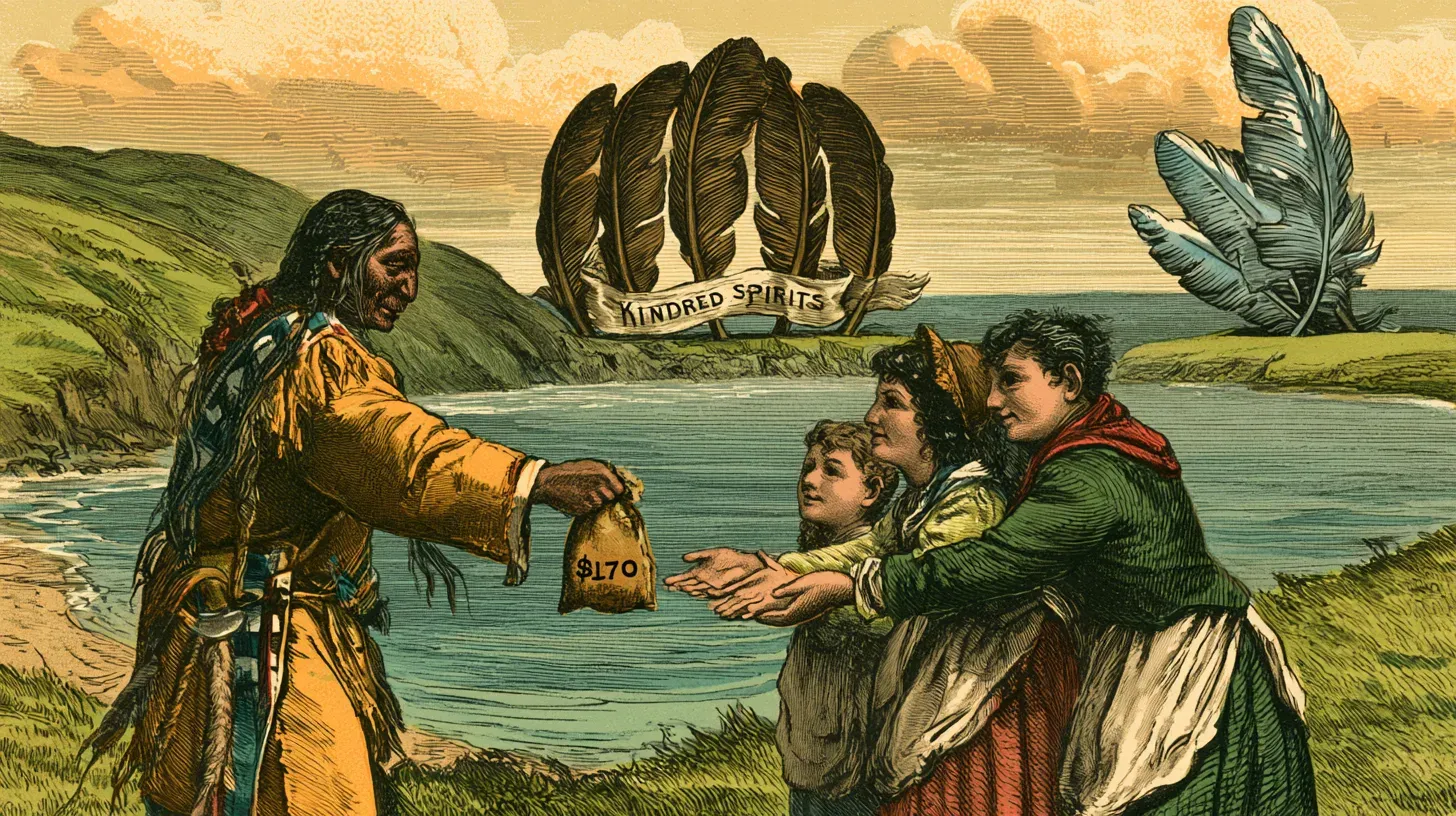
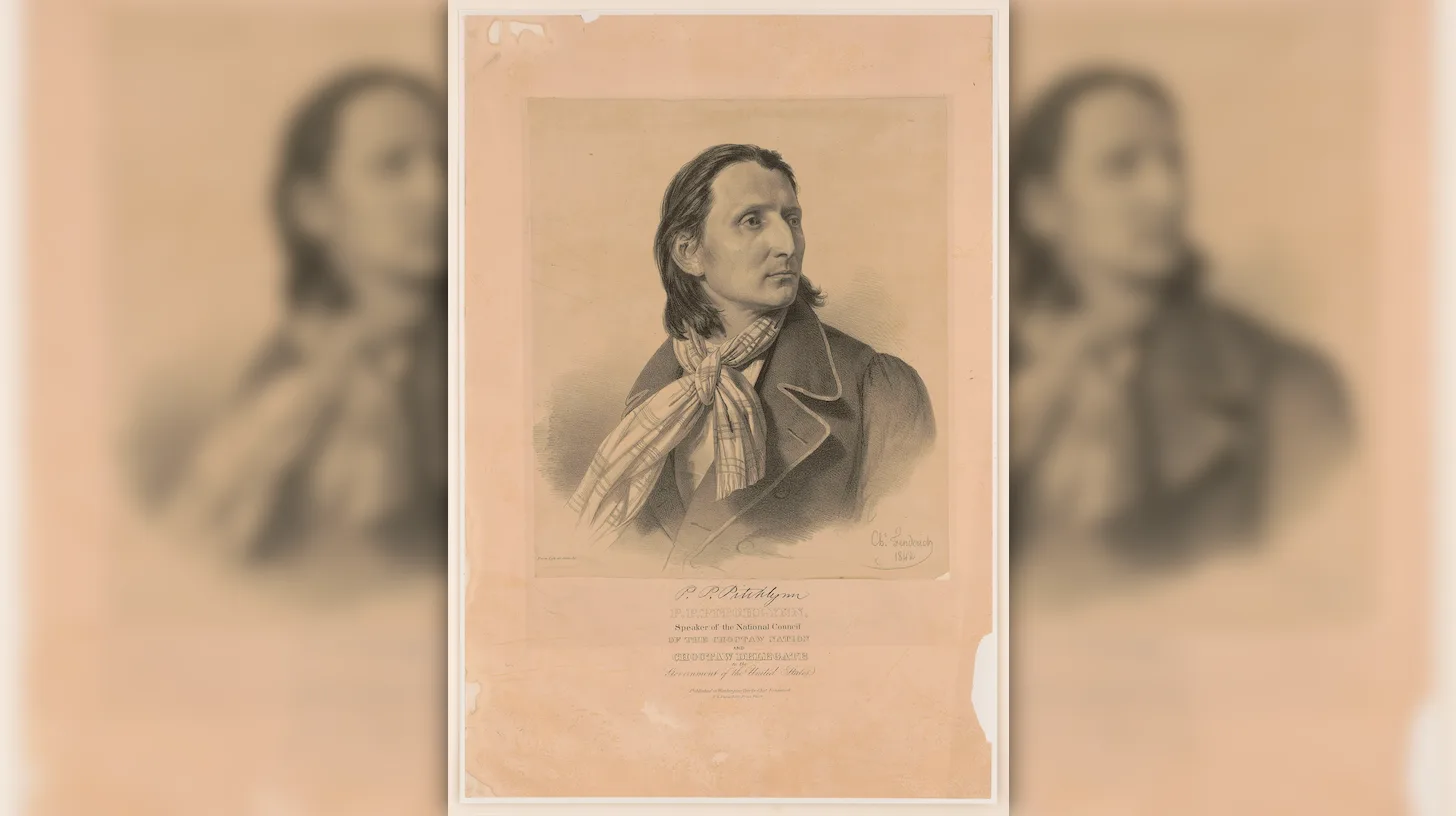
The first Choctaw families had been driven out of Mississippi under Andrew Jackson’s removal policy sixteen years before, and some were still arriving that winter, landed from a steamboat near the agency. The Choctaw donation to Ireland that reached the relief committee in New York from their meeting was $170. Ireland has remembered that sum ever since, with a president’s visit, a sculpture of steel feathers and, in the spring of 2020, a flood of Irish donations to Navajo and Hopi families that the donors said they were giving because of it. The records of 1847 are thinner than the memory, and they leave a question about the sum itself.
A road that ended at the agency
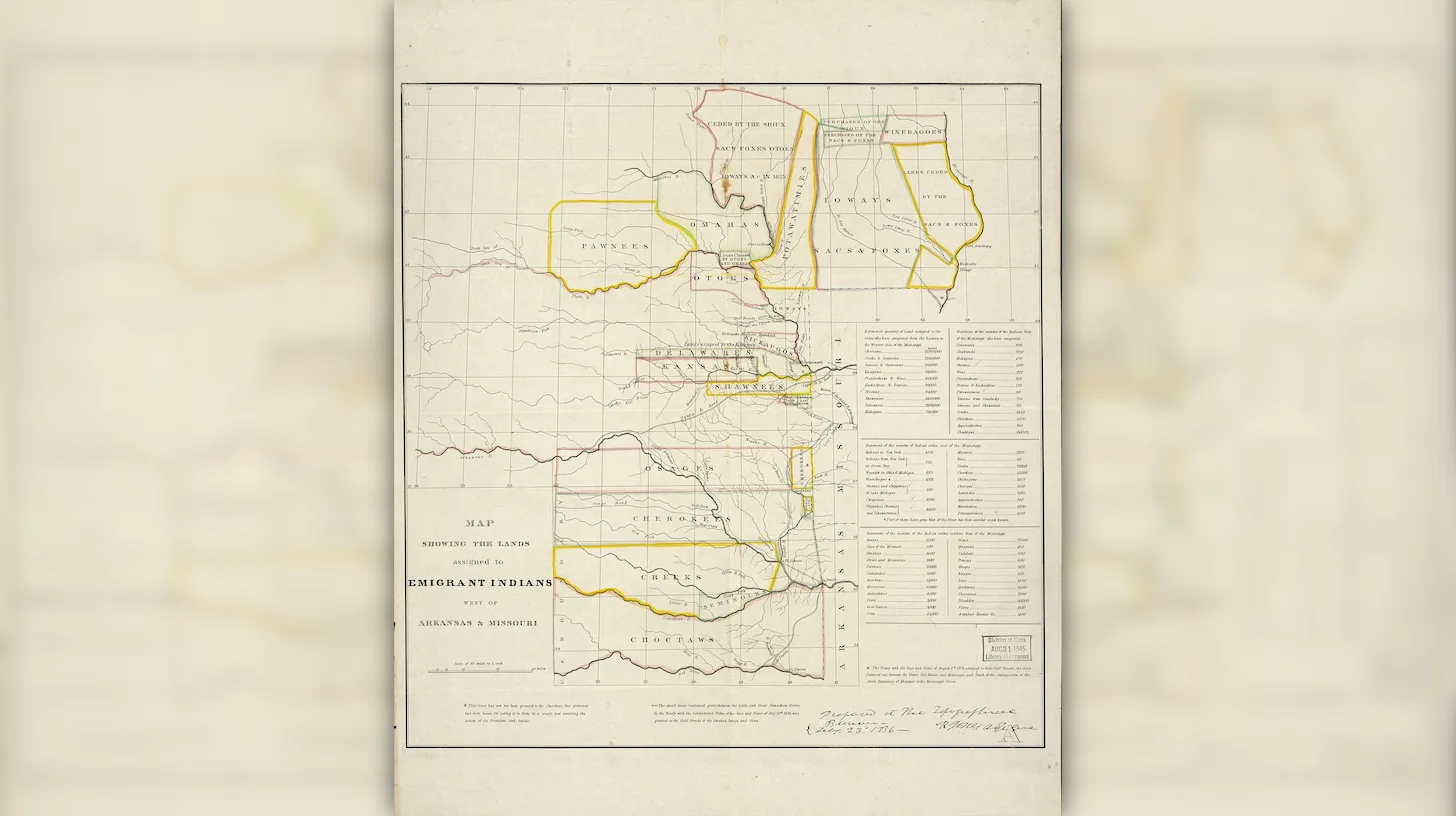
By the Treaty of Dancing Rabbit Creek, signed in 1830, they gave up more than 10 million acres east of the Mississippi River and agreed to move to land the government had set aside for them in the West. More than 6,000 arrived there in the first season of removal, 1831 and 1832, and about five thousand more in the two years after, according to the Oklahoma Historical Society. How many died on the way is not known with any certainty. Modern estimates run from about 1,500 to as many as 6,000.
A French visitor, Alexis de Tocqueville, watched one party of them cross the Mississippi at Memphis at the end of 1831. The snow had frozen hard upon the ground, he wrote, and the river was drifting huge masses of ice. The Choctaw had with them “neither tents nor wagons, but only their arms and some provisions,” and old men near death and children newly born crossed with the rest. “No cry, no sob was heard among the assembled crowd,” he wrote, and all of them were silent.
The government’s agent for the Choctaw in their new country was William Armstrong, who took the post in 1832 and kept it for the rest of his life. He was of Scots-Irish descent, and the Irish writer Turtle Bunbury gives his age at his death as fifty-two. No portrait of him has been found, and the papers of his time describe his judgment and his honesty but not his face. His agency stood at the settlement of Skullyville, one of the three main Choctaw towns, and the historian Muriel Wright believed that the name came from the Choctaw word for money. The Choctaw, she wrote, probably called the agency by a phrase meaning the place where money is given or presented.
The removal was not over by 1847. That winter a steamboat brought up 400 Choctaws from Mississippi and landed them at Fort Coffee, near the agency, where Armstrong paid them their scrip while they were still on the boat. Between four and five thousand more were still in Mississippi.
Skibbereen in February
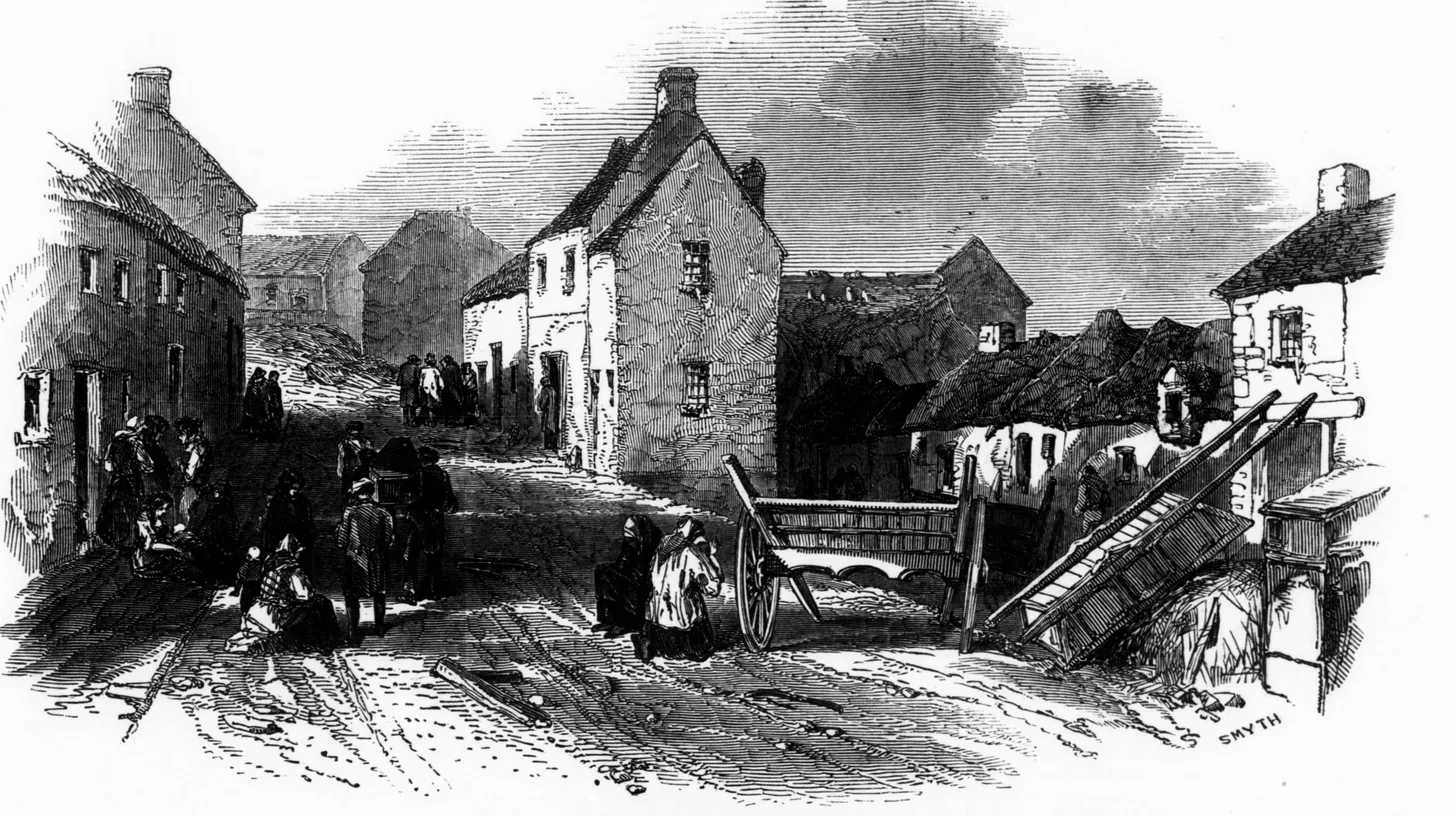
In the first weeks of 1847 the Illustrated London News sent an artist, James Mahony, to draw the Irish potato famine in the town of Skibbereen, in the southwest of Ireland, and the country west of it. The paper printed his sketches and his account in two February issues, under the heading “Sketches in the West of Ireland.” Those weeks were the worst of the famine in the southwest, and the Irish still call the year Black ‘47; the emigrants who fled it that year carried a typhus epidemic across the Atlantic with them.
At Clonakilty he passed a woman “carrying in her arms the corpse of a fine child.” On the road beyond it, he wrote, they “either met a funeral or a coffin” at every hundred yards. In one house at Skibbereen, he wrote, “there I saw the dying, the living, and the dead, lying indiscriminately upon the same floor.” At Schull, farther west, he drew the hut of a man named Mullins who lay dying in a corner of it, and he gave its size: it did not exceed ten feet square. He confessed that “neither pen nor pencil ever could portray the misery” he had seen.
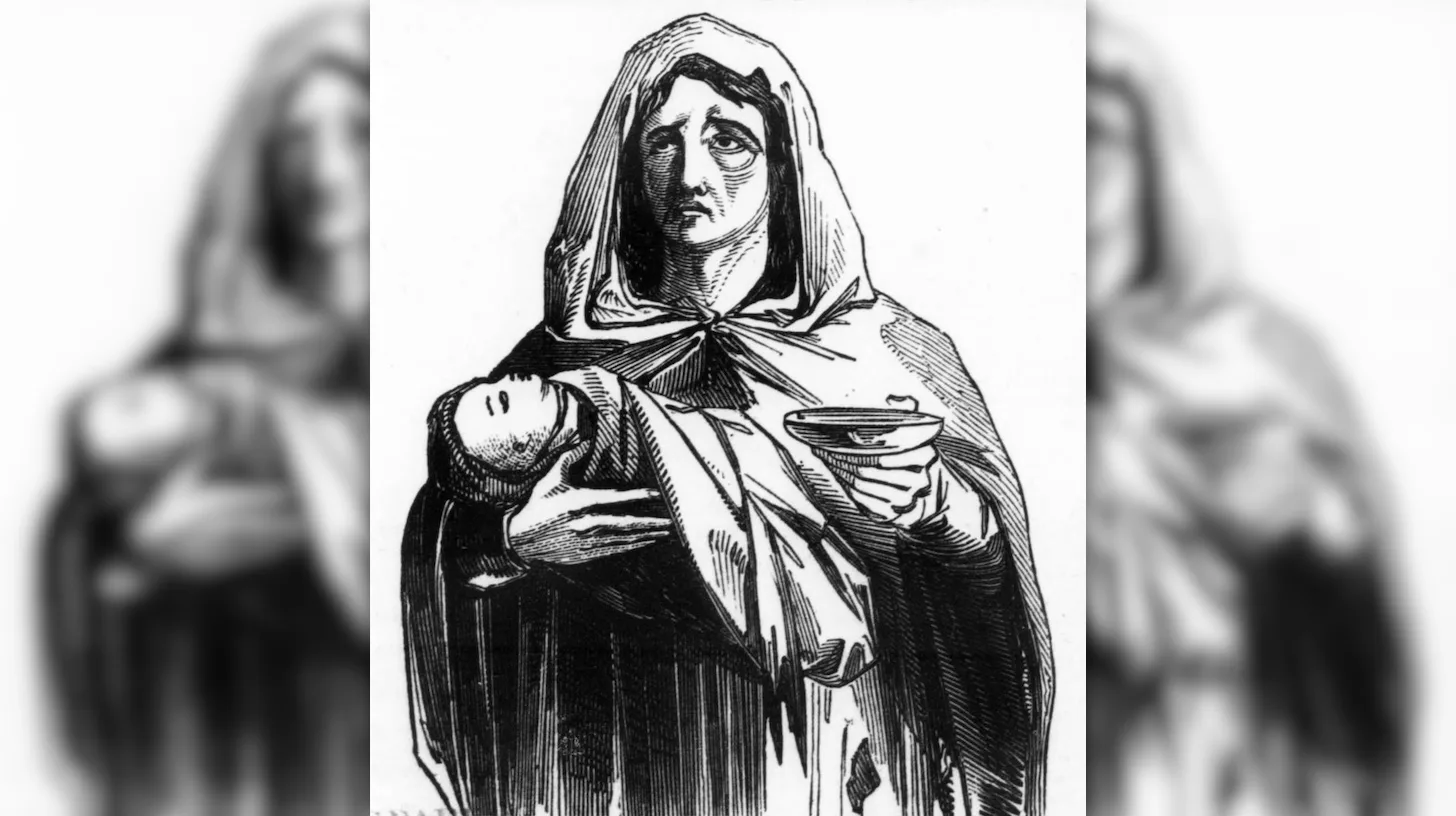
In the United States that winter and spring, relief committees gathered money for Ireland. The largest was the General Relief Committee of the City of New York, and committees in other towns sent what they raised on to it. One of them was at Memphis, Tennessee, and it printed a circular asking for help, and a copy of it reached the Choctaw Agency. In London, the Times wrote of the American help that “it does not become us to resent the assistance of a generous kinsman and friend.”
A circular read aloud at the agency
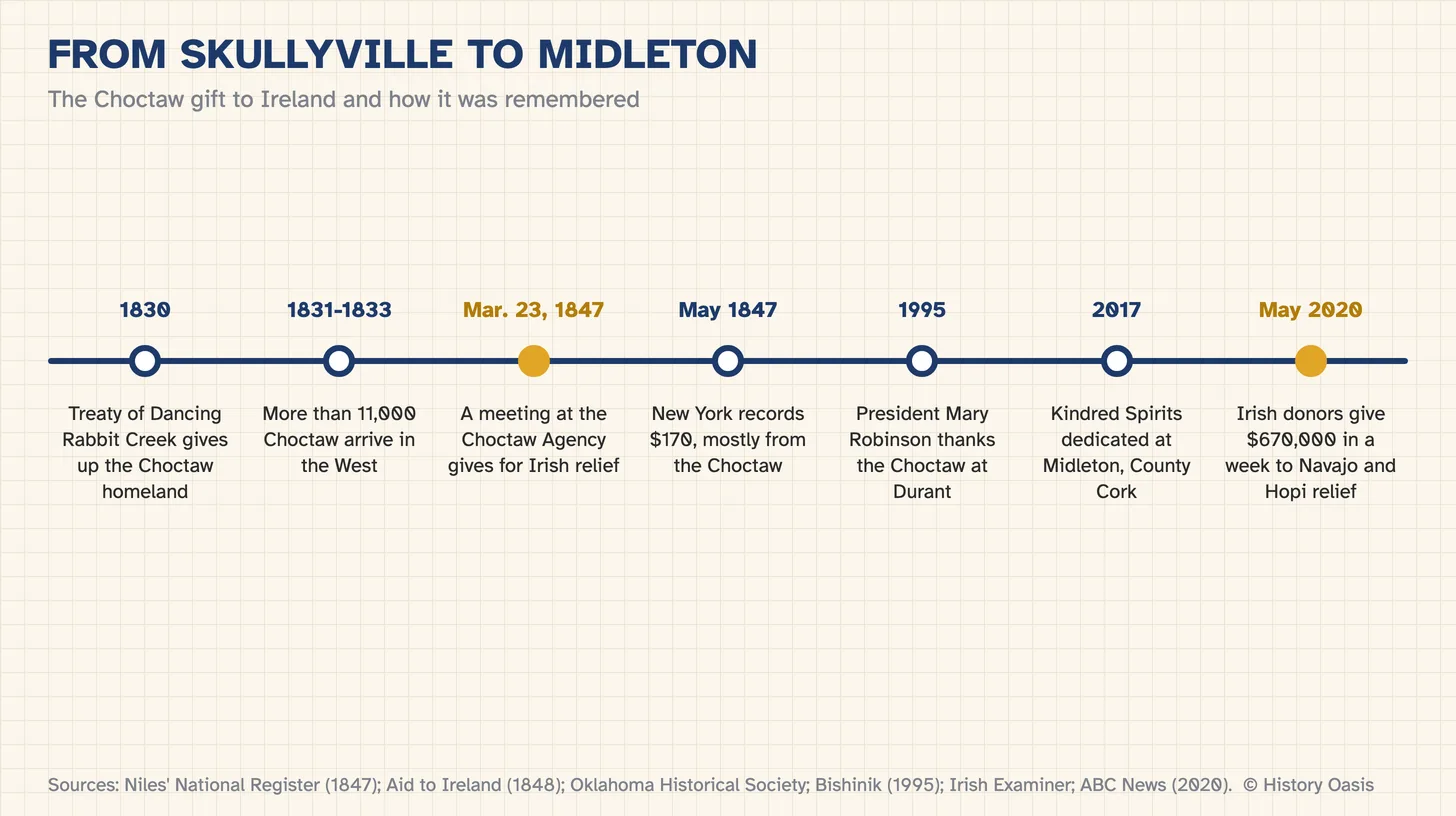
The only account of the meeting at the Choctaw Agency is a short notice in the Arkansas Intelligencer of Van Buren, Arkansas, early in April, which survives because Niles’ National Register reprinted it a month later. It gives the place, “the Choctaw Agency,” and the day, “the 23d ultimo,” which was March 23, a Tuesday. It names the chairman, Major Armstrong, and the secretary, a man named J. B. Luce, and it says that a circular of the Memphis committee was read and that the meeting then gave its money. It gives no hour, no weather and no speeches, and it names none of the Choctaw who were there.
It does say who gave. “All subscribed,” the Intelligencer reported. It listed agents, missionaries, traders and Indians, and it said that “a considerable portion of which fund was made up by the latter.” The paper’s editor was pleased with the picture of the Indian “sending his mite to the poor Irish!” The Cherokee held a meeting of their own at Fort Gibson, and the two nations together, by one modern count, gave more than $800.
The Intelligencer gives a figure for the Choctaw meeting, and it is not $170. It is $710. The two numbers have travelled side by side ever since. The New York committee’s printed report, which recorded what it actually received, has $170, and so do the Choctaw Nation’s own history pages and most newspapers. The 1847 notice, the historian Carolyn Foreman in 1930, and Mary Robinson, the president of Ireland, in 1995, all have $710. The Irish scholar Padraig Kirwan, writing in 2022, said the gap raises the question of a misprint or of money lost along the way, and it has never been settled. What can be said is that $170 reached New York, and that the one report of the meeting says $710 was given there.
By way of Memphis, New York and Dublin
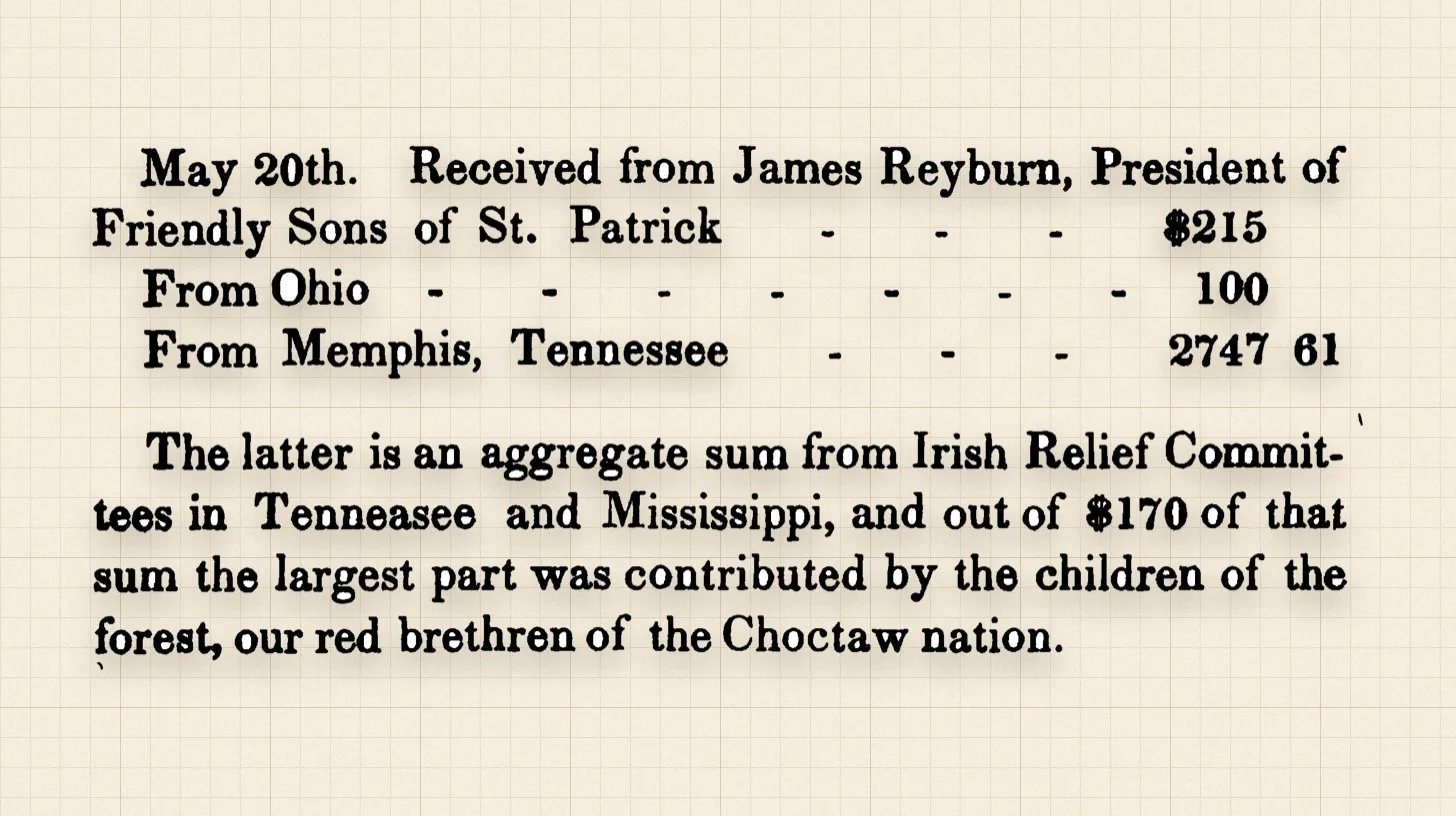
The Memphis committee gathered its money from the towns and settlements around it and sent it on to New York in a single remittance, and the Choctaw sum was carried in it under Armstrong’s name. The New York committee’s schedule of receipts lists it as from Captain William Armstrong, “Indian agent near Fort Smith, Arkansas,” with a note: “A large portion of this sum was contributed by our red brethren” of the Choctaw nation. The sum entered beside it is $170.
The chairman of the New York committee, Myndert Van Schaick, wrote to the Quaker relief committee in Dublin late in May to tell them what he was sending. Out of $170 of the Memphis money, he wrote, “the largest part was contributed by the children of the forest, our red brethren of the Choctaw nation.” He went on in the same letter.
“Even those distant men have felt the force of Christian example, and have given their cheerful aid in this good cause, though they are separated from you by many miles of land and an ocean’s breadth.”
The Memphis committee had asked that its money go to the north of Ireland, to Belfast or Londonderry. Van Schaick left the choice to the Quakers, who he thought were “the best judges in Ireland,” and where the Choctaw dollars went after that, the record does not say. The Choctaw Nation’s history pages now say the money was sent to the town of Midleton, in County Cork, but no document of 1847 shows it. Measured by the Minneapolis Federal Reserve’s price index, $170 in 1847 was worth about $4,700 in the dollars of 2020.
William Armstrong did not live to see the end of the year. He died that summer, and the obituary that Niles reprinted from a Baltimore paper said that thousands of Indians had respected and esteemed him. His last instructions, his secretary wrote, were about the Indian schools.
A walk, a president and nine feathers
For more than a century the gift was a line in old reports. It came back into Irish memory in 1990, when Choctaw leaders went to County Mayo to walk in the first Famine Walk there, and in 1992 eight people from Ireland walked 500 miles of the Choctaw removal route, from Broken Bow in Oklahoma to Nanih Waiya in Mississippi, to raise money for famine relief in Somalia. The Choctaw paper’s headline on that walk was “Irish Repay Choctaw Famine Gift.”
In May 1995 Mary Robinson, the president of Ireland, came to the Choctaw Nation to thank it. About 500 people waited for her at the tribal headquarters in Durant, and she spoke to them from the front steps. She used the figure from the 1847 notice, telling them that “$710 was raised and sent to Memphis,” and she said why she had come.
“I am here to thank the Choctaw Nation for their extraordinary generosity and thoughtfulness when they learned in 1847 about the plight of poor Irish famine victims.”
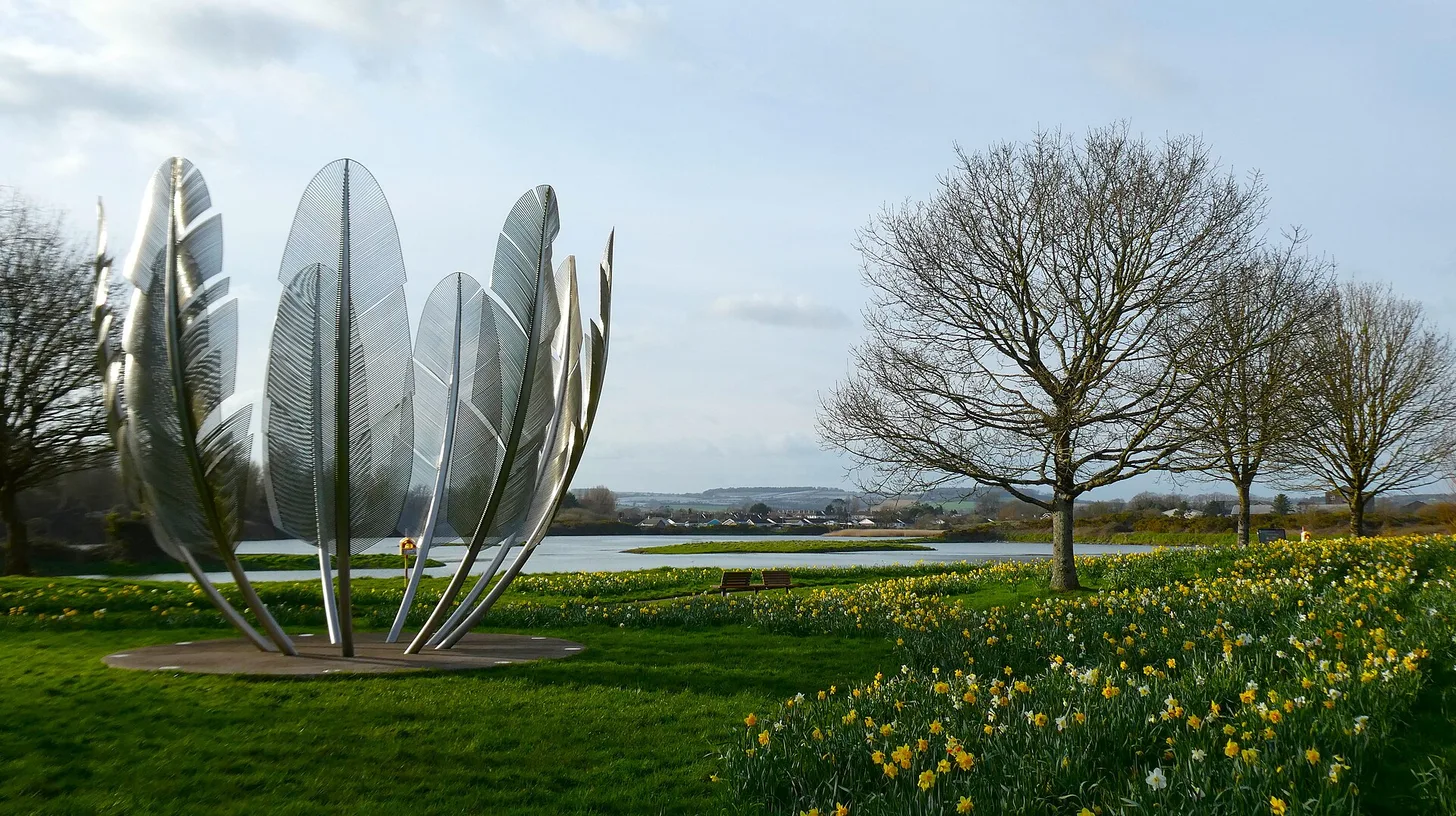
In 2013 a local council in County Cork commissioned a sculpture for Bailick Park in Midleton from a Cork artist, Alex Pentek. He made it of nine stainless steel feathers, each about twenty feet high and each one different, set in a ring so that together they form the shape of an empty bowl. Each feather has 300 veins, and each vein took six welds. It was set up in 2015 and dedicated in June 2017, with Choctaw and Irish music and dancing and a delegation of more than fifteen from the Choctaw Nation, led by Chief Gary Batton. Pentek called it Kindred Spirits. “The title came easily,” he said, because the Choctaw had felt a kinship with Ireland “as a fellow oppressed nation.”
Chief Batton was asked about the money that week. “I know $170 is not a lot of money,” he told the Irish Times. The next year the Taoiseach, Leo Varadkar, went to Durant to thank the Choctaw in person and announced a scholarship for Choctaw students to study in Ireland, and he gave the chief a hurley and received a Choctaw stickball in return.
The spring of 2020
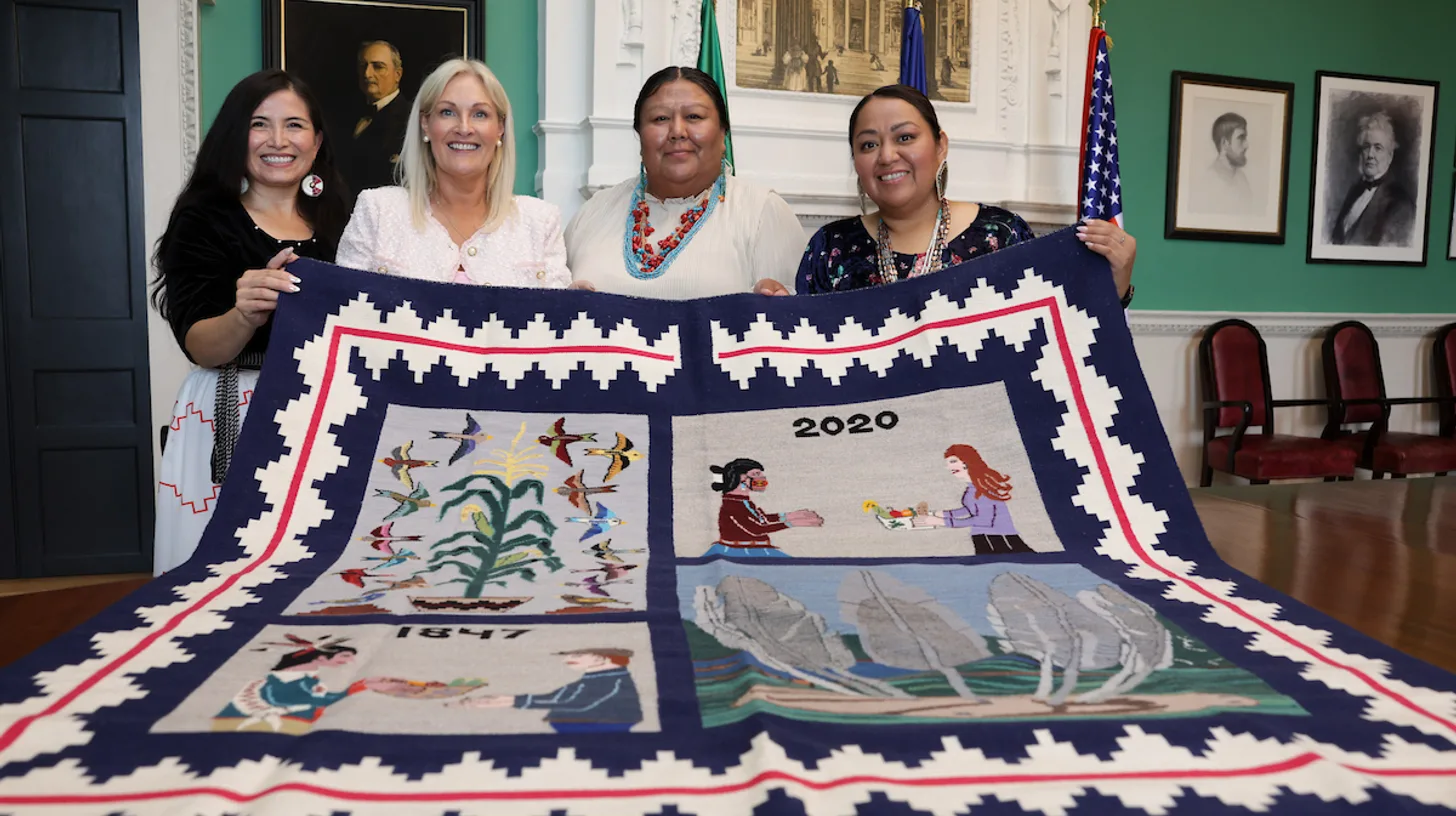
In the first days of May 2020, when the coronavirus was spreading through the Navajo Nation, a relief fund for Navajo and Hopi families began to circulate in Ireland, and the donations from Ireland came in by the thousands. Many of the donors left a message beside their money, and many of the messages named the Choctaw. “Ireland remembers,” some of them read. Others wrote in Irish, “Ní neart go cur le chéile,” there is no strength without unity. One donor wrote, as ABC News reported, that the generosity of 1847 “will never be forgotten.”
Within the first week, the fund’s organizers were told, at least 20,000 donations totaling $670,000 had come from Ireland. By the autumn, the Irish Post reported, about 27,000 Irish donors had given some $1 million. One of the organizers, Cassandra Begay, told the Irish Times what it would buy.
“We’re going to make sure that money is used to get food and essential supplies and water to our elders and our families. It definitely makes a difference and we will always remember.”
None of the money went to the Choctaw, and the Choctaw did not ask for any. Chief Batton said the nation was gratified, and he gave a Choctaw word for what the Irish had done, iyyikowa, which he said “means serving those in need.” The donors called it paying it forward.
In July 2025 a delegation from the Navajo and Hopi fund came to Dublin and carried a woven rug into the Irish parliament. Two dates were woven into it, 1847 and 2020.