14 min read
At about three o’clock on the afternoon of Saturday, August 19, 1854, with the wind blowing hard across the North Platte, a brevet second lieutenant named John L. Grattan rode out of Fort Laramie with twenty-nine enlisted men of Company G, 6th Infantry, a wagon, an interpreter and two howitzers. He was going to bring back one man. Two days before, that man had killed a lame cow that had strayed from a train of Mormon emigrants on the road west.
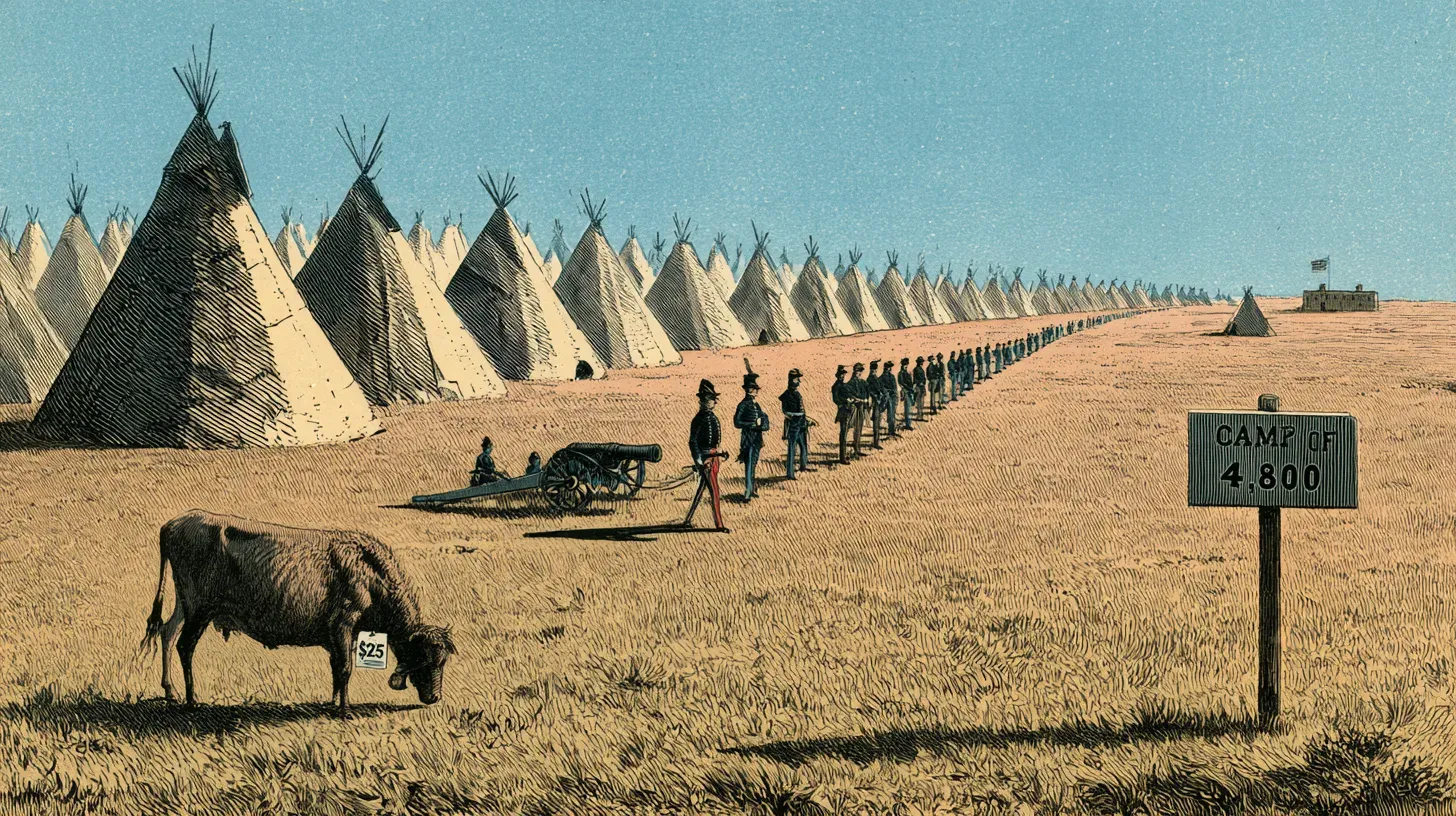
Down the river valley, for several miles east of the fort, stood an estimated six hundred lodges of the Lakota, who had been waiting most of the summer for the goods the government owed them by treaty. By sunset Grattan was dead, and so, by that night or within two days, was every soldier he had taken with him. The Army called it a massacre. The men who saw it from the trading houses, and the Lakota who were in the camp, told it differently, and their sworn statements, gathered that fall and printed by Congress, tell how a dead cow became the opening of a generation of war on the northern plains.
A lame cow on the emigrant road
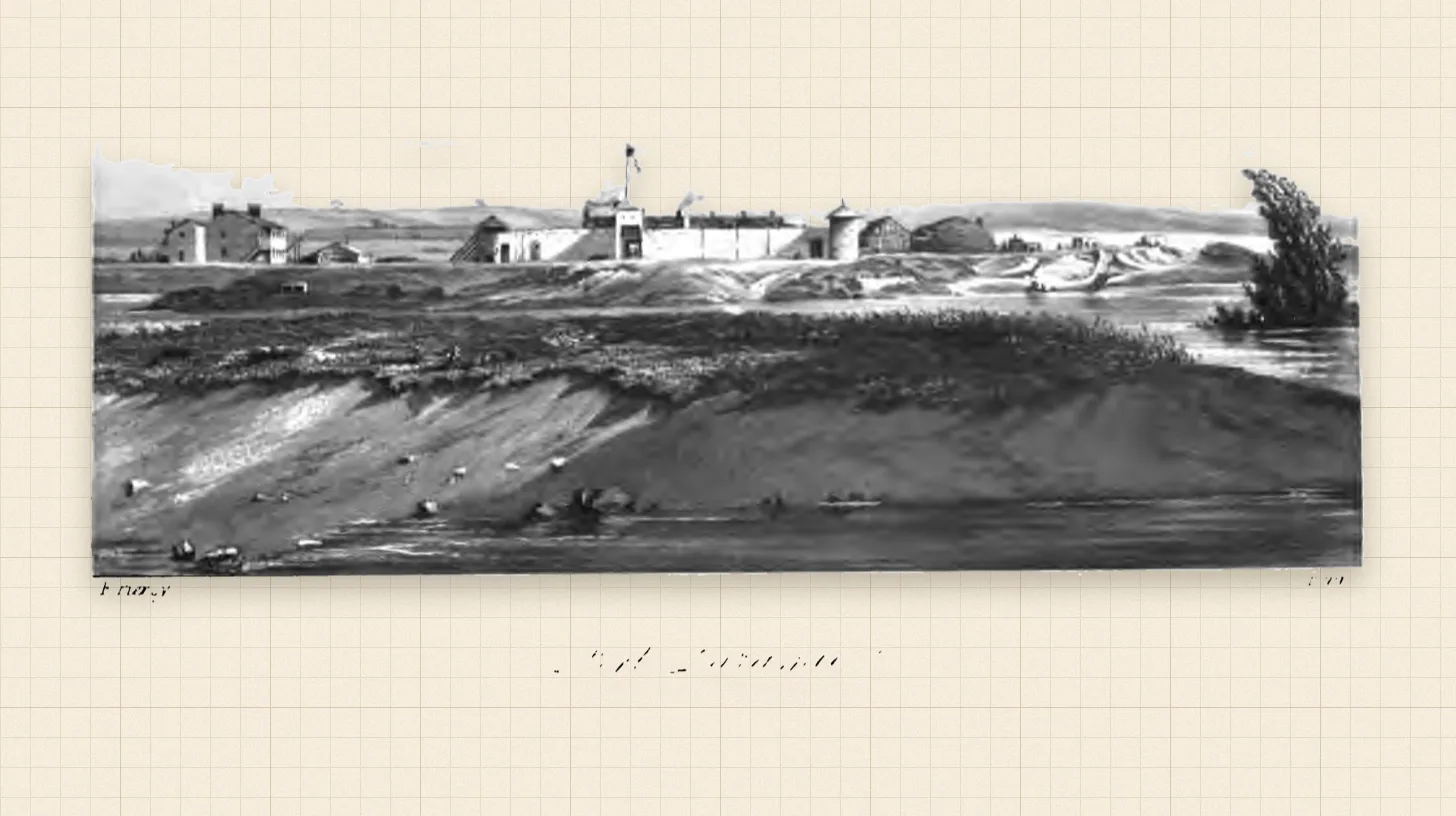
The Lakota had come to the Platte that summer to collect their annuities, the yearly payment of goods promised under the treaty of 1851, and the agent was late. They told the trader James Bordeaux, who kept a trading house a few miles below the fort, that they had been waiting on the agent two months and “that their children were starving.” Brulé, Oglala and Miniconjou bands camped along the river, some two or three hundred lodges in one group around Bordeaux’s house alone. The emigrant road to Oregon, California and the Great Salt Lake ran past them.
On August 17 a company of Mormon emigrants, most of them converts from Denmark, came down the road. One of their cows was lame. As Bordeaux told it, “by some means or other the cow got frightened, and ran towards the village,” and a stranger from the Miniconjou band, a visitor in the Brulé camp, killed it, and the people there ate it. An emigrant in the company wrote in his journal that night, in a translation now kept by the church, a sentence that put the matter more simply.
“They shot one of our cows, that was lame and we let them have the meat.”
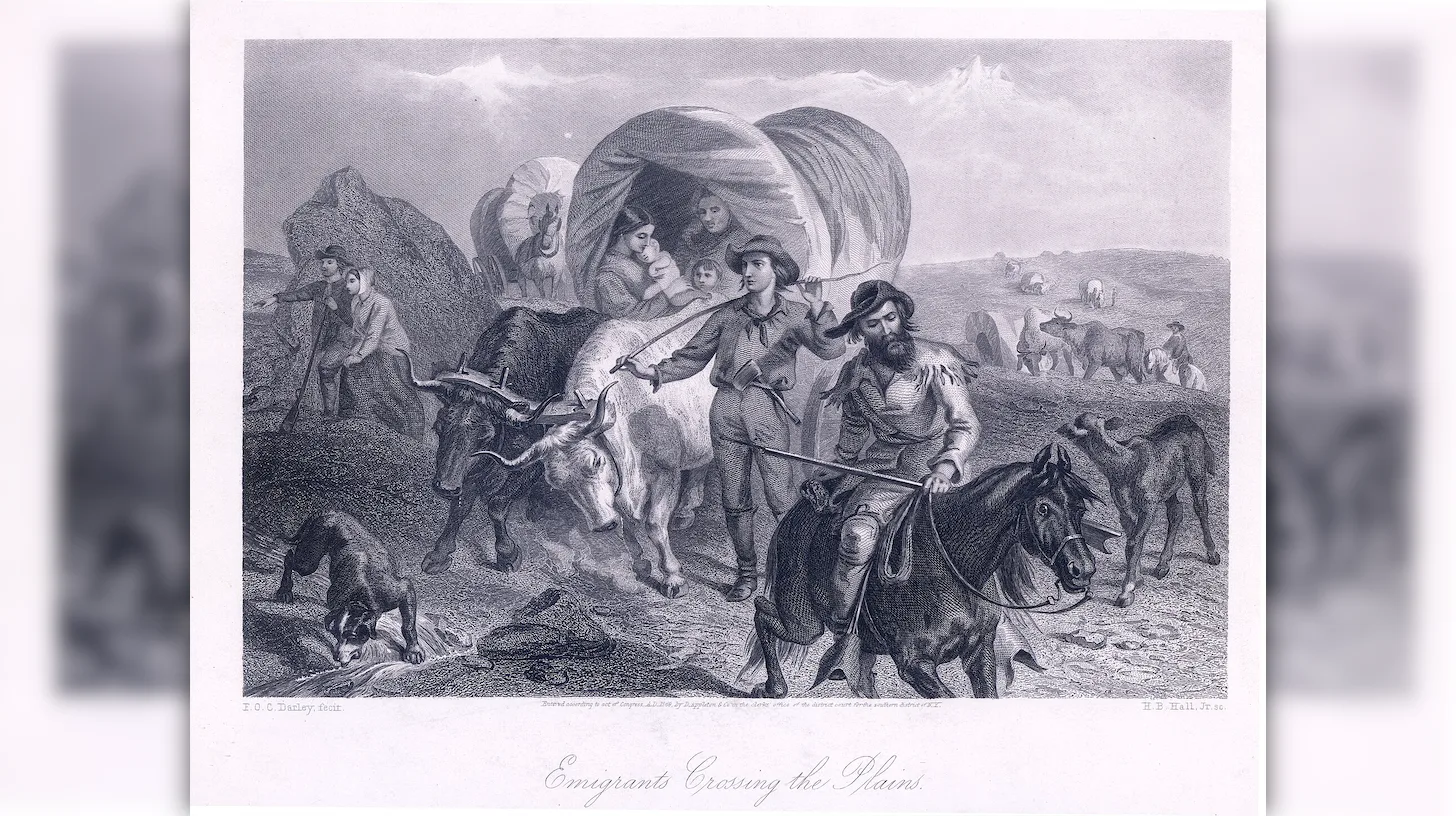
Someone in the company took it further. An emigrant came to the fort, the post’s commander wrote, and reported that the Sioux had killed one of his cattle and that he had “barely escaped with his life.” At Bordeaux’s he was offered ten dollars for the cow and refused it, asking twenty-five. On August 18 the Brulé chief Conquering Bear, whom the government had named head chief of all the Sioux at the 1851 treaty, came to the fort himself, reported the killing and expressed a willingness to give up the offender. He offered a horse for the cow. The commander, Lt. H. B. Fleming, himself a second lieutenant, put the matter off for a day.
A year out of West Point
John Lawrence Grattan was twenty-four. He had been born in Vermont, the son of Peter Grattan, and appointed to West Point from New Hampshire, and he had graduated in 1853 thirty-sixth in a class of fifty-two, after losing a year to mathematics. No portrait of him is known, and no one who served with him left a word about his face. What they left was his talk. An Army surgeon who knew him at the post called him “a brave young man, impetuous, bold, and daring,” with “the enthusiastic ardor of his race, (Irish,)” and wrote down what he had heard him say more than once.
“It was Mr. Grattan’s opinion, as expressed often and in earnest, that, with thirty men, he could whip the combined force of all the Indians of the prairie.”
The post chaplain thought he had “an unwarrantable contempt of Indian character,” and had seen him thrust his clenched fist into the faces of Lakota men in the chaplain’s own quarters. Yet a guest who lived in Grattan’s room that summer said the young man had “a great admiration” for Conquering Bear and “implicit confidence in him.”
Fleming’s orders to Grattan, as he wrote them up three months later, were to use his own discretion and “to be careful not to hazard an engagement without certainty of success.” The man was to be told that he would not be harmed and would be held for the agent. Fleming authorized a detail of twenty men. Thirty went. Before he left, Grattan asked his guest, in case he did not return, to pay a sum of money due to his servant.
The wind was blowing very hard
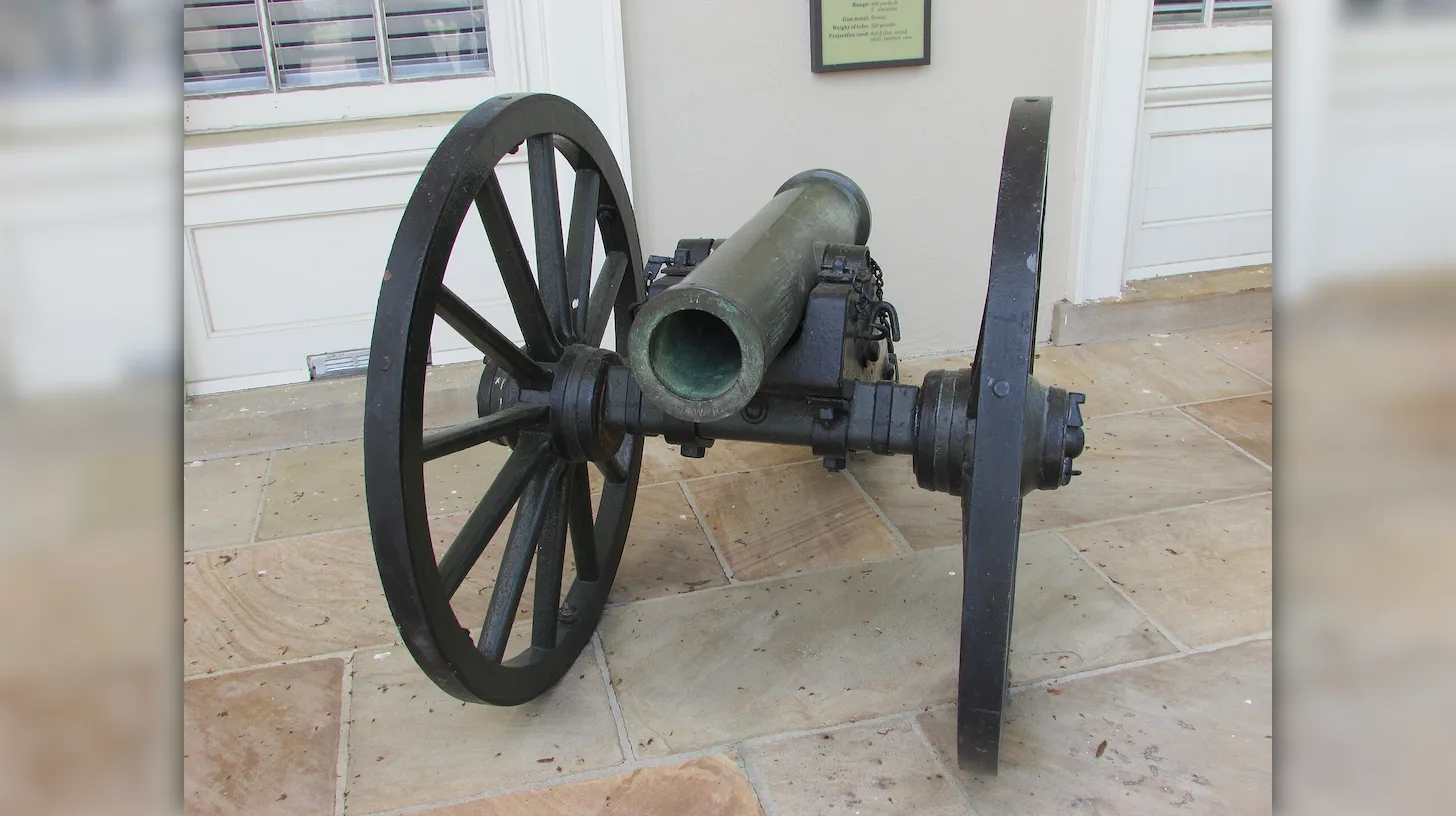
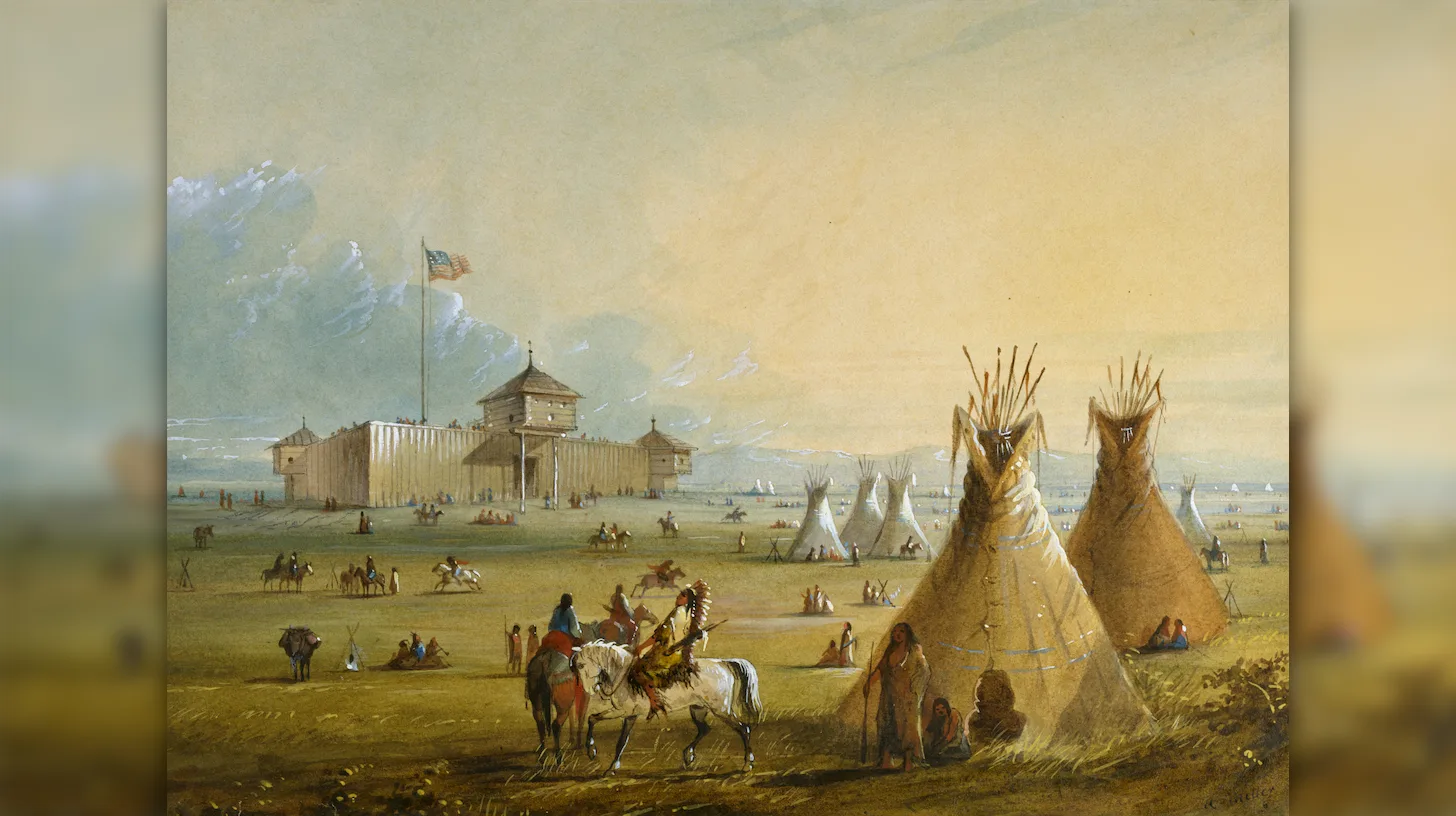
Man Afraid of His Horses, an Oglala leader who was at the fort that afternoon, gave the Army a statement that survives in the National Archives, undated and unsigned, and a historian printed it in 1956. Soldiers dragged a cannon out of the old adobe fort and cleaned it. “The wind was blowing very hard at this time.” The interpreter, Lucien Auguste, said, “I am ready but must have something to drink before I die,” and someone gave him a bottle. Grattan “was playfully sticking at the interpreter with his sword, telling him to make haste.” Man Afraid asked them to look at how many lodges there were.
Grattan rode out with the infantry in the wagon and on the gun limbers, a twelve-pounder field howitzer and a mountain howitzer behind them. A civilian named Obridge Allen rode with him and later gave two statements. At a trading house on the way Grattan had the men load their muskets, and he took the interpreter’s flask from him. “The Lieutenant asked him for it to take a drink,” Allen said, but instead broke it on his saddle. Grattan told the men he did not believe a gun would be fired. But he “hoped to God they would have a fight.”
From the top of a bluff the lodges could be seen along the river, at least six hundred of them, and Allen asked whether the lieutenant saw how many there were. Grattan’s answer, as an officer who investigated the affair the next year heard it, was this: “but I don’t care how many there are; with thirty men I can whip all the Indians this side of the Missouri.” The interpreter had been taunting the Lakota along the way. The Indian agent heard afterward that he was “drunk and swearing he would take their hearts,” and the investigating officer was told what he had called out.
“We have come to fight, not to talk. Last summer we killed some of you, but now we have come to wipe you out; you are women.”
Three quarters of an hour at the lodges
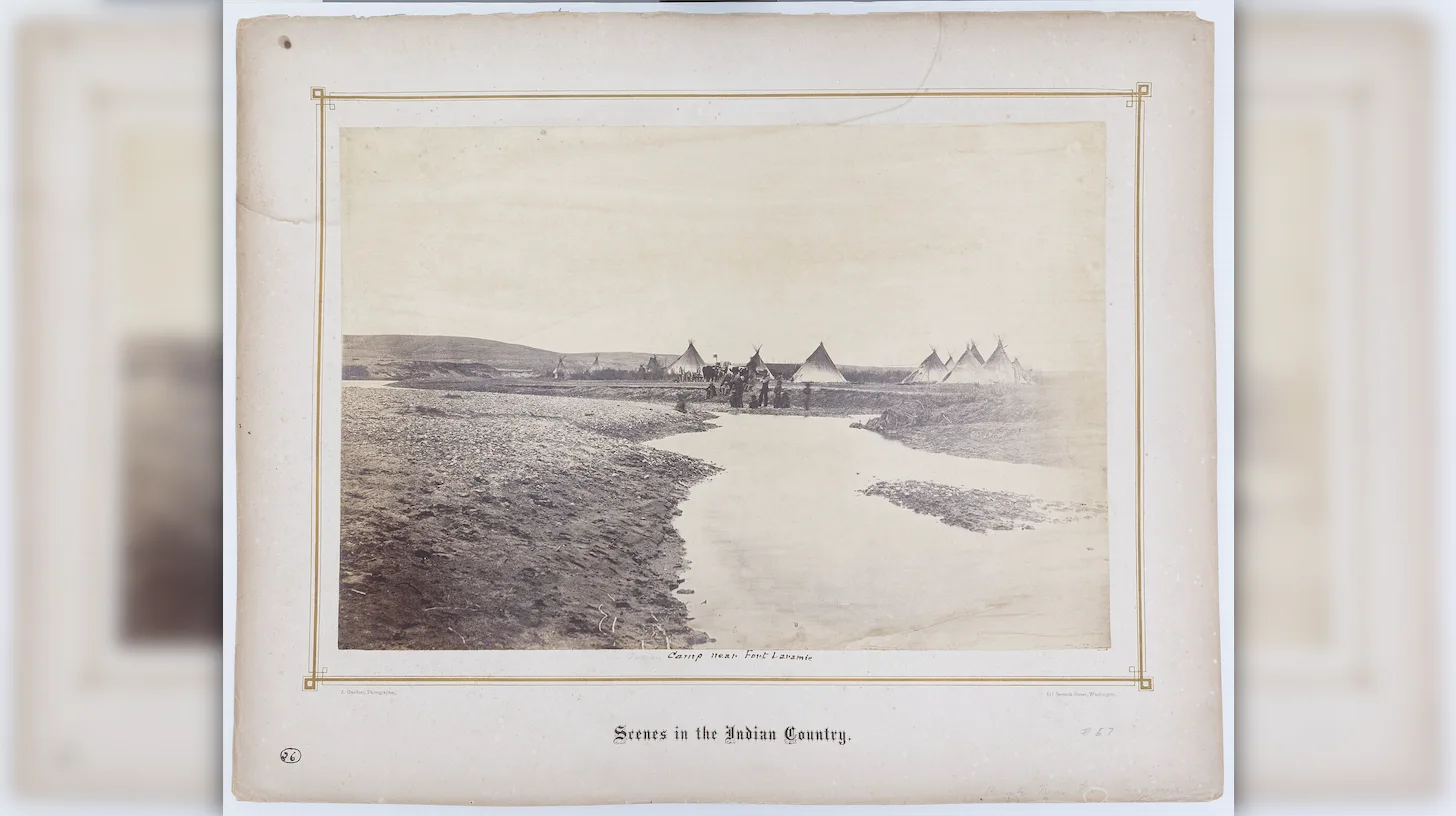
At Bordeaux’s house Grattan sent for Conquering Bear. The chief said, Bordeaux remembered, “Very well, but I must go and put on my dress-coat before I give an answer.” Allen heard Grattan’s message to him: “You tell the Bear that I have come down here for that man, and I’ll have him or die.” Bordeaux begged Grattan to put the interpreter in the house and promised that if he did, he would settle the difficulty in thirty minutes. The chief explained that it was their custom to make a demand four times. Grattan told Bordeaux he had two revolvers with twelve shots, and then he marched his men into the Brulé camp.
He halted them near the two lodges where the Miniconjou visitors stayed. “The men all sat down on the ground.” For about three quarters of an hour Grattan, the interpreter and Conquering Bear talked, while women and children left the camp and men on horseback gathered along the river. The Miniconjou would not come out, and the word came back that he was ready to die. Conquering Bear offered a mule in place of the cow. Man Afraid, who was there, remembered what the chief said.
“The Bear said it was hard as it was a poor cow and that today the soldiers had made him ashamed that he was made chief by the whites”
Grattan, according to an account the Lakota gave the Army that November, took out his watch and said, “It is getting late, and I can’t wait any longer.” Man Afraid ran to Bordeaux’s house and called up to him: “My friend, come on; the interpreter is going to get us into a fight, and they are going to fight if you don’t come.” Bordeaux got onto Allen’s mare, found the stirrups too long and turned back. Allen had climbed onto a roof to watch.
Firing began on the soldiers’ right
The first shots came from the right of the line, and one Lakota man was hit. Who fired first was the question everyone asked afterward. Bordeaux said “the first fire was made by the soldiers,” and the officer who looked into it the next year agreed: “I believe the troops fired first.” Allen, on his roof, saw the troops rise and level their muskets, “when the Indians instantly fired upon them.” Conquering Bear was hit three times. Bordeaux saw the second cannon fired by Lieutenant Grattan, “and then he fell.”
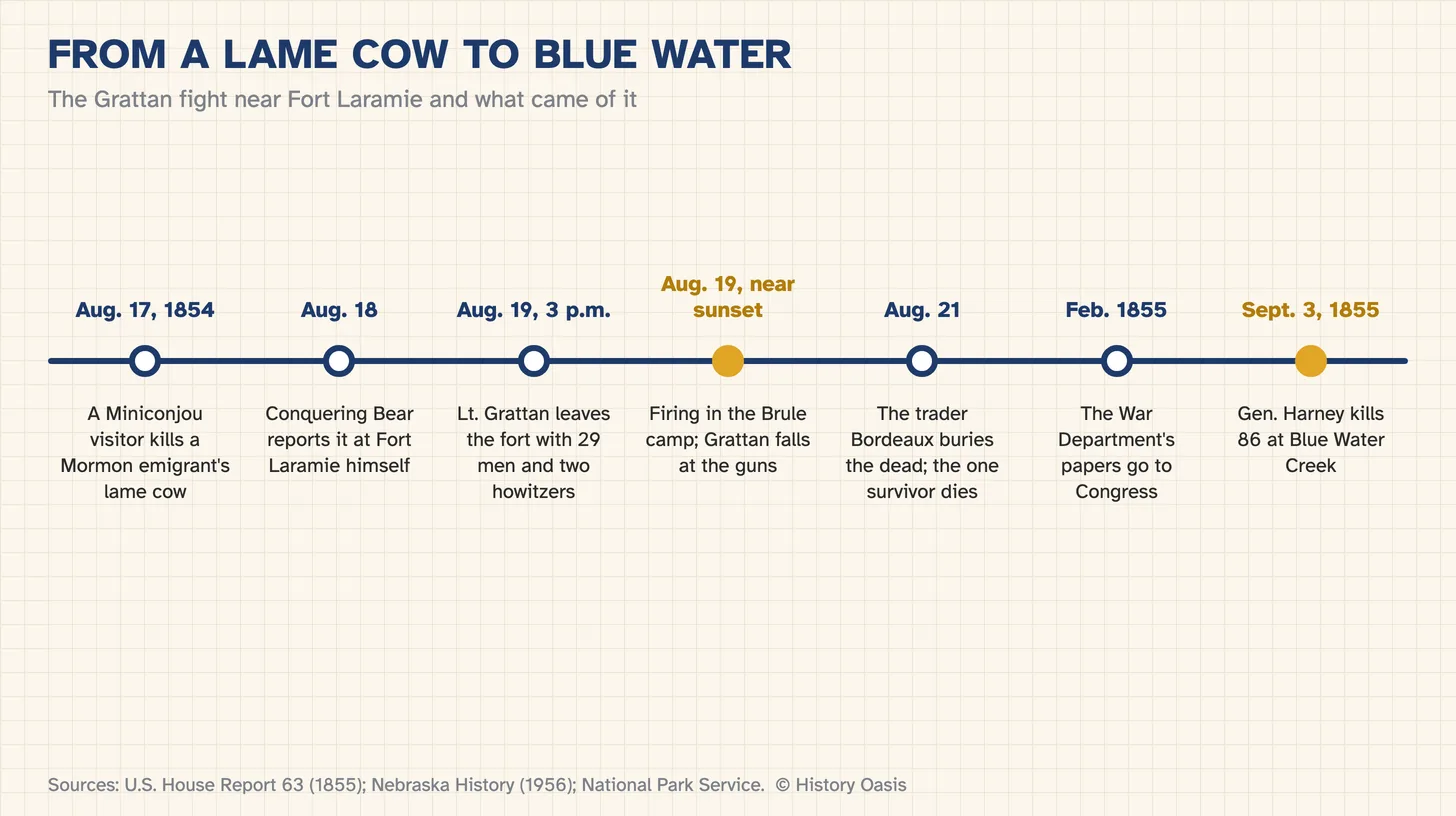
The guns had been laid too high, and the canister went through the peaks of the lodges. A private ran with the limber of the field howitzer and the wagon followed. The interpreter and the soldier riding Grattan’s horse got half a mile before they were caught and killed. The men on foot, about eighteen of them, were run down along the road, and a report that fall said they were found “scattered along the road for a mile or a mile and a half, all dead, and mostly killed by arrows.” Grattan lay with two men by the large gun. A St. Louis paper said there were twenty-four arrows in his body, one through his head. A history written a century later says he could be identified only by his pocket watch, but no account of 1854 says so.
That night the warriors talked of going on to the fort, where only ten soldiers remained. Bordeaux and the chiefs talked them out of it. “If the sun had been two hours higher,” Bordeaux said, “they could not have stopped it.” One wounded soldier, Pvt. John Cuddy, was found alive, and a Lakota man who was a friend of the traders stood over him. “If you kill this soldier, you kill me,” he said, “for I shall die with him.” Allen put him in a buggy, and when the buggy broke down, carried him to the fort on his own horse. Cuddy died on August 21 without telling what he had seen.
A report to Congress
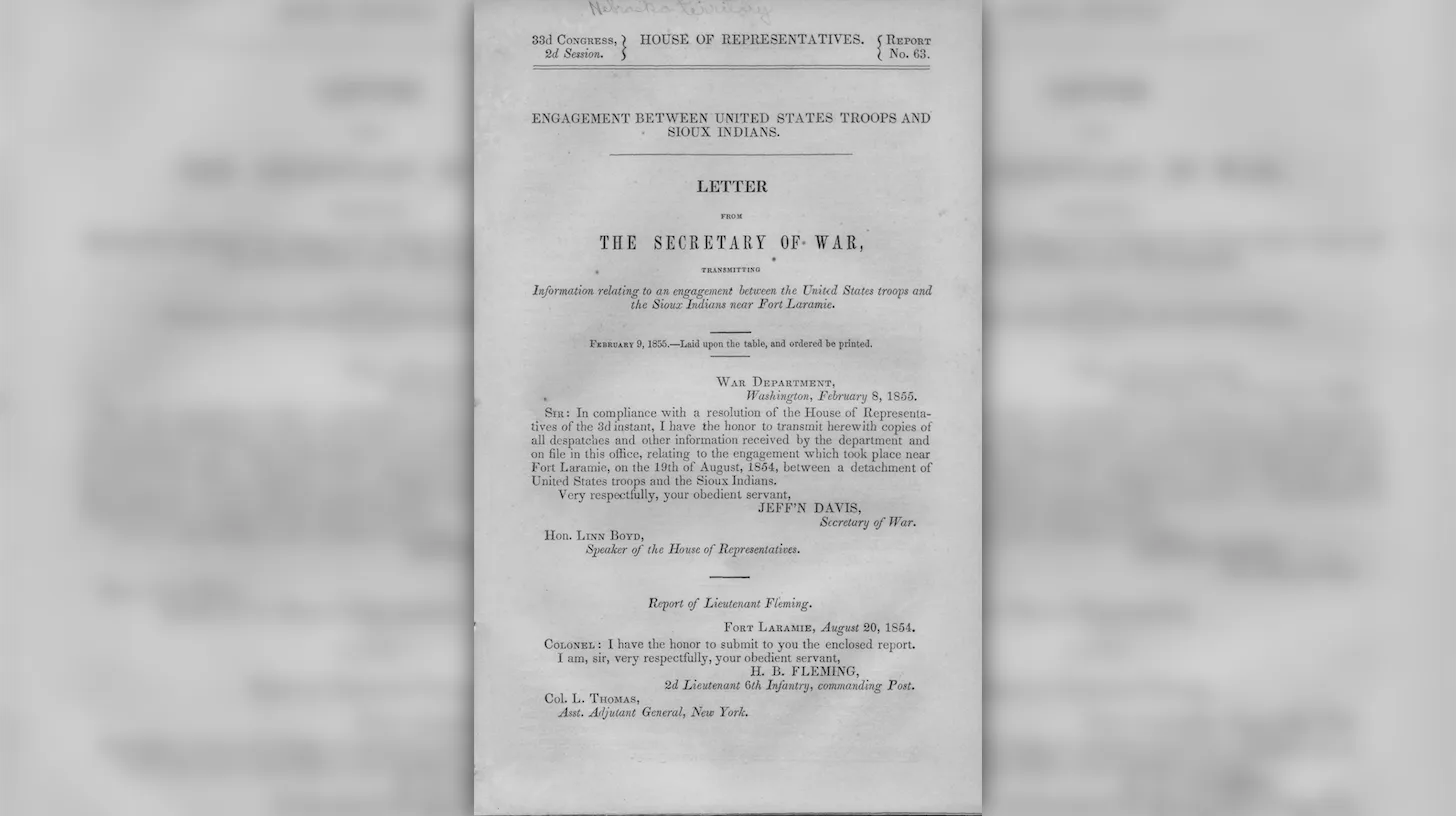
On Monday morning, Bordeaux said, “I received a note from Lieutenant Fleming, requesting me to bury the dead, and I did so.” The enlisted men went into a shallow grave on the field. Grattan’s body was taken to the fort and later to Fort Leavenworth. Conquering Bear was carried away by his people and died of his wounds some days later on the Niobrara.
The first reports said Grattan had taken twenty men, and that it was “a preconcerted plan on the part of the Indians to waylay and murder the party.” Then the statements came in. The agent who arrived with the annuities wrote that the Sioux would have paid any number of horses for the cow, and the Commissioner of Indian Affairs told Washington that no Army officer had the authority to make the arrest at all. The new commander at the fort wrote that Grattan had left it “with a desire to have a fight with the Indians,” and the Army’s adjutant general wrote a reply on the report.
“While this remark adds nothing to the character of Lieutenant Grattan for bravery, it would seem to detract from his judgment as an officer.”
The Secretary of War sent the papers to the House in February 1855. That summer and fall Capt. Edward Johnson took more statements at the fort and concluded that the fight had been no ambush. Of Grattan himself he wrote: “He appears to have been a young officer of courage, but rash and impulsive almost beyond belief.”
Blue Water
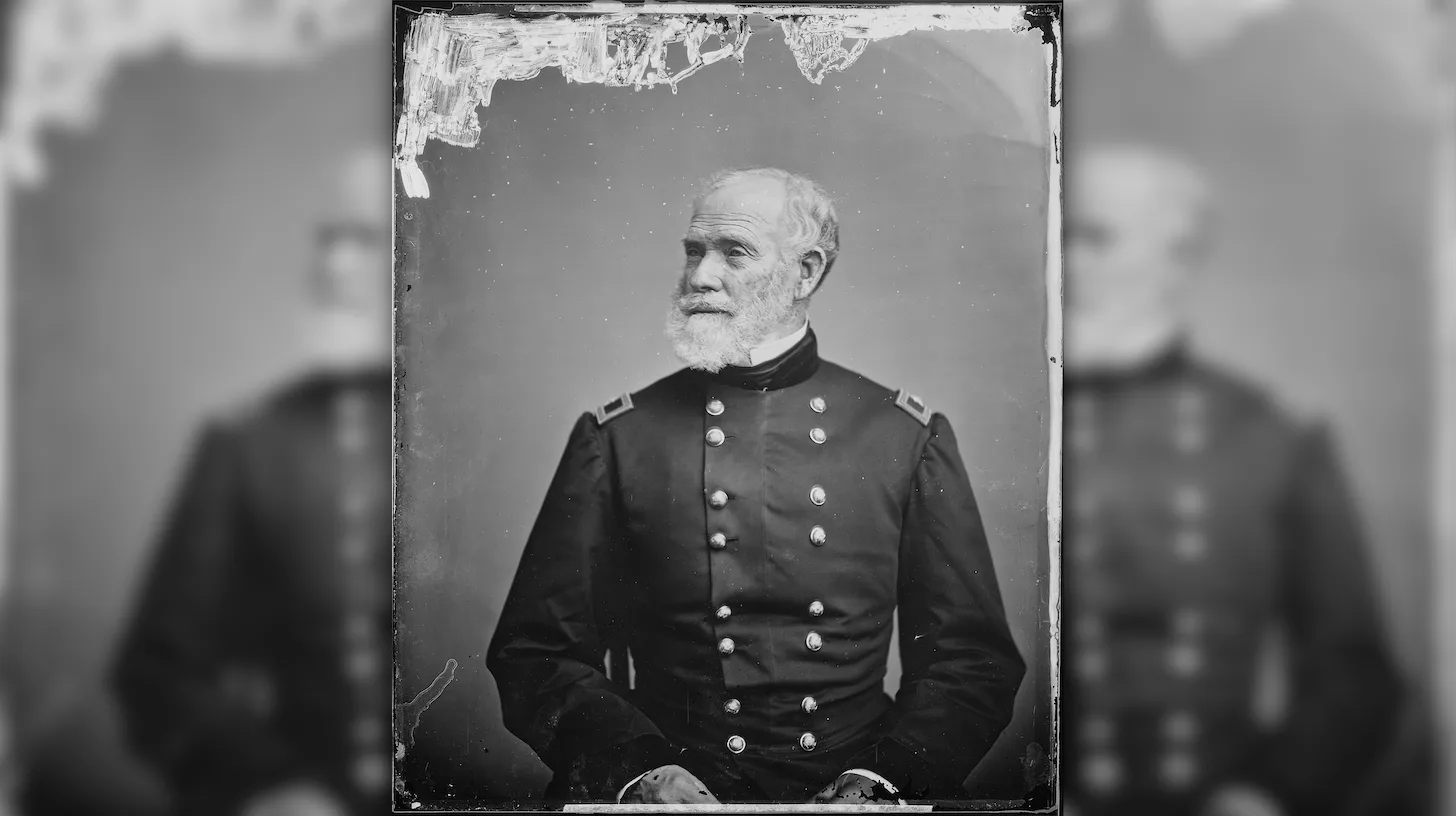
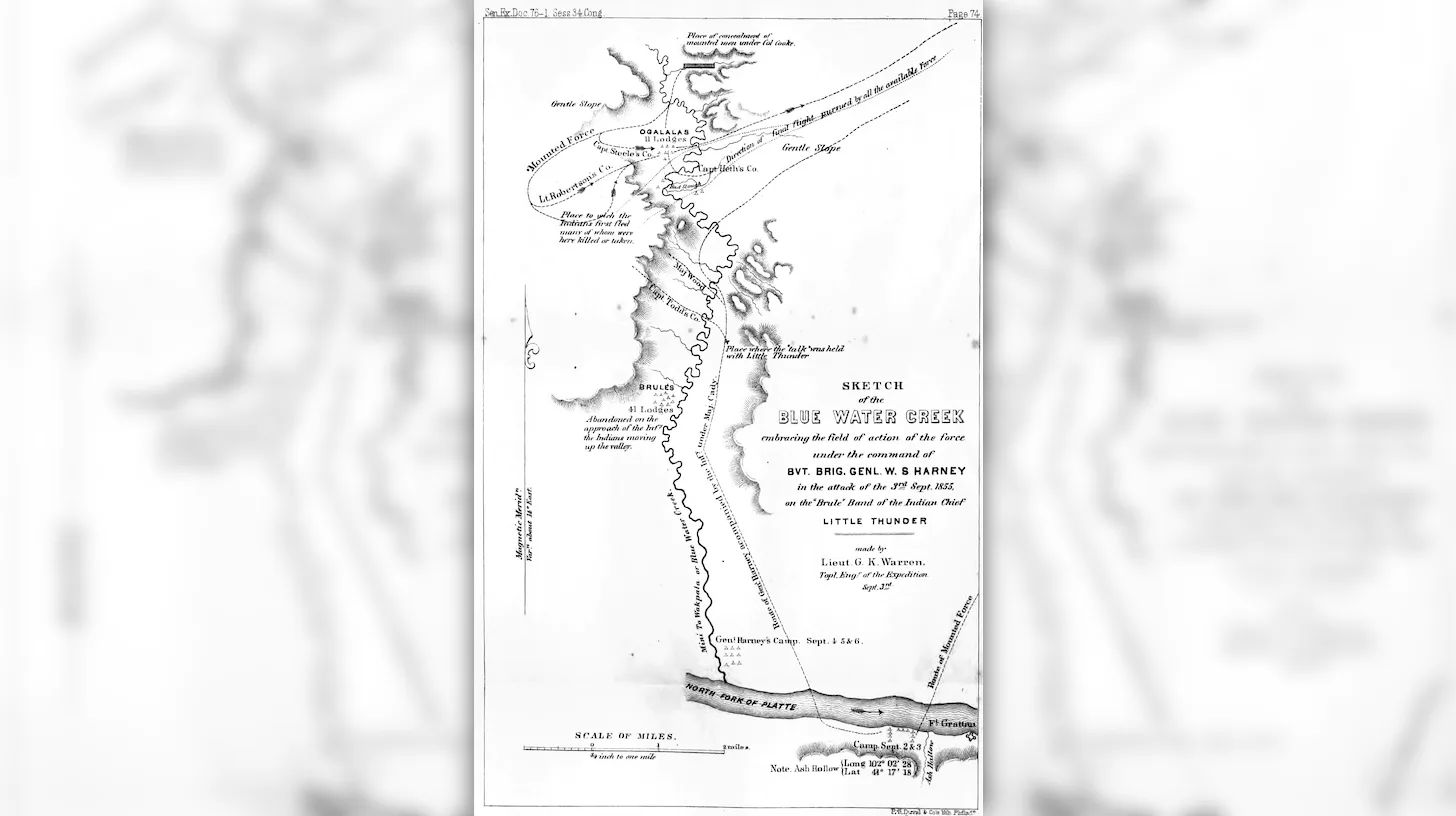
By then the Army had made up its mind. In the summer of 1855 a force of 600 men under Gen. William S. Harney marched west from Fort Leavenworth, and on September 3 it attacked the Brulé camp of Little Thunder on Blue Water Creek, near Ash Hollow in what is now Nebraska, killing 86 people and capturing about as many women and children. The National Park Service calls it punishment for the Grattan defeat.
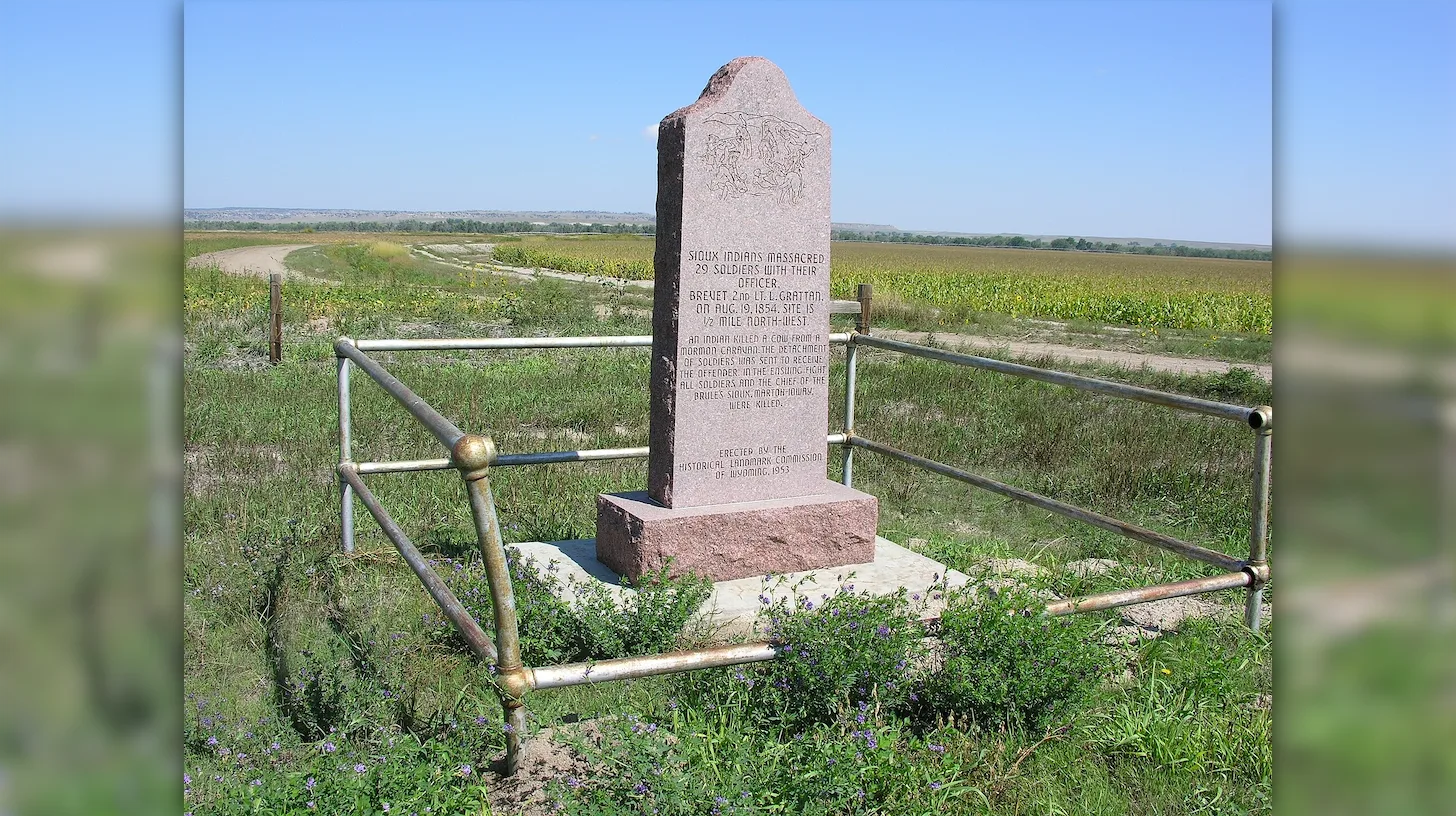
Half a century later the Oglala chief Red Cloud still spoke of the day “when Conquering Bear was assassinated by the drunken lieutenant’s orders.” The enlisted men were moved in time to a single grave at the Fort McPherson National Cemetery in Nebraska. A granite marker stands near the site, south of Lingle, Wyoming, and says the Sioux massacred twenty-nine soldiers there with their officer.
The emigrants whose cow it was had already moved on. They had let the Lakota keep the meat.