14 min read
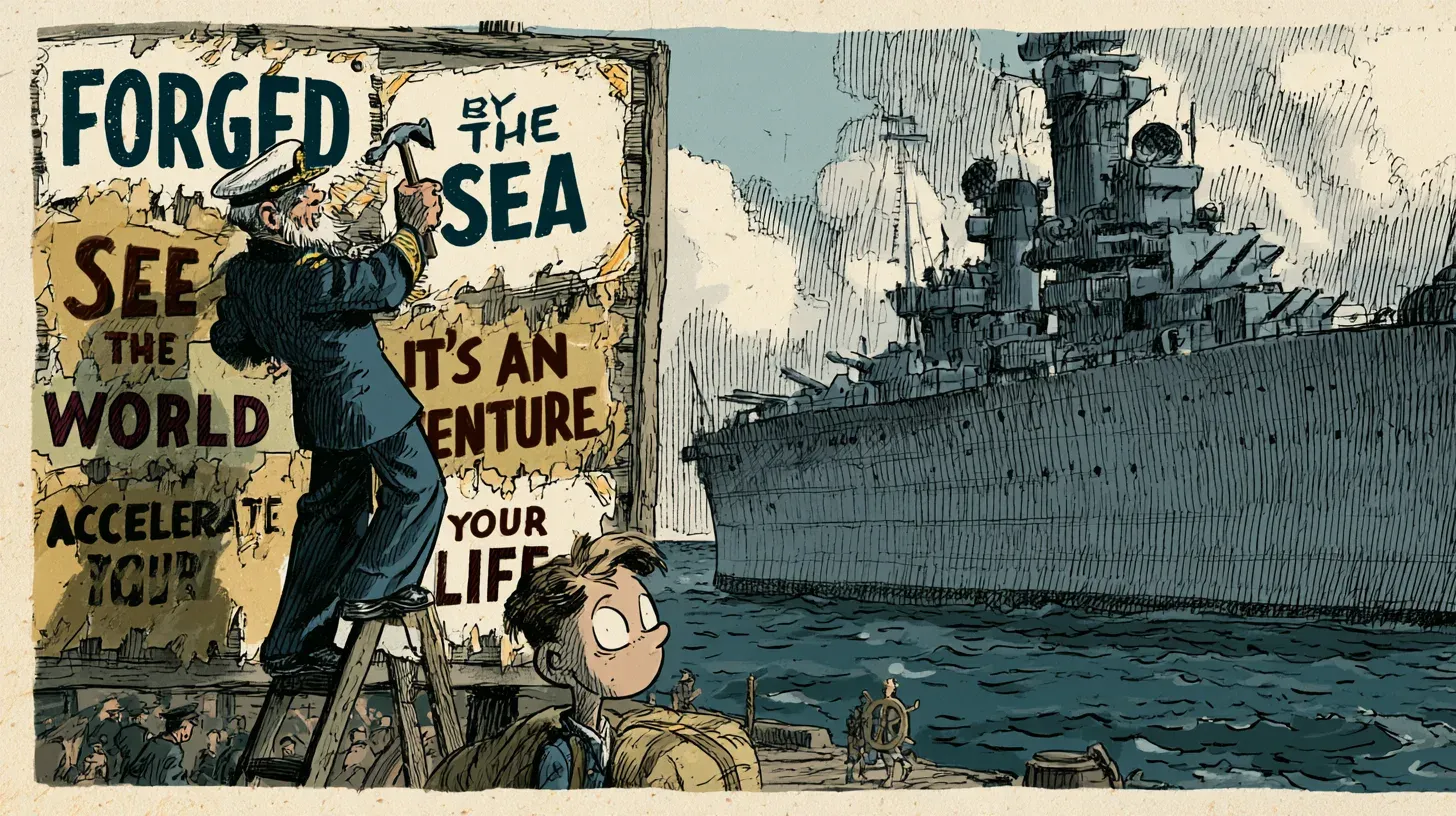
The U.S. Navy’s recruiting slogan is “Forged by the Sea,” launched during the Army-Navy game on December 9, 2017, and still running in 2026. Navy Recruiting Command counts it as the 10th tagline since the draft ended in 1973. The Navy has never had an official motto, and its own historians say so.
Before the taglines there were posters that promised a trip abroad. After them came a run of slogans the Navy kept replacing, including one that 50 of the 56 Navy Times readers who wrote in disliked.
LIST OF NAVY SLOGANS
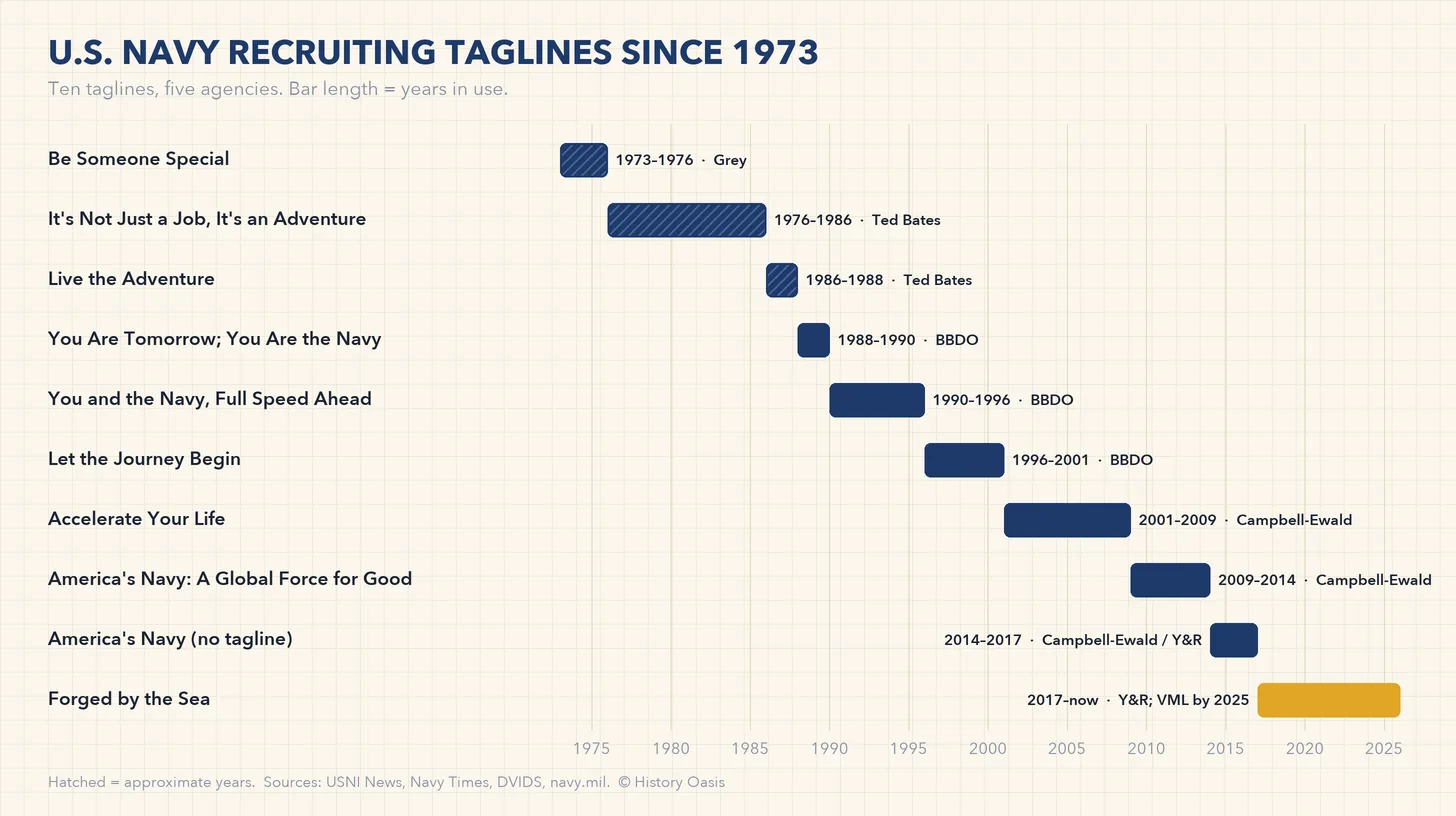
The Navy has used ten recruiting taglines since 1973, written by at least five advertising agencies, plus one older poster promise that never had an end date.
| Slogan | Years | Agency |
|---|---|---|
| Join the Navy and See the World | World War I posters | Poster appeal, not a tagline |
| Be Someone Special | 1973–c. 1976 | Grey Advertising |
| It’s Not Just a Job, It’s an Adventure | 1976–c. 1986 | Ted Bates |
| Live the Adventure | c. 1986–1988 | Ted Bates |
| You Are Tomorrow; You Are the Navy | 1988–1990 | BBDO |
| You and the Navy, Full Speed Ahead | 1990–1996 | BBDO |
| Let the Journey Begin | 1996–2001 | BBDO |
| Accelerate Your Life | 2001–2009 | Campbell-Ewald |
| America’s Navy: A Global Force for Good | 2009–2014 | Campbell-Ewald |
| America’s Navy (no tagline) | 2014–2017 | Campbell-Ewald, then Young & Rubicam |
| Forged by the Sea | 2017–present | Young & Rubicam; VML by 2025 |
The count of ten is the Navy’s own. When “Forged by the Sea” launched, the command called it “the 10th tagline adopted by the sea service in the past 45 years.” The years for “Live the Adventure” come only from a former recruiter’s site, Navy CyberSpace; no Navy source dates it.
JOIN THE NAVY AND SEE THE WORLD
“Join the Navy and see the world” was never an official tagline. It was the pitch on Navy recruiting posters of the World War I era. A poster from a Little Rock ad agency, dated between 1914 and 1918, shows a sailor pointing a young man to a billboard under the line “See the world, serve your country, save your money.”
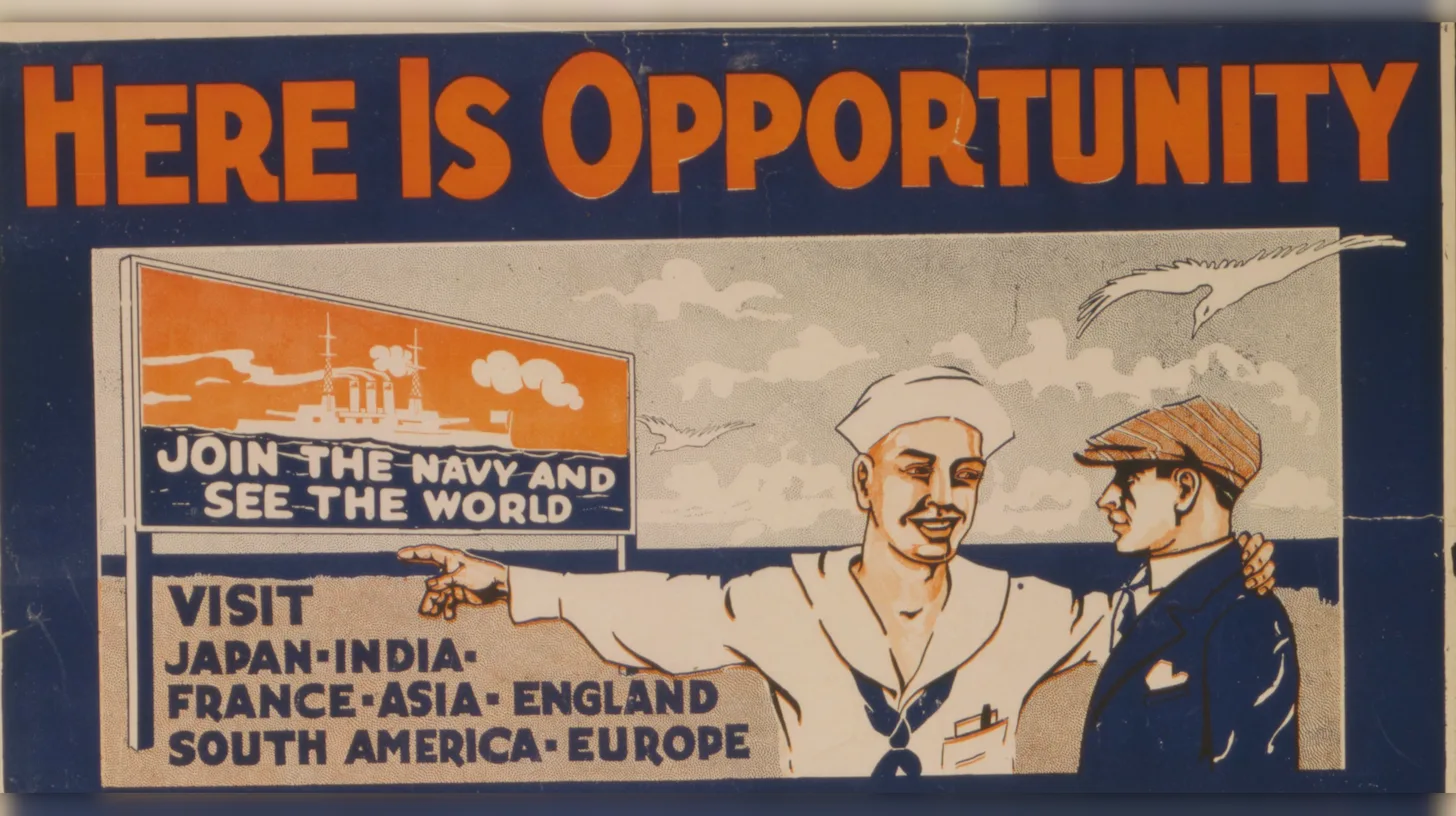
The order of the promises moved around. A poster in the Naval History and Heritage Command’s collection puts the money second: “See the world! Save your money! Serve your Country!”
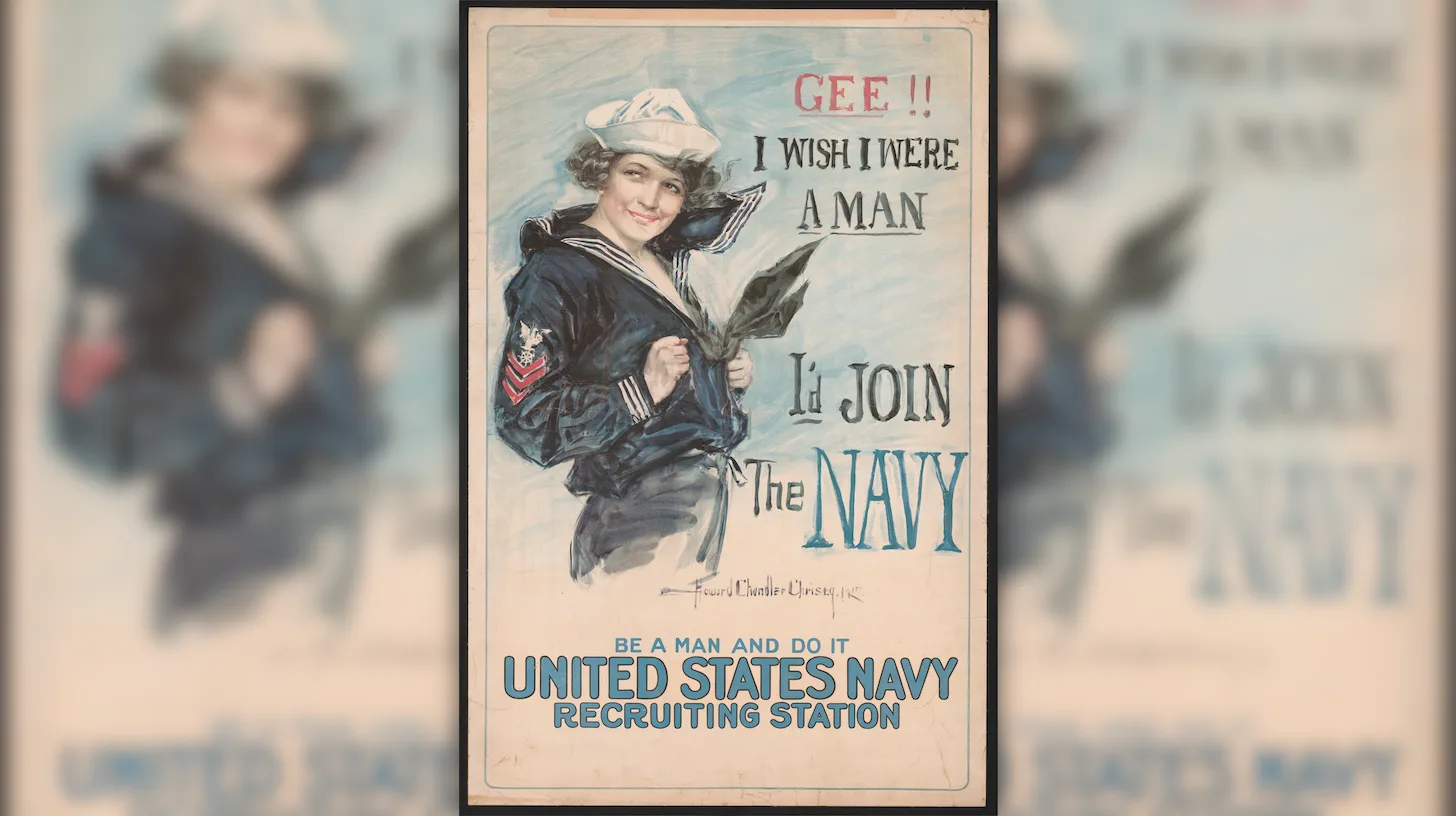
The best-known poster of the war took a different approach. Howard Chandler Christy’s 1917 design put a young woman in a sailor’s uniform above the words “Gee!! I wish I were a man, I’d join the Navy.” The line underneath did the recruiting: “Be a man and do it.”
By 1942 the travel pitch had a new job. A World War II poster painted a destroyer over a chained globe and crossed out one word: the Navy no longer offered to let you see the world, but to free it.
BE SOMEONE SPECIAL
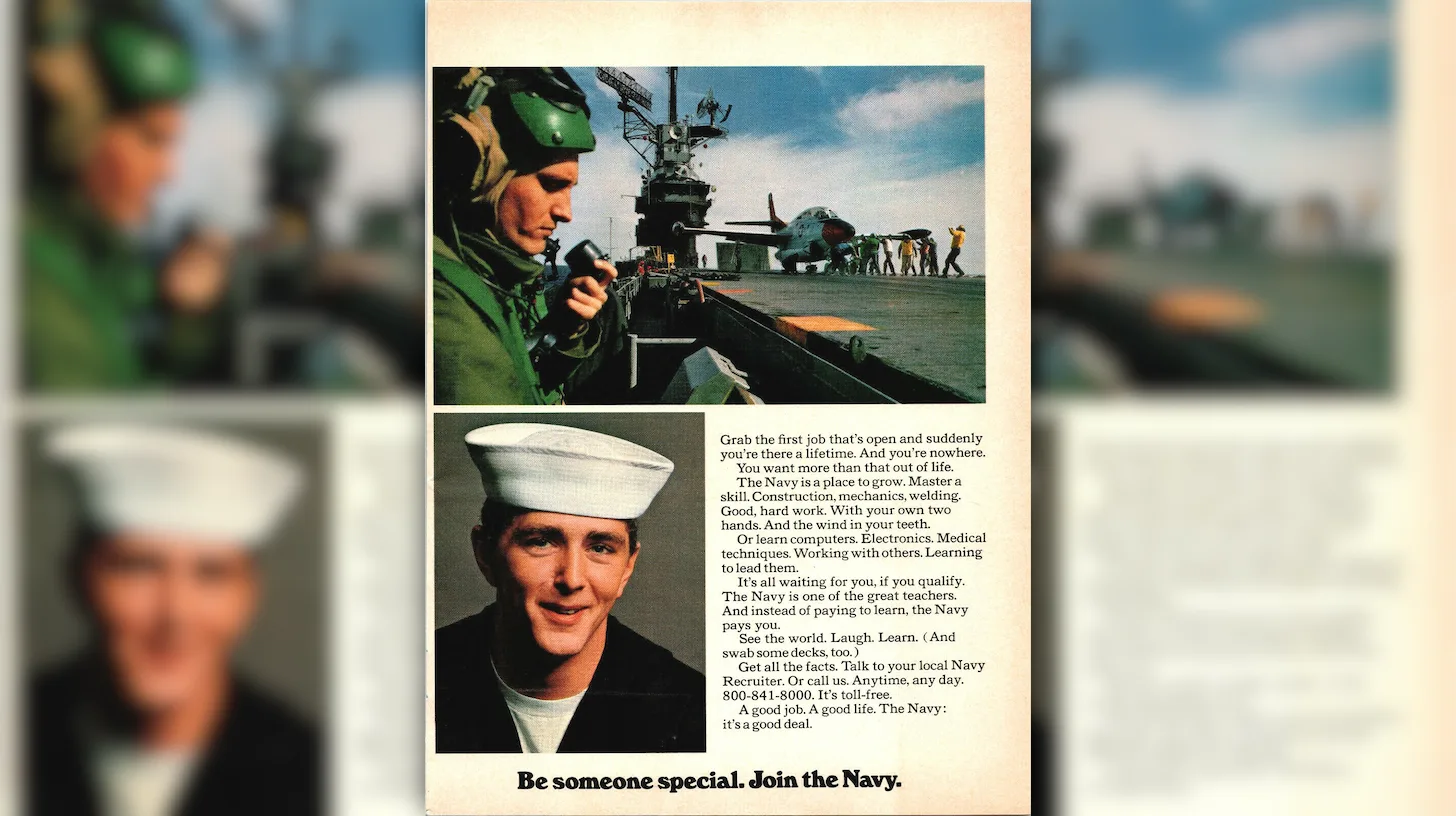
“Be Someone Special” was the Navy’s first slogan of the all-volunteer era, written by Grey Advertising in 1973. That year Defense Secretary Melvin Laird announced there would be no more draft, and the Navy turned to advertising agencies and television to fill its ranks. USNI News calls Grey’s campaign “short-lived.”
It ended in a fight over the account. When the Navy chose its next recruiting agency in 1975, the command that would use the ads wanted to keep Grey. A federal ruling records that “it was the opinion of NRPO and the requiring activity, the Navy Recruiting Command (NRC), that the contract should be awarded to Grey.”
The Navy gave it to Ted Bates Advertising instead, on September 2, 1975. The job was sized at $16 million and 143,000 man-hours for the year. Grey protested to the General Accounting Office, which ruled on May 14, 1976: “The protest is denied.”
USNI News later wrote that the protest “wasn’t resolved until 1977.” The GAO’s own decision carries the 1976 date.
IT’S NOT JUST A JOB, IT’S AN ADVENTURE
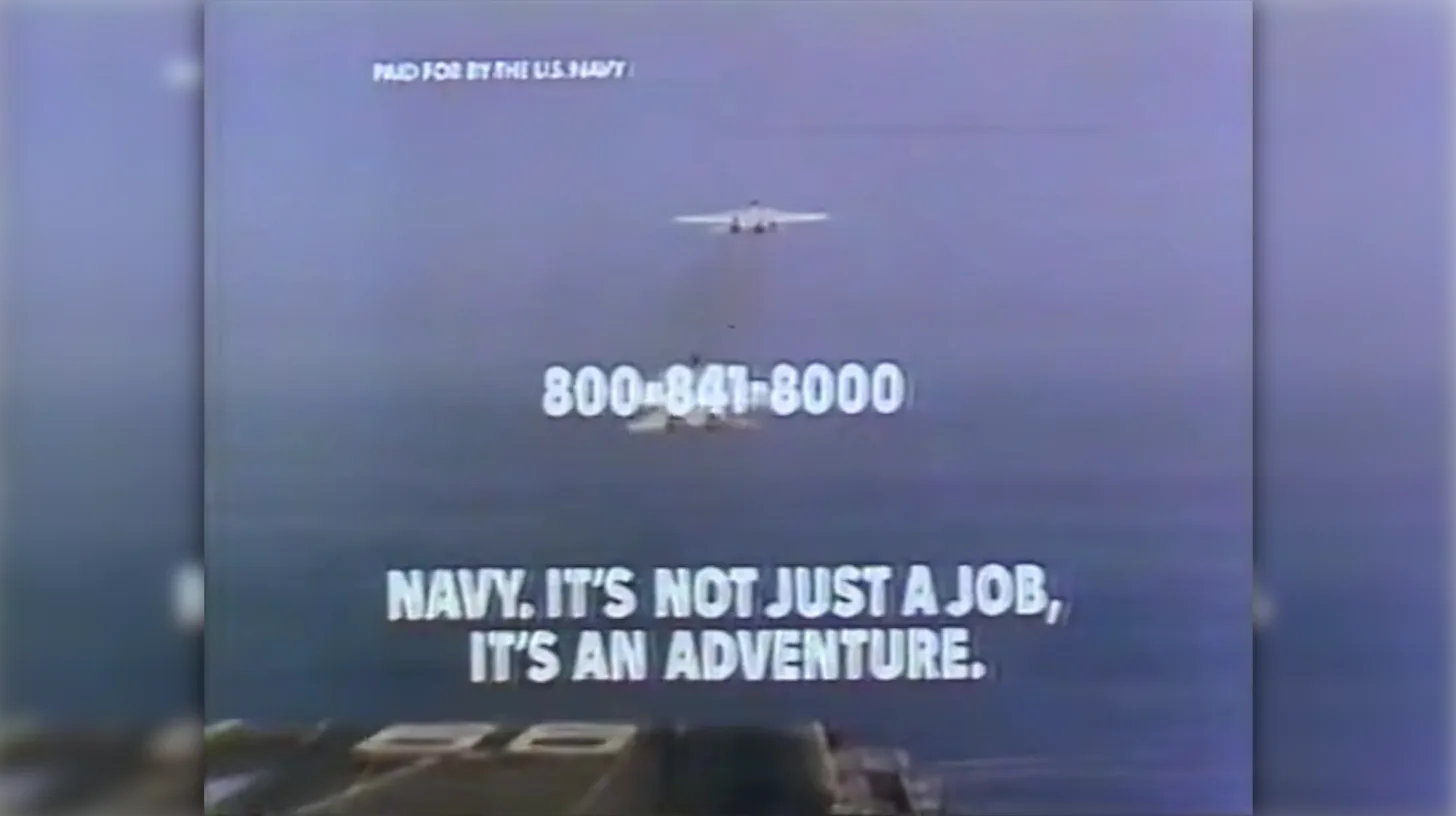
“Navy. It’s Not Just a Job, It’s an Adventure” was Ted Bates & Company’s slogan for the Navy, launched after the agency took over the account in 1976. USNI News calls it one of the most enduring Navy recruiting slogans. The commercials showed sailors on liberty in foreign ports such as Hong Kong, and USNI News describes them as answering a recruit’s “what’s in it for me” question.
Bates kept the formula and changed the words. “Bates tried a few variations on the general theme before the service moved on in 1988,” USNI News records. The last of them was “Live the Adventure,” which a Navy story on DVIDS lists among the post-draft slogans.
One thing survived the change of agencies. The 1981 sign-off above gives the same toll-free number, 800-841-8000, that closed Grey’s Be Someone Special print ads.
WAS ‘IN THE NAVY’ A RECRUITING VIDEO?
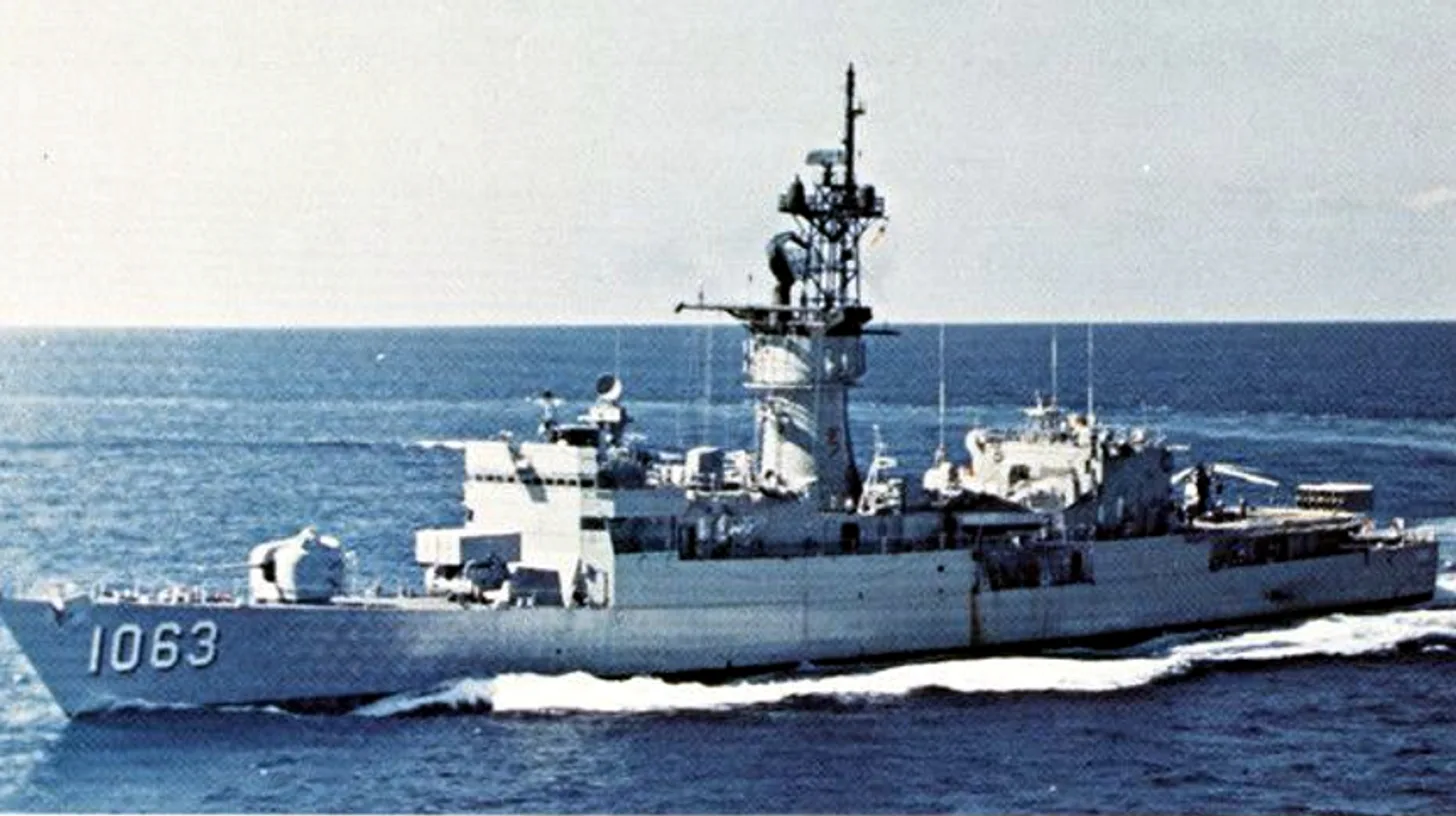
The Village People’s In the Navy may have started as one, but the Navy says it has no record of that. The video premiered in March 1979 and was shot aboard the frigate USS Reasoner. Task & Purpose reported in 2019 that Navy public affairs officers in the Pacific Fleet had contacted the band’s co-founder, Henri Belolo, and that the video “was originally intended as a recruiting video.”
The Naval History and Heritage Command found nothing to back that up. A search of existing records, its spokesman told the magazine, showed “no record of a connection” between the Navy and the Village People.
The crew’s version has one date problem. Two sailors told Task & Purpose that “then-Secretary of the Navy John F. Lehman Jr.” disavowed the video. Lehman became Navy Secretary in 1981, two years after it premiered.
THE BBDO SLOGANS, 1988 TO 2001
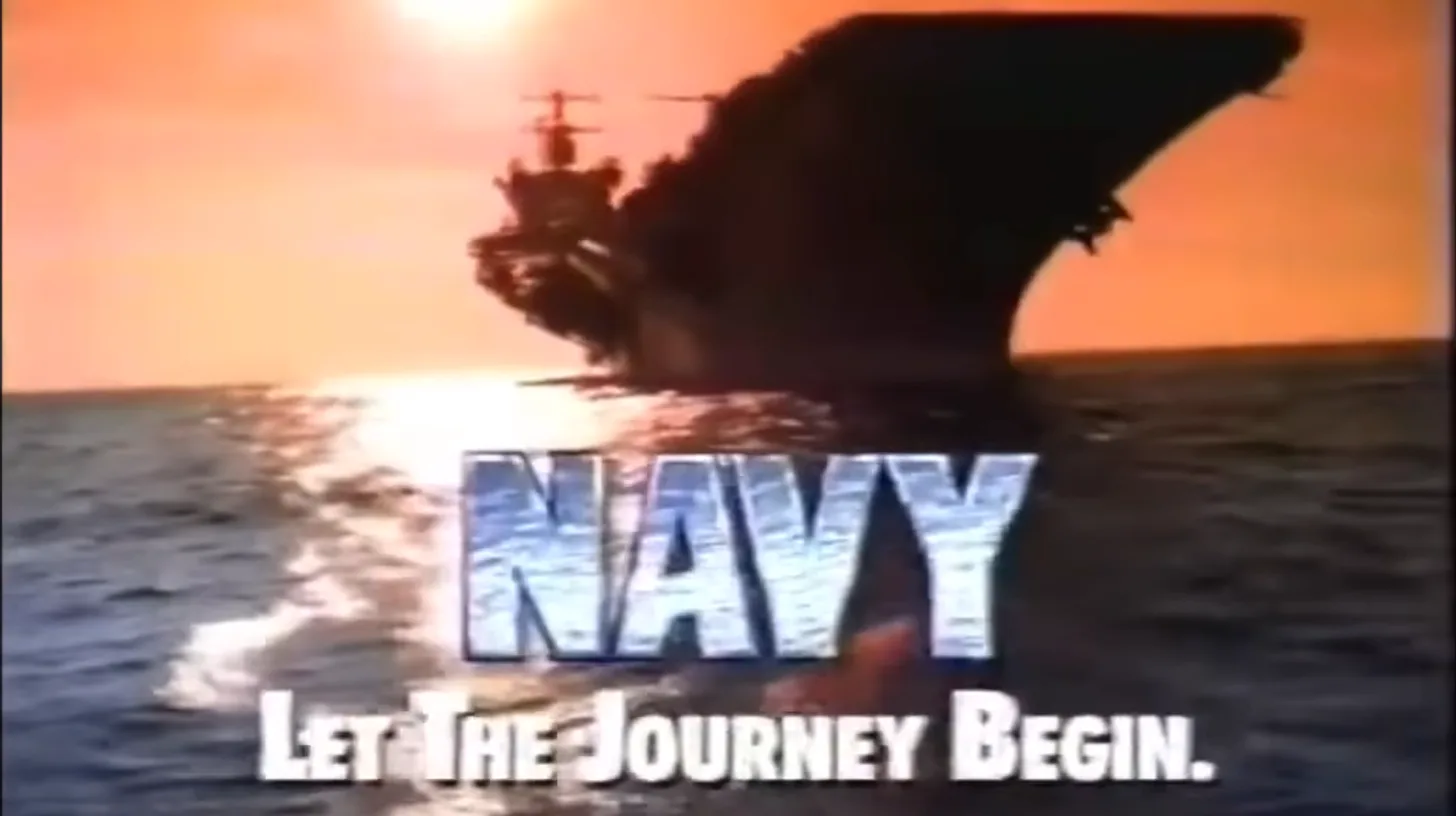
BBDO Worldwide took the Navy’s advertising in 1988 and wrote three slogans in 13 years: “You Are Tomorrow; You Are the Navy” (1988–1990), “You and the Navy, Full Speed Ahead” (1990–1996) and “Let the Journey Begin” (1996–2001), according to USNI News. BBDO New York had launched Visa’s long-running card campaign three years earlier.
At least one sailor signed up because of the last one. Chief Quartermaster Tyrone Anthony, interviewed when the Navy changed slogans in 2017, remembered signing up under it: “I joined under ‘Let the Journey Begin,’” he said. “I loved it because, at the time, that is what I wanted out of life.”
The turnover had a cost the Navy itself measured. A 2002 internal report concluded that “the Navy has historically had an image problem,” and named a cause: “Significant turnover in slogans and campaigns, and inconsistent advertising spending practices are contributors to the current problem.”
ACCELERATE YOUR LIFE
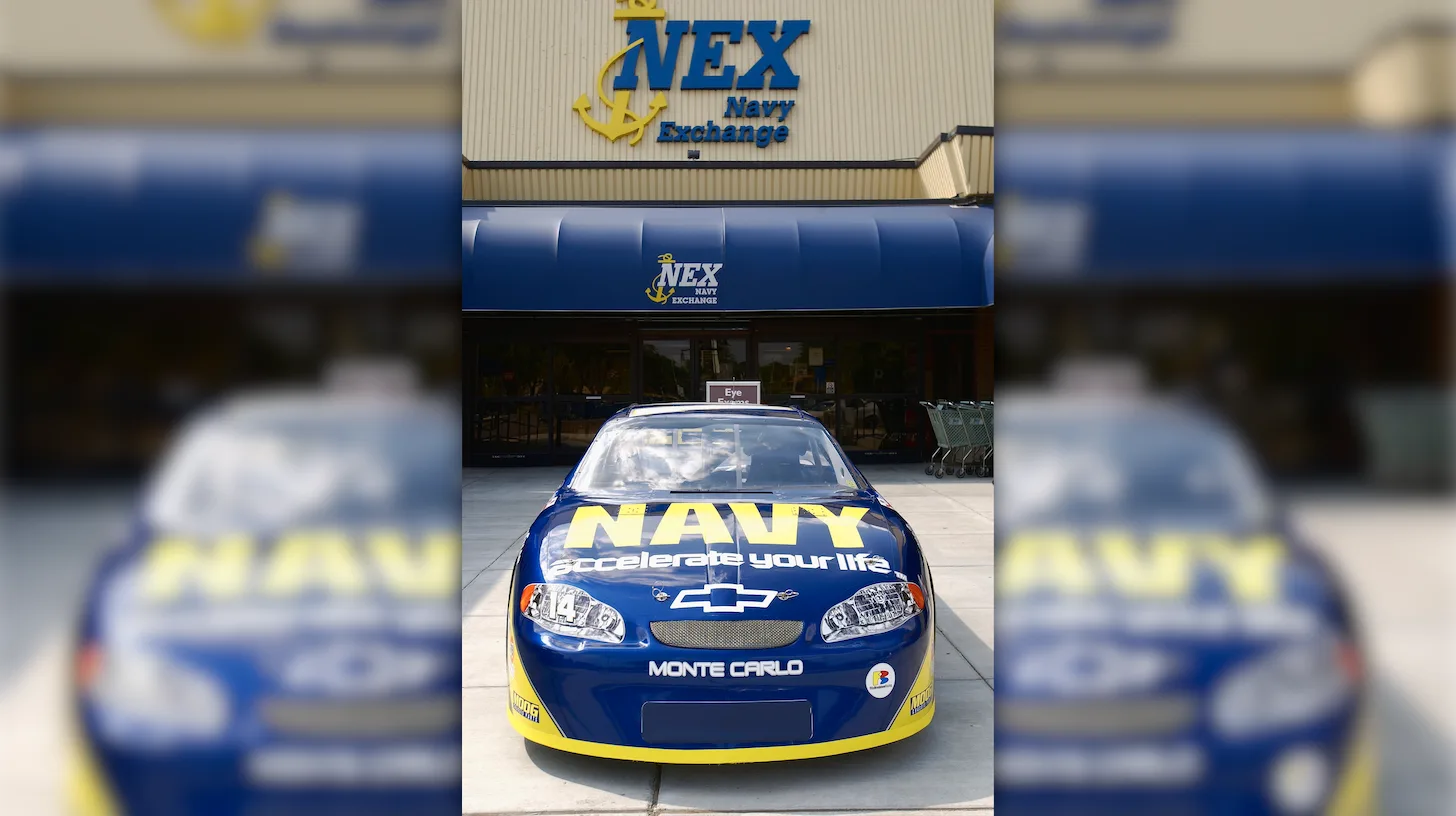
“Accelerate Your Life” was the Navy’s slogan from 2001 to 2009, written by Campbell-Ewald, the Detroit agency that made Chevrolet’s ads for 90 years. An Associated Press story in 2006 dated its start to January 2001. The campaign put a No. 14 Navy car on NASCAR tracks and ran the 2006 Footprints spot for the SEALs.
The commercials had a soundtrack: the hard-rock band Godsmack. The Navy used Awake for three years, then came back for Sick of Life. Singer Sully Erna told Arthur magazine in 2006 that he doubted the music did much recruiting: “But I doubt very seriously that a kid is going to join the Marines or the US Navy because he heard Godsmack as the underlying bed music in the commercial.”
The voice on those spots belonged to the actor Keith David, who narrated Navy commercials for 16 years.
The slogan’s weakness was the audience it skipped. The Navy’s advertising chief, Capt. Phil Altizer, said in 2009 that “‘Accelerate your life’ was never designed to energize sailors, veterans, influencers and stakeholders about naval service.”
A GLOBAL FORCE FOR GOOD
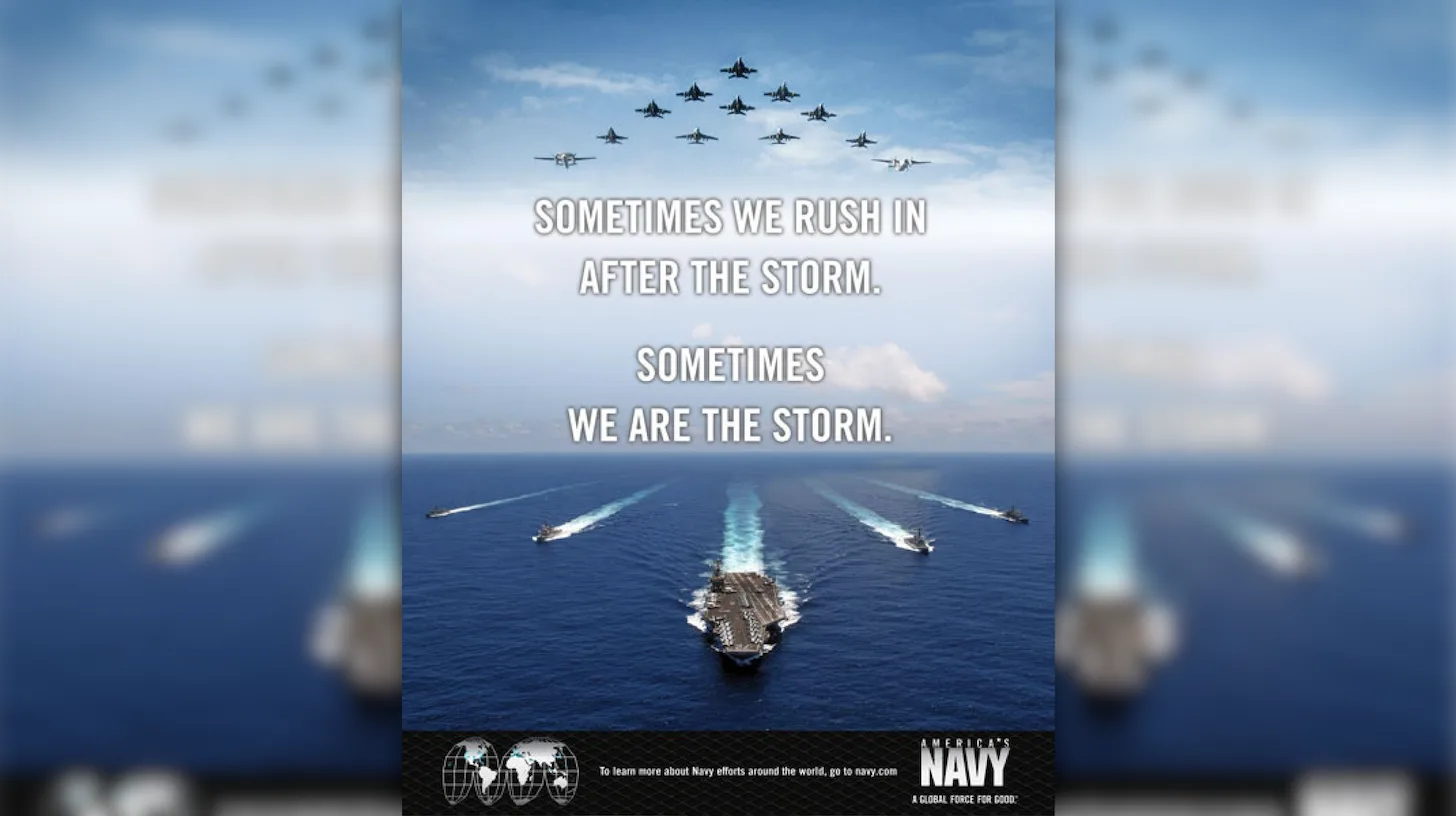
“America’s Navy: A Global Force for Good” replaced “Accelerate Your Life” in the fall of 2009, timed to the Navy’s 234th birthday on October 13. The first TV spot leaned on service: sailors delivering humanitarian supplies and a long shot of the hospital ship Mercy. Altizer knew the gamble: “It’s absolutely a risk - every time you invest in something like that, it’s a risk.”
Sailors answered within the week. Of the 56 readers who e-mailed Navy Times about it, 50 disliked it. “Holy cow! This is getting really stupid,” said Machinist’s Mate 1st Class Michael Dayton. “Why do we need to change our slogan again?”
The complaints did not fade. In June 2013 the Navy paid Gallup $40,000 to host 19 focus groups of sailors and veterans. One senior enlisted sailor in San Diego summed it up: “It doesn’t do anything for me. It does nothing.”
The Navy phased it out over 2014. A spokesman, Cmdr. Chris Servello, said in December 2014: “We’ve been phasing out the global force for good tagline over the past year.” NPR’s verdict the next summer was shorter: “Just about everybody hated it.”
FORGED BY THE SEA
“Forged by the Sea” is the Navy’s current slogan. It debuted in a commercial called Sea to Stars during the second quarter of the Army-Navy game on December 9, 2017, after “more than 18 months of research, development and focus group testing.” It was aimed at what the Navy called centennials, recruits aged 17 to 21.
For three years before that, the Navy ran on its name alone. The December 2014 Army-Navy spot The Shield closed with Keith David’s voice: “To get to you, they’d have to get by us: America’s Navy.” A 2015 Navy Times reader contest picked a replacement, “America’s Navy: We’ve got the watch,” which the Navy never used.
The new line came from Young & Rubicam, the agency that cast Bert Lahr in Lay’s potato chip ads in 1963. Rear Adm. Pete Garvin, head of Navy Recruiting Command, explained it in the launch release: “For more than 200 years our sailors have been tested and shaped by the sea.”
The launch campaign itself came to roughly $10 million. The contract behind it was far larger: Young & Rubicam’s price for up to five years of Navy advertising was $457,461,287, according to the GAO decision that upheld the award. USNI News printed the figure as $475.5 million.
Nearly nine years on, the line is still running. In August 2026, USNI News called the Navy’s newest commercial “the latest in the Forged By The Sea campaign,” and the Navy met its 2026 recruiting goal in July, three months early. The agency on the account is now VML.
WHAT IS THE NAVY MOTTO?
The U.S. Navy has no official motto. The Naval History and Heritage Command puts it plainly: “There is no official motto for the U.S. Navy.” The phrase most often cited is the Latin “Non sibi sed patriae,” meaning “not self but country,” which the USO notes is inscribed above the chapel doors of the Naval Academy.
The Navy’s other unofficial motto is younger. A retired senior chief, Jim Murphy, wrote in Proceedings in 2009 that “another unofficial motto is sometimes found on the Internet: Semper Fortis, or Always Strong.” He wanted the Navy to adopt it, and ended his column: “We need to be Semper Fortis!” It never did.
What the Navy does have officially are core values, and those were borrowed. From 1955 to 1992 they were professionalism, integrity and tradition. After the 1991 Tailhook scandal, a 2017 Proceedings essay records, “the Navy simply adopted the Marine Corps’ core values in toto”: honor, courage, commitment.
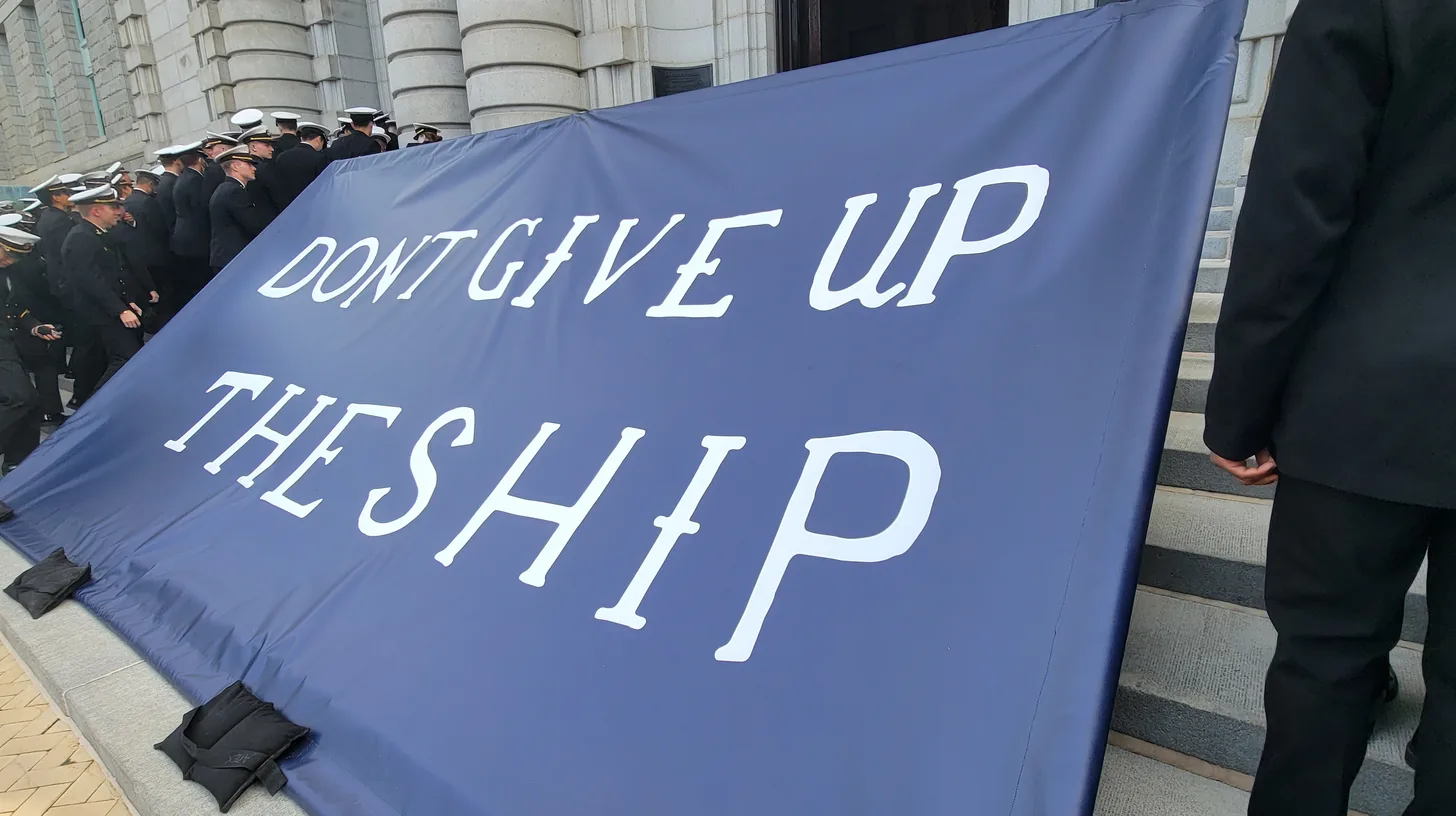
The Air Force went 63 years before it chose a motto in 2010. The Navy, founded in 1775, is still waiting. The phrase sailors fly instead is Capt. James Lawrence’s cry from the War of 1812, shouted aboard USS Chesapeake in 1813: “Don’t give up the ship!”
Three months later Oliver Hazard Perry carried the words into the Battle of Lake Erie on a battle flag, spelled without the apostrophe, and the flag has been at the Naval Academy since 1849. The copies sailors fly are navy blue. Conservators who treated the original after 2003 found it was “probably tan or brown, or possibly even black.”
NAVY SLOGANS FAQ
What is the current Navy slogan?
The current Navy slogan is “Forged by the Sea,” introduced during the Army-Navy game on December 9, 2017. It was still the Navy’s campaign theme in 2026, when USNI News called the year’s commercial the latest in the Forged by the Sea campaign. Before it came “America’s Navy” alone (2014–2017) and “A Global Force for Good” (2009–2014).
What does Semper Fortis mean?
“Semper Fortis” is Latin for “always strong,” also translated “always courageous.” It is an unofficial Navy motto, not an adopted one, and its origin is undocumented. The earliest dated Navy press mention found is a 2009 Proceedings column that called it a motto “sometimes found on the Internet.” It echoes the Marine Corps’ official motto, Semper Fidelis.
What is the Navy motto in Latin?
The Navy has no official motto in Latin or English. The Latin phrase most often cited is “Non sibi sed patriae,” meaning “not self but country,” which the Naval History and Heritage Command acknowledges is “often cited as the Navy’s motto.” A second Latin phrase, “Semper Fortis,” circulates as an unofficial motto. Neither was ever adopted.
What is the Navy’s battle cry?
The Navy has no official battle cry. The phrase used as one is “Don’t give up the ship!”, the cry Capt. James Lawrence raised aboard USS Chesapeake on June 1, 1813. Months later Oliver Hazard Perry flew it on his battle flag at Lake Erie. The other is Adm. David Farragut’s “Damn the torpedoes” at Mobile Bay in 1864.