15 min read
The Marine Corps’ recruiting slogan, “The Few. The Proud. The Marines.,” has run since 1977, written by J. Walter Thompson, the agency that has held the Marine account since 1947. The Corps planned to drop it in 2016 and kept it after all. The motto behind it is older: Semper Fidelis, adopted about 1883.
Since the 1970s, most of the Corps’ slogans have said the same thing in different words: the Marine Corps does not take everyone.
LIST OF MARINE CORPS SLOGANS
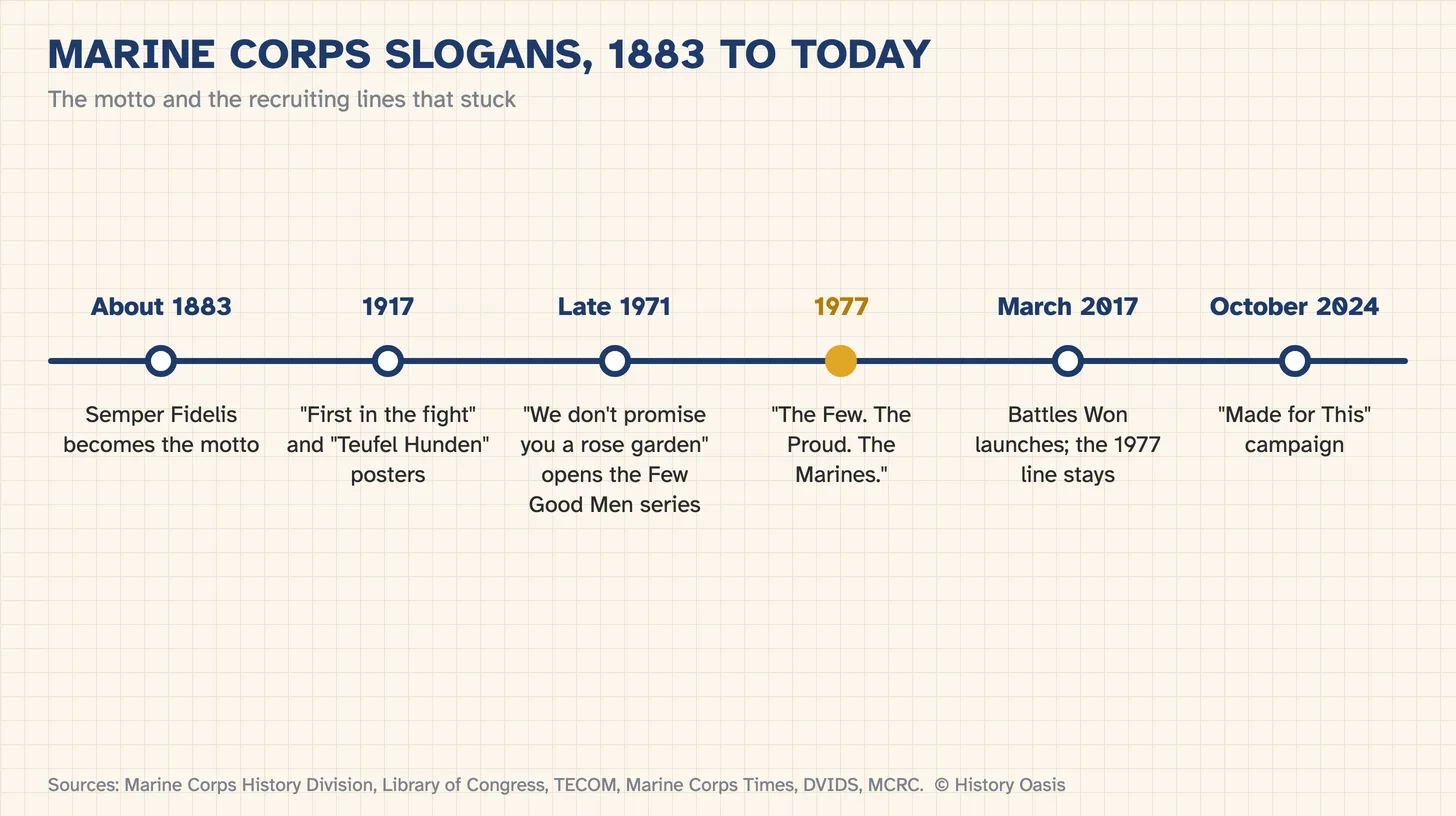
The Marine Corps has one official motto, three older traditional ones, and recruiting slogans going back to World War I.
| Slogan | Years | Who made it |
|---|---|---|
| Fortitudine; By Sea and by Land; To the Shores of Tripoli | Before 1812 to 1848 | Traditional mottoes |
| Semper Fidelis | About 1883 to present | Official motto |
| Soldiers of the Sea | 1916–1918 | World War I posters |
| First in the Fight / First to Fight | From 1917 | Posters; the 1929 hymn |
| Teufel Hunden (Devil Dogs) | 1917–1918 | Recruiting poster |
| Tell That to the Marines! | 1918 | James Montgomery Flagg |
| The Marine Corps Builds Men | c. 1950s–early 1980s | Recruiting posters |
| We Don’t Promise You a Rose Garden | Late 1971–mid-1984 | J. Walter Thompson |
| The Few. The Proud. The Marines. | 1977–present | J. Walter Thompson |
| Battles Won (brand, no new tagline) | 2017–present | J. Walter Thompson |
| Made for This | 2024–present | Thompson (VML) |
Two more taglines ran beside The Few in the same years, according to Marine Corps Times: “If Everybody Could Get In the Marines, It Wouldn’t Be the Marines” and “We’re Looking for a Few Good Men.” A third, “The Change Is Forever,” has no recorded years, and the dates for “The Marine Corps Builds Men” come only from a list on We Are The Mighty.
One agency wrote most of the modern lines. The Marine Corps hired J. Walter Thompson in July 1947, and its founder, James Walter Thompson, had served as a Marine himself. The same agency’s London office wrote Kit Kat’s slogan in 1957.
SEMPER FIDELIS AND THE OLD MARINE CORPS MOTTOES
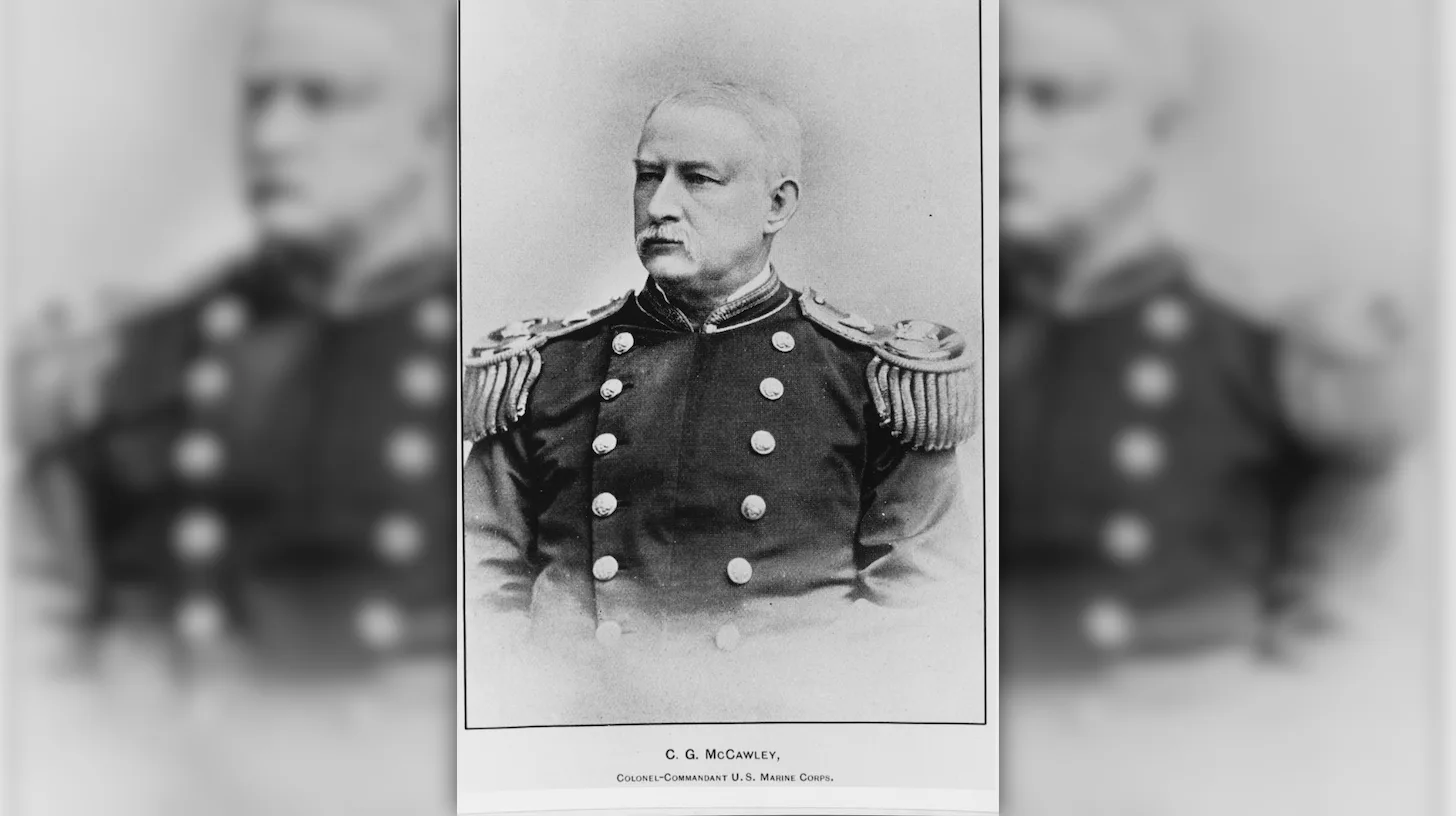
Semper Fidelis, Latin for “always faithful,” became the Marine Corps motto about 1883. Before it, the Corps had three mottoes, “all traditional rather than official,” according to the Marine Corps History Division.
The first, Fortitudine (“with fortitude”), dates from before the War of 1812. The second, “By Sea and by Land,” the History Division calls “obviously a translation” of the British Royal Marines’ Per Mare, Per Terram. The third, “To the Shores of Tripoli,” honored Presley O’Bannon’s capture of Derna, on the shores of Tripoli, in 1805. After the capture of Mexico City it grew, in 1848, into “From the Halls of the Montezumas to the Shores of Tripoli.”
Commandant Charles McCawley made Semper Fidelis official in 1883, Task & Purpose reported, and nobody wrote down why. “No records have yet been uncovered to indicate the reason for the adoption of this particular motto,” the History Division told the magazine. The Corps shares it with a British regiment, the Devonshire Regiment, once the 11th Foot.
Five years later the motto got its music. John Philip Sousa, who led the Marine Band from 1880 to 1892, wrote the “Semper Fidelis” march in 1888 and dedicated it to “the officers and men of the Marine Corps.”
FIRST TO FIGHT: THE WORLD WAR I POSTERS
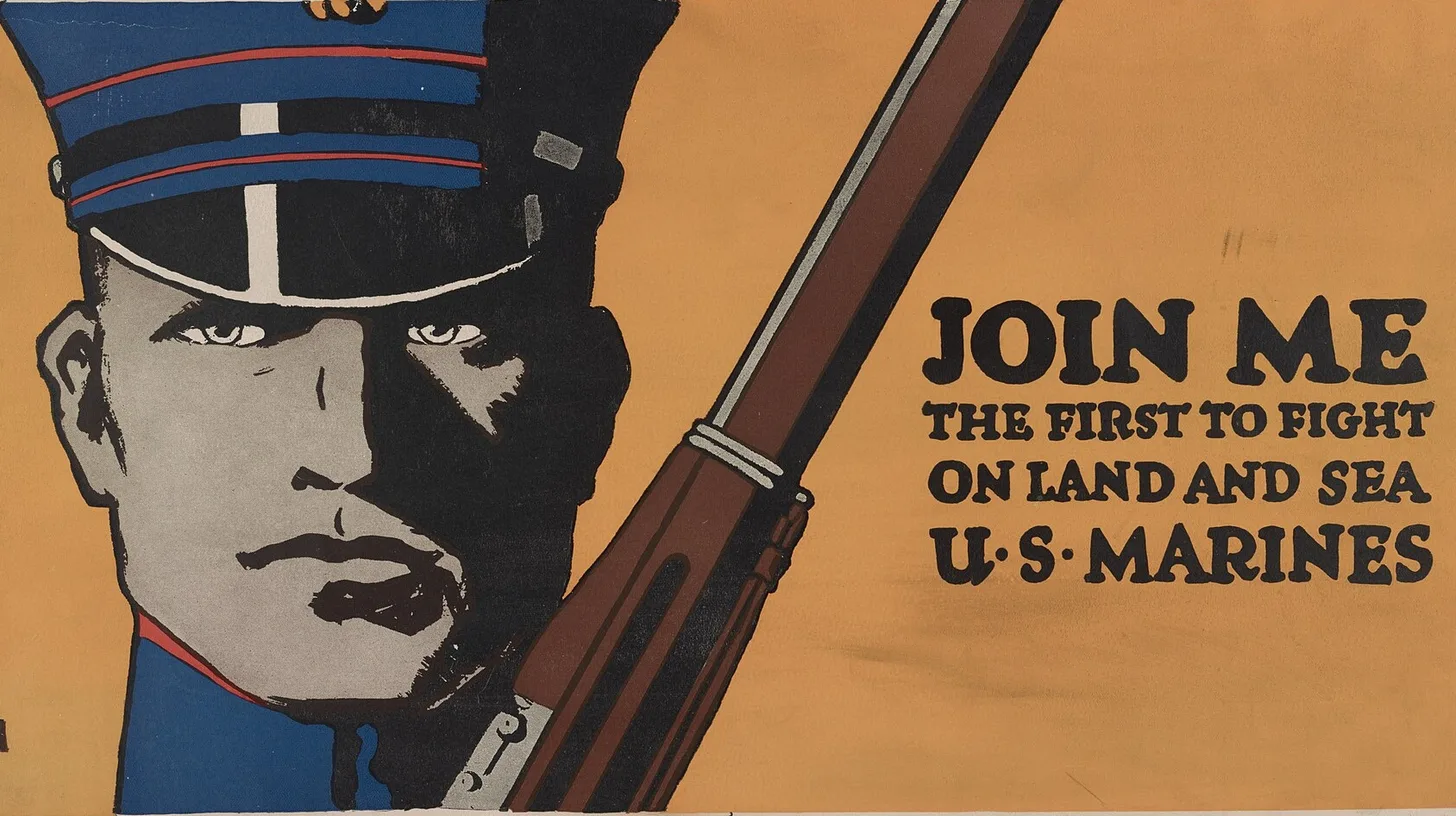
“First to fight” has been on Marine recruiting posters since World War I, and it is now in the Marines’ Hymn. The Commandant made its verses official in 1929, beginning with “First to fight for right and freedom.” James Montgomery Flagg’s version, dated July 19, 1917, read “First in the fight. Always faithful. Be a U.S. Marine!”
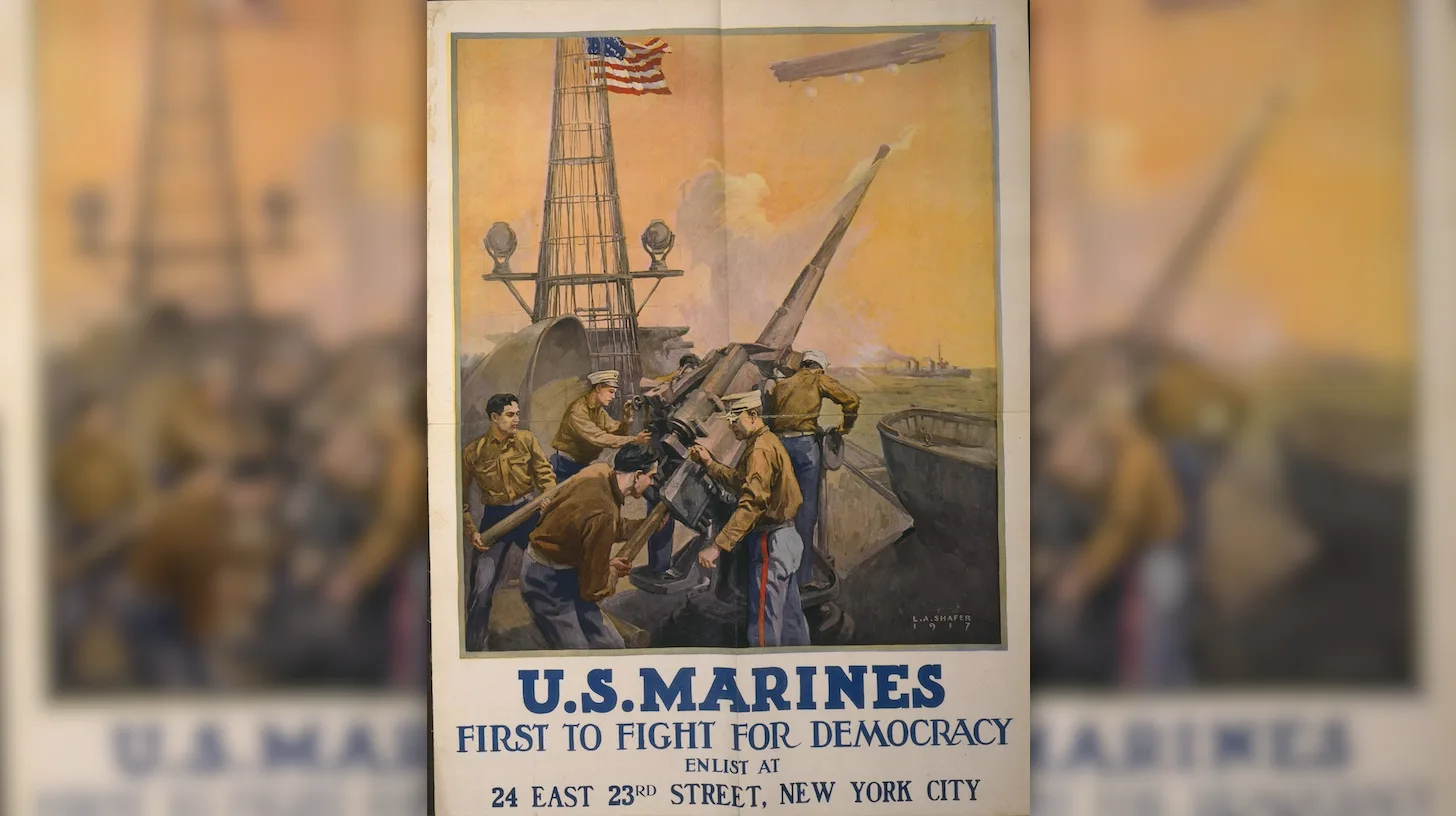
The Corps already had an office for this kind of work. A recruiting publicity bureau opened in Chicago in 1907, and the national Marine Corps Recruiting Publicity Bureau followed in New York in 1911, Marine Corps History records. Its monthly Recruiters’ Bulletin ran from 1914 to 1922.
The older line on those posters was “Soldiers of the Sea.” Sidney Riesenberg’s 1916 poster asked men to “Rally ‘round the flag with United States Marines,” and J.C. Leyendecker painted two Marines signaling to ships under the same words in 1917.
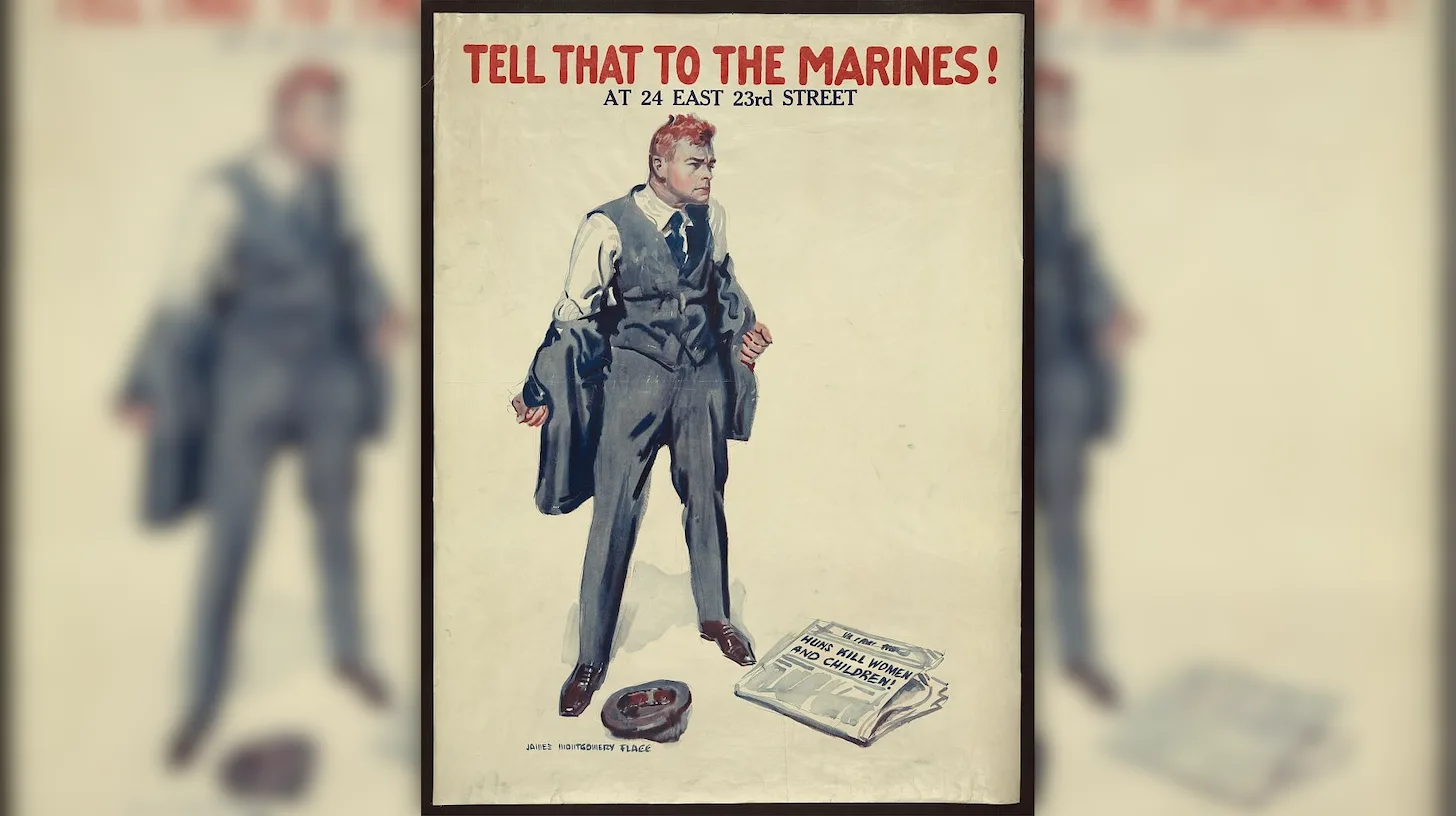
The angriest of them came in 1918. Flagg painted “Tell That to the Marines!” in public on August 1, 1918. The poster shows an angry man pulling off his coat over a newspaper headline: “Huns kill women and children!”
DEVIL DOGS AND BELLEAU WOOD
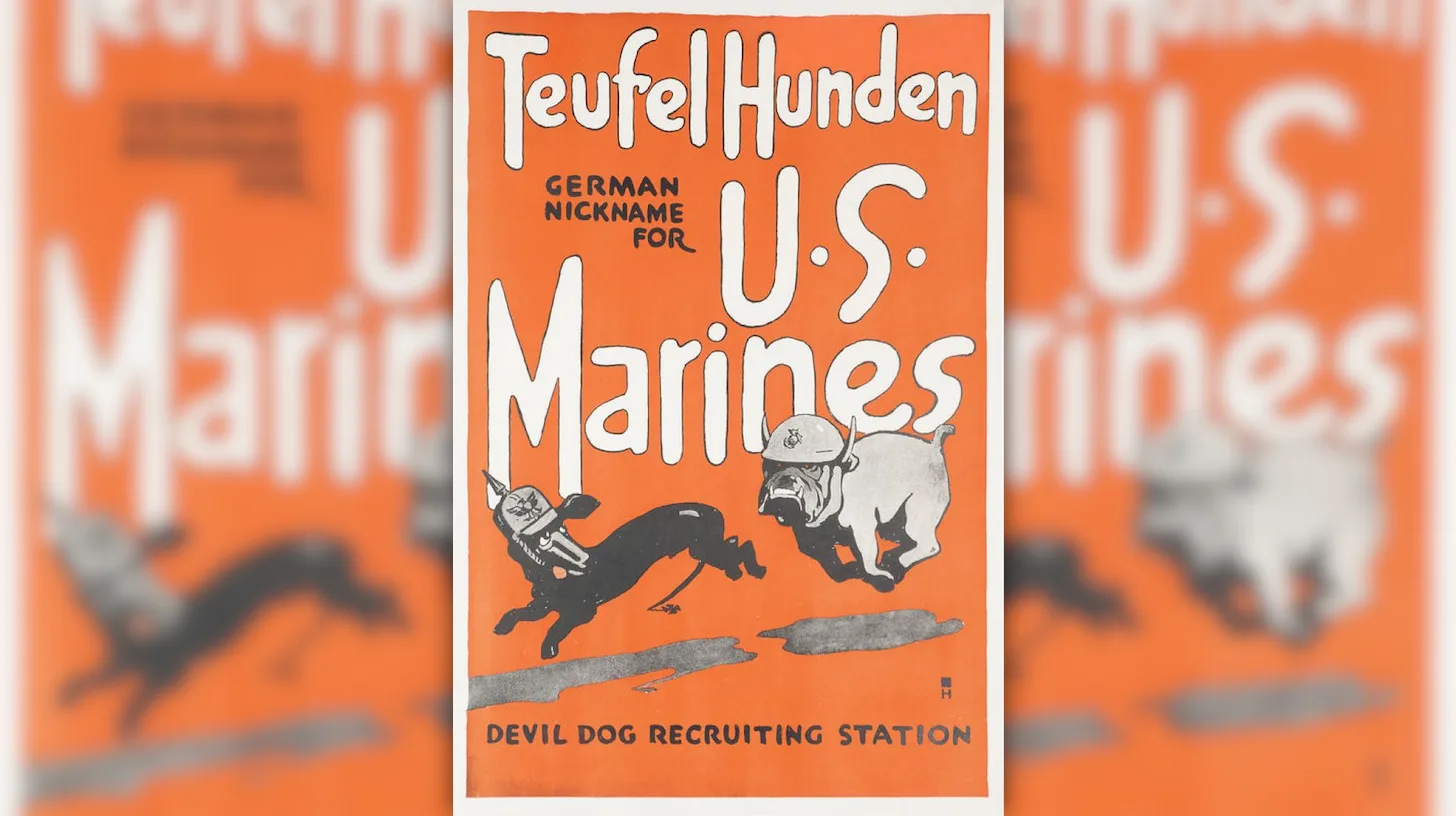
Marine lore says German troops named the Marines Teufelshunde, or Devil Dogs, at Belleau Wood in June 1918. In the version the U.S. Army retells, German officers used the word in their battle reports, and the war correspondent Floyd Gibbons helped by calling one gunnery sergeant “Devil Dog Dan” in his dispatches.
The Marines’ own poster may be older than the battle. The Library of Congress dates a recruiting poster titled “Teufel hunden, German nickname for U.S. Marines” to 1917. It shows a bulldog in a Marine helmet chasing a dachshund in a German helmet. Other copies are dated 1917 or 1918, so the order is likely, not certain.
The poster was known well enough to parody within months. In August 1918 a cartoonist, Clifford Berryman, drew a parody of it with a note: “With apologies to a U.S. Marine poster.”
Belleau Wood gave the Corps its best-known sayings anyway. “Retreat Hell! We’ve just got here!” is credited by the History Division to “several World War I Marine Corps officers”; the name most often given is Capt. Lloyd Williams, on June 2, 1918. Gunnery Sgt. Dan Daly, one of only two Marines with two Medals of Honor for separate acts, is credited with “Come on, you sons of bitches, do you want to live forever?”
WE DON’T PROMISE YOU A ROSE GARDEN
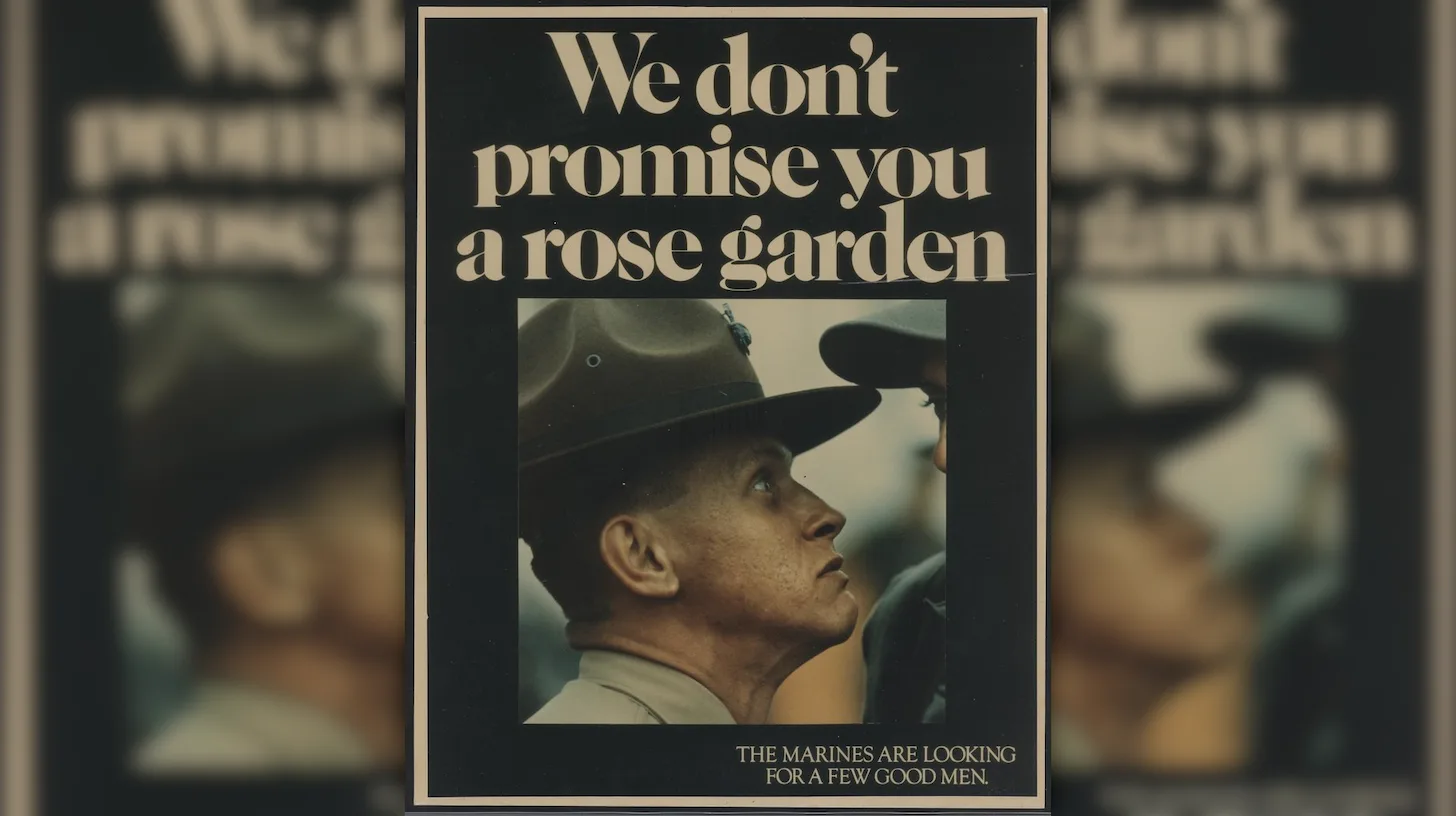
“We Don’t Promise You a Rose Garden” was the poster that opened the Marine Corps’ 1970s recruiting push. The face on it belonged to Sgt. Charles A. Taliano, a drill instructor, and the series it started carried the line “The Marines are looking for a few good men.” Taliano says it ran from late 1971 until mid-1984.
The photo was never meant for a poster. A Marine reservist took it in 1968 for a book about boot camp, and Taliano learned he was the face of the campaign from a Newsweek article published on November 29, 1971. Years later, a signing at the Parris Island store sold about 500 copies in two days.
The title borrowed from a pop song. J. Walter Thompson found its inspiration in Lynn Anderson’s hit “I Never Promised You a Rose Garden,” according to the Veterans Breakfast Club.
The “few good men” line is older than the poster, but how much older is uncertain. Marine tradition credits Capt. William Jones, who is said to have advertised for “a few good men” in 1779. Accounts disagree on whether the ad ran in Providence or Boston, and no copy of it turned up for this article. The Corps’ own recruiting site puts the phrase at Tun Tavern in 1775.
THE FEW. THE PROUD. THE MARINES.
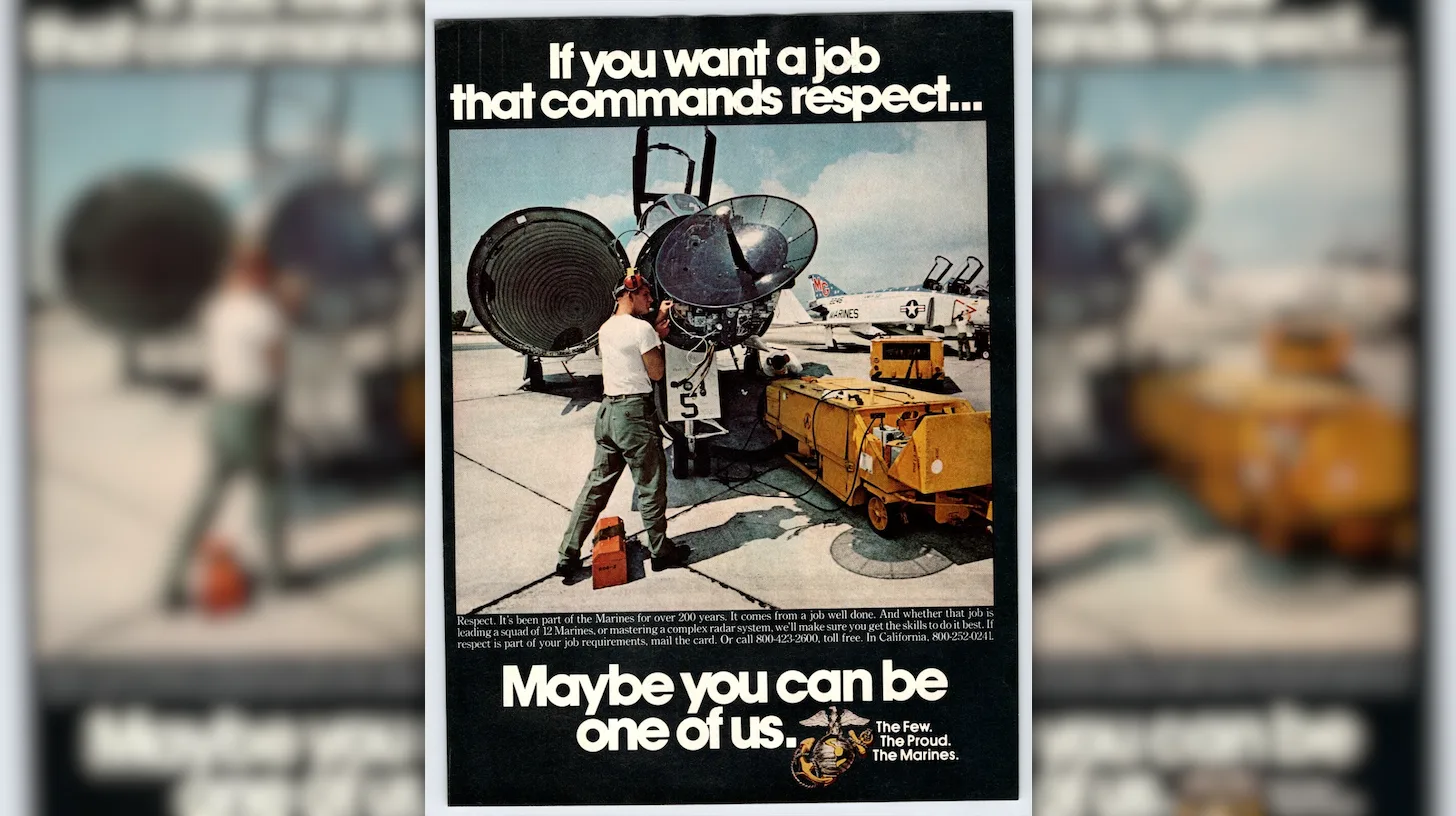
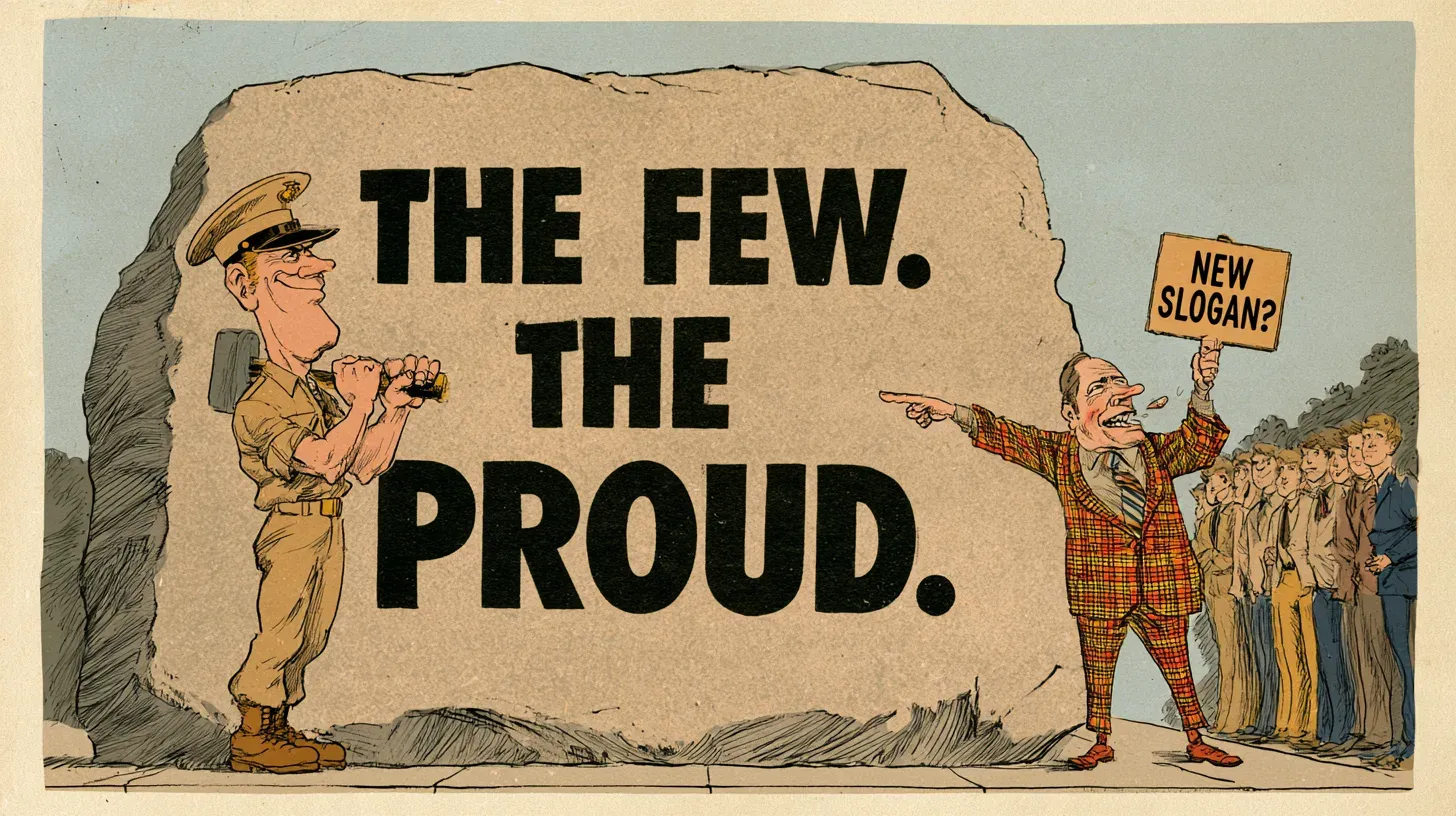
“The Few. The Proud. The Marines.” has been the Marine Corps’ tagline since 1977, according to J. Walter Thompson, the agency that wrote it. It came out soon after the end of the draft, when every service had to fill its ranks with volunteers. NBC News reported that it is widely considered “one of the most successful ad campaigns of the 20th century.”
In September 2007, online voters put it on Madison Avenue’s Advertising Walk of Fame in New York, alongside Southwest Airlines’ “you are now free to move about the country.”
The Marines’ TV campaign began in 1983, and by 2002 the budget allowed a new spot only every three or four years. One put the Marine on a giant chessboard. The best remembered, Rite of Passage from 1998, has a hero swing a sword with the Marine emblem on its hilt, slay a lava monster and turn into a Marine in dress blues.
The Corps registered THE FEW THE PROUD THE MARINES as a trademark for lapel and hat pins in 2016, claiming first use on June 1, 2007. A 2012 filing to register the line for recruiting services claimed first use on April 15, 1997, twenty years after the date the agency gives. That application was abandoned.
DID THE MARINES REPLACE ‘THE FEW, THE PROUD’?
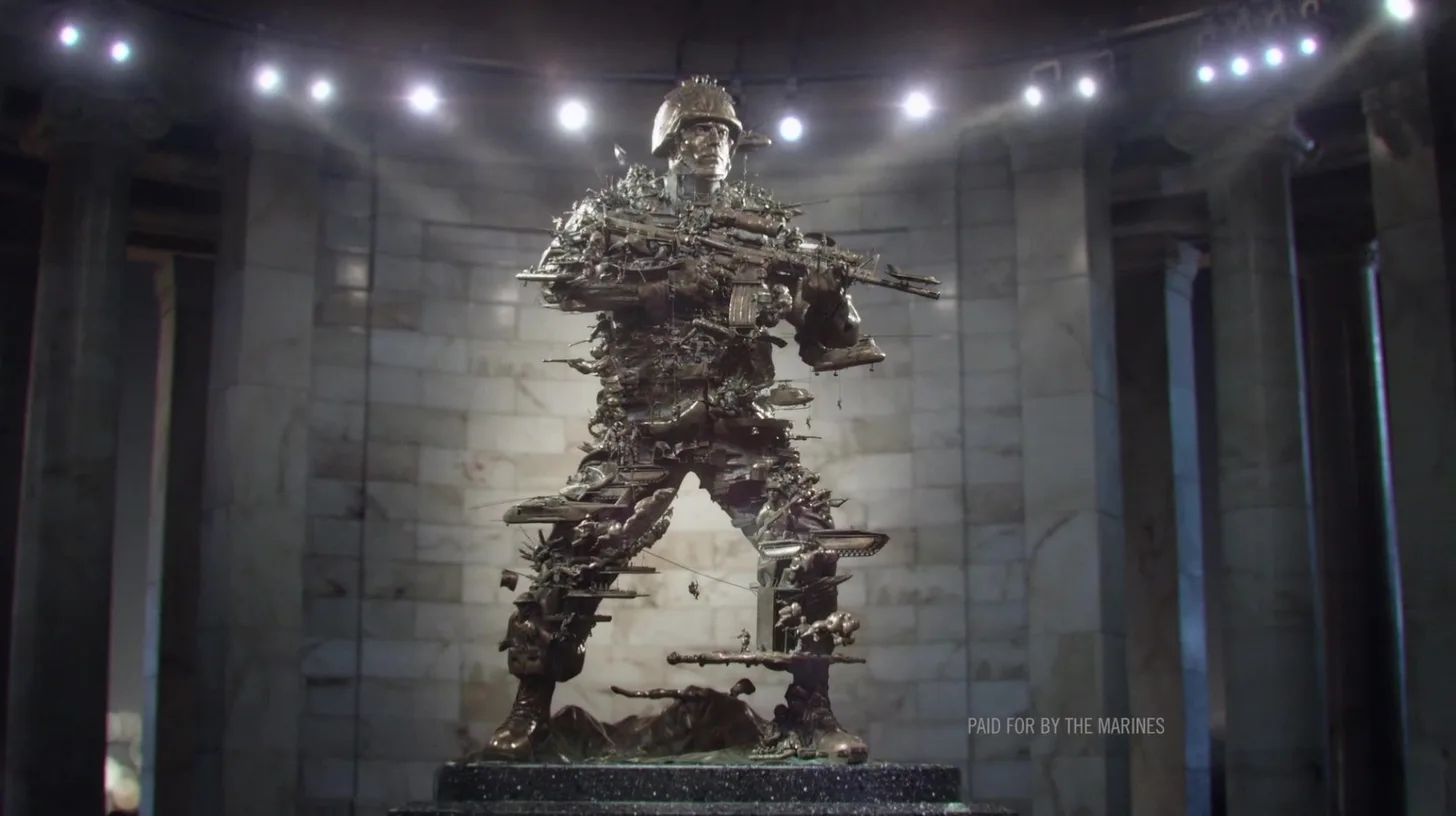
No. The Marine Corps planned to retire “The Few, The Proud” in 2016, but the line was still on the new ads in March 2017 and back at the end of the main commercial by the end of that month. In September 2016, the recruiting command’s spokesman, Lt. Col. John Caldwell, explained the problem: “‘The Few, The Proud’ does a great job distinguishing ourselves from the other branches and making us prestigious to recruits, but it doesn’t say anything about what we do or why we exist.”
Caldwell said the change had nothing to do with women, who had just been cleared to train for every combat job.
The new brand, “Battles Won,” launched on March 17, 2017. In February, Caldwell had said its commercials would end with no tagline. Even so, on the first ads, the old slogan still appeared under the logo.
By March 30, the main commercial, Anthem, closed with it too. “Including the tagline with the brand was the final decision made before the new TV ads entered the market,” Caldwell told Marine Corps Times. He added that the line “still belongs to the Marines, along with all previous taglines used.”
WHAT IS THE MARINE CORPS SLOGAN NOW?
The Marine Corps’ current campaign is “Made for This,” released on October 25, 2024, as the newest part of the Battles Won family. In November 2026 the Corps’ recruiting site still opens on “Marines are Made for This.” Lt. Col. Anton Semelroth said the campaign speaks to “the genuine desire of Generation Z to make the world a better place and their willingness to fight for it.” The commercial itself still closes on the old line: “The Few. The Proud.”
The agency is the same one, under a new name. J. Walter Thompson became Wunderman Thompson in 2018 and was folded into VML in January 2024. That November it kept the Marine account under a 10-year contract valued at $1.9 billion. VML also makes the Navy’s ads.
The Marine Corps has met its recruiting goal every year since 1994. In 2022, when the Army fell about 15,000 soldiers short, the Marines made their goal by eight recruits. In 2026 they enlisted 31,250, and the head of Marine recruiting still put it in the old terms: “The few young Americans who earn the title of Marine…”
MARINE CORPS NICKNAMES AND SAYINGS
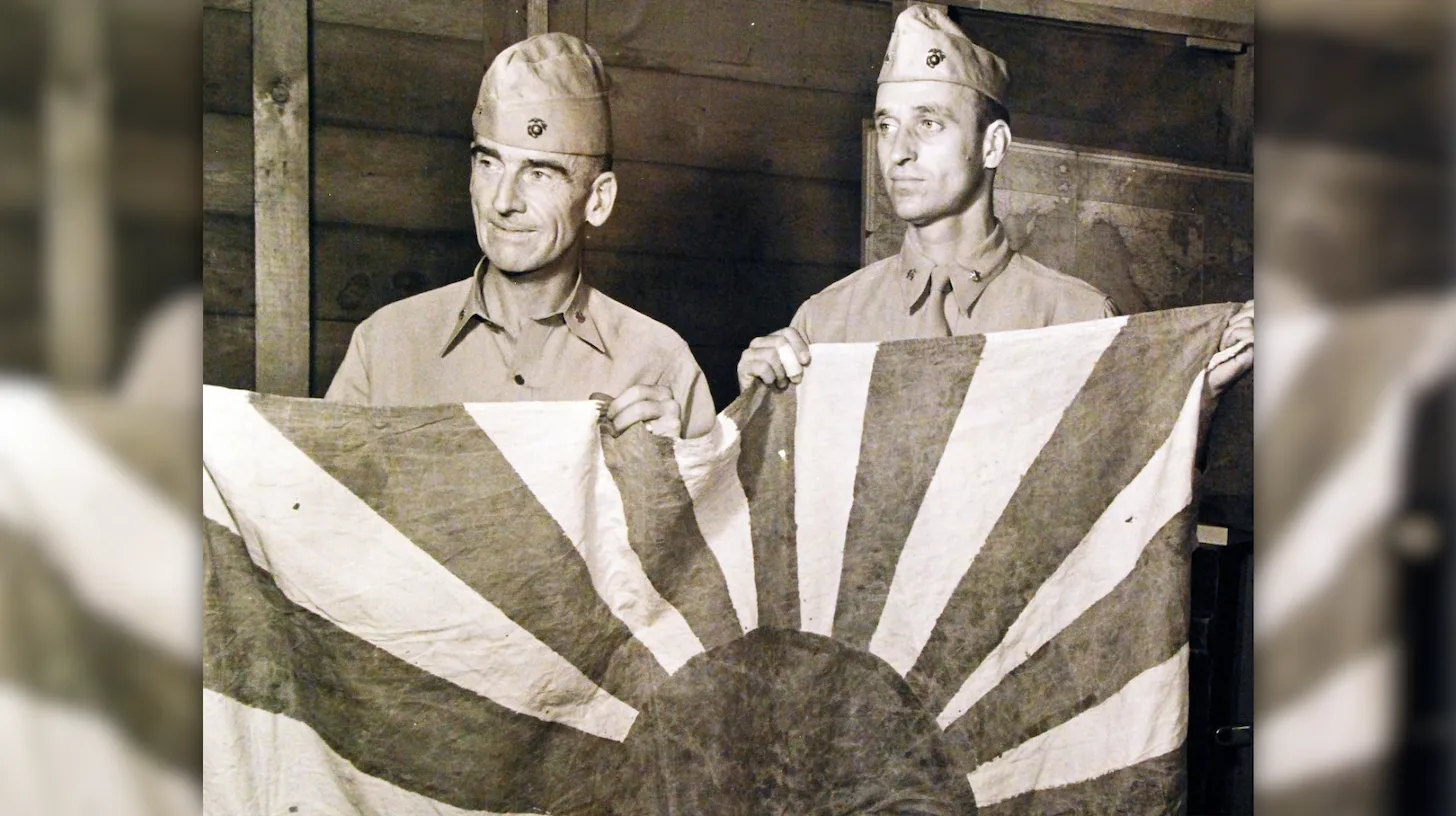
Most Marine nicknames started small: a piece of uniform, a raiders’ motto, a submarine alarm.
| Saying | Earliest record | Origin |
|---|---|---|
| Leatherneck | 1798–1872 | Leather collar on the uniform |
| Once a Marine, always a Marine | In print by 1907 | Recruiting-era saying |
| Devil Dog | 1917 poster | Teufel Hunden legend |
| Gung Ho | 1942 | Carlson’s Raiders |
| Uncommon valor was a common virtue | March 16, 1945 | Adm. Chester Nimitz, Iwo Jima |
| Oorah | 1953 | Recon Marines in Korea |
Leatherneck comes from the black leather stock, or collar, that Marines wore from 1798 to 1872. Legend says it guarded the neck from a cutlass. Leatherneck magazine gives a “more likely reason”: discipline, to keep a Marine’s head high and straight.
Gung Ho is a Chinese expression meaning “working together.” Lt. Col. Evans Carlson made it the slogan of his Marine Raiders, who raided Makin Island from two submarines in August 1942.
Oorah came from a submarine too, by the Marine Corps’ own account. Recon Marines in Korea in 1953 rode submarines whose dive alarm made a very distinct “Aarugha” sound, and they copied it. The word spread through the Corps in the 1980s and 1990s.
“Once a Marine, always a Marine” is older than its usual story. The History Division credits Master Sgt. Paul Woyshner, a 40-year Marine, who is said to have coined it in a taproom argument. The phrase was already in print in a Texas newspaper in 1907, when Woyshner was about 13.
MARINE CORPS SLOGANS FAQ
What is the current Marine Corps slogan?
The Marine Corps’ best-known slogan, “The Few. The Proud. The Marines.,” is still in use, nearly 50 years after J. Walter Thompson introduced it in 1977. The current advertising campaign is “Made for This,” released in October 2024 under the Battles Won brand, and the Corps’ recruiting site opens on “Marines are Made for This.”
Is it Semper Fi or Semper Fidelis?
Both are correct. Semper Fidelis, Latin for “always faithful,” is the official Marine Corps motto, adopted about 1883 and printed on the ribbon of the eagle, globe and anchor emblem. “Semper Fi” is the short form Marines use for it, and the full motto is also the title of John Philip Sousa’s 1888 march.
Why do Marines say “once a Marine, always a Marine”?
The saying holds that a Marine stays a Marine after leaving the service. The Marine Corps History Division credits Master Sgt. Paul Woyshner with coining the phrase in a taproom argument with a discharged Marine, but a Texas newspaper had already printed it as a Marine slogan in 1907.
What is the Marine Corps yell?
The Marine Corps yell is Oorah. According to a 2004 Marine Corps account, it began with recon Marines in Korea in 1953, who copied the Aarugha sound of the dive alarm on the submarines they rode. The word spread through the whole Corps in the 1980s and 1990s.
What are the Marine Corps core values?
The Marine Corps core values are honor, courage and commitment. They were the Marine Corps’ values before 1992, when the Navy adopted the same three for its own sailors. In 2021 the Sergeant Major of the Marine Corps wrote that the Corps had identified itself through them for “nearly thirty years.”