13 min read
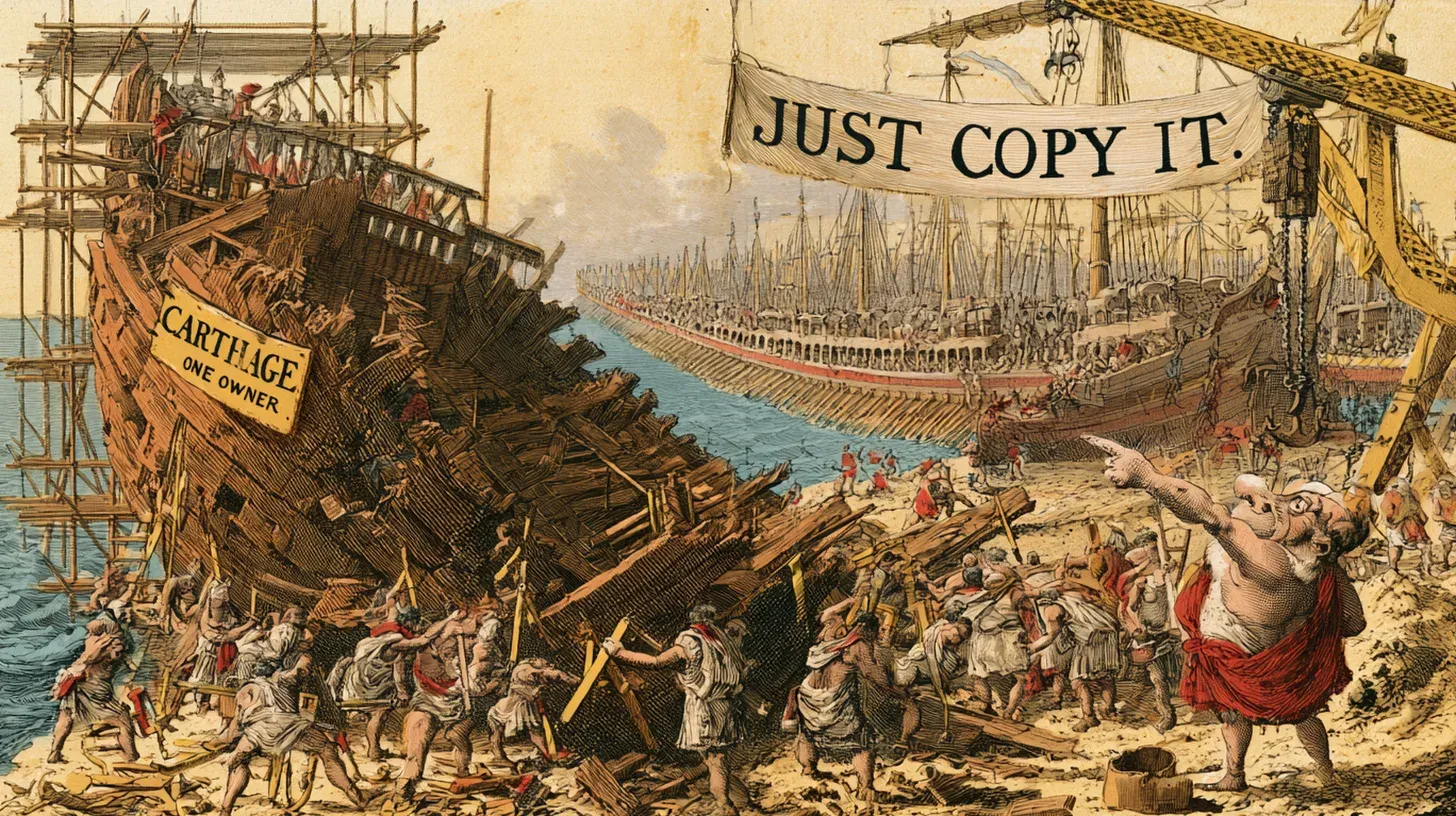
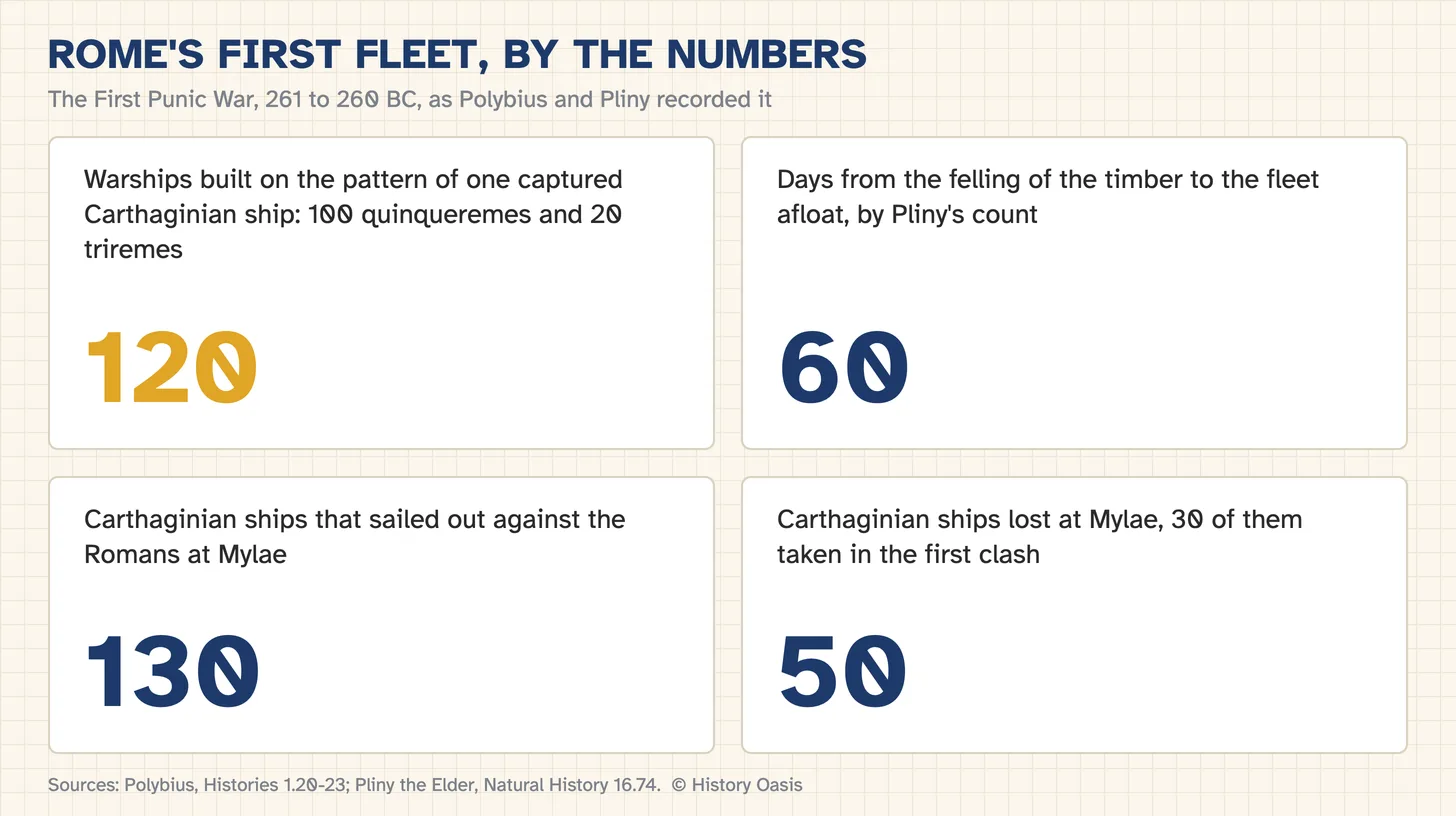
In 261 BC, somewhere on the coast of Italy, the crews of a fleet that did not yet exist sat down on rowers’ benches built on dry land, set out in the same order as the benches of a ship. There they learned to row. The men fell back all together, drawing their hands in, and came forward pushing them out, and they began and ended each stroke at the call of the fugle-man, who kept the time. Close by, the shipwrights were building the ships those men would row, a hundred quinqueremes and twenty triremes, and every one of them was built on the pattern of a single Carthaginian warship.
That ship had fallen into Roman hands three years before, when it chased a Roman crossing into Sicily too eagerly and ran aground. Rome was at war with Carthage, which ruled the sea, and Rome had no fleet that could fight it. The Greek historian Polybius, who told the story about a century later, wrote that without the captured ship the Romans could not have built their navy at all. Scholars still argue over how much of that is true. But the fleet was built, and within a year it met the Carthaginians at sea.
A quarrel over Messana
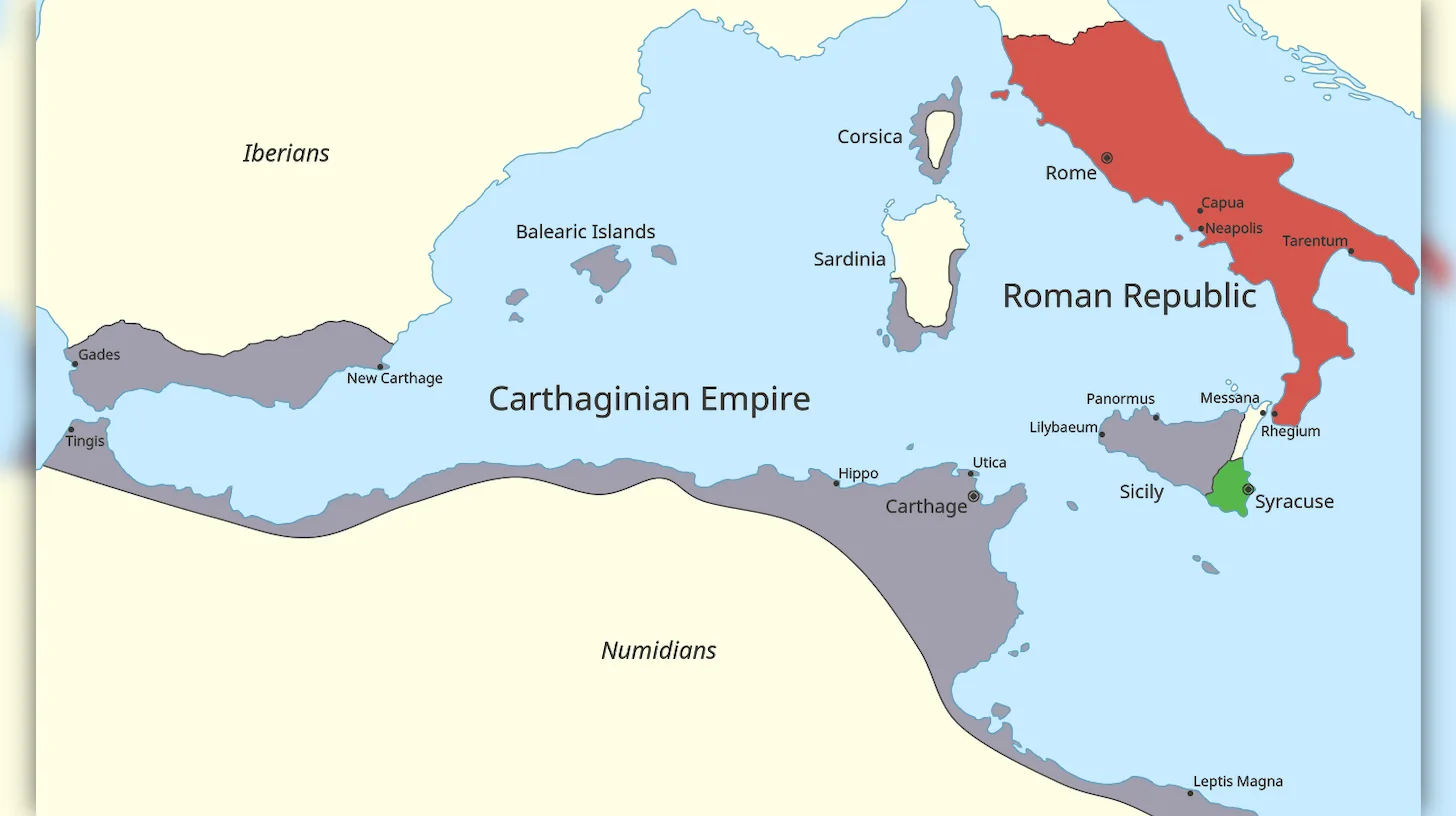
What started the First Punic War was a quarrel over Messana, the city on the Sicilian side of the strait that divides the island from Italy. Campanian mercenaries had seized it and called themselves the Mamertines, and when Hiero, the ruler of Syracuse, beat them in the field, they split. Some of them, Polybius wrote, appealed to the Carthaginians, “proposing to put themselves and the citadel into their hands,” while the rest sent an embassy to Rome and begged for help as a kindred people.
“The Romans were long at a loss, the succour demanded being so obviously unjustifiable,” Polybius wrote. What decided them was Carthage, the trading city on the African coast, which already held much of Sicily. The Romans feared, in his words, that if the Carthaginians “also became masters of Sicily, they would be most troublesome and dangerous neighbours, hemming them in on all sides and threatening every part of Italy.” The Senate could not make up its mind, and the people voted for war after their commanders had pointed out “the great benefit in the way of plunder” that each of them would draw from it.
The command went to one of the consuls, Appius Claudius, in 264 BC. He had an army and no warships. The Romans borrowed fifty-oared boats and triremes from the Greek cities of the south, Tarentum and Locri, Elea and Naples, and took their troops over in these “at great hazard.” Appius himself crossed the strait by night and got into Messana.
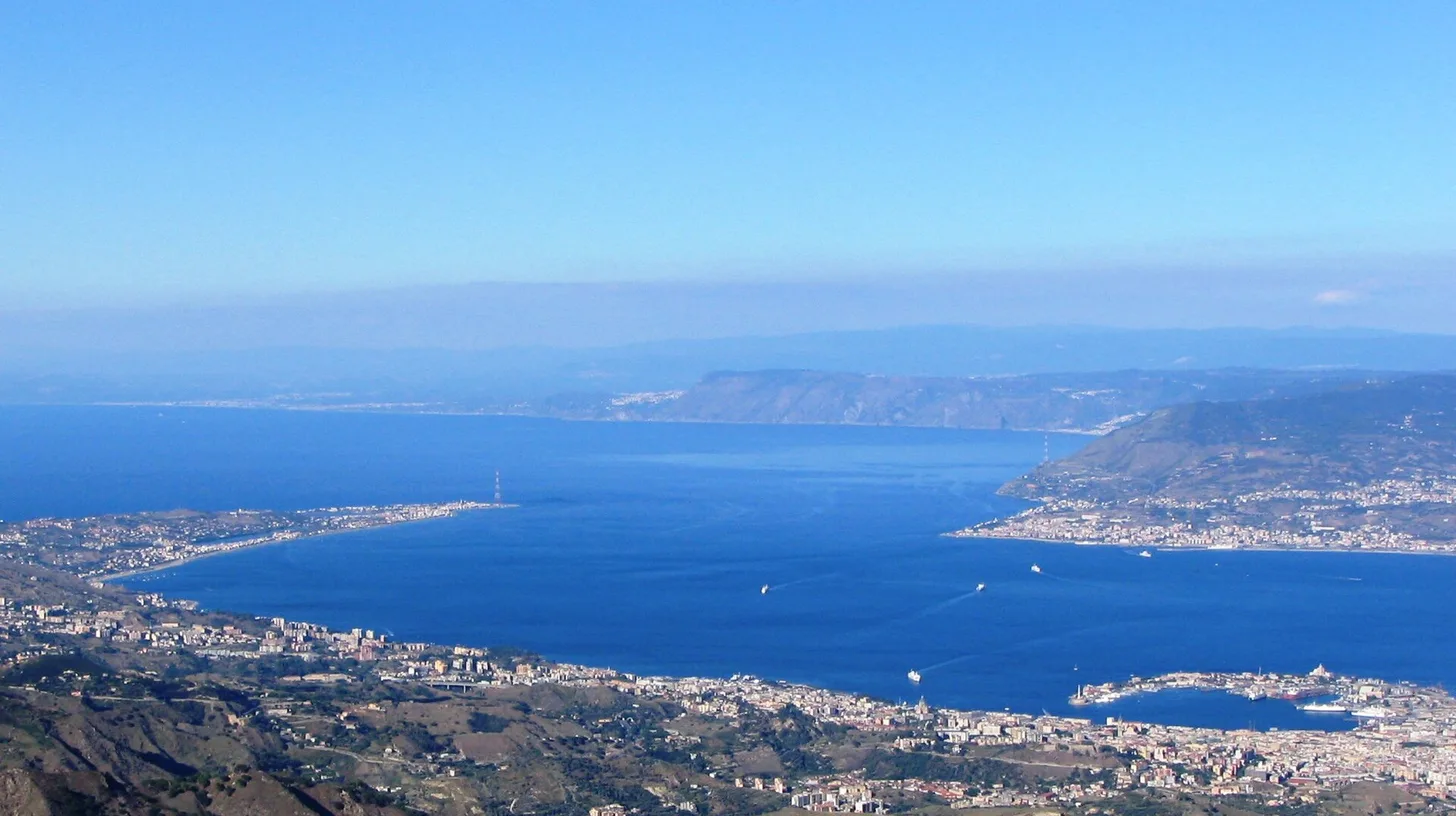
The Carthaginians put out to stop one of those crossings, and in the chase one of their decked warships ran ahead of the rest. It “advanced too far in its eagerness to overtake them,” Polybius wrote, “and running aground fell into the hands of the Romans.” It was not a wreck washed up on a beach, as the story is sometimes told now. It was a whole ship of the line, taken intact, and the Romans kept it.
Built on one ship’s pattern
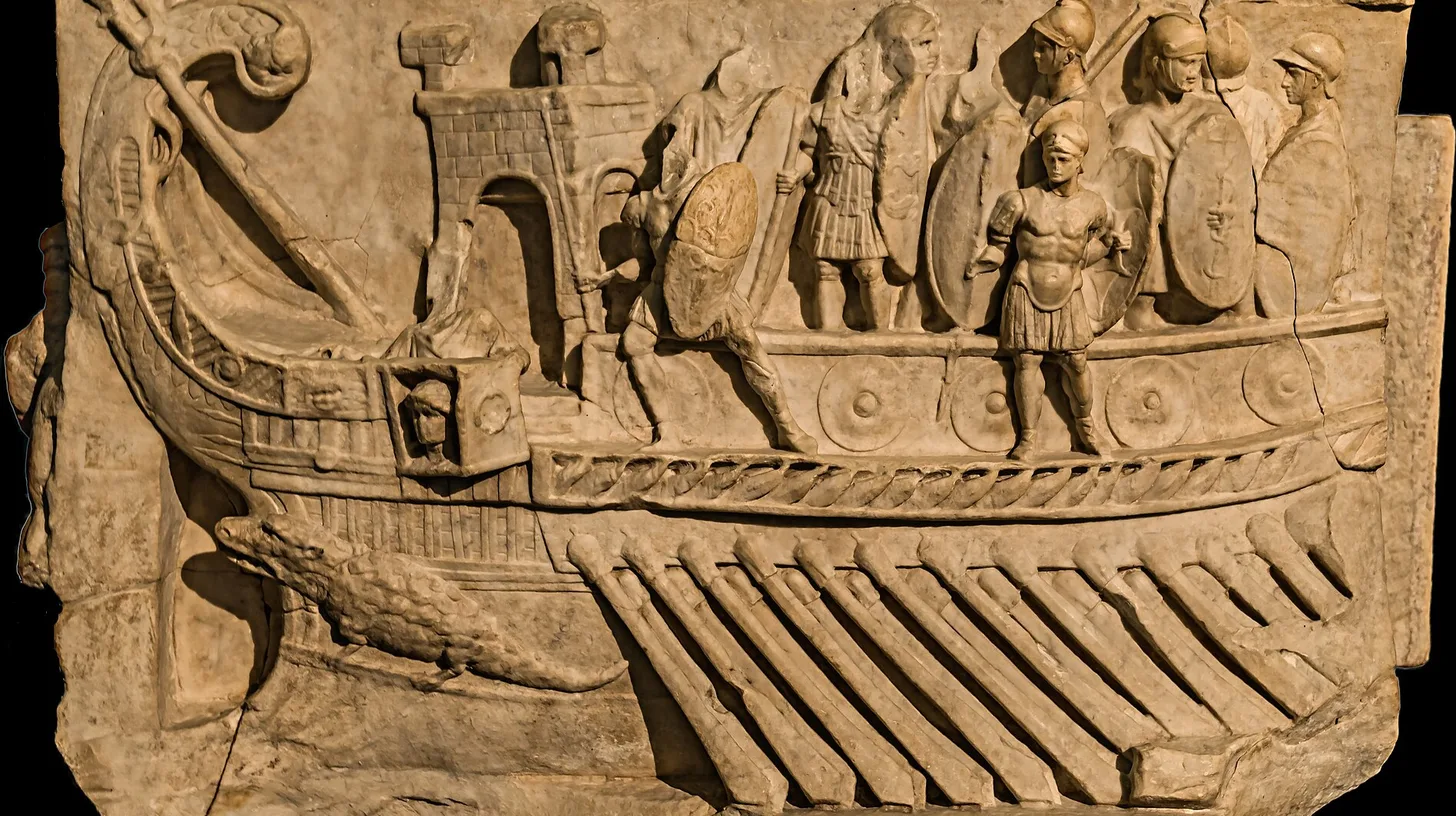
For three years the war was fought on land, and on land Rome did well. The Roman armies took Agrigentum on the south coast of Sicily. But the Carthaginians kept the sea without any trouble, and while their ships raided the coasts of Italy, their own country in Africa was never touched. So the Romans decided to put to sea themselves, and they undertook “for the first time to build ships, a hundred quinqueremes and twenty triremes.” A quinquereme was the heavy warship of the day, and a few years later each Roman one would carry 300 rowers and 120 marines. Polybius wrote of the decision with open admiration.
“It was not that they had fairly good resources for it, but they had none whatever, nor had they ever given a thought to the sea; yet when they once had conceived the project, they took it in hand so boldly, that before gaining any experience in the matter they at once engaged the Carthaginians”
The shipwrights had never built a quinquereme, “such ships never having been in use in Italy,” and the work gave them much difficulty. But they had the ship from the strait. “This ship they now used as a model, and built their whole fleet on its pattern,” Polybius wrote. How long it took he did not say. Pliny the Elder wrote that the fleet commanded by Duilius “was on the water within sixty days from the time the timber was cut.” The historian Florus gave the same sixty days, though he made the fleet 160 ships.
Modern historians have been less sure. Polybius’s line that Rome had never given a thought to the sea cannot be taken literally: as early as 311 BC, Livy recorded, the Roman people had begun electing two naval commissioners “to superintend the equipment and refitting of the fleet.” The quinquereme itself, a 2023 study points out, had been invented at Syracuse, on the same island, in 399 BC. The historian W. E. Heitland wrote in 1909 that the tale of the copied ship was “highly coloured in the course of boastful tradition, but that a great and successful effort was made is clear.”
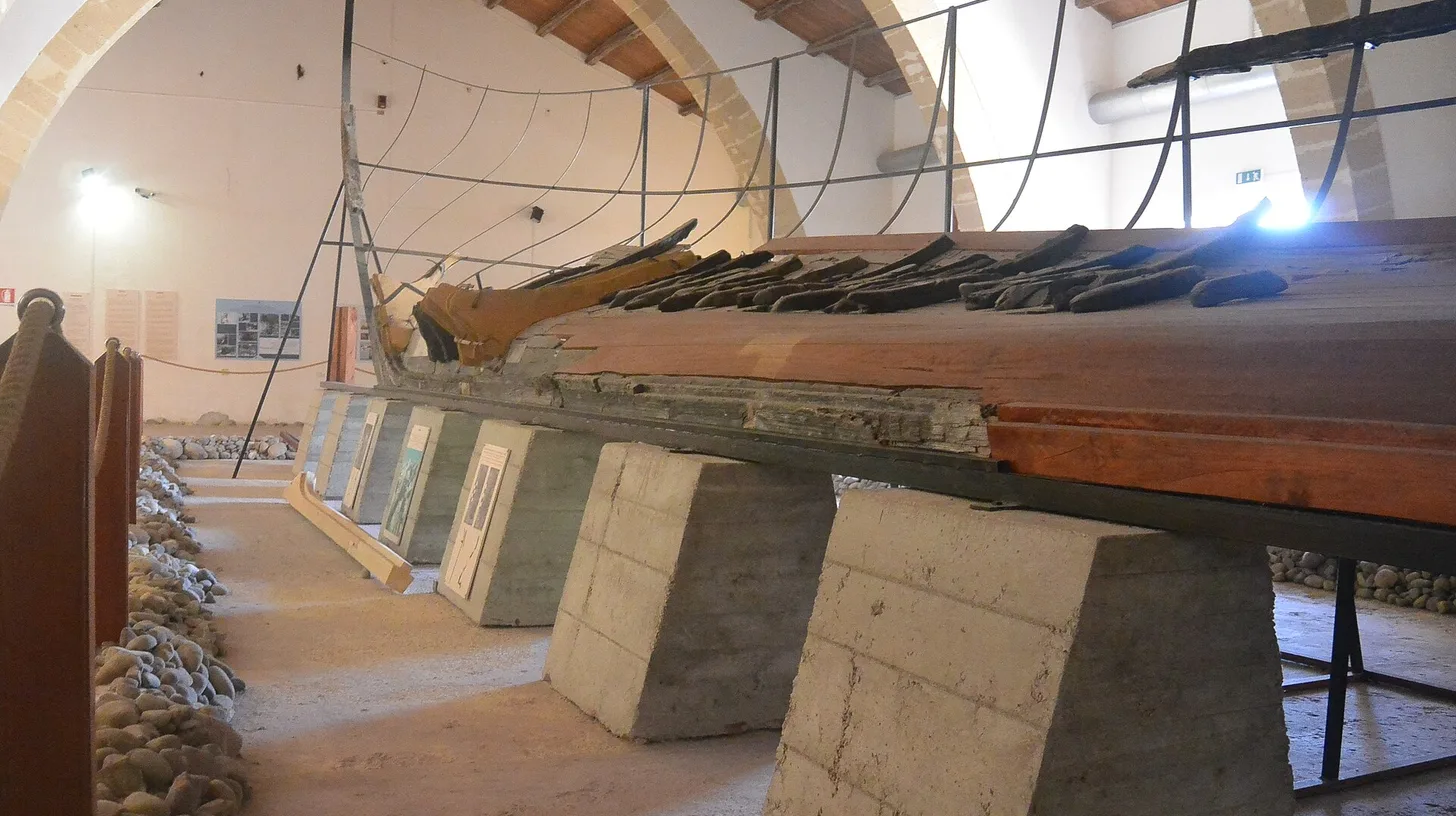
A Carthaginian ship found off Marsala, at the western tip of Sicily, suggests what the Romans may really have learned. Its timbers carry more than a hundred painted and incised marks, letters that told the shipwrights the order in which to put the hull together, and it was “quickly built and still new” when it sank. It is the first system of prefabrication ever identified in an ancient ship. That 2023 study, written for the Honor Frost Foundation, argued that the Romans may have copied a method of mass production rather than one design.
Rowing on dry land
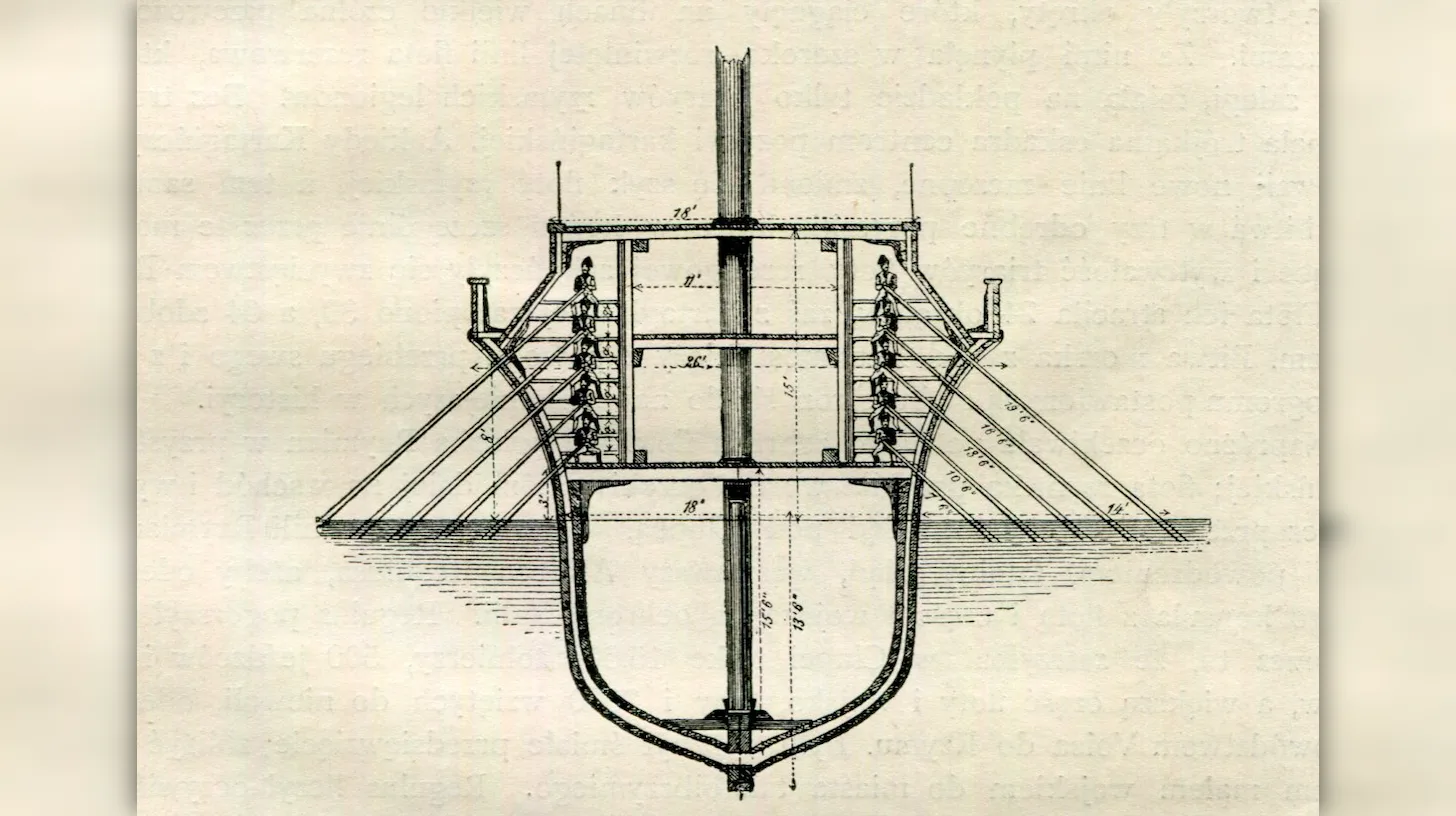
While the hulls were going together, the men who had gathered the crews were teaching them on shore. Polybius set down how they did it.
“Making the men sit on rowers’ benches on dry land, in the same order as on the benches of the ships themselves, they accustomed them to fall back all at once bringing their hands up to them, and again to come forward pushing out their hands,”
They were to begin and end each movement “at the word of command of the fugle-man.” As soon as the ships were finished they were launched, and the crews practised “for a brief time actual rowing at sea” before they sailed along the coast of Italy toward the strait.
One of the two consuls for 260 BC, Gnaeus Cornelius Scipio, could not wait for them. He had told the captains to make for the strait when the fleet was ready, and he went ahead to Messana with seventeen ships. From there he sailed on to the harbour of Lipara, on the islands off the north coast of Sicily.
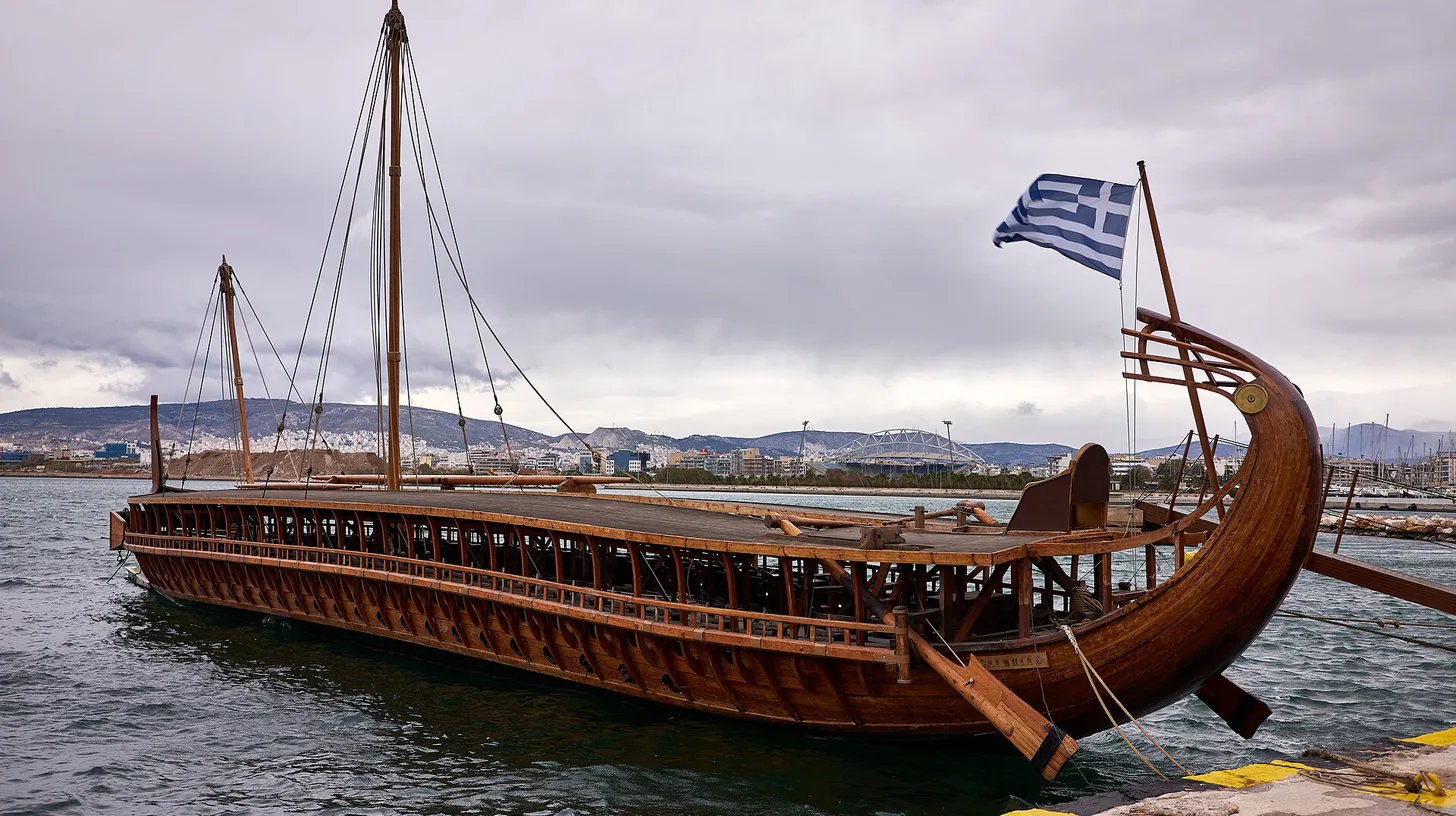
The Carthaginian admiral, Hannibal, heard of it. He gave twenty ships to Boödes, a member of the Carthaginian senate, and sent him off. Boödes sailed up to Lipara at night and shut the Roman ships up in the harbour. “When day dawned the Roman crews hastily took refuge on land,” Polybius wrote, and Scipio, “falling into a state of terror and being unable to do anything, finally surrendered to the enemy.” The Carthaginians sailed away with the seventeen ships and the consul of Rome. A later Roman summary of Livy gives a kinder version, that Scipio was “captured under the pretext of negotiations.” He was free again within a few years, and consul a second time.
A few days later Hannibal himself, with fifty ships, ran into the whole Roman fleet off the Cape of Italy. “He lost most of his ships and escaped himself with the remainder, which was more than he expected or hoped.”
The ravens
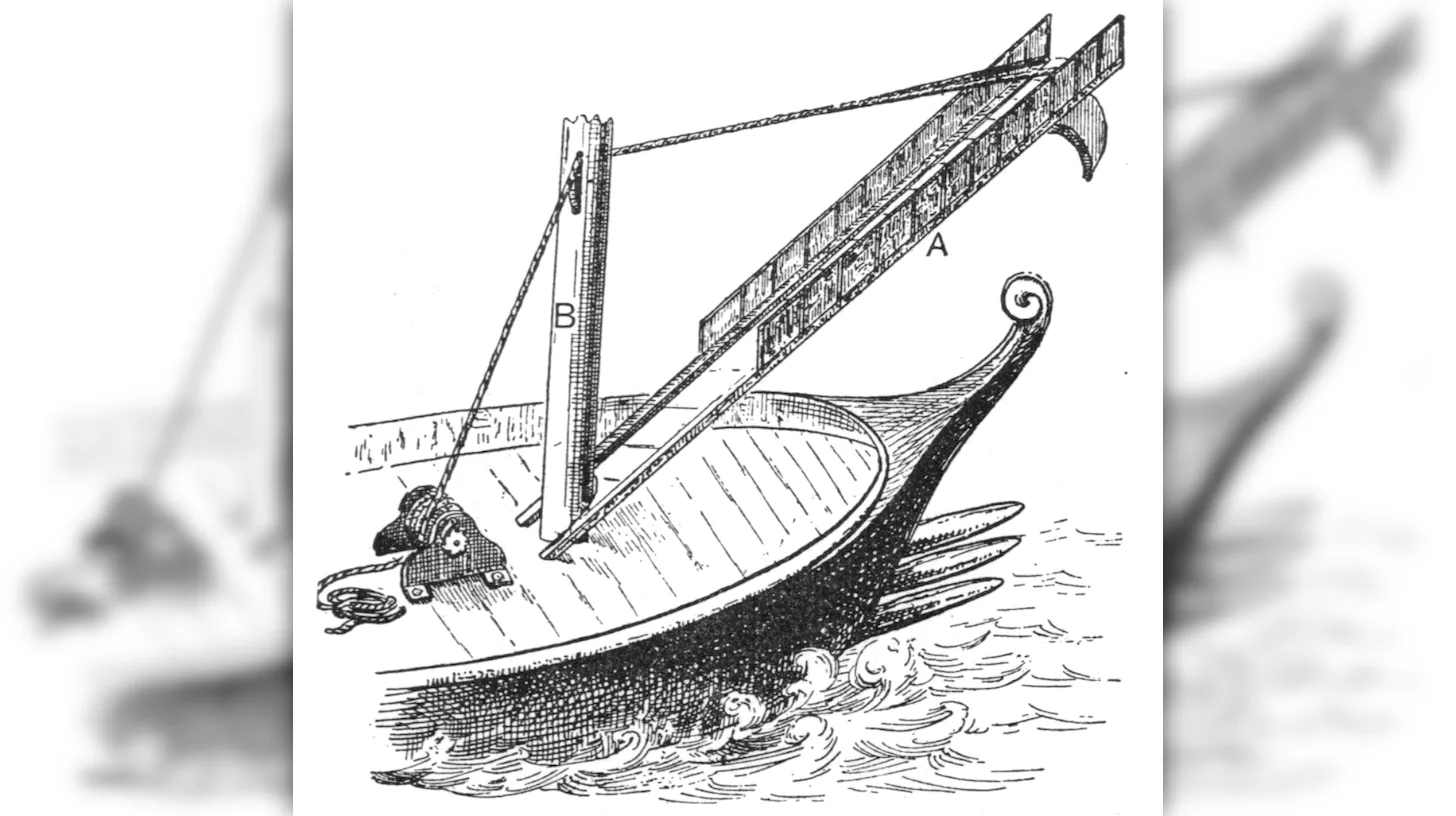
The new Roman ships, Polybius admitted, “were ill-built and slow in their movements,” no match in a battle of ramming and turning. So, Polybius wrote, someone suggested a device to help them, one of the engines “which afterwards came to be called” ravens. No writer of the time gives the inventor’s name. The Latin word for the device, corvus, means raven, and it is the name the Roman corvus is known by today.
Polybius described it to the inch. On the prow of each ship stood a round pole “four fathoms in height and three palms in diameter,” about twenty-four feet tall, with a pulley at the top. Around it hung a gangway of planks nailed crosswise, “four feet in width and six fathoms in length,” about thirty-six feet, with a railing on each side “as high as a man’s knee.”
“At its extremity was fastened an iron object like a pestle pointed at one end and with a ring at the other end, so that the whole looked like the machine for pounding corn.”
When an enemy ship came alongside or rammed, the crew hauled the raven up by the pulley and let it drop on the enemy’s deck, where the spike drove in and held. Then the soldiers went across the gangway two abreast, the leaders holding their shields in front of them and the men behind resting theirs on the railings. A sea fight would become a fight between soldiers.
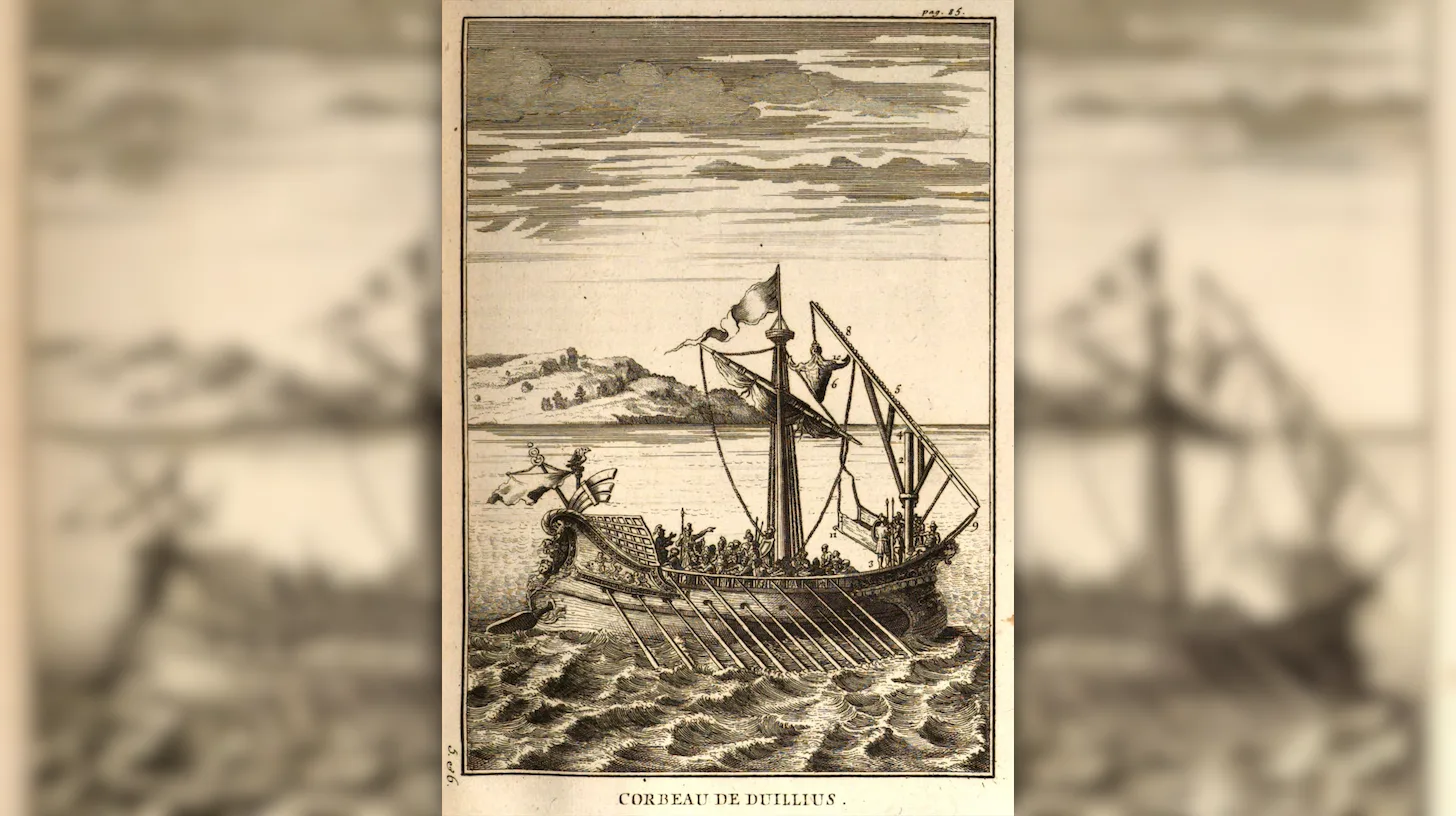
The other consul, Gaius Duilius, had been commanding the army in Sicily. After Scipio’s surrender he handed his legions to the military tribunes and went to the fleet. Some modern scholars, Christa Steinby among them, think the boarding bridge mattered less than Polybius claims. But it was the weapon Duilius took to sea.
Ravens nodding on the prows
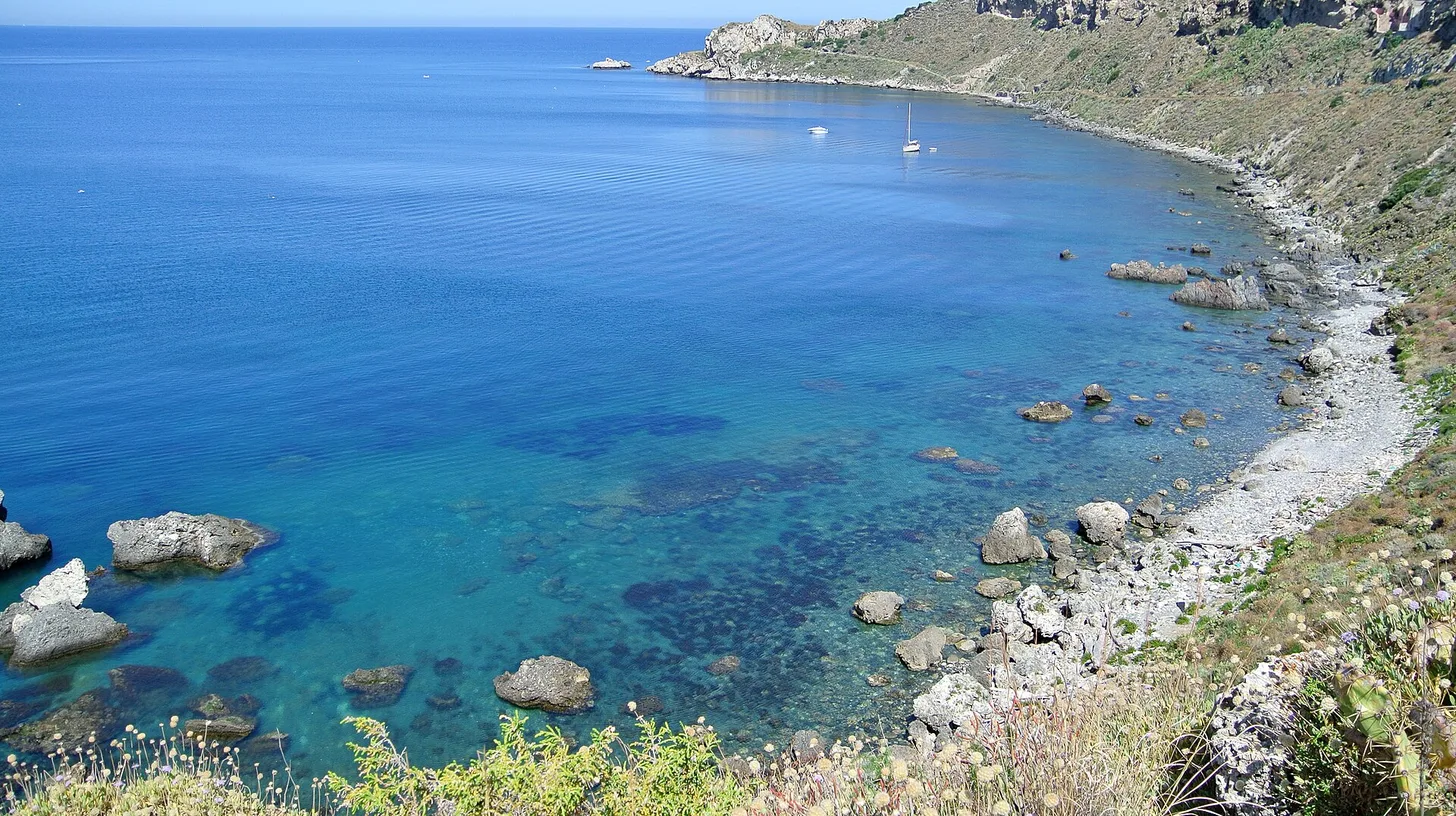
Duilius learned that the Carthaginians were ravaging the country around Mylae, on the north coast of Sicily west of the strait, and he sailed against them with his whole force. That was how the battle of Mylae began, in 260 BC. The Carthaginians, Polybius wrote, put to sea “with a hundred and thirty sail, quite overjoyed and eager, as they despised the inexperience of the Romans.” Hannibal led them in a seven-banked galley that had once belonged to King Pyrrhus of Epirus.
They came on without keeping order, as if the Roman ships were already theirs. “On approaching and seeing the ravens nodding aloft on the prow of each ship, the Carthaginians were at first nonplussed, being surprised at the construction of the engines.” Florus, much later, said the grappling irons “before the battle had caused much derision on the part of the enemy.” The leading Carthaginian ships held their course and charged. As each one struck, a raven came down on its deck and held it fast, and the Roman soldiers went over the gangways, and the fighting on the decks became, in Polybius’s words, “just like a fight on land.”
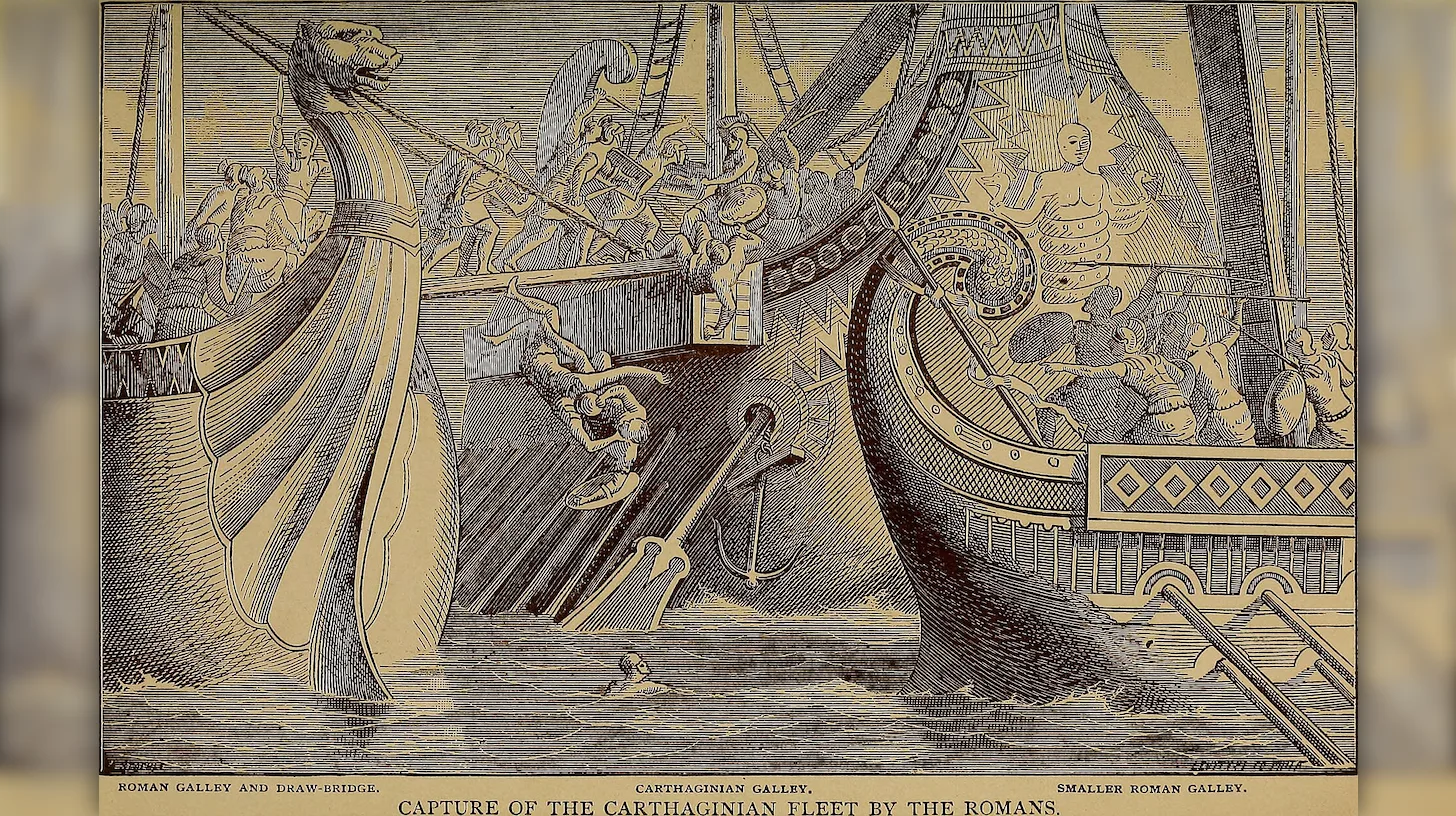
The first thirty Carthaginian ships to close with the Romans were taken with every man aboard, and Pyrrhus’s old galley was one of them. Polybius told what became of its commander.
“So the first thirty ships that engaged were taken with all their crews, including the commander’s galley, Hannibal himself managing to escape beyond his hopes by a miracle in the jolly-boat.”
The rest of the Carthaginian fleet, seeing what had happened, swung wide to come at the Romans from the sides and the stern, where the ravens could not reach. But the ravens swung round as well and came down wherever a ship came near, and at last the Carthaginians turned and fled, “terror-stricken by this novel experience and with the loss of fifty ships.” The inscription later carved for Duilius gives slightly different figures, thirty-one ships captured, the seven-banker among them, and thirteen sunk. Duilius landed in Sicily, raised the siege of Segesta, which was in its last distress, and took the town of Macella by storm.
A torch-bearer and a flute player
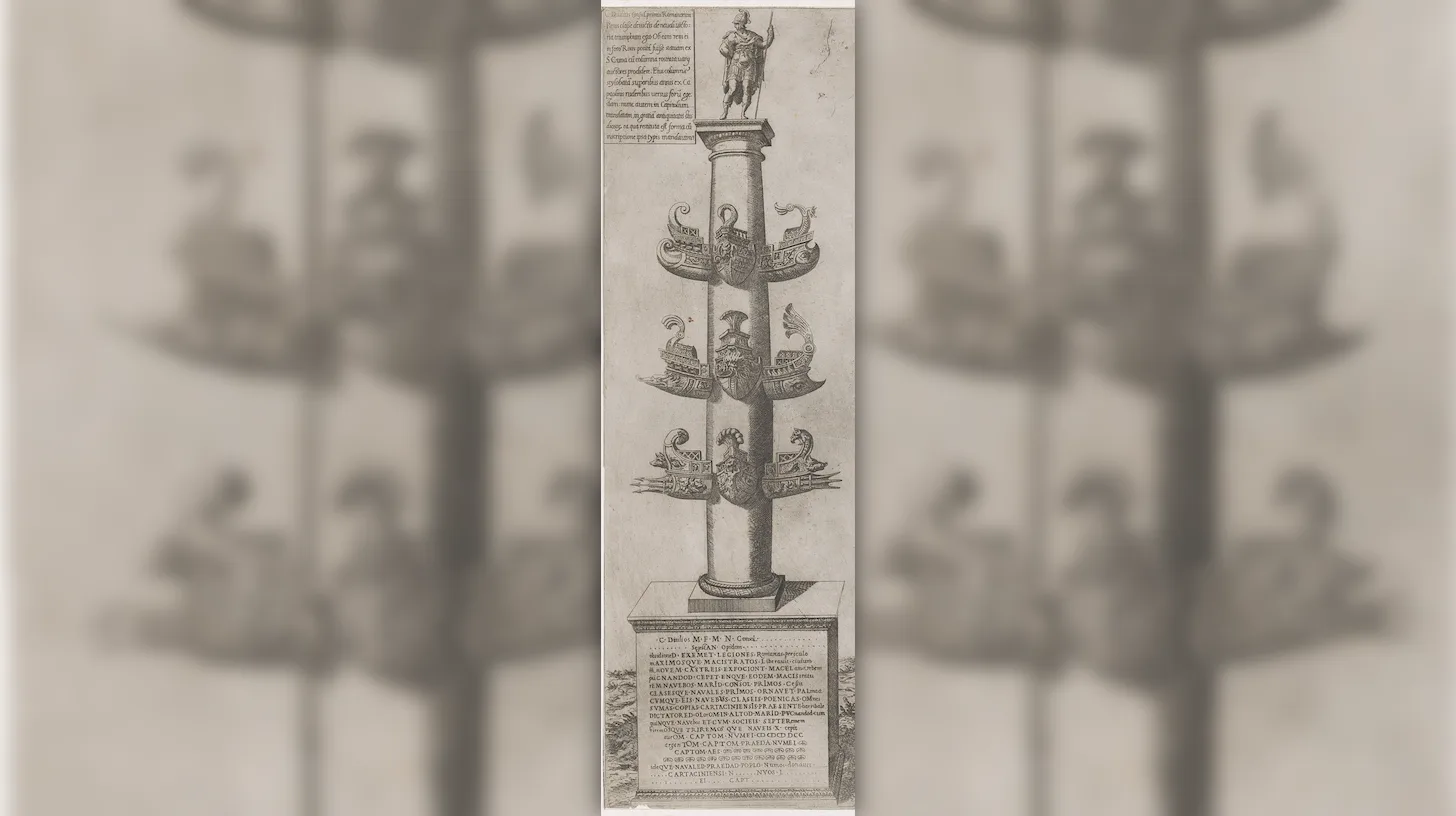
Duilius was given the first naval triumph in Roman history, and a column decked with the bronze beaks of the captured ships was set up for him in the Forum. Pliny the Elder, three centuries later, wrote that his column “still remains in the Forum.” The stone with his inscription that survives today, in the Capitoline Museums, is a later copy, cut in deliberately old-fashioned spelling, and much of its text is a modern guess. It says that “he celebrated a naval triumph, bestowed a gift of money on the people, and led many Carthaginian captives in front of his chariot.”
No description of Duilius’s face, build or dress has come down from antiquity. What remains is one habit. For the rest of his life, when he went home from dinner, a torch-bearer and a flute player walked ahead of him. The summary of Livy says the honour was given to him, and Florus says he ordered it himself. Cicero, in a dialogue, put the memory in the mouth of Cato the Elder, who had been a boy in Rome when Duilius was old.
“Gaius Duellius, son of Marcus, and the first Roman to win a naval victory over the Carthaginians, was often seen by me in my childhood, when he was an old man, returning home from dining out, attended, as was his delight, by a torch-bearer and flute-player”
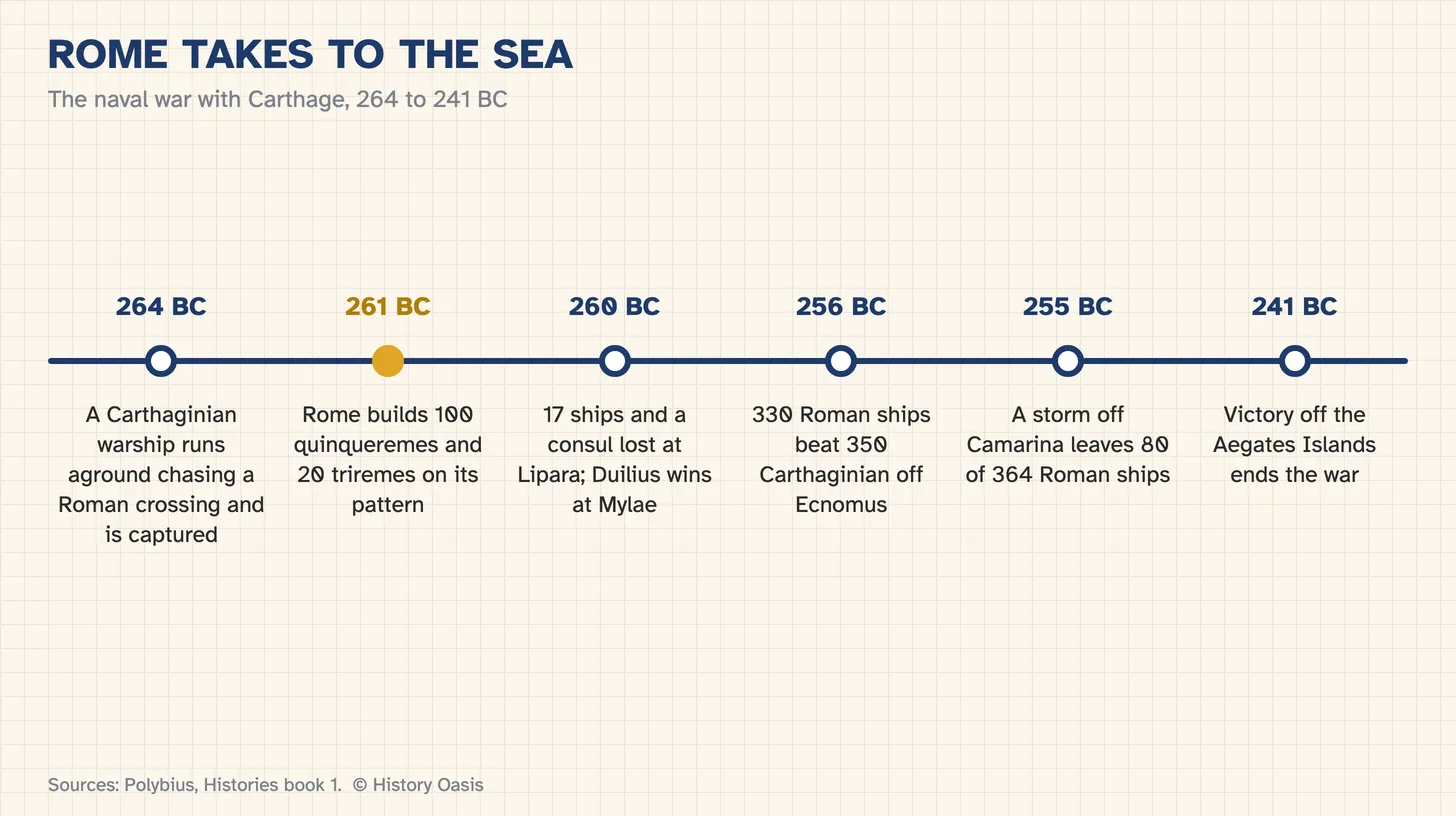
The war went on for twenty-four years, the longest Polybius knew of. In 256 BC a Roman navy of 330 ships, each holding 300 rowers and 120 marines, beat a Carthaginian fleet of 350 off Ecnomus. The next year a storm off Camarina saved only eighty of 364 Roman ships. “History tells of no greater catastrophe at sea taking place at one time,” Polybius wrote. He blamed the commanders, and the Roman habit of mind.
“The Romans, to speak generally, rely on force in all their enterprises, and think it is incumbent on them to carry out their projects in spite of all, and that nothing is impossible when they have once decided on it.”
By the end Rome had lost about seven hundred quinqueremes, most of them to the weather, and Carthage about five hundred. In 241 BC wealthy citizens paid for a last fleet of 200 quinqueremes, to be repaid if all went well, and off the Aegates Islands, west of Sicily, it sank fifty Carthaginian ships and took seventy. Rome won the First Punic War. Carthage gave up Sicily and agreed to pay 2,200 talents of silver in twenty years.
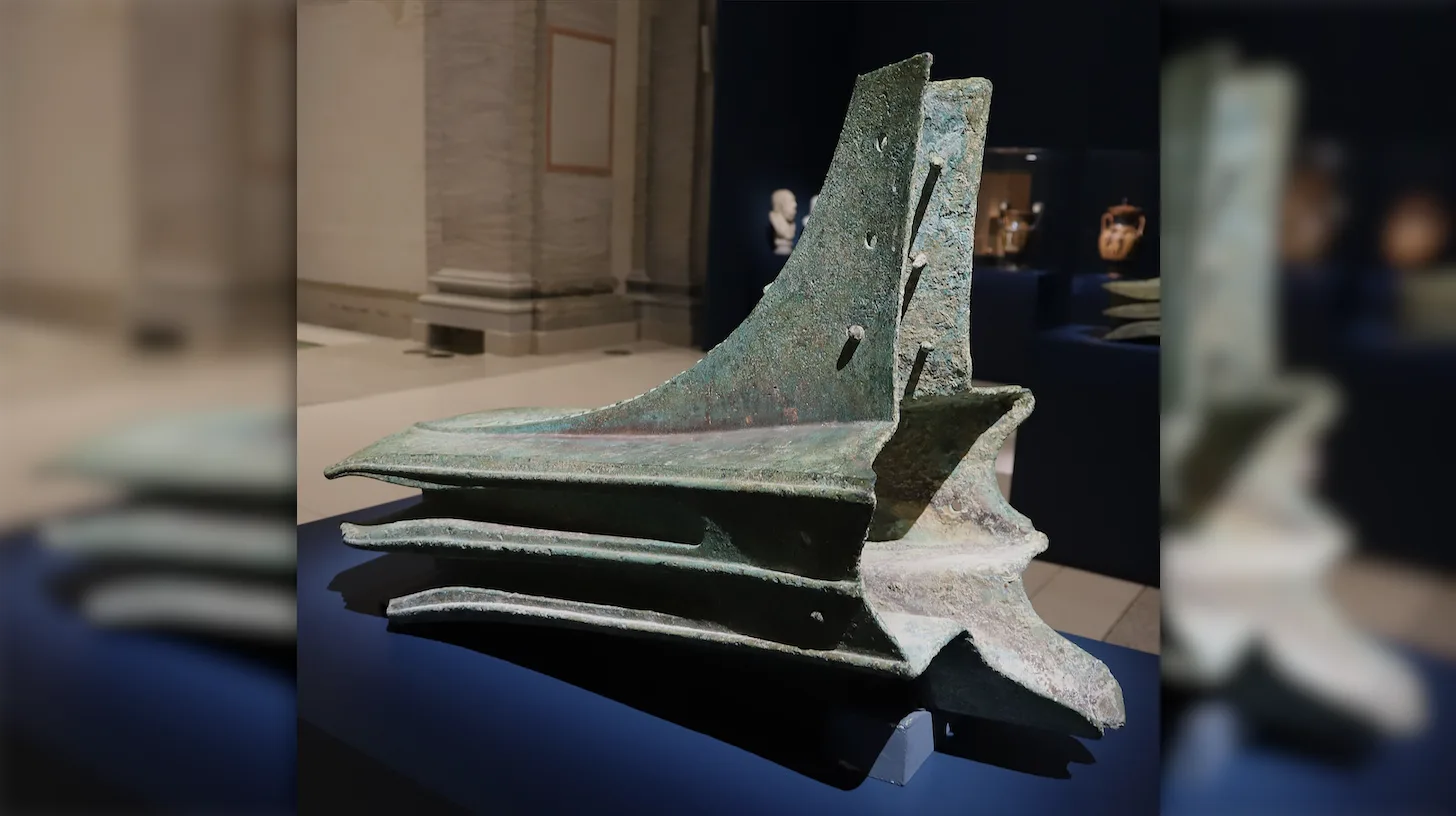
Since 2008 divers working with the RPM Nautical Foundation and Sicily’s Superintendency of the Sea have brought up 27 bronze rams from the seabed off the island of Levanzo. That last battle was fought there, and bronze helmets lie among the rams. Most of the rams are Roman. Several carry Latin inscriptions recording that a quaestor, a Roman finance officer, had approved them. That fleet, Polybius wrote, was built on the model of a captured Carthaginian ship.