
Food Trivia Quiz
This food trivia quiz serves up ten questions on the candy, sodas, cereal, and fast food that shaped how America eats — from candy corn's original name to the drug that once put the sparkle in 7 Up. Answer them in the widget for an instant score, or scroll past it and read every question and answer in full. It's free, and there's no sign-up.
Question 1 of 10
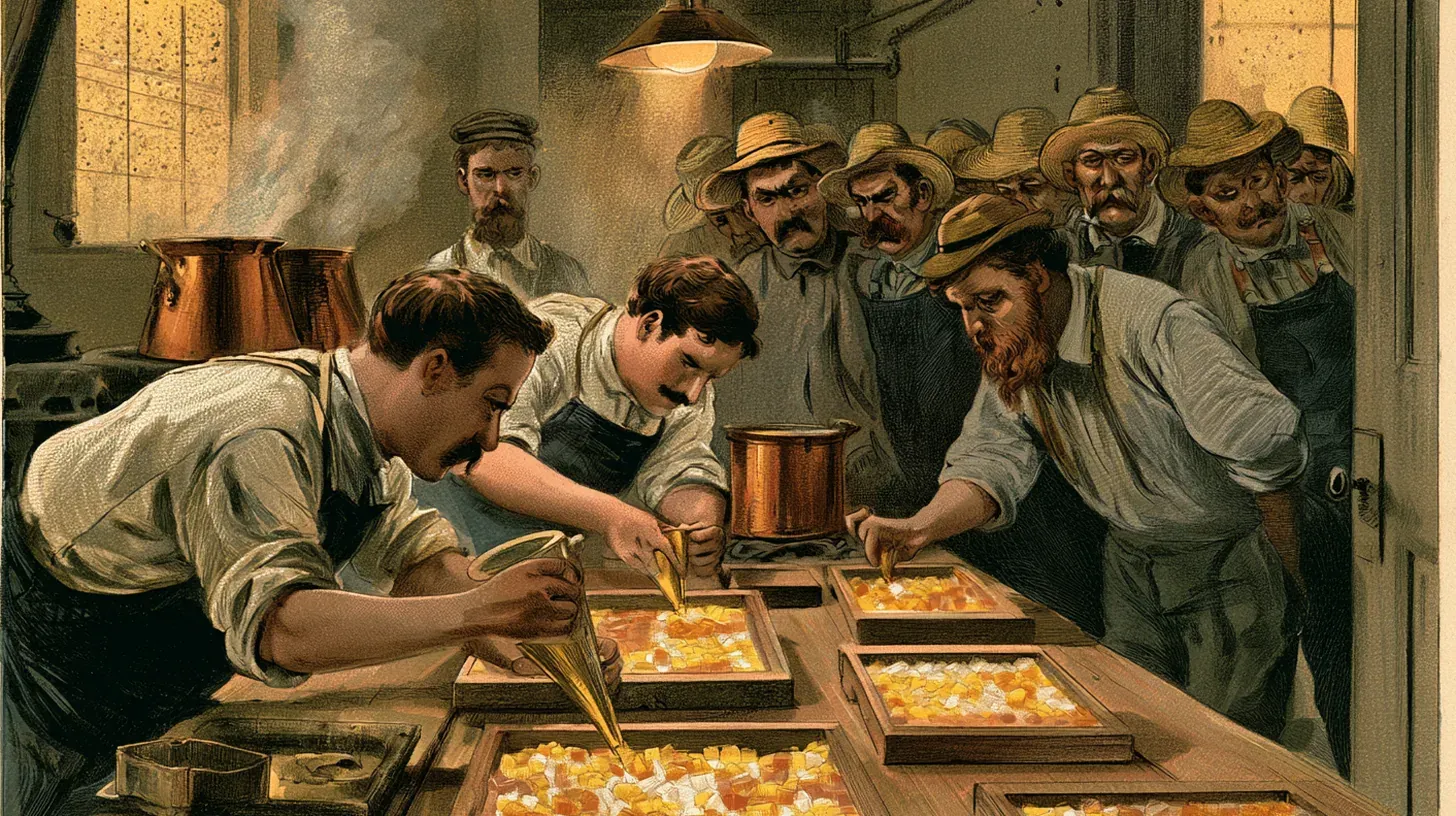
Candy corn was invented in the 1880s — but for its first decades it was sold under what name?
See all answers & explanations
1. Candy corn was invented in the 1880s — but for its first decades it was sold under what name?
Answer: Chicken Feed. George Renninger of Philadelphia's Wunderle Candy Company invented the tri-color kernel in the 1880s, and it was marketed as "Chicken Feed" — corn was still considered livestock food, and the name courted America's farming majority. Halloween didn't claim the candy until well into the twentieth century. Go deeper: The Illustrated History of Candy Corn.
2. When 7 Up launched in 1929, its formula included a surprise ingredient that stayed in the recipe until 1948. What was it?
Answer: Lithium citrate. 7 Up began life as "Bib-Label Lithiated Lemon-Lime Soda," with the mood-stabilizing drug lithium citrate right there in the name. The name shrank to "7 Up Lithiated Lemon Soda" by 1936, and the lithium finally left the formula in 1948. Go deeper: The Unknown History of 7 UP.
3. McDonald's franchisee Lou Groen invented the Filet-O-Fish in 1962 because his Cincinnati restaurant kept losing money — to whom?
Answer: Catholic customers skipping meat on Fridays during Lent. Groen's neighborhood was heavily Catholic, and his burger sales cratered every Friday during Lent — so he pitched a fish sandwich. Ray Kroc bet a new suit that his own meatless idea, the Hula Burger (grilled pineapple and cheese on a bun), would outsell it; the final score was reportedly 350 Filet-O-Fish to 6 Hula Burgers, and Kroc paid up. Go deeper: The Most Iconic Discontinued Mcdonald’s Menu Items.
4. Ruth Wakefield invented the chocolate chip cookie at her Toll House Inn in 1938. What did she get when Nestlé put her recipe on its chocolate-bar wrappers?
Answer: One dollar and a lifetime supply of chocolate. Wakefield struck the deal in 1939: her "Toll House Chocolate Crunch Cookie" recipe on Nestlé's wrappers in exchange for one dollar and a lifetime supply of chocolate. By 1941 Nestlé was selling pre-cut chocolate chips, and the Toll House name is still on the bag. Go deeper: The Unknown History of Chocolate Chip Cookies.
5. Häagen-Dazs sounds impeccably Scandinavian. What does the name actually mean in Danish?
Answer: Nothing — it's a made-up phrase. Bronx ice-cream maker Reuben Mattus invented the name in 1961 because it sounded Danish and premium — it means nothing in Danish or any other language, and Danish doesn't even use an umlaut. Early cartons doubled down on the bit with an outline map of Denmark.
6. Kellogg's Corn Flakes trace back to an 1894 kitchen accident at the Battle Creek Sanitarium. What happened?
Answer: A batch of cooked wheat sat out overnight and went stale. The Kellogg brothers ran the batch of stale cooked wheat through rollers anyway, and it broke into crisp flakes their sanitarium patients loved. John Harvey wanted to sell it as crumbs, Will insisted on flakes — the corn version followed in 1898 and launched the entire breakfast-cereal industry. Go deeper: Iconic Discontinued Kellogg's Cereals You Forgot About.
7. PEZ was invented in Vienna in 1927 and marketed to sophisticated adults. What was it supposed to help them do?
Answer: Quit smoking. Eduard Haas III was an anti-smoking advocate who compressed intense peppermint into tiny bricks and sold them with the slogan "Smoking prohibited, PEZing allowed!" The name squeezes the German word for peppermint, PfeffErminZ, into three letters — and the character-head dispensers only arrived after PEZ pivoted to American children in the 1950s. Go deeper: The Anti-Smoking History of Pez Candy.
8. Taco Bell axed the Mexican Pizza in November 2020 — citing its packaging waste — then brought it back in May 2022. What forced the reversal?
Answer: A fan petition with nearly 200,000 signatures. The item began as the "Pizzazz Pizza" in the Reagan era, and its 2020 removal ignited a backlash petition that gathered nearly 200,000 signatures. Taco Bell surrendered in May 2022 — many locations sold out on the return — and the Mexican Pizza has stayed on the menu since. Go deeper: 12 Discontinued Taco Bell Menu Items.
9. The Popsicle was invented by accident in 1905. Who gets the credit?
Answer: An 11-year-old boy who left soda water out on a cold night. Eleven-year-old Frank Epperson left a cup of soda-water mix with its stirring stick outside on a freezing San Francisco Bay–area night and found it frozen solid by morning. He called his invention the "Epsicle" and patented it as an adult in 1924 — his children's name for it, Pop's 'sicle, is the one that stuck.
10. Oreo debuted in 1912 — as a challenger to which older sandwich cookie, launched four years earlier?
Answer: Hydrox. Sunshine Biscuits launched Hydrox — named for hydrogen and oxygen, the elements of pure water — in 1908, and Nabisco's Oreo arrived four years later as the direct competitor. Oreo's mid-century marketing was so effective that most Americans came to assume Hydrox was the knockoff. Go deeper: 19 Iconic Discontinued Cookies That Crumbled Under Pressure.
Food Trivia Quiz FAQ
What are some food trivia questions?
Food trivia questions are quiz questions about the history of what we eat and drink — the candy, fast food, sodas, cereals, and ice cream behind the grocery aisle. The classics ask what candy corn was originally called, why McDonald's invented the Filet-O-Fish, and which drug 7 Up quietly carried in its formula for nearly two decades.
The ten questions and answers above lean into exactly that territory, and every question comes with a short explanation, so a wrong guess still leaves you with a story to tell.
There's plenty the quiz didn't have room for, too. Dr Pepper is a year older than Coca-Cola — a Waco, Texas pharmacist first served it in 1885 — and McDonald's opened in 1940 not as a burger stand but as a barbecue drive-in with carhop service.
What was the very first candy ever invented?
The oldest known candy is honey-based: ancient Egyptians were combining honey with nuts, fruits, and spices into sweet confections roughly 4,000 years ago, long before refined sugar existed. Hard sugar candy only became possible after cane sugar spread from India through the medieval Islamic world into Europe.
The candy bar is far younger. Joseph Fry molded the first chocolate bar in 1847 by mixing cocoa fat back into cocoa solids — turning what had been a drink for most of its history into something you could snap and chew.
The American icons came later still: candy corn in the 1880s, the Hershey's Milk Chocolate Bar in 1900 at five cents, and the Tootsie Roll in 1907.
What are some cool facts about candy?
Start with the origin stories. PEZ began in 1927 Vienna as an anti-smoking mint for grown-ups — its slogan was "Smoking prohibited, PEZing allowed!" — and candy corn spent its early decades marketed to farm country as "Chicken Feed." Both stories appear in the quiz above, in full.
The Tootsie Roll, launched in 1907, was the first individually wrapped penny candy, engineered to survive summer heat without melting; the story goes that inventor Leo Hirshfield named it after his daughter Clara, whose nickname was Tootsie.
Even the rivalries are underdog tales: Hydrox, the original creme sandwich cookie of 1908, spent a century being mistaken for an Oreo knockoff — because Oreo, the actual imitator, simply out-marketed it.
What is the most famous candy ever?
There's no official title-holder, but sales rankings usually crown Snickers, widely cited as the world's best-selling candy bar. In the United States, Reese's Peanut Butter Cups lead the market and regularly top Halloween-popularity surveys.
Fame comes in other flavors, though. M&M's are arguably the most recognizable candy on Earth, the Hershey's Milk Chocolate Bar has been the archetypal American chocolate since 1900, and candy corn owns Halloween the way no other sweet owns a holiday.
If famous means historic, the strongest claims belong to the pioneers: Fry's 1847 chocolate bar, the first ever sold, and the Tootsie Roll of 1907, the first penny candy to come individually wrapped.