
Cold War Quiz
This Cold War quiz spans the whole standoff — 10 multiple-choice Cold War trivia questions with answers, running from Churchill's iron curtain speech to the strange barter deal that briefly handed Pepsi a Soviet fleet. The superpowers never traded shots directly, but the close calls were real, and several answers here stayed secret for decades. Every question is written out with a full explanation in the answer key below.
Question 1 of 10
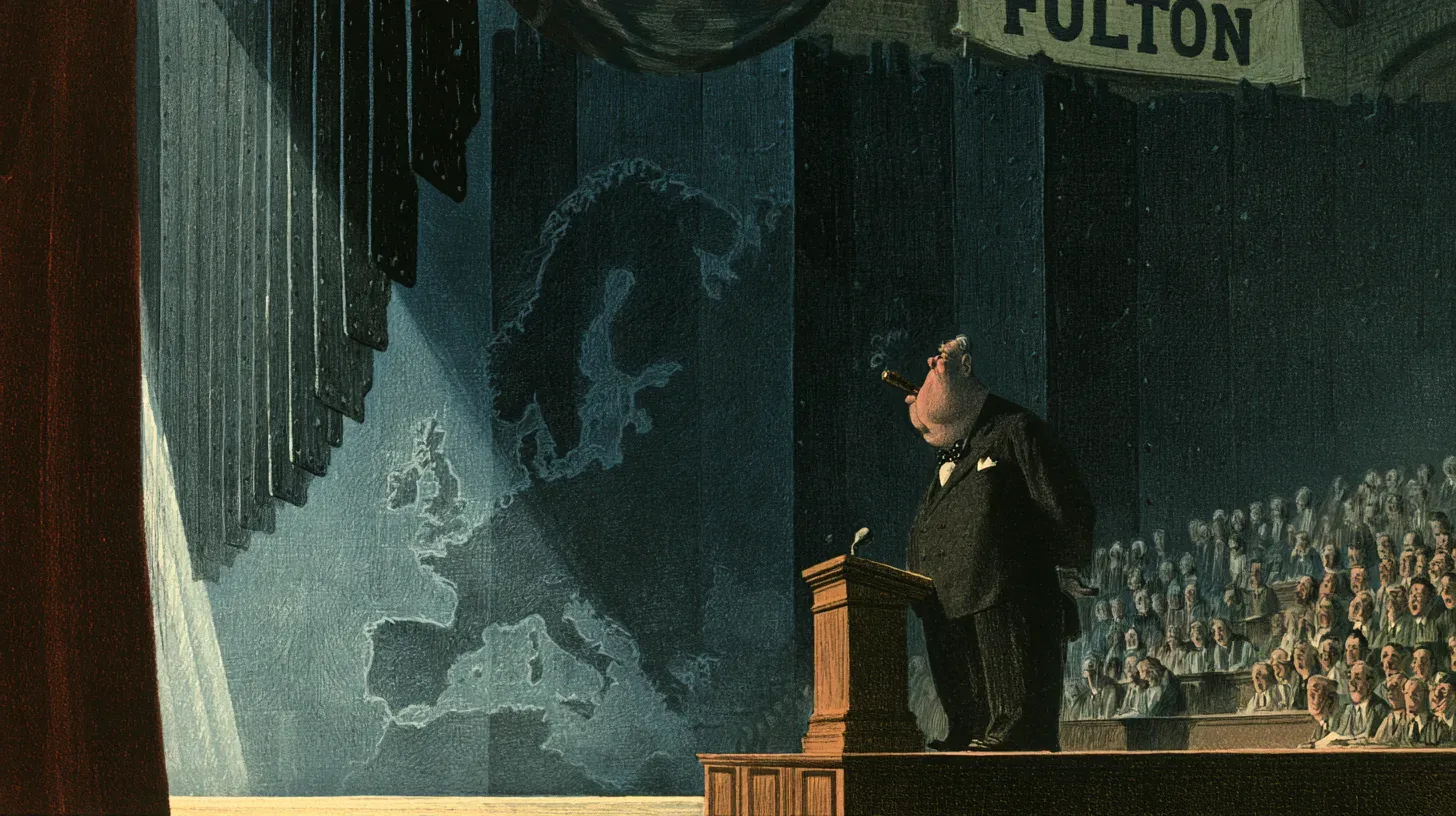
Winston Churchill coined the Cold War's defining image — "an iron curtain has descended across the Continent" — in a March 1946 speech at a small college in Fulton, Missouri. What office did he hold at the time?
See all answers & explanations
1. Winston Churchill coined the Cold War's defining image — "an iron curtain has descended across the Continent" — in a March 1946 speech at a small college in Fulton, Missouri. What office did he hold at the time?
Answer: Leader of the Opposition. British voters had swept Churchill out of Downing Street in July 1945, weeks after victory in Europe, so the most famous speech of the early Cold War came from an opposition politician. He delivered "The Sinews of Peace" at Westminster College at President Truman's personal invitation — Truman rode the train out to Missouri with him and had read a draft along the way.
2. During the 1948–49 Berlin Airlift, US pilot Gail Halvorsen launched "Operation Little Vittles," which ultimately dropped 23 tons of candy to Berlin's children on tiny handmade parachutes. How did it start?
Answer: With two sticks of gum Halvorsen handed to children at the airfield fence. Halvorsen met a cluster of children watching the transports land at Tempelhof in July 1948 and gave them the only thing in his pockets — two sticks of gum — promising to drop more from his plane, wiggling his wings so they'd know it was him. His commanding officer reprimanded him when the freelance candy drops came to light, then the airlift's commander made the operation official; by the end, American pilots had released more than 250,000 tiny parachutes.
3. The armistice signed at Panmunjom on July 27, 1953 stopped the fighting in Korea. Which combatant refused to sign it?
Answer: South Korea. President Syngman Rhee would not accept a divided peninsula, so South Korea never signed the armistice — the signatures came from the US-led United Nations Command, North Korea, and China. No peace treaty ever followed, which is why the Korean War has technically never ended.
4. Senator Joseph McCarthy's anticommunist crusade collapsed after a live-televised exchange on June 9, 1954, when he was asked, "Have you no sense of decency, sir?" Who said it?
Answer: Joseph Welch, the Army's lawyer at the hearings. Welch, chief counsel for the Army during the Army–McCarthy hearings, delivered the rebuke after McCarthy attacked a young lawyer at Welch's own firm on air. The gallery burst into applause, McCarthy's public support never recovered, and the Senate formally censured him that December.
5. In July 1959, Vice President Richard Nixon and Soviet leader Nikita Khrushchev squared off in the famous "Kitchen Debate," arguing the merits of capitalism and communism. Where did it happen?
Answer: A model American kitchen at a trade exhibition in Moscow. The two sparred in front of a display kitchen inside a model suburban house at the American National Exhibition in Moscow's Sokolniki Park — not a summit, but an impromptu shouting match at a consumer-goods fair. It was captured on color videotape and broadcast in both countries, with each side convinced its man had won.
6. Yuri Gagarin became the first human in space on April 12, 1961 — but for years afterward the Soviet Union concealed one detail of his flight. What was it?
Answer: Gagarin ejected and parachuted to the ground separately from his capsule. Vostok 1 had no way to land softly with a person inside, so Gagarin ejected at about 7,000 meters and floated down under his own parachute while the capsule slammed into a field nearby. The Soviets hid this because international record-keeping rules required a pilot to land with the craft — the rules were later changed, and Gagarin kept the record. Go deeper: Starbound: The Most Iconic Moments in Space History.
7. On October 27, 1962 — the most dangerous day of the Cuban Missile Crisis — the Soviet submarine B-59, out of contact with Moscow and hammered by US practice depth charges, prepared to fire its nuclear torpedo. What stopped it?
Answer: One officer aboard, Vasili Arkhipov, refused to give his required consent. Launching B-59's nuclear torpedo required the unanimous agreement of the three senior officers aboard, and flotilla chief of staff Vasili Arkhipov alone said no. The episode stayed essentially unknown until a 2002 conference on the crisis, after which the director of the National Security Archive called Arkhipov "the man who saved the world."
8. Sergei Korolev masterminded Sputnik and Gagarin's flight as the guiding genius of the Soviet space program. When did the Soviet public first learn his name?
Answer: When Pravda printed his obituary in 1966. Moscow kept its rocket chief's identity a state secret — for his entire career he was publicly referred to only as "the Chief Designer." Korolev died in January 1966 after surgery, and only then did the Soviet press reveal the name behind the space program's triumphs; he was buried with honors in the Kremlin wall.
9. The Berlin Wall opened on the night of November 9, 1989. What actually set it off?
Answer: A government spokesman botching a live press conference. East German spokesman Günter Schabowski, handed new travel rules he had not been briefed on, stammered to reporters that they took effect "immediately, without delay." Crowds mobbed the crossings within hours and the overwhelmed border guards — who had received no orders — opened the gates. Reagan's famous speech was real, but it came two and a half years earlier, in June 1987. Go deeper: Stones of Power: The Most Famous Historic Walls.
10. As the Soviet Union ran out of hard currency in the Cold War's final years, PepsiCo agreed to take payment for its cola syrup in an unusual form. What did Pepsi briefly come to own?
Answer: A fleet of aging Soviet submarines and warships. Pepsi had bartered cola for Stolichnaya vodka since the 1970s, but with the ruble worthless abroad the Soviets eventually paid in hardware — 17 aging submarines plus a cruiser, a frigate, and a destroyer, which went more or less straight to the scrapyard. The internet legend that this made Pepsi "the sixth-largest navy on Earth" doesn't hold up: the vessels were unseaworthy relics, and Pepsi was effectively a scrap middleman. Go deeper: The Time Pepsi Bought Naval Ships from the Soviet Union.
Cold War Quiz FAQ
What was the Cold War?
The Cold War was the four-decade standoff between the United States and the Soviet Union that ran from the late 1940s until 1991 — a global rivalry fought with every tool short of open war between the two superpowers, including nuclear arms races, espionage, propaganda, and proxy conflicts on nearly every continent.
The name captures its strangest feature: the two main antagonists never fought each other directly. The shooting stayed at the margins, in wars like Korea and Vietnam and in US-backed coups across Latin America, while Washington and Moscow armed and funded opposite sides.
It was also a contest of daily life. The space race turned rockets into scorecards, and consumer goods became weapons of persuasion — Coca-Cola and Pepsi's rival adventures behind the Iron Curtain track the conflict's entire arc, from Marshal Zhukov's secret colorless "White Coke" to the submarine barter in question 10 above.
What was the Cuban Missile Crisis?
The Cuban Missile Crisis was a thirteen-day confrontation in October 1962, triggered when American reconnaissance photos revealed Soviet nuclear missile sites under construction in Cuba, roughly 90 miles from Florida. It is widely considered the closest the Cold War ever came to nuclear war.
President Kennedy ordered a naval "quarantine" of the island rather than an immediate strike, and for nearly two weeks the world held its breath while Washington and Moscow traded ultimatums. The crisis broke on October 28, when Khrushchev agreed to withdraw the missiles in exchange for a public American pledge not to invade Cuba — and a secret promise to pull US Jupiter missiles out of Turkey, a concession kept quiet for years.
The most dangerous moment may have passed underwater: as question 7 above recounts, a single Soviet submarine officer's refusal to consent likely stopped a nuclear torpedo launch on October 27 — a story that stayed buried until 2002.
Why was the Berlin Wall built?
East Germany built the Berlin Wall to stop its own people from leaving. By 1961, more than 2.5 million East Germans had fled to the West since the country's founding — most simply by walking into West Berlin, the last open door in the Iron Curtain — and the exodus was draining the state of its workers and professionals.
The regime sealed the border overnight. In the early hours of August 13, 1961, under a secret plan codenamed Operation Rose, troops strung barbed wire across the city's crossing points; the concrete wall, the floodlit "death strip," and hundreds of watchtowers followed. At least 140 people died at the Wall before it fell — one of the grimmest entries in history's long catalog of dividing walls.
Officially, East Berlin called it the "Anti-Fascist Protection Rampart" and insisted it was built to keep enemies out. Nobody was fooled: every fortification faced inward.
When did the Cold War end?
The Cold War ended in stages between 1989 and 1991, and historians use both endpoints. The revolutions of 1989 — capped by the opening of the Berlin Wall on November 9 — collapsed the Soviet bloc in Eastern Europe, and within weeks Gorbachev and President George H. W. Bush were signaling the era's end at the Malta summit that December.
The formal end came two years later. Gorbachev resigned as Soviet president on December 25, 1991, transferring the nuclear launch codes to Boris Yeltsin, and the hammer-and-sickle flag came down over the Kremlin that same evening. The next day, the Soviet Union formally voted itself out of existence.
As for who won: the United States and its allies outlasted their rival, which dissolved into fifteen independent states. But the aftermath was messier than a scoreboard — the empire's fleet went to the scrapyard, its markets went to the cola companies, and its successor states into a turbulent decade.