
US Presidents Quiz — Free 10-Question Presidential Trivia
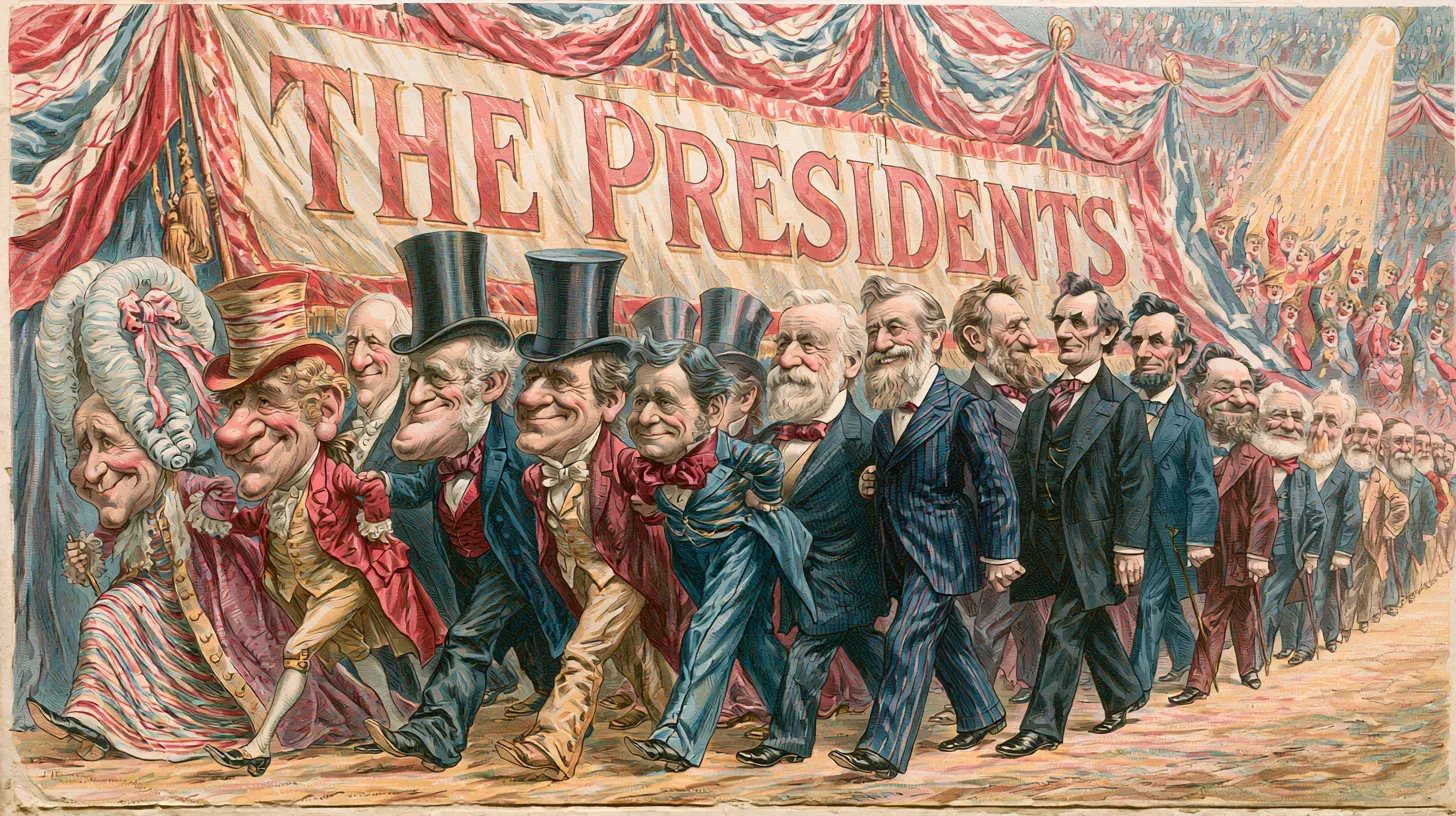
Think you know the men who ran the country? This free US presidents quiz serves up 10 multiple-choice presidential trivia questions — from George Washington's will to Nixon's resignation — with instant scoring and a short explanation after every answer. No sign-up, no timer. Prefer to read? Every question is written out below with its answer.
Question 1 of 10
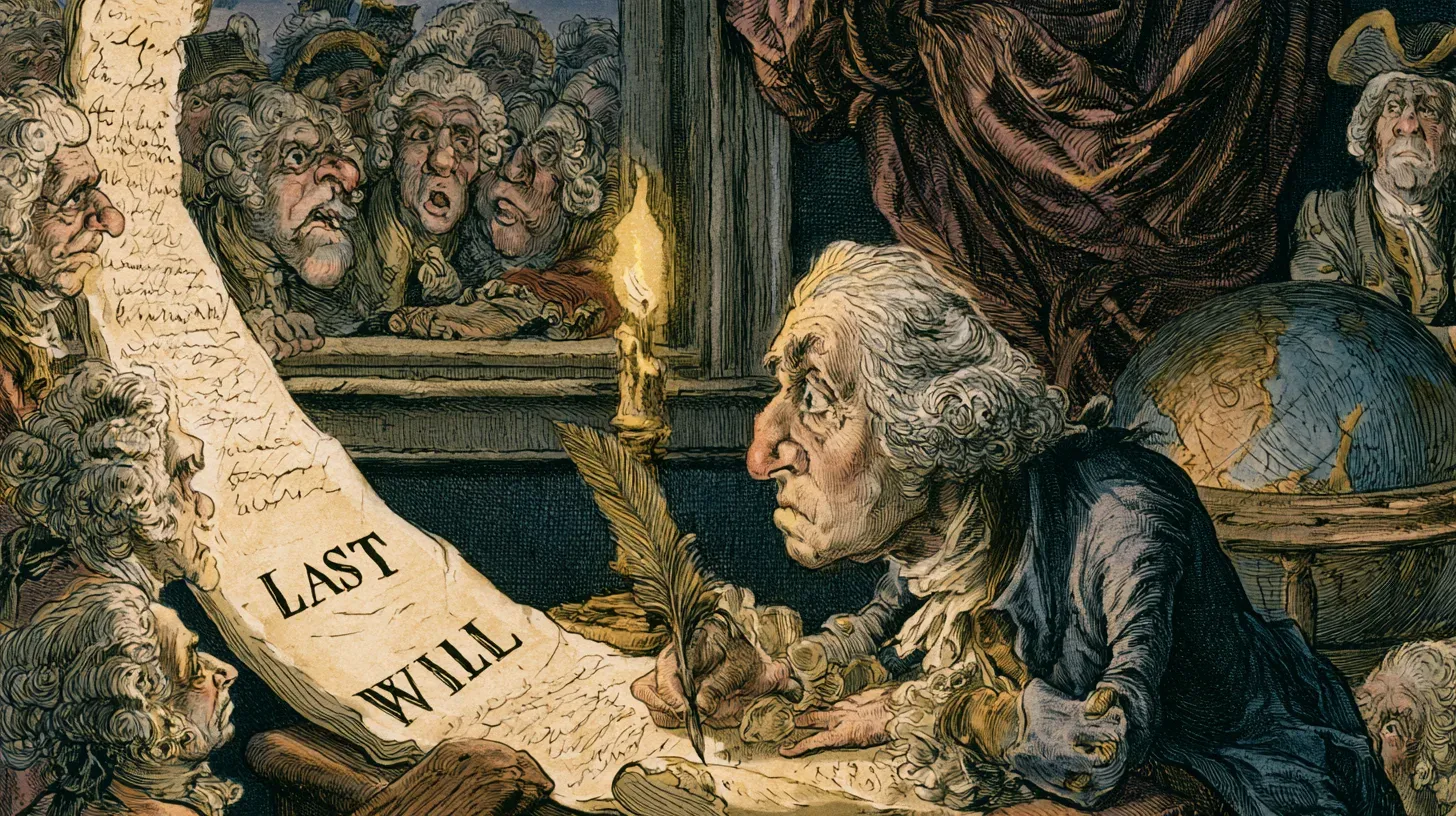
George Washington's will set him apart from the other slaveholding founders. What did it order?
See all answers & explanations
1. George Washington's will set him apart from the other slaveholding founders. What did it order?
Answer: That the enslaved people he owned be freed after Martha's death. Washington directed that the 123 enslaved people he personally owned be freed once Martha died; she signed the deed early, and they became free on January 1, 1801. He could not free the far larger group of "dower" slaves at Mount Vernon, who legally belonged to her first husband's estate. Go deeper: List Of Founding Fathers Who Owned Slaves: Unmasking the Irony.
2. In January 1835 a man aimed two pistols at Andrew Jackson and both misfired. Why is that moment a landmark?
Answer: It was the first assassination attempt on a sitting US president. Unemployed house painter Richard Lawrence stepped out on the Capitol's East Portico and pulled the trigger twice on the 67-year-old president; damp weather is the likely reason both flintlocks failed. Jackson set about him with his cane until bystanders — Davy Crockett among them — pulled the two apart. Go deeper: Andrew Jackson: 14 Facts About Donald Trump's Favorite President.
3. Which president served the shortest term in American history?
Answer: William Henry Harrison. Harrison died 31 days into his term on April 4, 1841, the first president to die in office. His death forced the unsettled question of succession, and Vice President John Tyler's insistence that he was now president — not merely acting as one — set the precedent ever after.
4. On what date was Abraham Lincoln shot at Ford's Theatre?
Answer: April 14, 1865. John Wilkes Booth shot Lincoln on the evening of April 14, 1865, just five days after Robert E. Lee surrendered to Ulysses S. Grant at Appomattox on April 9. Lincoln died the following morning without regaining consciousness. Go deeper: History in April.
5. Which president is counted twice in the numbered list — as both the 22nd and the 24th president?
Answer: Grover Cleveland. Cleveland won in 1884, lost the 1888 rematch to Benjamin Harrison despite winning more votes nationwide, then beat Harrison again in 1892. For more than a century he was the only president numbered twice; Donald Trump became the second when he returned to office in 2025 as the 47th president.
6. Which president signed the Pure Food and Drug Act of 1906, the law that grew into the FDA?
Answer: Theodore Roosevelt. Roosevelt signed it the same day as the Federal Meat Inspection Act, both driven by public revulsion at Upton Sinclair's novel "The Jungle." Before the law, over-the-counter remedies could legally contain morphine, arsenic, or formaldehyde without saying so on the label.
7. Grover Cleveland's face appeared on which piece of American paper money, last printed in 1945?
Answer: The $1,000 bill. James Madison held down the $5,000 note and Woodrow Wilson appeared on the $100,000 gold certificate, which never circulated publicly. The Treasury killed every denomination above $100 in July 1969 for lack of use, though the old notes are still legal tender. Go deeper: Discontinued U.S. Currency That We’d All Like to Find in Our Attic.
8. Which president appointed Frances Perkins, the first woman ever to serve in a US Cabinet?
Answer: Franklin D. Roosevelt. Roosevelt made Perkins his Secretary of Labor in March 1933. She stayed twelve years — still the longest tenure anyone has had in that job — and was a principal architect of Social Security, the minimum wage, and the forty-hour week. Go deeper: History in March.
9. Which president was in office when the Soviets shot down an American U-2 spy plane in 1960 and captured the pilot alive?
Answer: Dwight D. Eisenhower. Washington's cover story — a stray weather plane — collapsed when Nikita Khrushchev produced pilot Francis Gary Powers in Moscow. The embarrassment wrecked a planned Paris summit between Eisenhower and Khrushchev weeks later. Go deeper: History in May.
10. Which president resigned in August 1974 rather than face near-certain impeachment?
Answer: Richard Nixon. Nixon resigned on August 9, 1974, after his own Oval Office tape recordings confirmed he had helped cover up the Watergate break-in. He remains the only president ever to resign the office; his successor, Gerald Ford, pardoned him a month later. Go deeper: History in May.
US Presidents Quiz FAQ
Who was the only president elected four times?
Franklin D. Roosevelt is the only president elected four times, winning in 1932, 1936, 1940, and 1944. He took office at the bottom of the Great Depression and died in April 1945, only months into his fourth term — twelve years and one month in the job, the longest presidency in American history.
Nobody will match it. The Twenty-Second Amendment, ratified in 1951, holds presidents to two elected terms, and anyone who has already served more than two years of someone else's unexpired term can be elected only once.
Roosevelt's third and fourth runs were contentious even at the time: every president since George Washington had voluntarily stopped at two, and breaking the custom struck critics as one man holding power too long, while supporters argued that depression and world war were no moment to change captains. The amendment settled the argument by writing Washington's informal rule into the Constitution. The quiz above skips FDR's election record but does test his most consequential appointment.
Which president was known as Old Hickory?
Andrew Jackson, the seventh president, was known as Old Hickory — and he earned it in the field, not in politics. In 1813 he marched more than two thousand Tennessee volunteers toward New Orleans, only to be told at Natchez that they were no longer needed and should disband where they stood, hundreds of miles from home. Jackson refused. He led the whole column back to Nashville at his own expense, walking so that the sick could ride.
His men said he was as tough as hickory, one of the hardest woods in North America, and the name stuck for the rest of his life. By the 1820s "Old Hickory" was a campaign slogan for a movement that cast him as the plain man's candidate against entrenched elites.
As president from 1829 to 1837 he expanded the office's power and fought the national bank — and he signed the Indian Removal Act of 1830, the law behind the Trail of Tears and thousands of deaths. Jackson turns up in the quiz above, though not for his nickname.
Who was the only president to hold a PhD?
Woodrow Wilson is the only president to hold a doctorate, awarded by Johns Hopkins University in 1886 in history and political science. His dissertation, "Congressional Government," argued that real power in Washington sat in congressional committee rooms rather than in the White House — a book still assigned in political science courses more than a century later.
Wilson spent his career in the academy before he ever ran for anything, teaching at Bryn Mawr and Wesleyan and then serving as president of Princeton, which makes him one of the few people to lead a major university and then the country. He went from Princeton to the New Jersey governorship in 1910 and to the presidency in 1912.
The scholar's habits showed: in 1913 he revived the practice of delivering the State of the Union as a speech to Congress, something no president had done since Jefferson abandoned it in 1801, and it has been a spoken address ever since. Other presidents have held law degrees and master's degrees, but the PhD remains Wilson's alone.
Can you name all the US presidents in order?
Most people can manage the first few and the last few and get lost in the middle — which is where the real trivia lives. The list runs to 47 presidencies held by 45 different people.
The gap is the one piece of presidential arithmetic that trips everyone up: a president who serves two non-consecutive terms gets counted twice. Grover Cleveland did it first, as the 22nd and 24th president, and Donald Trump did it again in 2025, having been the 45th and returning as the 47th. Everyone else served once or served back-to-back terms, so they take a single number.
If you want the whole sequence by heart, don't try to swallow it in one piece. Break it into the eras historians already use — early republic, antebellum, Civil War and Reconstruction, Gilded Age, the world wars, the modern presidency — and anchor each block on the two or three names you already know cold, then fill inward. Flashcards and the old sing-it-to-a-tune trick both work, but self-testing is what actually builds recall, which is what the quiz above is for.