
American Revolution Quiz
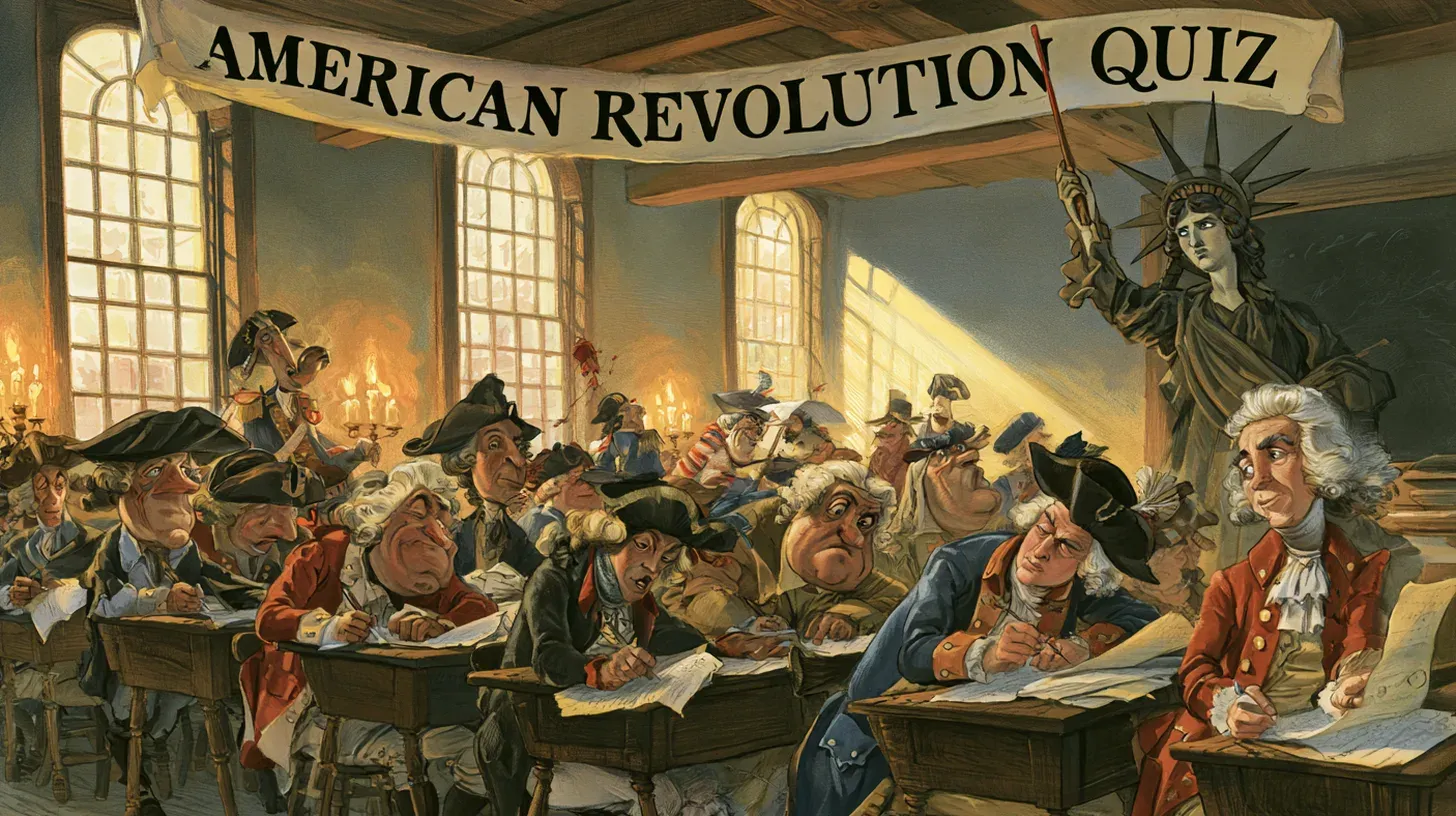
This American Revolution quiz runs from the Stamp Act to the king's parting verdict on George Washington — 10 multiple-choice Revolutionary War trivia questions on the taxes, battles, spies, and unlikely soldiers of 1765 to 1783. A few of the answers every school course covers; most are the kind that trip up even history buffs. Every question is written out in the answer key below with a full, sourced explanation.
Question 1 of 10
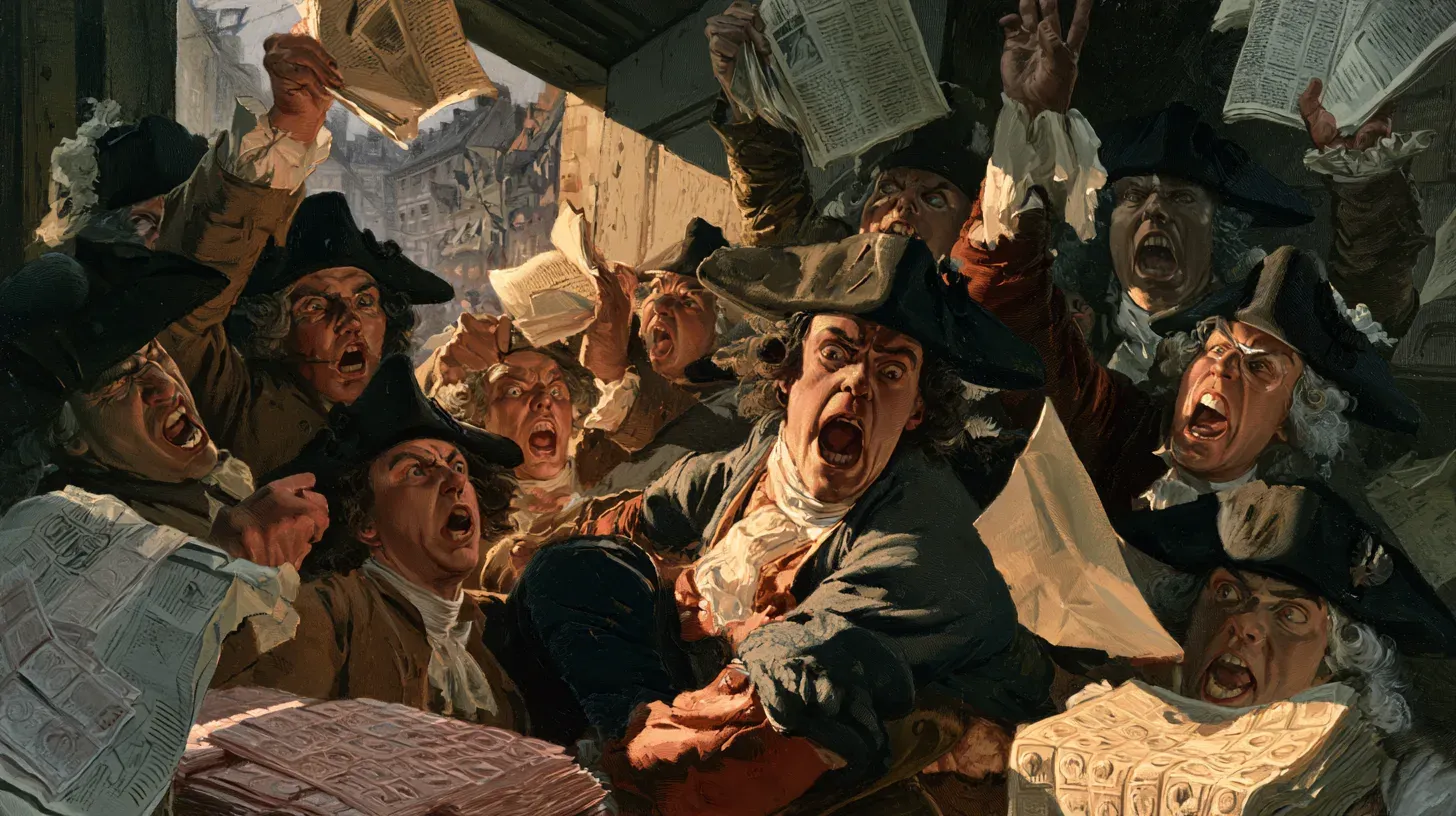
The Stamp Act of 1765 taxed paper goods across the colonies — but one item drew a duty of ten shillings, ten times the tax on a deck of playing cards. Which?
See all answers & explanations
1. The Stamp Act of 1765 taxed paper goods across the colonies — but one item drew a duty of ten shillings, ten times the tax on a deck of playing cards. Which?
Answer: A pair of dice. Parliament scaled the duties to what it thought each purchase could bear, and gambling gear sat at the luxury end — one shilling on a pack of cards, ten on a pair of dice. The act's fine print went further still: any document written in a language other than English paid double the ordinary duty.
2. For roughly half a century after December 1773, Americans did not call it the "Boston Tea Party." What did they call it?
Answer: The destruction of the tea. The name "Boston Tea Party" didn't appear in print until December 30, 1825 — 52 years after the 342 chests went into the harbor. Contemporaries spoke of "the destruction of the tea," and the earliest uses of "tea party" seem to have referred to the party of men who dumped the cargo, not the night itself.
3. According to eyewitness depositions, what did Paul Revere actually say to rouse the countryside on the night of April 18, 1775?
Answer: The regulars are coming out!. Sergeant William Munroe of the Lexington militia deposed that Revere warned "the regulars are coming out" — the professional British troops. "The British are coming" would have baffled colonists who still considered themselves British; that wording doesn't surface in the record until around 1822, decades after the ride.
4. The Battle of Bunker Hill, fought June 17, 1775, has a geography problem. Where did most of the fighting actually happen?
Answer: Breed's Hill. Colonel William Prescott was ordered to fortify Bunker Hill but dug his redoubt on Breed's Hill instead — lower, but closer to Boston and easier to defend. Early accounts called the fight the Battle of Charlestown Heights before the misnomer settled in for good.
5. The cannons that finally drove the British out of Boston in March 1776 appeared on Dorchester Heights almost overnight. Where had they come from?
Answer: Fort Ticonderoga — 300 miles away. Ethan Allen and Benedict Arnold had seized Fort Ticonderoga in May 1775 with fewer than a hundred men. That winter Henry Knox hauled some 59 of its guns roughly 300 miles to Boston by ox-drawn sled. Once they commanded the harbor from Dorchester Heights, the British evacuated the city on March 17, 1776.
6. Washington's crossing of the Delaware ended in the rout of the Hessian garrison at Trenton. Which future president was among the few Americans wounded there?
Answer: James Monroe. Eighteen-year-old Lieutenant James Monroe — the future fifth president — was badly wounded at Trenton on December 26, 1776, in a surprise attack that took nearly 900 Hessian prisoners. Andrew Jackson served in the Revolution too, but as a teenage courier taken prisoner by the British in the Carolinas.
7. The Revolution forced the Six Nations of the Iroquois Confederacy to choose sides. How did they split?
Answer: The Oneida and Tuscarora backed the Americans; the other four nations backed Britain. Unable to agree on one course — the Oneida had pleaded "We are unwilling to join either side of such a contest, for we love you both" — the confederacy fractured. The Oneida and Tuscarora sided with the Americans, while the Mohawk, Seneca, Cayuga, and Onondaga fought for Britain, setting nation against nation.
8. In May 1781, after a two-month siege, the British Gulf Coast stronghold of Pensacola surrendered — to which army?
Answer: A Spanish force under Bernardo de Gálvez. Spain entered the war in 1779, and its Louisiana governor, Bernardo de Gálvez, swept the British from the Gulf — Baton Rouge, then Mobile, then Pensacola after a siege that ran from March 9 to May 8, 1781. The southern front he opened tied down British troops and ships that could otherwise have reinforced Cornwallis.
9. Deborah Sampson served seventeen months in the Continental Army's light infantry and was wounded twice. How did she manage it?
Answer: By enlisting disguised as a man named "Robert Shurtliff". Sampson enlisted in the 4th Massachusetts Regiment under the alias Robert Shurtliff and fought in the Hudson Valley until an army doctor discovered her secret. General Henry Knox granted her an honorable discharge in October 1783, and in 1805 — with Paul Revere lobbying Congress on her behalf — she became the first American woman awarded a military pension.
10. Told that George Washington planned to give up command of the army and go home to his farm, King George III reportedly made what prediction?
Answer: If he does that, he will be the greatest man in the world. The remark comes down to us from the American painter Benjamin West, who knew the king well. Asked what Washington would do with the war won, West said he expected him to retire to his farm — and the king replied that if he did, he would be the greatest man in the world. Washington resigned his commission at Annapolis on December 23, 1783.
American Revolution Quiz FAQ
What killed the most soldiers in the Revolutionary War?
Disease killed far more soldiers than combat did. Fewer than 7,000 American soldiers died in battle across eight years of war, while conservative estimates put deaths from disease at 17,000 or more — dysentery, typhus, typhoid fever, and above all smallpox, which swept North America as an epidemic through the very years of the fighting.
Smallpox frightened George Washington enough that he gambled on a then-controversial fix: in February 1777 he ordered the secret mass inoculation of the Continental Army, a program often described as the first large-scale immunization campaign in American history. Washington knew the stakes personally — he had survived smallpox as a young man and carried the immunity (and the facial scars) for life.
The imbalance held on both sides, but it hit the Americans harder: smallpox was endemic in Britain, so most redcoats arrived already immune, while the average Continental soldier had never been exposed. Several questions in the quiz above turn on this quieter, deadlier side of the war.
What are 10 interesting facts about the Revolutionary War?
Start with the ones most quizzes miss. Nearly 800 American privateers — privately owned warships — were commissioned during the war and are credited with capturing or destroying about 600 British vessels, far outweighing the tiny Continental Navy. The Continental Army marched north in 1775 in the first of several American invasions of Canada. And the legendary Valley Forge winter of 1777–78 was actually mild for Pennsylvania — the roughly 2,000 deaths there came from supply failures and camp disease, not cold.
The war's human ledger is stranger than the textbook version. An estimated 60,000 to 80,000 Loyalists left the country during and after the war, tens of thousands of them for Canada. When the British evacuated New York on November 25, 1783, they registered some 3,000 formerly enslaved people in a ledger called the "Book of Negroes" and carried them to Nova Scotia as free people — several founding fathers owned slaves, and some of these refugees had escaped their estates. James Armistead, an enslaved Virginian who spied on Cornwallis as a double agent, had to wait until 1787 for Virginia to free him, after the Marquis de Lafayette personally vouched for his service.
Even the famous words are slippery. John Paul Jones's "I have not yet begun to fight!" wasn't written down until 1825, and George III's anguished "America is lost!" comes from a private essay — one of the more revealing King George III quotes to survive. And when the Treaty of Paris was signed in 1783, John Adams and Benjamin Franklin — who had feuded their way through the diplomacy that won it — signed with John Jay in strict alphabetical order.
What are 5 fun facts about George Washington?
His teeth were never wooden — his dentures were built from ivory, metal, and human and animal teeth. He caught smallpox in Barbados in 1751 on his only trip outside the future United States, and the immunity it left him proved priceless when the disease ravaged his army decades later. By 1799 his Mount Vernon distillery was producing nearly 11,000 gallons of whiskey a year, making it one of the largest in the country.
He also never lived in the White House. Washington picked the site and watched the project begin, but the mansion wasn't finished until 1800, and John Adams was the first president to move in. And he remains the only president ever elected unanimously by the Electoral College — a feat he managed twice, in 1789 and 1792.
If the presidents are your strong suit, our US Presidents quiz runs from Washington's will to Watergate.
What is a good American Revolution quiz question for kids?
Good questions for kids stick to the big, concrete story beats. Which country did the thirteen colonies break away from? (Great Britain.) Who commanded the Continental Army? (George Washington.) What did colonists throw into Boston Harbor in 1773? (Tea — 342 chests of it.) For older kids, add a why: colonists objected to the Stamp Act because they had no representatives in the Parliament that passed it — "no taxation without representation."
The quiz on this page is written for adults and sharp middle-schoolers, so younger classes usually do better tackling it as a team. Teachers hunting for more material can pull from the answer key above — every question comes with a short, sourced explanation a student can read aloud.