
Wild West Trivia
This Wild West trivia quiz rides from the first Pony Express run in 1860 to Butch Cassidy's escape to South America in 1901: 10 multiple-choice questions on the outlaws, lawmen, cowboys and frontier towns of the Old West. A few are campfire classics; others take the legends apart. Every question is written out in the answer key below, with a sourced explanation.
Question 1 of 10
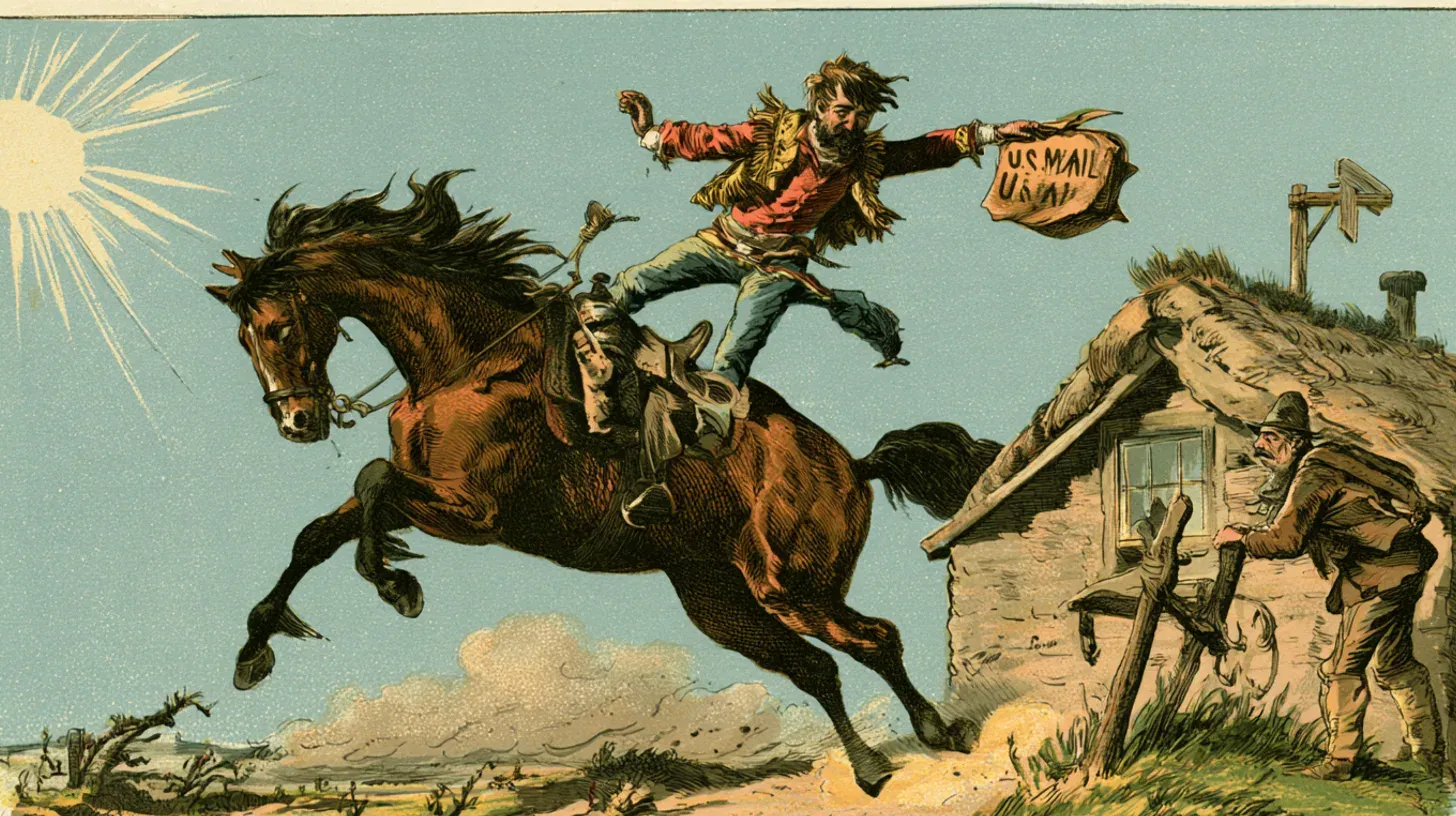
The Pony Express carried its first westbound mail on April 3, 1860. From which Missouri town did that first rider set out?
See all answers & explanations
1. The Pony Express carried its first westbound mail on April 3, 1860. From which Missouri town did that first rider set out?
Answer: St. Joseph. St. Joseph, on the Missouri River, was the eastern end of the line, and the first westbound mail reached Sacramento, California, ten days later. The service lasted only about 18 months. The transcontinental telegraph was finished in late October 1861, and the Pony Express shut down within days of it. Go deeper: 7 Dark Facts about the Pony Express.
2. Cattleman Charles Goodnight is credited with fitting out an Army-surplus wagon for his 1866 trail drive out of Texas. What did it become?
Answer: The chuck wagon, the trail cook's rolling kitchen. Goodnight is generally credited with the chuck wagon, a cook's wagon with a box of shelves and drawers built onto the back, first used on the drive that opened the Goodnight-Loving Trail to New Mexico and Colorado. "Chuck" was cowboy slang for food. In 2005 the Texas Legislature made the chuck wagon the official state vehicle. Go deeper: Saddles & Gunslingers: The Most Famous Cowboys & Cowgirls.
3. Charley Parkhurst was one of the most respected "whips" of Gold Rush California, and only after Parkhurst's death in 1879 did people learn Charley had been born female. What was a whip?
Answer: A stagecoach driver. In stagecoach slang, the whip was the driver, and Parkhurst drove coaches on steep California routes for years despite losing an eye to a horse's kick. Santa Cruz County records list a Charles Darkey Parkhurst as a registered voter in 1867, and the name appears on a poll list for the 1868 election. No record proves a ballot was actually cast, so the popular "first woman to vote" claim remains unconfirmed. Go deeper: Saddles & Gunslingers: The Most Famous Cowboys & Cowgirls.
4. On May 10, 1869, a golden spike marked the joining of the Union Pacific and Central Pacific rails, completing the first transcontinental railroad. Where did the two lines meet?
Answer: Promontory Summit, Utah Territory. Congress fixed the meeting place at Promontory Summit, in the hills north of the Great Salt Lake. Promontory Point is a different place, the tip of a peninsula reaching into the lake to the south, but some captions of the day used that name and the mix-up has followed the event ever since. The site is now Golden Spike National Historical Park.
5. Which deputy U.S. marshal, born into slavery, rode Indian Territory for about 32 years and is credited with more than 3,000 arrests?
Answer: Bass Reeves. Judge Isaac Parker's federal court at Fort Smith, Arkansas, commissioned Bass Reeves in 1875, and he worked Indian Territory until 1907. The 3,000 figure comes from later retellings rather than court tallies, because newspapers of the day rarely reported his arrests. Bill Tilghman and Heck Thomas were real Oklahoma deputies too, and Bat Masterson made his name as a Dodge City lawman before ending up a New York sportswriter. Go deeper: Saddles & Gunslingers: The Most Famous Cowboys & Cowgirls.
6. Wild Bill Hickok was shot from behind at a poker table on August 2, 1876. In which gold-rush town did it happen?
Answer: Deadwood, Dakota Territory. Jack McCall shot Hickok in Nuttal & Mann's saloon in Deadwood, a camp that had sprung up that year on Black Hills land the 1868 Fort Laramie Treaty had promised to the Lakota. Hickok's cards were said to be black aces and black eights, the hand poker players still call the dead man's hand. A miners' court acquitted McCall; he was tried again, convicted and hanged in March 1877. Go deeper: Saddles & Gunslingers: The Most Famous Cowboys & Cowgirls.
7. The Gunfight at the O.K. Corral in Tombstone, on October 26, 1881, was over in about 30 seconds. Where was it actually fought?
Answer: In a narrow lot on Fremont Street, beside a photographer's studio. The Earp brothers and Doc Holliday faced the Clantons and McLaurys in a narrow lot on Fremont Street, next to C. S. Fly's boarding house and photography studio, several doors from the corral's back entrance. Three men died: Billy Clanton and Tom and Frank McLaury. The 1957 film Gunfight at the O.K. Corral fixed the corral in the public mind as the scene of the fight. Go deeper: Saddles & Gunslingers: The Most Famous Cowboys & Cowgirls.
8. Jesse James was living in St. Joseph, Missouri, under a false name when he was shot in his own home on April 3, 1882. Who pulled the trigger?
Answer: Robert Ford. Robert Ford, a recent recruit to the James gang, shot him in the back of the head while James stood on a chair to fix a picture on the wall. Ford and his brother Charley were after the reward Missouri's governor had promised. James was living as "Thomas Howard" in the same town the Pony Express had set out from 22 years earlier. Go deeper: Saddles & Gunslingers: The Most Famous Cowboys & Cowgirls.
9. Weeks before the Spanish-American War, Annie Oakley wrote to President William McKinley with an offer. What did she propose?
Answer: To raise a company of 50 women sharpshooters. Her letter of April 5, 1898, offered "a company of fifty lady sharpshooters" who would bring their own arms and ammunition if war came. The National Archives still holds it, written on letterhead that billed her as "America's Representative Lady Shot." The Army filed it as a tender of service, and no such company was ever raised.
10. In February 1901, with Pinkerton detectives on their trail, Butch Cassidy and the Sundance Kid sailed out of New York. In which country did they settle?
Answer: Argentina. With Etta Place, they sailed for Buenos Aires and took up a ranch near Cholila in Patagonia, where their log cabin still stands. They sold it in 1905 as the law closed in again, and by most accounts both men died in Bolivia in 1908. Pinkerton operative Charlie Siringo had spent years trailing Cassidy's gang before the pair left the country. Go deeper: Famous Detectives in History: From Pinkerton to Petrosino.
Wild West Trivia FAQ
What was the wildest town in the Old West?
There is no official ranking, but Dodge City, Tombstone and Deadwood are the towns most often named, and each earned its reputation differently. Dodge City was the cattle market where Texas drovers were paid off after months on the trail. Tombstone was a silver boomtown, home of the 30-second fight in the quiz above. Deadwood sprang up in 1876 on Black Hills land that had been promised to the Lakota, with no lawful government in its first months, and it was there that Wild Bill Hickok was shot at the card table.
The body counts were smaller than the legend. Historian Robert Dykstra counted 45 violent deaths in the five major Kansas cattle towns between 1870 and 1885, police killings included, an average of about 1.5 per cattle season. Dodge City itself recorded 15 homicides from 1876 to 1885. One reason is that many cattle towns made visiting cowboys hand over their guns at the town limits.
So the wildest town depends on what you count. Deadwood had the least law, Tombstone the most famous gunfight, and Dodge City the loudest reputation, much of it written after the cattle trade had moved on.
Who was the worst outlaw in the West?
By his own count, John Wesley Hardin. When he was sentenced in Texas, he claimed to have killed 42 men. Newspapers of his day put the number at 27, and historians who have checked the individual cases can confirm fewer still, since Hardin was known to inflate his own stories.
Hardin's later life was as strange as his early one. He studied law in prison, was admitted to the bar after his release in 1894, and was shot dead the next year in an El Paso saloon by a constable, John Selman.
Billy the Kid is the name most people expect here, and the legend credits him with 21 killings, one for each year of his life. The documented number is far smaller. Outlaws like Jesse James, who robbed banks and trains for some 16 years, did more damage to property than to people. "Worst" depends on the yardstick, but on lives taken, Hardin's name comes up first.
What are 10 interesting facts about cowboys?
The real cowboys were more varied than the movie version. In Texas, as many as one in four cowhands was Black: historian Kenneth Porter estimated that 6,000 to 9,000 of the roughly 35,000 cowboys of the trail-drive era were African American. Nat Love, born enslaved in Tennessee, won the nickname "Deadwood Dick" in a roping and shooting contest in Deadwood, by his own account on July 4, 1876.
Much of the job came from Mexican vaqueros, along with its words. "Lariat" comes from the Spanish la reata, "chaps" from chaparreras, and "buckaroo" is an English rendering of vaquero. Bill Pickett, a Black cowboy from Texas, invented bulldogging, the rodeo event now called steer wrestling, by biting a steer's lip to bring it down.
The great trail-drive era was short. It took off after the Civil War, when Texas had millions of cattle and the railheads were in Kansas, and railroads and barbed wire had largely ended it by the late 1880s. In the years between, cowboys like Charles Goodnight laid out trails, outfitted the first chuck wagons, and turned cattle into the legend of the American cowboy.