
American Civil War Quiz
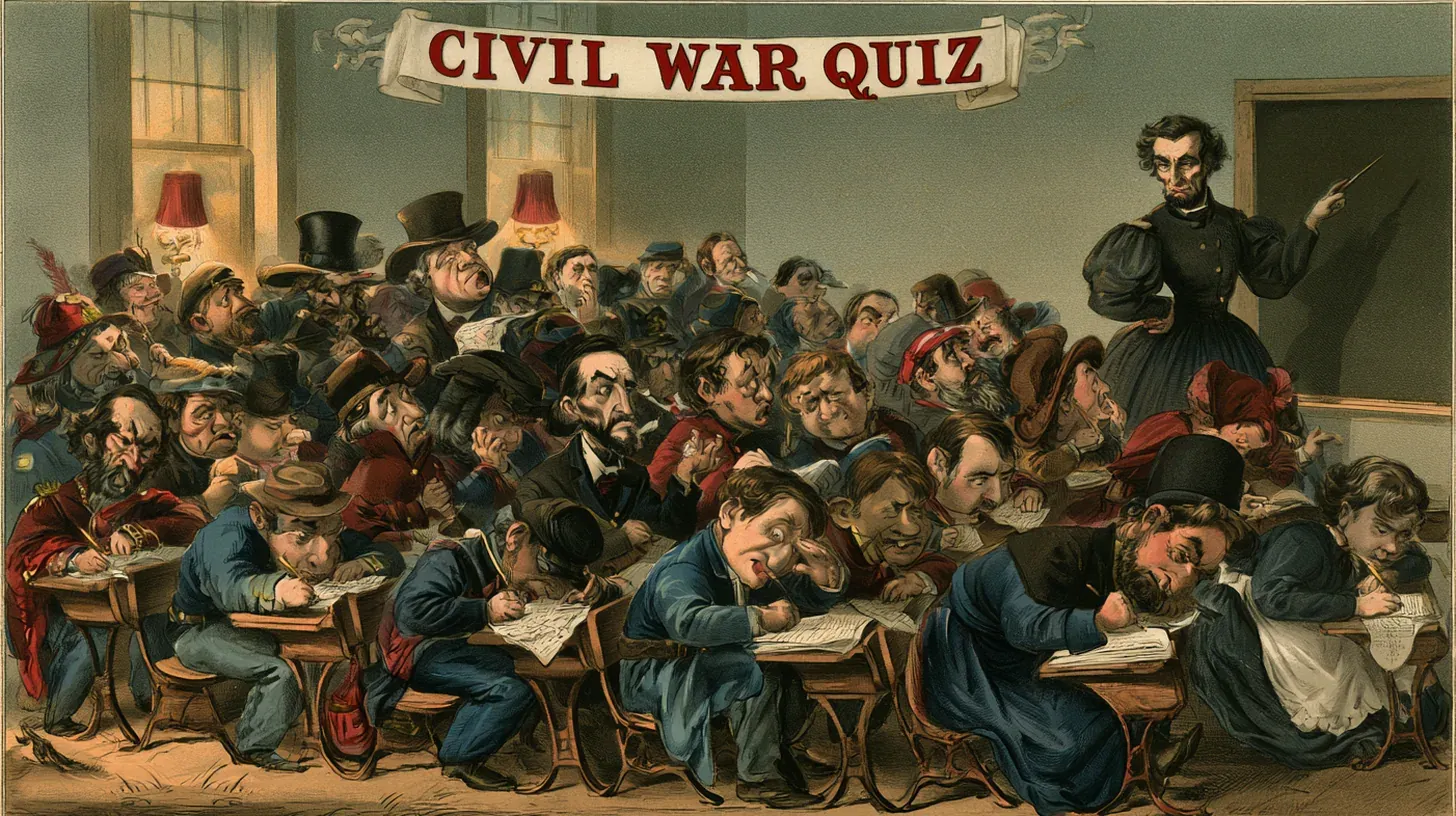
This American Civil War quiz runs from the secession winter of 1860 to the last shots fired in Texas — 10 multiple-choice trivia questions on the battles, blunders, and unlikely heroes of 1861 to 1865. Some answers every school course covers; others trip up even Civil War buffs. Every question is written out in the answer key below with a full explanation.
Question 1 of 10
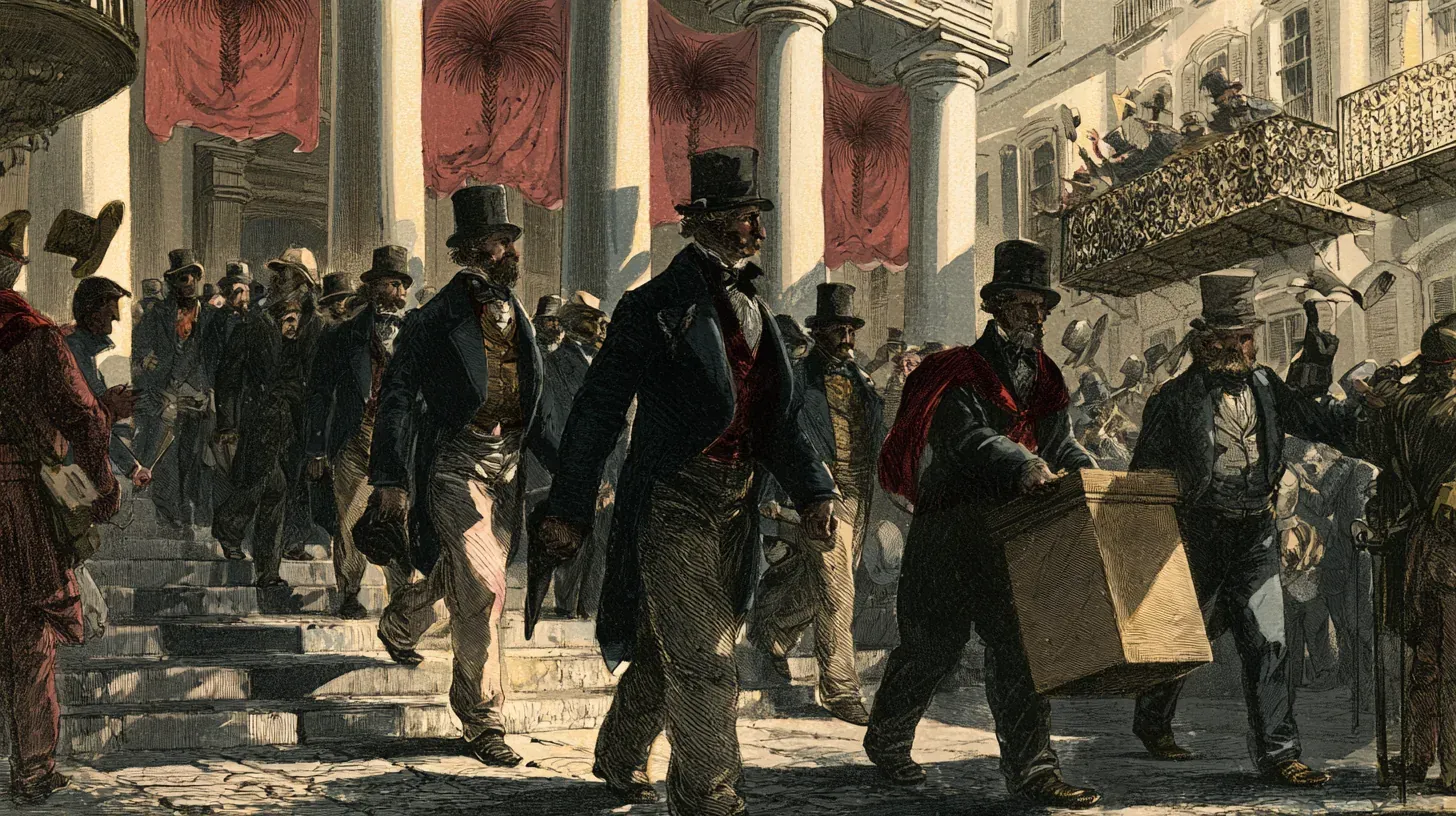
South Carolina led the South out of the Union on December 20, 1860. What was the final vote in its secession convention?
See all answers & explanations
1. South Carolina led the South out of the Union on December 20, 1860. What was the final vote in its secession convention?
Answer: 169 to 0. Every one of the 169 delegates present voted to secede — not a single no. The convention had fled Columbia for Charleston days earlier to escape a smallpox outbreak, and its unanimous ordinance made South Carolina the first state to declare itself out of the Union.
2. The bombardment of Fort Sumter opened the war on April 12, 1861. How many soldiers were killed in combat during the 34-hour battle?
Answer: None. Neither side lost a man to enemy fire in the entire battle. The war's first death came only after the fort surrendered, when a cannon exploded prematurely during the Union garrison's 100-gun evacuation salute, killing Private Daniel Hough — an accident, not a casualty of combat.
3. In 1861 the Union Army stood up a first-of-its-kind corps led by the aeronaut Thaddeus S. C. Lowe. What did it operate?
Answer: Observation balloons. Lowe's Balloon Corps sent observers up in tethered, hydrogen-filled silk balloons to spot Confederate positions — the first aerial reconnaissance in U.S. military history — and telegraphed what they saw down to commanders on the ground in real time. Go deeper: The Overlooked History of Balloons in War.
4. The Confederate ironclad CSS Virginia fought the USS Monitor to a draw at Hampton Roads in 1862 — history's first battle between ironclads. The Virginia was rebuilt from the hull of which Union warship?
Answer: USS Merrimack. The Union Navy burned and scuttled the steam frigate USS Merrimack when it abandoned the Norfolk navy yard in April 1861; the Confederates raised the hull and armored it into the CSS Virginia. The Congress and the Cumberland were the wooden Union warships the Virginia destroyed the day before the Monitor steamed in.
5. How did Robert Smalls, an enslaved harbor pilot in Charleston, free himself, his family, and a dozen others in May 1862?
Answer: He commandeered a Confederate steamer and sailed it to the Union blockade. Before dawn on May 13, 1862, Smalls took the wheel of the armed transport Planter while its white officers slept ashore, gave the correct signals to pass Charleston's forts, and surrendered the ship to the Union blockade outside the harbor. After the war he was elected to the U.S. House of Representatives from South Carolina.
6. When the Emancipation Proclamation took effect on January 1, 1863, whom did it actually declare free?
Answer: Enslaved people in Confederate territory still in rebellion. The proclamation applied only to areas still in rebellion — territory where Lincoln's authority could not yet reach — and exempted the loyal border states and Union-occupied districts. Nationwide abolition had to wait for the 13th Amendment, ratified in December 1865. Go deeper: Chattel Slavery Vs Indentured Servitude: Shades Of Horror.
7. How was the Confederate general Stonewall Jackson fatally wounded at Chancellorsville in May 1863?
Answer: His own troops shot him by mistake. Riding back from a night reconnaissance on May 2, 1863, Jackson was fired on in the dark by men of the 18th North Carolina, who mistook his party for Union cavalry. Surgeons amputated his left arm, and he died of pneumonia eight days later.
8. During the New York City draft riots of July 1863, what could a drafted man legally pay to buy his way out of service?
Answer: $300. The Enrollment Act let a draftee pay a $300 commutation fee or hire a substitute — options far beyond the reach of the city's working poor, which is why "rich man's war, poor man's fight" became the rioters' cry. The riots rank among the deadliest in American history, though the death toll is still disputed.
9. The Canadian-born Sarah Emma Edmonds served two years in the 2nd Michigan Infantry. How did she manage it?
Answer: Disguised as a man named Franklin Thompson. Edmonds enlisted in May 1861 as "Franklin Thompson" and served until malaria forced her to slip away in 1863 — a hospital stay would have exposed her. In 1884, after her old comrades vouched for her identity, Congress granted her a veteran's pension of $12 a month. Go deeper: Famous Female Spies: Women Who Infiltrated Enemy Lines.
10. The war's last land battle was fought at Palmito Ranch, Texas, on May 12 and 13, 1865 — more than a month after Lee surrendered at Appomattox. How did it end?
Answer: A Confederate victory. Colonel John "Rip" Ford's Confederates drove the Union column back to the coast in the war's final land engagement — a Confederate win weeks after the cause was lost. News moved slowly on the Rio Grande, and the Confederacy's main Trans-Mississippi force did not formally surrender until late May. Go deeper: History in April.
American Civil War Quiz FAQ
What caused the Civil War?
Slavery was the central cause of the Civil War — and the seceding states said so themselves. South Carolina's declaration of causes complained of "an increasing hostility on the part of the non-slaveholding States to the institution of slavery," and Mississippi's declared bluntly that its position was "thoroughly identified with the institution of slavery."
The plainest statement came from the Confederacy's own vice president. In March 1861, Alexander Stephens told a Savannah audience that the new government's "corner-stone" rested on the great truth, as he put it, that the negro is not equal to the white man — a speech preserved in full by the American Battlefield Trust.
Disputes over tariffs, territory, and states' rights were real, but each one circled back to the same underlying question: whether slavery would expand into the West or be put, as Lincoln said, on a course toward extinction. Abraham Lincoln's election in November 1860 on a platform of stopping slavery's expansion — without carrying a single Southern state — was the trigger. South Carolina seceded six weeks later, and the quiz above opens with what its convention did next.
Who won the Battle of Gettysburg?
The Union won the Battle of Gettysburg. The Army of the Potomac under General George G. Meade turned back Robert E. Lee's Army of Northern Virginia over three days, July 1 to 3, 1863, ending Lee's second and final invasion of the North.
Many people reach for Ulysses S. Grant, but Grant was hundreds of miles away besieging Vicksburg, which fell the very next day, July 4. Meade had held command of the army for all of three days when the fighting began. The battle's climax came on the third day, when the Confederate assault remembered as Pickett's Charge broke against the Union center on Cemetery Ridge.
Gettysburg was the costliest battle ever fought in North America, with roughly 51,000 casualties across both armies, and Lincoln's Gettysburg Address reframed the war's purpose over the battlefield's cemetery four months later. Gettysburg also anchors a question in our broader US history trivia quiz, if you want to keep testing yourself after this one.
How long did the Civil War last?
The Civil War lasted almost exactly four years — from the bombardment of Fort Sumter on April 12, 1861, to the collapse of the Confederacy in the spring of 1865.
It ended in stages rather than on a single day. Robert E. Lee surrendered the Army of Northern Virginia to Ulysses S. Grant at Appomattox Court House on April 9, 1865; Joseph E. Johnston surrendered the Confederacy's other major army to William T. Sherman in North Carolina on April 26; and the Trans-Mississippi command gave up in late May. As the quiz above covers, the last land battle — at Palmito Ranch, Texas — was actually fought a month after Appomattox.
The war's human cost is still being counted. The traditional figure of about 620,000 dead stood for a century, but a 2011 census-based study by the historian J. David Hacker put the likelier toll near 750,000 — most of them killed not by bullets but by disease.
What are some bizarre facts about the Civil War?
Start with Wilmer McLean, the man the war followed home. The first major battle broke out on his farm at Manassas in July 1861 — a shell crashed into his kitchen — so he moved his family 120 miles south to a quiet village called Appomattox Court House. On April 9, 1865, Lee surrendered to Grant in McLean's front parlor. He is remembered for claiming the war began in his front yard and ended in his parlor.
The story that Jefferson Davis was captured fleeing in a woman's dress is a myth — when Union cavalry caught him near Irwinville, Georgia, in May 1865, he had grabbed his wife's shawl in the predawn dark, and Northern cartoonists did the rest. And Abraham Lincoln sat for two life masks, one in 1860 and one in early 1865; the second so plainly records the war's toll on his face that sculptors long mistook it for a death mask.
The quiz above holds a few more in the same vein — a battle that killed no one, a war hero who stole his own ship, and a soldier named Franklin Thompson who wasn't named Franklin Thompson.