
World War 1 Quiz
This WW1 quiz runs the length of the Great War in 10 multiple-choice questions, from the wrong turn in Sarajevo that set it off to the last minutes before the guns fell silent in November 1918. Several answers overturn stories that still get repeated every year, including one famous photograph. Every question is written out with a full explanation in the answer key below.
Question 1 of 10
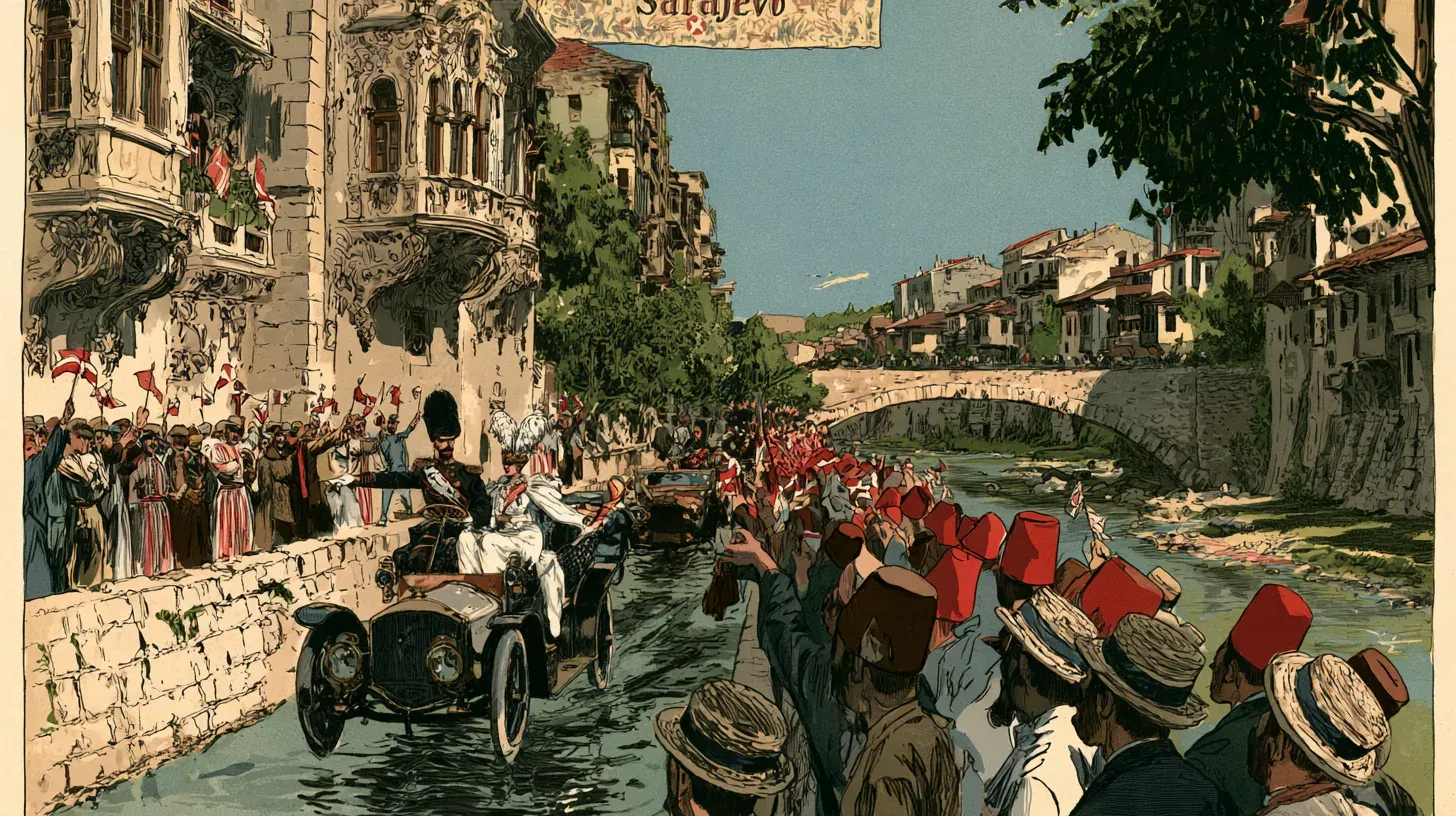
On June 28, 1914, Gavrilo Princip shot Archduke Franz Ferdinand in Sarajevo — less than an hour after another conspirator's bomb had missed the Archduke's car and the plot seemed to have failed. How did the car end up in front of Princip?
See all answers & explanations
1. On June 28, 1914, Gavrilo Princip shot Archduke Franz Ferdinand in Sarajevo — less than an hour after another conspirator's bomb had missed the Archduke's car and the plot seemed to have failed. How did the car end up in front of Princip?
Answer: The driver took a wrong turn, and the car stalled while backing up. After the bomb exploded under the car behind his, Franz Ferdinand chose to visit the wounded officers in hospital, and the route was changed to avoid the city center. Nobody told the driver. He turned onto Franz Joseph Street as the original plan had it, the governor riding with him shouted that it was the wrong way, and the car stopped while reversing — a few steps from Princip, who killed the Archduke and his wife Sophie with two shots. The popular story that Princip had gone for a sandwich has no historical basis.
2. When Britain protested Germany's invasion of Belgium on August 4, 1914, the German chancellor reportedly scoffed that Britain was going to war over "a scrap of paper." What was the scrap of paper?
Answer: An 1839 treaty guaranteeing Belgium's neutrality. The 1839 Treaty of London, signed by Britain and Prussia among others, had guaranteed Belgian independence and neutrality for 75 years. Chancellor Theobald von Bethmann-Hollweg's sneer reached the world through the British ambassador, Sir Edward Goschen, who was summarizing the conversation rather than quoting it word for word — but the phrase stuck, Britain declared war that same day, and "the scrap of paper" became a recruiting-poster slogan.
3. The 1914 Christmas Truce really happened — along stretches of the Western Front, British and German soldiers met in no man's land to swap food, souvenirs and carols. What does the most widely shared photo of the truce's "football match" actually show?
Answer: British soldiers playing in Greece on Christmas Day, 1915. The picture shows men of the British 26th Division's ammunition train kicking a ball around outside Salonika, Greece, a year after the truce and some 1,600 miles from Flanders, yet it gets recycled every December. The truce itself is well documented in soldiers' letters home, and informal kickabouts may well have happened, but there is no solid evidence of an organized match between the two armies. Go deeper: Believe it or Not: Rare Events that Shaped History.
4. When Anzac troops secretly abandoned Gallipoli in December 1915, the last men out left "drip rifles" in the trenches. What did the drip rifles do?
Answer: Kept firing on their own for up to 20 minutes after the men had gone. Lance Corporal William Scurry's device hung a water-filled tin above an empty one tied to the rifle's trigger; as water leaked into the lower tin, its weight eventually fired the shot. Scattered gunfire kept the Ottoman lines from noticing the trenches had emptied, and no Anzacs were killed in the evacuation — a startling end to a campaign that had cost the Allies dearly.
5. The first tanks went into battle at the Somme in September 1916. Where does the name "tank" come from?
Answer: A cover story telling workers they were building water tanks. The machines were developed in secret, first under the Admiralty's Landships Committee, and the prototypes were passed off as "water carriers" for the desert campaign in Mesopotamia. In December 1915 the code name switched to "tank" — the story goes that "water carrier" was dropped because the committee's initials, W.C., would have spelled out a toilet — and the name outlived the secret.
6. In January 1917, British codebreakers intercepted a secret German message to Mexico — the Zimmermann Telegram — that helped pull the United States into the war. What did Germany offer Mexico?
Answer: The chance to reconquer Texas, New Mexico and Arizona. In return for an alliance if the US entered the war, Germany promised Mexico "generous financial support" and help to "reconquer the lost territory in Texas, New Mexico, and Arizona." The telegram hit American newspapers on March 1, 1917, and together with Germany's return to unrestricted submarine warfare it ended American neutrality; Congress declared war on April 6. The Lusitania, sunk with 128 Americans aboard in May 1915, had not done it — that took almost two more years. Go deeper: Sunken Fates: 14 of the Worst Maritime Disasters.
7. Kleenex went on sale in 1924 as a disposable way to wipe off cold cream. What had the company's cotton-substitute material been used for during World War 1?
Answer: Filters in soldiers' gas masks. Cellucotton, a wood-pulp wadding that stood in for scarce cotton, went into bandages and gas-mask filters during the war. The company came out of it with warehouses of surplus, and two household brands followed — Kotex pads in 1920, after nurses had used the wadding as disposable menstrual pads, and then Kleenex. Only later did the tissue get sold as a replacement for the handkerchief. Go deeper: The Unknown History of Kleenex.
8. The 1918 influenza pandemic killed tens of millions of people worldwide. Why is it called the "Spanish" flu?
Answer: Spain's uncensored newspapers covered it while warring nations kept quiet. Spain stayed out of the war, so its press had no wartime censors and reported the outbreak openly — including King Alfonso XIII's own case in 1918 — while the combatant nations suppressed flu news to protect morale. Readers abroad concluded Spain was ground zero. It almost certainly wasn't, and the Spanish themselves blamed France. Estimates of the pandemic's death toll run from 50 million to 100 million. Go deeper: Civilization-Ending Plagues: The Worst Pandemics Ever.
9. Cher Ami, the pigeon credited with saving the US Army's "Lost Battalion" in October 1918, has been on display at the Smithsonian for more than a century. What did a 2021 DNA test reveal about the bird?
Answer: Cher Ami was male, not the heroine of so many retellings. A century of retellings had called Cher Ami a hen about as often as a cock, until DNA taken from the mounted bird settled it — he was male. The rest of the legend has soft spots too. He was badly wounded, lost a leg and received the French Croix de Guerre, but the Smithsonian itself calls the evidence inconclusive that his message was the one that brought the battalion relief.
10. The armistice was signed in a railway carriage in the Compiègne forest shortly after 5 a.m. on November 11, 1918, with the ceasefire set for 11 a.m. When was Private Henry Gunther of Baltimore — recognized as the last American soldier killed in the war — shot?
Answer: At 10:58 a.m., while charging a German machine gun. Gunther's 313th Infantry was still attacking near the village of Chaumont-devant-Damvillers that morning. He charged a German roadblock and was cut down at 10:58 a.m., two minutes before the armistice took effect. He had recently been busted from sergeant to private for a letter home that discouraged a friend from enlisting. All along the front, units kept attacking right up to the deadline, and thousands of men were killed or wounded on the war's final morning.
World War 1 Quiz FAQ
What caused World War 1?
World War 1 was caused by a regional crisis that Europe's alliance system turned into a continental war. The spark was the assassination of Austria-Hungary's heir, Archduke Franz Ferdinand, by a Bosnian Serb nationalist in Sarajevo on June 28, 1914 — question 1 above. Backed by Germany, Austria-Hungary blamed Serbia and declared war on it on July 28.
The rest fell in about a week. Russia mobilized to protect Serbia; Germany declared war on Russia and then on Russia's ally France. Germany's plan for beating France ran through neutral Belgium, and that invasion brought Britain into the war on August 4.
Historians still argue over how to weigh the deeper causes, which students often learn as MAIN: militarism, alliances, imperialism and nationalism. A naval arms race between Britain and Germany, rival empires, and nationalist movements in the Balkans had left the great powers primed for a fight, with mobilization timetables that were hard to stop once they started.
Who were the Allied and Central Powers in WW1?
The Allied Powers were led by France, Britain and Russia — the Triple Entente — and grew to include Serbia, Belgium, Japan, Italy, Romania, the United States and others. The Central Powers were Germany and Austria-Hungary, joined by the Ottoman Empire in late 1914 and Bulgaria in 1915.
Italy made the famous switch. Before the war it belonged to the Triple Alliance with Germany and Austria-Hungary, but it stayed neutral in 1914 and joined the Allies in May 1915, after a secret treaty signed in London promised it Austrian territory.
The alliance map kept shifting. The United States never formally became an Ally; it fought as an "associated power," a distinction that kept Washington outside the Allies' treaty commitments. Russia dropped out after the Bolshevik revolution, signing a separate peace with Germany at Brest-Litovsk in March 1918.
Why did the US enter World War 1?
The United States entered World War 1 in April 1917 because Germany resumed unrestricted submarine warfare — sinking American merchant ships without warning — and because the Zimmermann Telegram exposed a German offer to help Mexico take back Texas, New Mexico and Arizona. Congress declared war on April 6, 1917.
It was not the Lusitania, at least not directly. The liner's sinking in May 1915 killed 128 Americans and turned opinion against Germany, but President Woodrow Wilson kept the country neutral and won reelection in 1916 on the slogan "He kept us out of war." Germany's February 1917 return to unrestricted U-boat attacks, a gamble that it could starve Britain before American troops arrived in strength, changed the math.
The war reached American kitchens quickly. Sugar ran short, which is why a North Carolina bottler went light on sweetener when he created Cheerwine in 1917, and the wild wartime swings in sugar prices helped sink the original Pepsi-Cola Company.
When did World War 1 end?
World War 1 ended with the armistice that took effect at 11 a.m. on November 11, 1918 — the eleventh hour of the eleventh day of the eleventh month. German delegates signed it in a railway carriage in the Compiègne forest north of Paris early that morning, and the Allies won the war.
The formal peace came later. The Treaty of Versailles was signed on June 28, 1919 — five years to the day after the Sarajevo assassination — in the palace's Hall of Mirrors, the same room where the German Empire had been proclaimed in 1871. It stripped Germany of its colonies, capped its army, and made it accept responsibility for the war and pay reparations. Separate treaties settled terms with Austria, Hungary, Bulgaria and the Ottoman Empire.
November 11 is still marked as Armistice Day, Remembrance Day or, in the United States, Veterans Day. The peace even reached the sweet shop: the British candy maker Bassett's marked it with "Peace Babies," the sweets that were renamed Jelly Babies in 1953.