
Norse Mythology Quiz
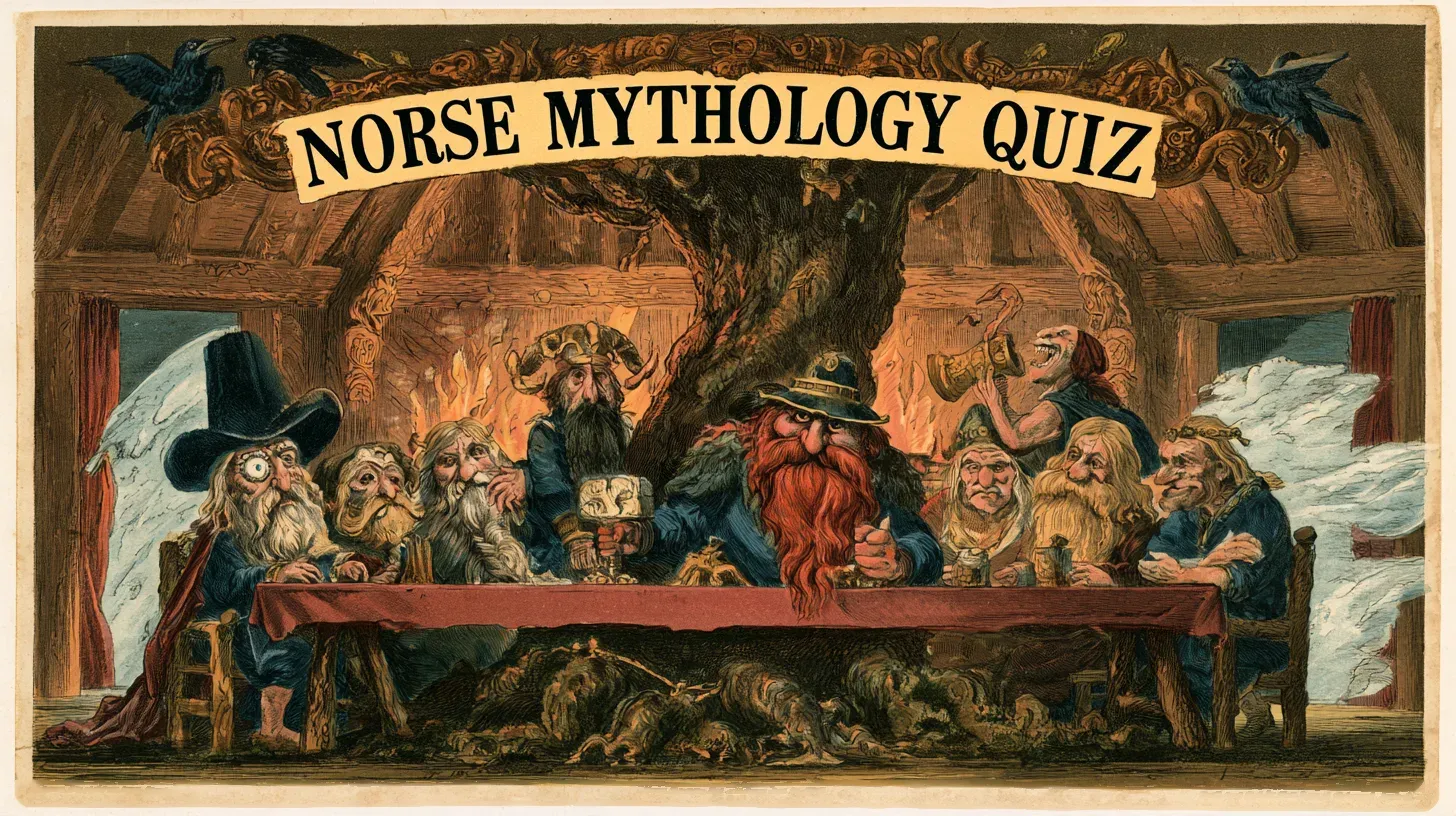
This Norse mythology quiz has 10 multiple-choice questions on Odin, Thor, Loki and the other Norse gods, from the one-eyed Allfather's bargains to the last battle at Ragnarök. Some are staples; a few come from deeper in the Eddas, the two medieval books that preserve most of the myths. Every question is written out in the answer key below, with the passage each answer comes from.
Question 1 of 10
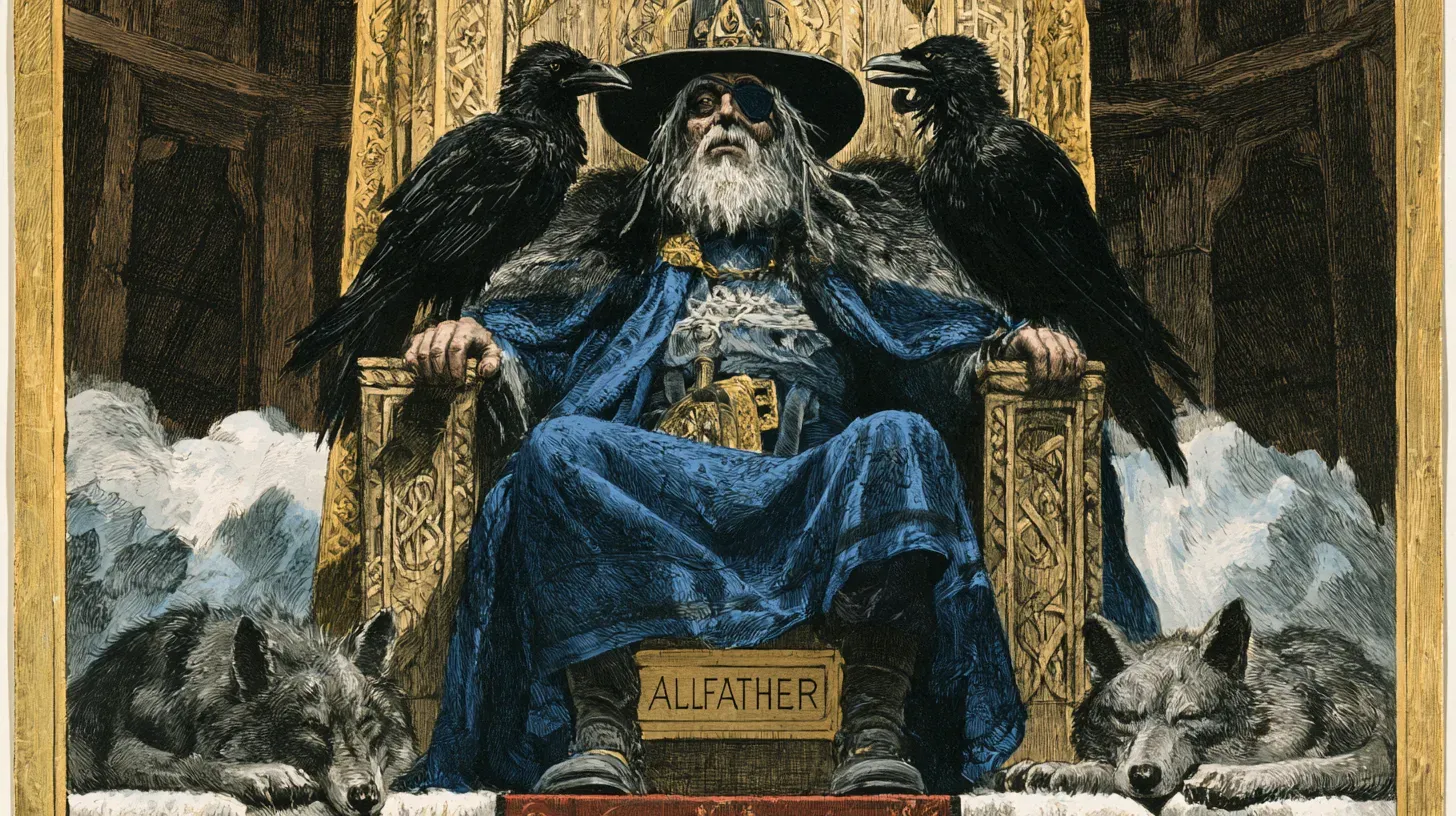
Odin, the chief of the Norse gods, has only one eye. According to the Prose Edda, what did he give the other one for?
See all answers & explanations
1. Odin, the chief of the Norse gods, has only one eye. According to the Prose Edda, what did he give the other one for?
Answer: A drink from Mimir's well of wisdom. Mimir's well lies under one of the three roots of the world tree, Yggdrasil, and "wisdom and understanding are stored" in it. Mimir drank from it every day, and when Odin asked for a single drink, "he got it not until he had laid his eye in pledge." Odin spends much of the mythology chasing knowledge. His two ravens, Huginn and Muninn, whose names mean Thought and Memory, fly out over the world each day and bring the news back to him. Go deeper: Beaks & Brains: Famous Crows & Ravens of the Past.
2. In the poem Hávamál, Odin hangs on a windswept tree for nine nights, wounded with a spear, as a sacrifice "myself to myself." What does he win by it?
Answer: The runes. "I took up the runes, shrieking I took them," Odin says, "and forthwith back I fell." Runes were the letters of the old Germanic alphabet, and in the myths they carry magic as well as meaning. The poem never names the tree, but readers have long taken it to be Yggdrasil. The mead of poetry is the tempting wrong answer: Odin got that too, but by stealing it from a giant. Hávamál means "Sayings of the High One," and most of it is Odin's advice on how to live. Go deeper: The Norse Code: 25 Viking Quotes From the Sagas.
3. Thor's hammer, Mjölnir, came out of the dwarfs' forge with a flaw. What is wrong with it?
Answer: Its handle is too short. Loki bet his own head that the dwarf Brokk and his brother Sindri could not make three treasures to match the gods' best. While Brokk worked the bellows, a fly bit him on the hand, then the neck, then the eyelid, until blood ran into his eye and he let go for a moment to brush it away. The first two treasures, a golden boar and a gold ring, survived. The hammer came out short in the handle. The gods judged it the best of all the gifts anyway, so Loki lost the bet, and Brokk sewed his lips shut. The rule that only the worthy can lift the hammer comes from Marvel comics, not the myths.
4. When the giant Thrym stole Mjölnir and demanded the goddess Freyja as his bride in exchange, how did Thor get his hammer back?
Answer: He went to the wedding disguised as the bride. Freyja refused so angrily that the hall of the gods shook and her necklace burst, so Heimdall suggested putting the bridal veil on Thor instead. Loki went along as the maid. At the feast the "bride" ate an ox and eight salmon and drank three tuns of mead, and Loki explained that she had been too excited to eat for eight nights. When Thrym had the hammer laid in the bride's lap to bless the marriage, Thor picked it up and killed him. The story is told in the poem Thrymskvitha.
5. Odin rides an eight-legged horse named Sleipnir. Who gave birth to it?
Answer: Loki. A builder offered to wall the gods' home in a single winter if they paid him with Freyja, the sun and the moon. His stallion, Svadilfari, hauled the stone so fast that he was about to finish on time. The gods blamed Loki, who had advised letting the builder use the horse, and Loki swore to fix it. That evening a mare ran out of the woods and led the stallion off for the night. The wall went unfinished, and "somewhat later" Loki "gave birth to a foal, which was gray and had eight feet." Angrboda is the tempting wrong answer: she is the mother of Loki's other children, the wolf Fenrir, the Midgard Serpent and Hel.
6. The gods bound the monstrous wolf Fenrir with a magic ribbon, but only after one of them put a hand in the wolf's mouth as a pledge of good faith. Which god lost that hand?
Answer: Tyr. Fenrir had already snapped two iron chains, so the gods sent to the dwarfs for a fetter called Gleipnir. It was made of six things, among them the sound of a cat's footfall, the beard of a woman, the breath of a fish and the spittle of a bird. The wolf smelled a trick and would not let the ribbon near him unless a god put a hand between his jaws. Only Tyr would do it, and when the ribbon held, the wolf bit the hand off at the wrist. Vidar is the tempting wrong answer: he is the god who kills Fenrir at Ragnarök.
7. The goddess Frigg made everything in the world swear not to harm her son Baldr, except one thing she thought too young to bother with. What killed him?
Answer: A shaft of mistletoe. With the oaths taken, the gods made a game of throwing things at Baldr and watching them bounce off. Loki, disguised as a woman, got Frigg to admit she had skipped the mistletoe. He pulled it up, handed it to Baldr's blind brother, Hod, and guided his aim. Hel, who rules the dead, agreed to send Baldr back if everything in the world wept for him. Everything did, except one giantess in a cave, and in the Prose Edda's words, "men deem that she who was there was Loki."
8. A creature named Ratatosk runs up and down the world tree, Yggdrasil, carrying spiteful words between the eagle at the top and the serpent gnawing at the roots. What kind of animal is it?
Answer: A squirrel. "The squirrel called Ratatosk runs up and down the length of the Ash, bearing envious words between the eagle and Nidhogg," the Prose Edda says. Yggdrasil is an ash tree that holds the worlds together, and it is a busy place: four stags graze on its branches, the serpent Nidhogg chews at one root, and a hawk sits between the eagle's eyes. Neither Edda gives the eagle a name.
9. At Ragnarök, the last battle of the gods, Thor finally kills the Midgard Serpent. What happens to him next?
Answer: He walks nine steps and falls dead from the serpent's venom. Thor "shall stride away nine paces from that spot; then shall he fall dead to the earth, because of the venom which the Snake has blown at him." The other choices belong to other gods. Fenrir swallows Odin, and Odin's son Vidar tears the wolf's jaws apart in revenge. Surt kills Freyr and then burns the world. Thor's sons Modi and Magni are among the few gods who live through it, and they inherit his hammer.
10. Most of what we know about the Norse myths was written down in the 1200s, more than two centuries after the country where it was written had become Christian. Which country was it?
Answer: Iceland. Iceland adopted Christianity by a decision of its national assembly, the Althing, around the year 1000. In the 1220s the Icelandic chieftain and poet Snorri Sturluson wrote the Prose Edda, a handbook for poets that retells the old stories so that young writers could follow the allusions in traditional verse. The Poetic Edda, a collection of anonymous older poems, survives mainly in one Icelandic manuscript from the 1270s. So nearly every story in this quiz comes to us through Christian writers looking back on a religion their ancestors had given up.
Norse Mythology Quiz FAQ
Is Loki Thor's brother in Norse mythology?
No. In the myths Loki is not related to Thor at all, by blood or by adoption. The Prose Edda calls him the son of the giant Farbauti and of Laufey, though it numbers him among the gods all the same. The adopted-brother story comes from Marvel's comics and films.
Loki's closest tie is to Odin. In the poem Lokasenna, Loki reminds Odin that the two of them once mixed their blood together, the old rite that made two men sworn brothers. That makes Loki something closer to Thor's uncle by oath than his brother. The two do travel together often, and the trip to Thrym's wedding in the quiz above is one of those journeys.
The films changed another family tie. In Thor: Ragnarok (2017), the death goddess Hela is Odin's firstborn. In the myths Hel is Loki's daughter, the sister of the wolf Fenrir and the Midgard Serpent.
What is Ragnarök in Norse mythology?
Ragnarök is the battle at the end of the world, in which most of the Norse gods die. The Old Norse word means "doom of the gods." A variant spelling, Ragnarøkkr, means "twilight of the gods," and the title of Richard Wagner's opera Götterdämmerung is the German for that.
It begins with three winters with no summer between them. Then the wolf Fenrir breaks his bonds, the Midgard Serpent comes ashore, and Loki and the giants march on the gods. The pairings are fixed in advance. Fenrir swallows Odin. Thor and the serpent kill each other, as in question 9 above. Heimdall and Loki kill each other too, and the fire giant Surt burns the world.
It is not quite the end. The earth rises green out of the sea, Baldr comes back from the dead, and a handful of younger gods survive. Two humans, Lif and Lifthrasir, hide in a wood through the fire, live on the morning dew, and repopulate the world.
Which days of the week are named after Norse gods?
Four of them: Tuesday, Wednesday, Thursday and Friday. The names come from Old English, whose speakers worshipped the same gods under slightly different names before they became Christian. Tuesday is Tiw's day (Tyr), Wednesday is Woden's day (Odin), Thursday is Thor's day, and Friday is Frigg's day.
The Germanic peoples borrowed the seven-day week from the Romans and swapped in their own gods for the Roman ones. Mars, the war god, became Tyr. Mercury became Odin, Jupiter the thunderer became Thor, and Venus became Frigg. Saturday kept its Roman god, Saturn, and Sunday and Monday are simply the sun's day and the moon's day.
Friday is sometimes credited to Freyja instead. The Old English name, Frigedæg, points to Frigg, but the line between the two goddesses is contested, and some Scandinavian forms of the day's name are read as Freyja's.
Who is the strongest Norse god?
Thor, according to the Prose Edda, which says he "is strongest of all the gods and men." He owns three treasures that add to that strength: the hammer Mjölnir, a belt that increases his strength by half when he buckles it on, and a pair of iron gloves he needs to grip the hammer's shaft.
The runner-up is Vidar, the silent god, who is "nearly as strong as Thor" and survives Ragnarök after killing the wolf Fenrir. Thor's son Magni makes a case too. When a dead giant's leg pinned Thor to the ground and none of the gods could shift it, Magni, three nights old, threw it off.
Strongest does not mean highest. Odin is the chief of the gods, and he rules by knowledge and cunning. That is one difference from the Greek gods, whose king, Zeus, is also the one who throws the thunderbolts. If you know that family better, try the Greek mythology quiz.