
World History Quiz
This world history quiz runs ten multiple-choice questions from Hammurabi's law code to the partition of India — trivia that crosses continents rather than working through one country century by century. Instant scoring, a short explanation after every answer, no sign-up and no timer. Prefer to read? Every question is written out below with its answer.
Question 1 of 10
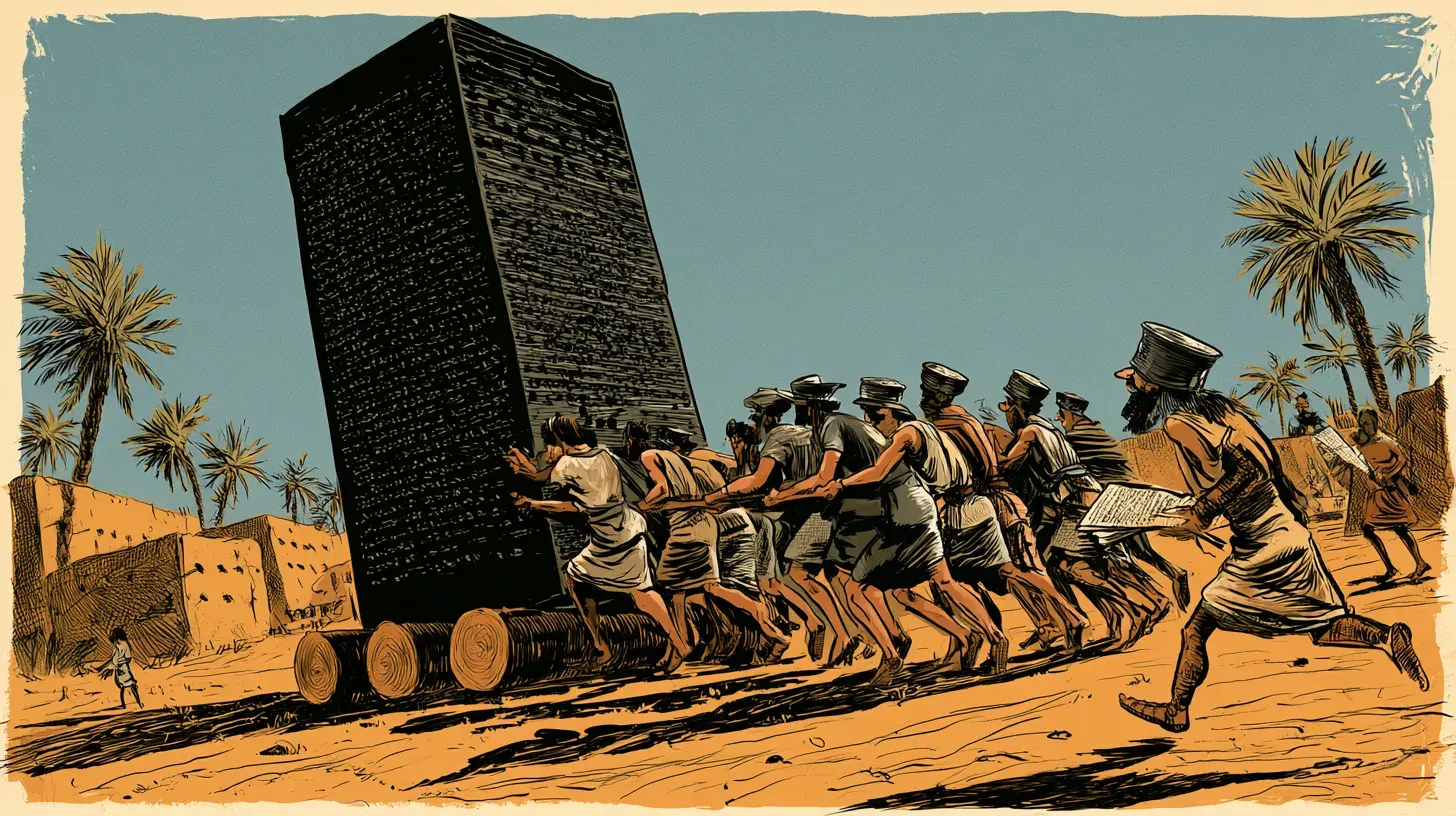
The stele carved with Hammurabi's 282 laws was dug up in 1901 — but not in Iraq. Where was it found?
See all answers & explanations
1. The stele carved with Hammurabi's 282 laws was dug up in 1901 — but not in Iraq. Where was it found?
Answer: Susa, in western Iran. Elamite raiders carried the seven-foot basalt stele off as war loot around 1150 BCE, which is why a French expedition under Jacques de Morgan found it at Susa in 1901–02. It has sat in the Louvre ever since. One thing the code is not: the oldest known set of written laws. The Code of Ur-Nammu predates it by roughly three centuries.
2. Sponge divers pulled the Antikythera mechanism out of a Greek shipwreck in 1901. What did the device actually do?
Answer: Predicted eclipses and tracked the Sun, Moon and planets. The mechanism is a bronze geared calculator built around 150–100 BCE that modeled the movements of the Sun, Moon and planets and predicted eclipses using the 223-month Saros cycle. Nothing of comparable gearing survives from anywhere in the world for well over a thousand years afterwards, which is why it still unsettles historians of technology.
3. Four ancient writing systems. Which one has never been deciphered?
Answer: The Indus Valley script. Roughly 4,000 inscribed Indus objects survive, but most carry only four or five signs, the longest known text runs to seventeen, and no bilingual inscription has ever surfaced to crack it. The others all fell: Linear B to Michael Ventris in 1952, hieroglyphs to Champollion in 1822, and cuneiform over the 1850s.
4. The words "algebra" and "algorithm" both trace back to the same ninth-century scholar in Baghdad. Who was he?
Answer: Muhammad ibn Musa al-Khwarizmi. "Algebra" comes from al-jabr in the title of al-Khwarizmi's treatise of around 820 CE, and "algorithm" from the Latin rendering of his name, Algoritmi. Worth being precise about what that does and does not mean: he did not invent step-by-step procedures, which are far older than him. Both English words are still his. Go deeper: The Most Famous Mathematicians Ever: Beyond the Numbers.
5. The oldest surviving book printed with movable metal type was produced in 1377. Where?
Answer: Korea. The Jikji, a Buddhist anthology printed at Heungdeok Temple in Cheongju, beat Gutenberg's 42-line Bible by 78 years. Every qualifier in that sentence is load-bearing — China's Bi Sheng had movable ceramic type by the 1040s, and the woodblock-printed Diamond Sutra of 868 is older than both. The only surviving volume of the Jikji is in Paris.
6. Between 1405 and 1433 Zheng He's Ming treasure fleets sailed west. How far did they actually get?
Answer: The east coast of Africa. The fleets reached Hormuz, Jeddah and the East African ports of Mogadishu, Malindi and Mombasa. The first voyage alone carried 317 ships and tens of thousands of men; Columbus set out 87 years later with three ships and about ninety. The claim that Zheng He reached the Americas rests on a single 2002 book that historians have rejected. Go deeper: From Sea to Space: Famous Explorers Who Risked it All.
7. Who completed the first circumnavigation of the globe?
Answer: Juan Sebastián Elcano. Magellan planned the voyage and led it out of Spain in 1519 with five ships, but he was killed in the Philippines in April 1521, roughly two-thirds of the way round. Elcano brought the Victoria home to Sanlúcar on 6 September 1522 with eighteen survivors of the crew of about 270 that had set out.
8. In 1825, with a French squadron anchored off its coast, Haiti agreed to pay France 150 million francs. What for?
Answer: To compensate former slaveholders for their lost "property". France demanded the sum — about six times Haiti's annual state revenue — in exchange for recognizing the independence Haitians had already won by force twenty-one years earlier. The formerly enslaved were made to pay the enslavers. The figure was cut to 90 million in 1838, and Haiti made its final payment in 1883.
9. The deadliest civil war in recorded history was led by a man who believed he was what?
Answer: The younger brother of Jesus Christ. Hong Xiuquan led the Taiping Rebellion against the Qing from 1850 to 1864, and estimates of the dead run from 20 to 30 million — much of it famine and disease rather than fighting, which is part of why the range is so wide. It ran almost exactly alongside the American Civil War, which killed roughly 750,000.
10. The lawyer who drew the India–Pakistan border in 1947 had one notable qualification for the job. What was it?
Answer: He had never set foot in India. Cyril Radcliffe had never visited India, or anywhere else in Asia, before being handed the job. He was given roughly five weeks to divide some 175,000 square miles and 88 million people, and the finished line was deliberately withheld until 17 August — two days after independence, so millions woke up in a new country without knowing which one.
World History Quiz FAQ
What is the hardest history question ever?
There is no single hardest history question, but the ones that defeat almost everybody share a shape: they ask about something the evidence cannot actually settle. How many people died in the Black Death is the classic example — credible scholarly estimates range from about 30% of Europe's population to 65%, a spread of more than double, because the figure has to be extrapolated from patchy parish and manorial records.
A second category is the question whose familiar answer is simply wrong. Ask who completed the first circumnavigation and most people say Magellan, who died a third of the way from the end. Ask where the Code of Hammurabi was found and most people say Babylon, not Iran.
A third is the unread evidence. The Indus Valley script has resisted every attempt at decipherment for a century, and in January 2025 the government of Tamil Nadu posted a million-dollar prize for anyone who cracks it.
If you want questions built deliberately at that difficulty, our hardest history questions quiz is the one to try next.
What are some good world history questions?
Good world history questions reward connecting things rather than memorizing them, and they usually turn on a specific, checkable detail — a date, a name, a number, or a "first" with its qualifiers intact.
The best ones tend to be comparative. Asking when government-issued paper money first appeared is more interesting than any single date, because the answer is Song-dynasty Sichuan in the 1020s and Europe did not follow until Sweden in 1661 — a gap of six centuries that reframes how people picture medieval economies. The same trick works for Zheng He's fleets against Columbus's three ships, or the Jikji against the Gutenberg Bible.
Questions that puncture a familiar story also work well, provided the correction is solid. Napoleon was not short; the conversion from French *pouces* to imperial inches is what shrank him. Vikings did not wear horned helmets; a costume designer for Wagner invented those in 1876.
What makes a bad question is a superlative without qualifiers — "the first law code" or "the largest empire" — because those almost always have a counter-example waiting. Every question in the quiz above states its qualifiers on purpose.
How many questions should a world history quiz have?
Ten is the practical answer for a quiz people actually finish, which is why this one runs ten. Longer banks of fifty or a hundred questions exist and they suit revision or a pub round, but completion rates fall off steeply once a quiz stops fitting in a short sitting.
What matters more than the count is coverage. A world history quiz with ten questions can still be genuinely global if the questions are chosen to spread across regions and eras rather than clustering on the same handful of famous European moments. The ten above run from ancient Mesopotamia, Greece and the Indus Valley through Baghdad, Korea and Ming China to Haiti, Qing China and the partition of India.
That spread is the harder constraint. Most "world history" quizzes are European history with a few guest appearances, and it is worth checking any quiz you take against that test — count how many of its questions leave Europe.