
History IQ Quiz
This history IQ quiz packs ten questions into more than four thousand years — from the crews who raised the Great Pyramid to the treaty that handed Hong Kong to Britain. Answer them in the widget for an instant score, or scroll past it and read every question, answer, and explanation in full. It's free, there's no sign-up, and the questions get harder as you go.
Question 1 of 10
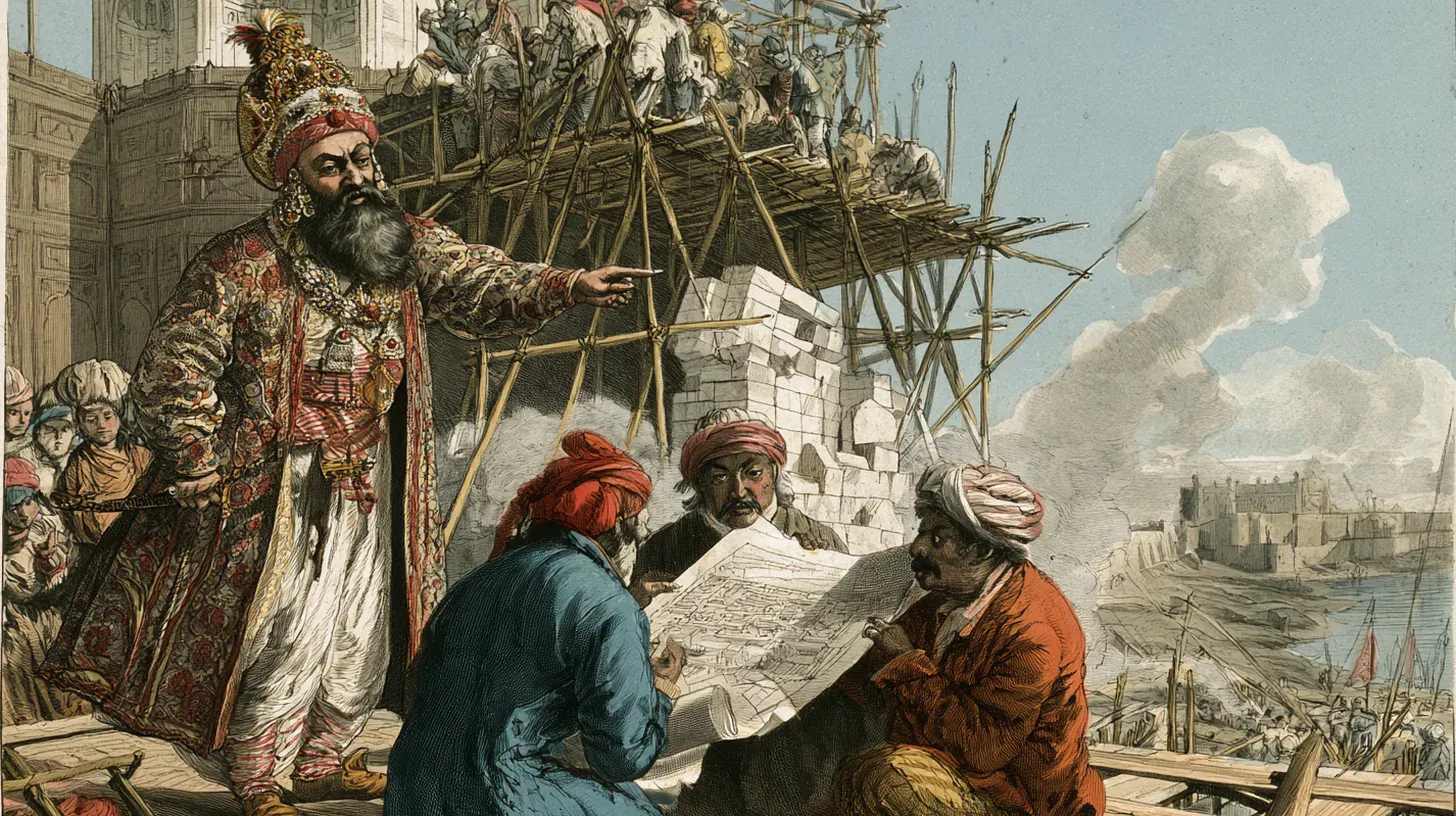
Mughal emperor Shah Jahan ordered the Taj Mahal built in the 1630s. What was it?
See all answers & explanations
1. Mughal emperor Shah Jahan ordered the Taj Mahal built in the 1630s. What was it?
Answer: A tomb for his wife. The Taj Mahal is a mausoleum for Mumtaz Mahal, Shah Jahan's wife, who died in childbirth in 1631. The main marble tomb went up between 1632 and 1648, and the surrounding complex took until about 1653 — roughly two decades of work by some 20,000 artisans.
2. China's Terracotta Army lay unrecorded and unseen for more than 2,000 years. Who finally found it in 1974?
Answer: Farmers digging a well. In March 1974, farmer Yang Zhifa and fellow villagers near Xi'an hit a life-sized clay figure while digging a well during a drought. The army guards the vast tomb complex of Qin Shi Huang, China's first emperor — whose burial mound is laced with mercury, exactly as ancient accounts claimed. Go deeper: Fun Facts form Ancient China that You Didn’t Know About.
3. Archaeologists have excavated the town that housed the Great Pyramid's workforce. Who does the evidence say built it?
Answer: Rotating crews of paid Egyptian laborers. The workers' settlement beside the Giza plateau had bakeries, breweries, medical care, and honorific tombs overlooking the pyramids — burials no enslaved workforce would have received. Khufu's Great Pyramid, raised around 2550 BCE from some 2.3 million limestone blocks, was built by rotating crews of Egyptian laborers fed and paid by the state. Go deeper: Power Along the Nile: 25 Famous Egyptian Pharaohs.
4. Michelangelo carved the David, the Moses, the Bacchus — and signed exactly one work in his life. Which?
Answer: The Pietà. After overhearing visitors credit the Pietà to another sculptor, Michelangelo — then 24 — carved his name into the sash across Mary's chest. He reportedly regretted the outburst and never signed anything again. Go deeper: 23 Famous Sculptures That Shaped Our Cultural Identity.
5. In July 1518, hundreds of people in Strasbourg began dancing uncontrollably for days on end. What did the authorities prescribe as a cure?
Answer: More dancing. Convinced the afflicted could only dance the mania out of their systems, the city cleared guild halls, built a stage, and hired musicians to keep them moving. It began with one woman, Frau Troffea, and grew to roughly 400 dancers before fading in September; how many died is still disputed by historians. Go deeper: Strange But True: 11 Funny Historical Facts That Will Make You Laugh.
6. Hagia Sophia, finished in 537, reigned as the world's largest cathedral for roughly a thousand years — until which church finally overtook it?
Answer: Seville Cathedral in Spain. Justinian's great domed basilica in Constantinople held the title from 537 until Seville Cathedral was completed in the early 1500s — a run of nearly a millennium. St. Peter's, the obvious guess, wasn't finished until 1626.
7. Angkor Wat in Cambodia, often called the world's largest religious monument, was originally built in the early 1100s as a temple of which faith?
Answer: Hinduism. Khmer king Suryavarman II raised it as a state temple to the Hindu god Vishnu, with sandstone floated in by canal from a quarry about 22 miles away. Only toward the end of the 1100s did it gradually become the Buddhist site it remains today — the trap answer is the modern one.
8. The Inca road network ran tens of thousands of kilometers through the Andes. Which of these did it operate entirely without?
Answer: Wheeled vehicles. The Qhapaq Ñan — some 30,000 km of it by UNESCO's estimate — carried llama caravans and relay runners, crossed gorges on fiber suspension bridges, and was paved in stretches, but never saw a wheeled vehicle. In the pre-Columbian Americas the wheel was never used for transport at all: stepped mountain terrain and the lack of draft animals made it useless. Go deeper: Ancient Tools: Amazing Facts & Discoveries.
9. The 1842 Treaty of Nanking closed the First Opium War — and handed Britain what?
Answer: Hong Kong Island. Signed aboard HMS Cornwallis, the treaty ceded Hong Kong Island to Britain, opened five treaty ports to Western trade, and imposed an indemnity on Qing China — the first of the "unequal treaties." It's why Hong Kong stayed British until 1997. Macau, the tempting wrong answer, was Portuguese.
10. In March 1896 at the Battle of Adwa, which country's army decisively defeated an invading Italian force — and got its independence formally recognized for it?
Answer: Ethiopia. Emperor Menelik II — with Empress Taitu commanding troops of her own — crushed the Italian invasion at Adwa on March 1–2, 1896. That October, Italy signed the Treaty of Addis Ababa recognizing Ethiopia's full sovereignty, a result almost no other African state secured during the Scramble for Africa.
History IQ Quiz FAQ
Does this history IQ quiz include the answers?
Yes — every answer is on this page, twice. Inside the widget, each guess gets instant feedback with a short explanation of why the right answer is right. Below the widget, the full answer key spells out all ten questions, answers, and explanations, so you can read the whole thing without playing a single round.
That also makes this page work as a ready-made question set. If you came looking for history quiz questions with answers for a trivia night or a classroom warm-up, the answer key is built for exactly that — multiple choice, four options each, with the reasoning included so you can settle disputes at the table.
Is this history IQ quiz suitable for adults?
Yes — it's written for adults, and the difficulty ramps deliberately. The first questions are ones most people can reason out; by the final stretch you're in territory that trips up genuine history buffs. If you enjoy reading about the worst Roman emperors or history's most famous explorers, you'll be at home here.
One honest note: your result is a for-fun knowledge score, not a psychometric IQ. A real IQ test is a standardized instrument administered under controlled conditions — this is ten multiple-choice questions about the human past. Treat your score as bragging rights, not a clinical measurement.
What's the hardest question in history?
There's no single agreed hardest question, but the toughest quiz questions share a shape: they hinge on facts that cut against what most people assume — a "Buddhist" temple built for Vishnu, a colonial war Europe lost. In this quiz, the final question on the Battle of Adwa is the one fewest players see coming.
If you want a whole round pitched at that level, our hardest history questions quiz is the site's dedicated hard tier — ten questions built specifically to beat know-it-alls, with the evidence laid out in every answer.