
10 History Trivia Questions (With Answers)
These ten history trivia questions start with the world's first vending machine and end with a myth about the Great Wall of China. In between: a fire, a flood of molasses, and history's shortest war. Answer all ten in the widget for an instant score — or scroll past it and read every question, answer, and explanation in full.
Question 1 of 10
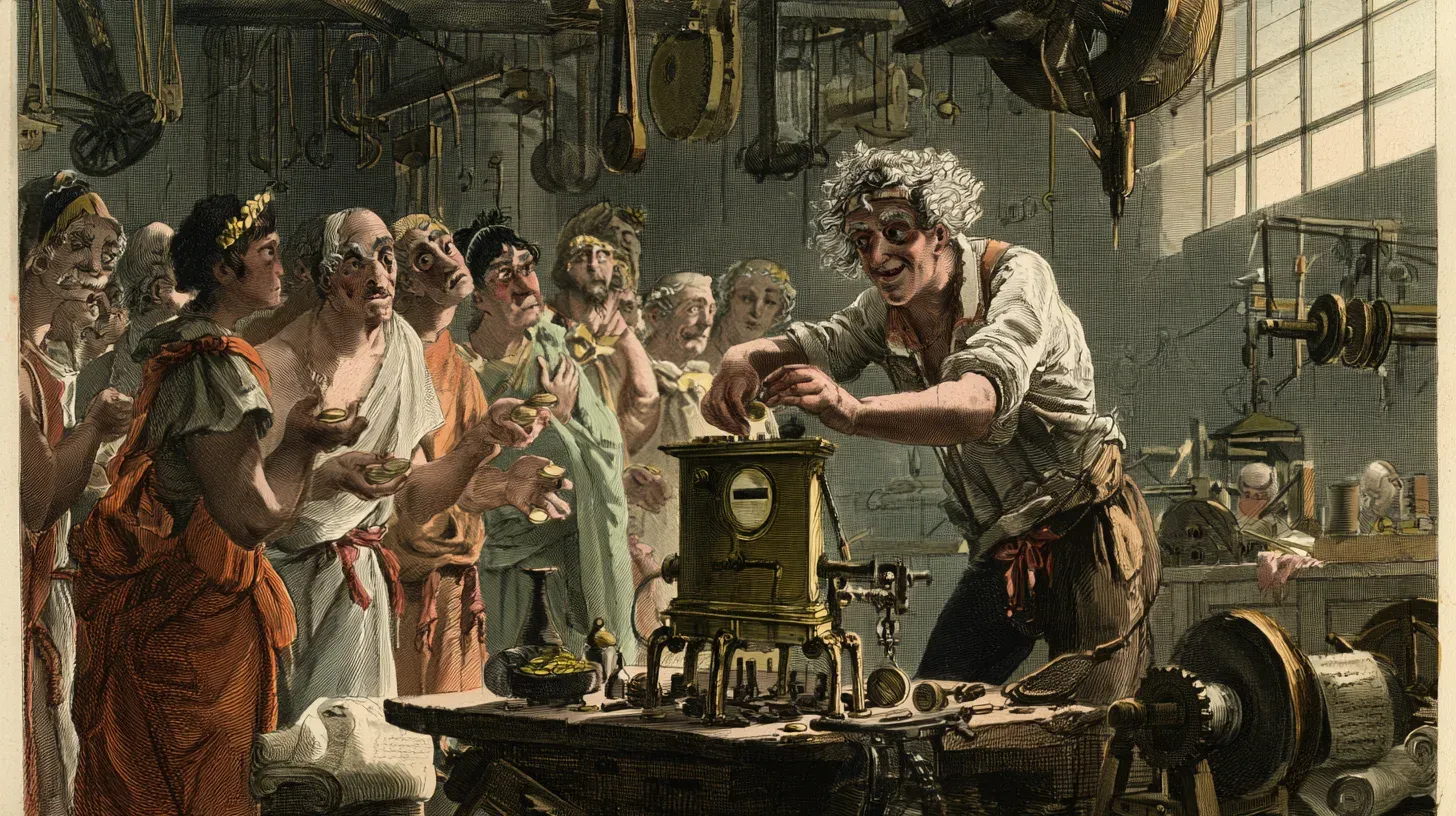
The world's first known vending machine, described by the engineer Hero of Alexandria in the 1st century AD, dispensed what?
See all answers & explanations
1. The world's first known vending machine, described by the engineer Hero of Alexandria in the 1st century AD, dispensed what?
Answer: A dose of holy water. Hero's Pneumatica describes a coin-operated dispenser built for temples in Roman Egypt — the coin's weight tipped a lever, the lever opened a valve, and out came a measured pour of holy water. It existed because worshippers kept helping themselves to more water than they had paid for.
2. The University of al-Qarawiyyin in Fez, Morocco — recognized as the world's oldest continually operating university — was founded in 859 AD by whom?
Answer: The daughter of a wealthy merchant. Fatima al-Fihri spent her inheritance to found al-Qarawiyyin, which UNESCO and Guinness World Records recognize as the oldest continually operating degree-granting institution on Earth. It was teaching students more than two centuries before the University of Bologna opened its doors.
3. The Aztecs used cacao beans as money — and their counterfeiters faked the beans with what?
Answer: Molded clay beans. Cacao was valuable enough to spend, and Spanish chroniclers writing soon after the conquest described forgers molding convincing fakes out of clay and slipping them into payments. Counterfeit money made of literal dirt — some habits are older than coins. Go deeper: Sacred & Savage: 25 Historical Aztecs Facts.
4. According to the official records, how many people died in the Great Fire of London in 1666?
Answer: 6. The fire destroyed roughly 13,200 houses and 87 churches, yet only six deaths were officially verified. Many historians suspect the true toll was far higher — the deaths of poorer Londoners simply went unrecorded, and the fiercest heat left little evidence behind.
5. Catherine the Great, Russia's longest-reigning empress, was born into what?
Answer: A minor German princely family. She was born Sophie of Anhalt-Zerbst in 1729 in Stettin, then part of Prussia. She learned Russian, converted to Orthodoxy, took the name Catherine — and in 1762 removed her own husband, Peter III, from the throne and ruled for 34 years.
6. Who found the Rosetta Stone in 1799?
Answer: French soldiers rebuilding an old fort. Soldiers on Napoleon's Egyptian campaign uncovered the inscribed slab in July 1799 while strengthening a fort near the town of Rosetta. Its three matching inscriptions eventually let Champollion crack hieroglyphs — in 1822, working in France from copies, without ever having seen Egypt. Go deeper: 20 Fascinating Historical Facts about Egyptian Hieroglyphics.
7. The shortest war in recorded history was fought between Britain and Zanzibar in 1896. Roughly how long did it last?
Answer: About 38 minutes. British warships opened fire on the sultan's palace at 9:02 on the morning of August 27, 1896, and stopped around 9:40 — most accounts put the fighting at 38 to 45 minutes. It was brutally one-sided, with roughly 500 Zanzibari casualties against a single wounded British sailor. Go deeper: Strange But True: 11 Funny Historical Facts That Will Make You Laugh.
8. When the explorer Hiram Bingham reached Machu Picchu in 1911, what did he find?
Answer: Local families living there and farming the old terraces. A local farmer, Melchor Arteaga, guided Bingham up the ridge — where Quechua families were living and farming among the ruins. Another Peruvian farmer, Agustín Lizárraga, had written his name on a wall there back in 1902. Bingham's real contribution was bringing Machu Picchu to the world's attention.
9. In January 1919, 21 people in Boston's North End were killed by a flood of what?
Answer: Molasses from a burst storage tank. A 50-foot steel storage tank ruptured and sent about 2.3 million gallons of molasses through the streets in a wave reported to have moved at around 35 miles per hour. The disaster killed 21 people, injured about 150, and flattened buildings along the waterfront.
10. According to astronauts who have looked for it, how visible is the Great Wall of China from low Earth orbit with the naked eye?
Answer: It's almost impossible to pick out. The wall is long but narrow, and it's built from local materials that blend into the terrain — astronauts report they can't reliably spot it without magnification. The "visible from space" claim actually predates spaceflight, with a version of it in print by the 1750s.
10 History Trivia Questions (With Answers) FAQ
What are some hard history trivia questions?
The hardest ones are usually the questions where the "obvious" answer is wrong. In the set above, the Great Fire of London is a good example — a fire that destroyed most of a city sounds like it should have killed thousands, and the officially recorded toll of six feels impossible. The shortest-war question works the same way: nothing about a war between an empire and a sultanate suggests it could be over in under an hour.
Questions about unfamiliar names are hard in a different way. Fatima al-Fihri and the University of al-Qarawiyyin rarely appear in Western textbooks, so even strong trivia players tend to guess a sultan founded the world's oldest university.
If this set felt comfortable, the site keeps a deliberately brutal tier in the hardest history questions quiz — questions built so the well-read guess is the wrong one.
What are some easy history trivia questions?
The easiest questions pair a name everyone knows with one memorable detail — the format most pub quizzes use for warm-up rounds. From the set above, Catherine the Great and the Great Wall of China are the gentlest entries: the names are familiar, and the answers reward common sense over memorization.
A good easy question still teaches something. Most people know the Great Wall; fewer know that astronauts say they can't pick it out from orbit, or that the claim was in print two centuries before anyone reached space. That's the difference between an easy question and a boring one.
For a gentler full set built around familiar American names and dates, start with the US history trivia quiz before working up to this one.
Where can I find history trivia questions with answers?
Every question on this page is written out in full beneath the quiz widget — open the answer key to read all ten history trivia questions and answers, each with a short explanation of the story behind the correct choice and links to sources.
The questions are multiple choice with four options apiece, which makes them easy to lift for a pub quiz, a classroom starter, or a family game night. The explanations are the part worth keeping: knowing that the Rosetta Stone turned up during fort repairs is a better story than the bare answer.
For more sets, the history quizzes hub collects every quiz on the site — American history, world history, ancient history, WW2, Greek mythology, and a hardest-questions tier — all free, with no sign-up and every answer explained.