
Ancient History Quiz
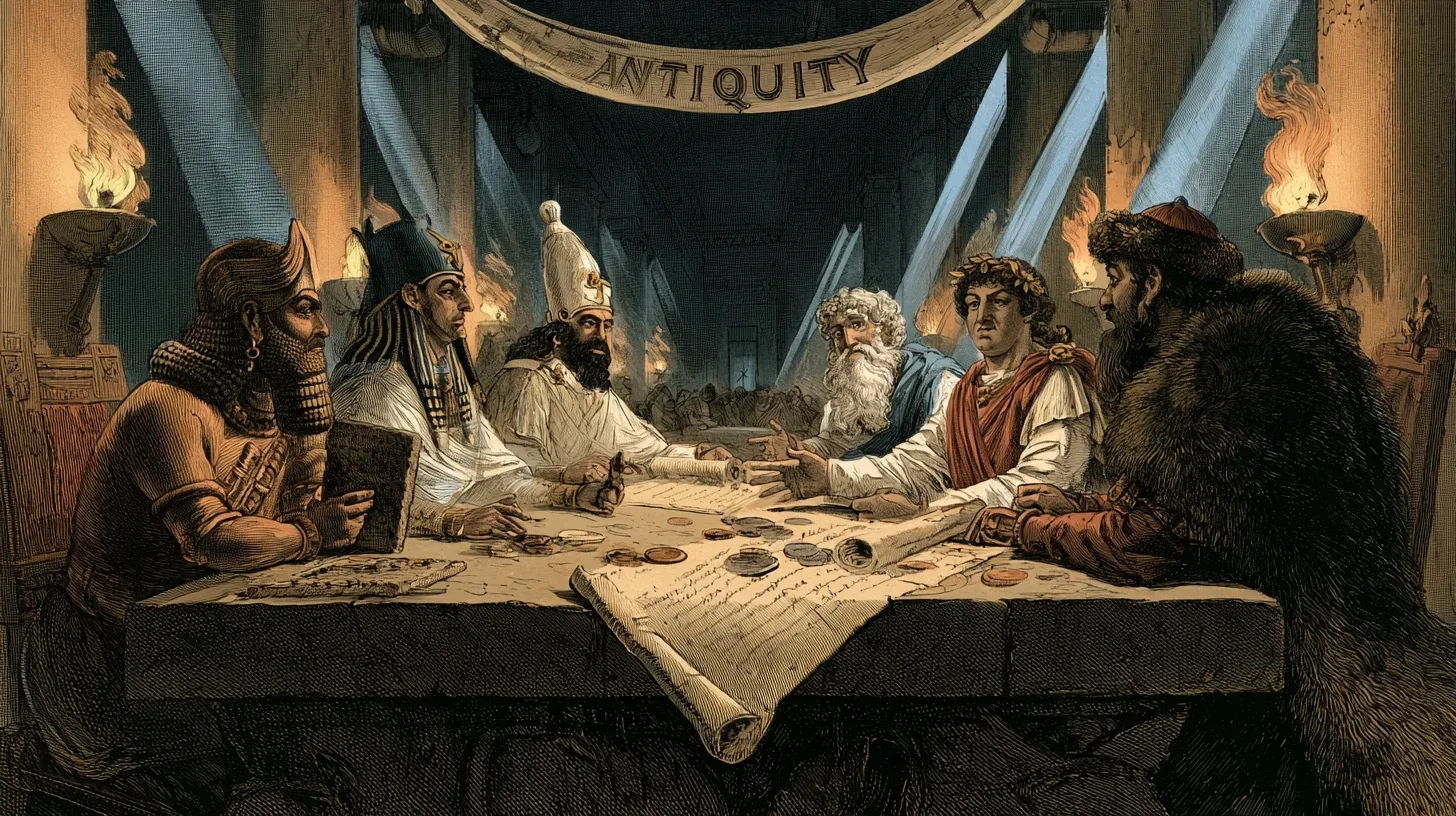
This ancient history quiz runs ten multiple-choice questions, from a furious customer in the city of Ur to a tattooed burial frozen into the Siberian permafrost. Egypt, Greece and Rome are all here — they just don't get to run the whole show. Instant scoring, a short explanation after every answer, no sign-up and no timer. Prefer to read? Every question is written out below with its answer.
Question 1 of 10
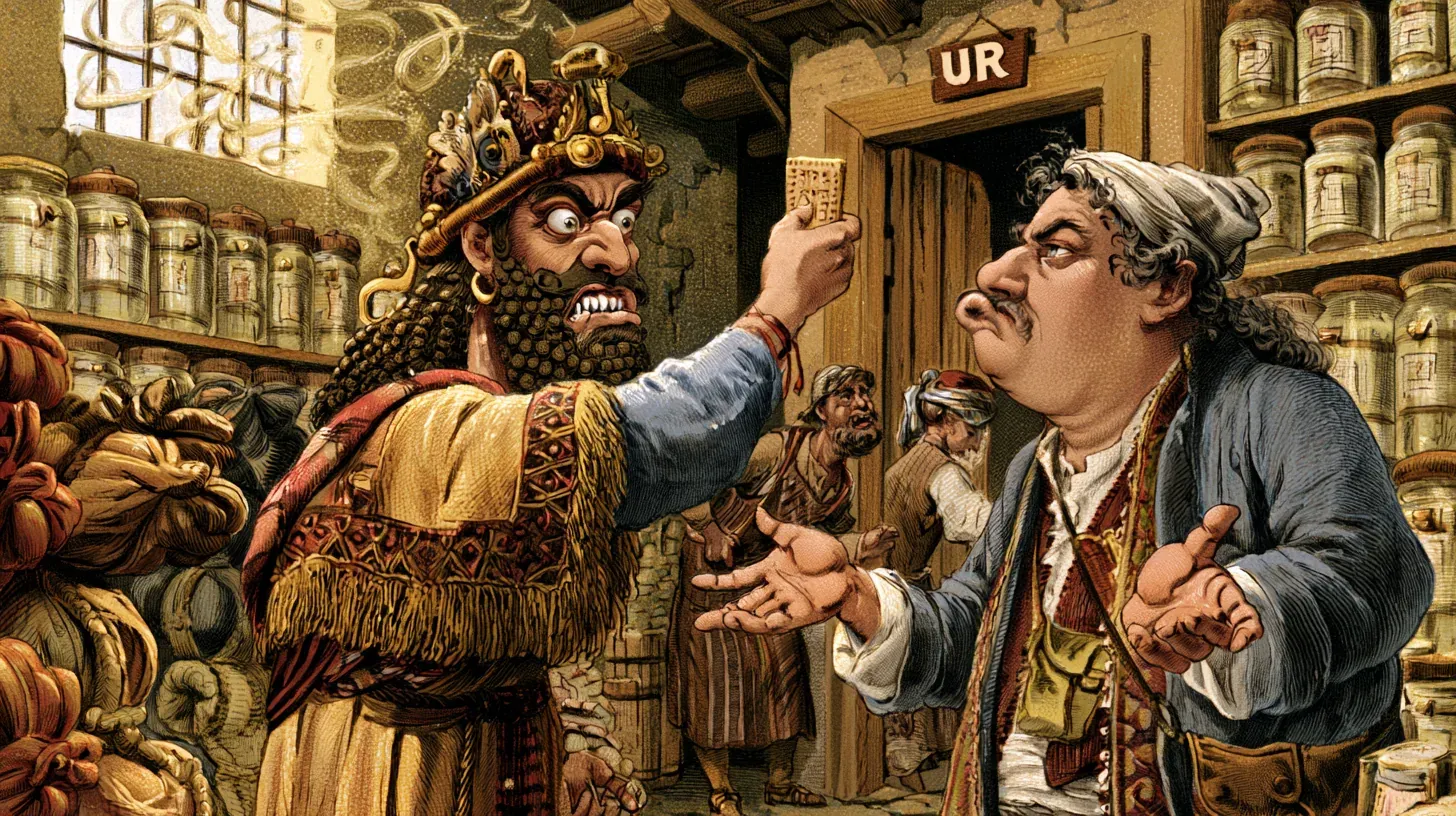
The oldest known written customer complaint is a clay tablet sent to a merchant in the city of Ur around 1750 BCE. What was the customer furious about?
See all answers & explanations
1. The oldest known written customer complaint is a clay tablet sent to a merchant in the city of Ur around 1750 BCE. What was the customer furious about?
Answer: The copper he was sold was the wrong grade. A man named Nanni wrote to a merchant called Ea-nasir to say he had been promised fine copper ingots, been handed poor ore instead, and had his messengers sent away empty-handed more than once. The tablet is about 11 cm tall, sits in the British Museum, and Guinness World Records recognises it as the oldest written customer complaint. Nearly four thousand years of commerce, and the first surviving letter from a customer is a man complaining about metal quality and bad service.
2. In year 29 of Ramesses III the tomb-builders of Deir el-Medina put down their tools and walked off the job — the first strike anywhere in the written record. What set it off?
Answer: Their grain rations were eighteen days late. The workers walked past the control post shouting that they were hungry, then staged sit-ins at the mortuary temples of Thutmose III and Ramesses II until someone paid them. Their scribe, Amunnakht, wrote the whole business down on what is now the Turin Strike Papyrus in the Museo Egizio. Note who these men were: not slaves, but skilled state artisans owed grain as wages, withholding their labour to collect a debt.
3. Cleopatra VII died in 30 BCE. Which of these was closest to her lifetime?
Answer: The first Moon landing. The Great Pyramid went up around 2560 BCE, roughly 2,500 years before Cleopatra was born. Apollo 11 landed in 1969, less than 2,000 years after she died. She is closer in time to us than to the pyramid that already stood in her own country as an ancient monument — tourists were carving graffiti on it centuries before she was born. "Ancient Egypt" covers so much time that its own people had ancient history of their own. Go deeper: Power Along the Nile: 25 Famous Egyptian Pharaohs.
4. The marathon is named after a run described by Herodotus, the only near-contemporary source. What run did he actually describe?
Answer: Athens to Sparta, about 140 miles, to ask for help before the battle. Herodotus sends Pheidippides to Sparta and back to beg for troops before the fighting starts. He says nothing about a dash from the battlefield, nothing about a dying gasp, and nothing about the distance we now race. That version turns up in Lucian roughly six hundred years later. So the modern 26.2-mile marathon is named after a run that probably never happened, and the run that did happen was more than five times longer.
5. What was a Roman vomitorium?
Answer: A passage that emptied a stadium of its crowd. The word comes from the Latin vomere, to spew forth, and what a vomitorium spewed forth was people: it is the passage under the seating that lets a packed amphitheatre empty out fast. The Colosseum is riddled with them. No ancient source describes a room set aside for vomiting between courses — that reading was invented much later by people reasoning backwards from the word, and it has been stuck to Roman banquets ever since.
6. Which kingdom was the first state in sub-Saharan Africa to mint its own coins?
Answer: Aksum. Aksum, in the Ethiopian highlands, began striking gold, silver and bronze coins at the end of the third century CE — the only coinage produced in Africa south of the Sahara in antiquity. The coins carried Greek inscriptions and were cut to Roman weight standards so they would pass in foreign trade. They also date a conversion: from the reign of Ezana in the mid-fourth century, a Christian cross replaces the older crescent and disc. Kush is the trap here — a major power, and a very old one, but it did not mint.
7. The Dujiangyan irrigation system on China's Min River was begun around 256 BCE and still waters farmland today. Which of these did its designer deliberately NOT build?
Answer: A dam. Li Bing split the river instead of stopping it. A levee divides the flow, a spillway sheds flood water and sediment, and a channel driven through the rock of Mount Yulei carries irrigation water onto the Chengdu plain — all of it working with the terrain rather than blocking it. The result has been in continuous service for over 2,200 years, survived the 2008 Wenchuan earthquake largely intact, and was inscribed by UNESCO in 2000. A dam would have silted up within a few generations.
8. While the pyramids at Giza were going up, what was happening in the Supe Valley of coastal Peru?
Answer: A city of monumental mounds was being built, without pottery. Radiocarbon dates published in Science in 2001 put monumental construction at Caral between roughly 2627 and 1977 BCE — platform mounds and sunken circular plazas across a site of about 65 hectares, raised at the same time Egypt was building its pyramid age. What Caral did not have was pottery. It belongs to the preceramic period, which means the standard checklist for a civilisation is missing one of its supposedly essential boxes. The Inca are nearly four thousand years later.
9. The seventeen known Olmec colossal heads were each carved from a single basalt boulder quarried at least 100 km away. How were the boulders moved?
Answer: By river raft and log rollers. The Olmec had no wheeled vehicles, no draft animals and no metal tools, so the heads travelled by water wherever the rivers allowed and overland on rollers where they did not. The stone is basalt from Cerro Cintepec in the Tuxtla Mountains of Veracruz; the finished heads average around eight tonnes and stand up to nearly three metres. Ten of the seventeen come from San Lorenzo alone, and every face is different, which is why they are usually read as portraits of individual rulers. Go deeper: 23 Famous Sculptures That Shaped Our Cultural Identity.
10. Permafrost sealed the Pazyryk burial mounds in the Altai Mountains of Siberia, preserving something that almost never survives from the ancient world. What?
Answer: Human skin, covered in animal tattoos. Ice turned these fifth- to third-century BCE tombs into freezers, keeping textiles, wood, horses and human bodies intact. Several of the mummies — including the woman found on the Ukok Plateau in 1993 and others held at the State Hermitage — carry sprawling tattoos of stags, horses and griffin-like creatures, pricked into the skin with a point and soot-based pigment. They are not the oldest tattoos known; Ötzi beats them by nearly three thousand years. They are among the most elaborate. Go deeper: Sacred Healing: Facts on Ancient Indigenous Medical Practices.
Ancient History Quiz FAQ
What is the oldest civilization in the world?
Sumer, in southern Mesopotamia, is the usual answer — cities such as Uruk and Ur were running temple economies and writing on clay by roughly 3500–3000 BCE, which makes Sumer the oldest civilisation for which we have both cities and written records.
The answer changes with the definition, though, and that is the real point. If you mean the oldest city-building society regardless of writing, Caral in Peru was raising monumental mounds by about 2627 BCE with no pottery at all. If you mean the oldest continuous cultural tradition rather than the earliest start, the usual candidates are China and Egypt. If you mean the oldest permanent settlement, Jericho has occupation layers older than any of them.
This is why "oldest civilisation" questions tend to produce arguments rather than answers. Almost every claim to be first is really a claim to be first at one specific thing — first writing, first city, first state, first continuous descent — and the qualifier is doing all the work.
For questions that cross into the medieval and modern world, our world history quiz is the one to try next.
Who is the father of history?
Herodotus, the fifth-century BCE Greek writer whose account of the Greco-Persian Wars gives us the phrase. The title is not Greek and not contemporary: Cicero coined it in Latin, calling him pater historiae in Book 1 of De Legibus in the first century BCE.
What usually gets left off is Cicero's second thought. In the same passage he points out that Herodotus's work is also full of fabulous stories, which is a fair summary — the Histories contain gold-digging ants, a Nile that behaves impossibly, and army numbers no modern historian accepts. That double reputation has followed him ever since, and he collects the sceptical epithets to match.
His claim to the title rests on method rather than accuracy. Herodotus set out to explain why a war happened, named his sources, reported versions he doubted while saying he doubted them, and treated foreign customs as things worth describing rather than dismissing. That is recognisably history rather than chronicle or epic, and it is why the label has stuck for two thousand years despite the gold-digging ants.
Who was the last pharaoh of ancient Egypt?
Cleopatra VII is the popular answer, and it is very nearly right — but the last pharaoh was her son. Ptolemy XV, known as Caesarion, had been her co-ruler since 44 BCE and became sole ruler when she died on 12 August 30 BCE. He held the throne for a matter of days before Octavian had him killed later that month, unwilling to leave a son of Julius Caesar alive to complicate his own claim to be Caesar's heir.
Both were Ptolemies, a Macedonian Greek dynasty that had ruled Egypt since Alexander's general took the country in 323 BCE — so the last pharaohs of ancient Egypt were not Egyptian by descent, and the family married siblings to keep the bloodline closed.
With Caesarion's death Egypt became a Roman province, and roughly three thousand years of pharaonic rule ended. It is worth sitting with how long that is: more time separates the first pharaohs from Cleopatra than separates Cleopatra from us.