
Gilded Age Quiz
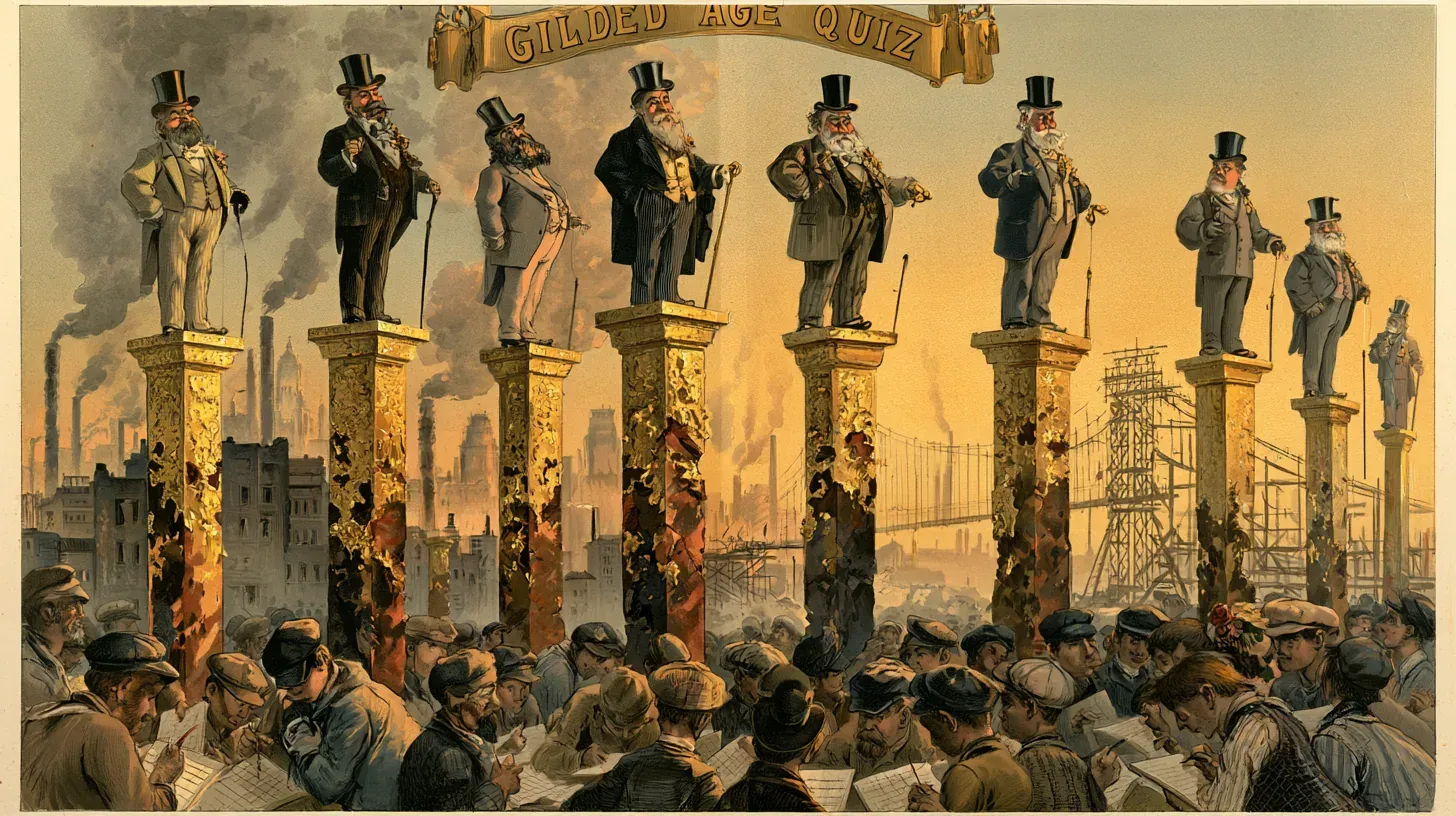
This Gilded Age quiz covers the three decades after Reconstruction, when America got rich fast and not always honestly: 10 multiple-choice questions on robber barons, political machines, immigration, strikes and the landmarks the era built. Some are textbook staples; a few go behind them. Every question is written out in the answer key below, with a sourced explanation.
Question 1 of 10
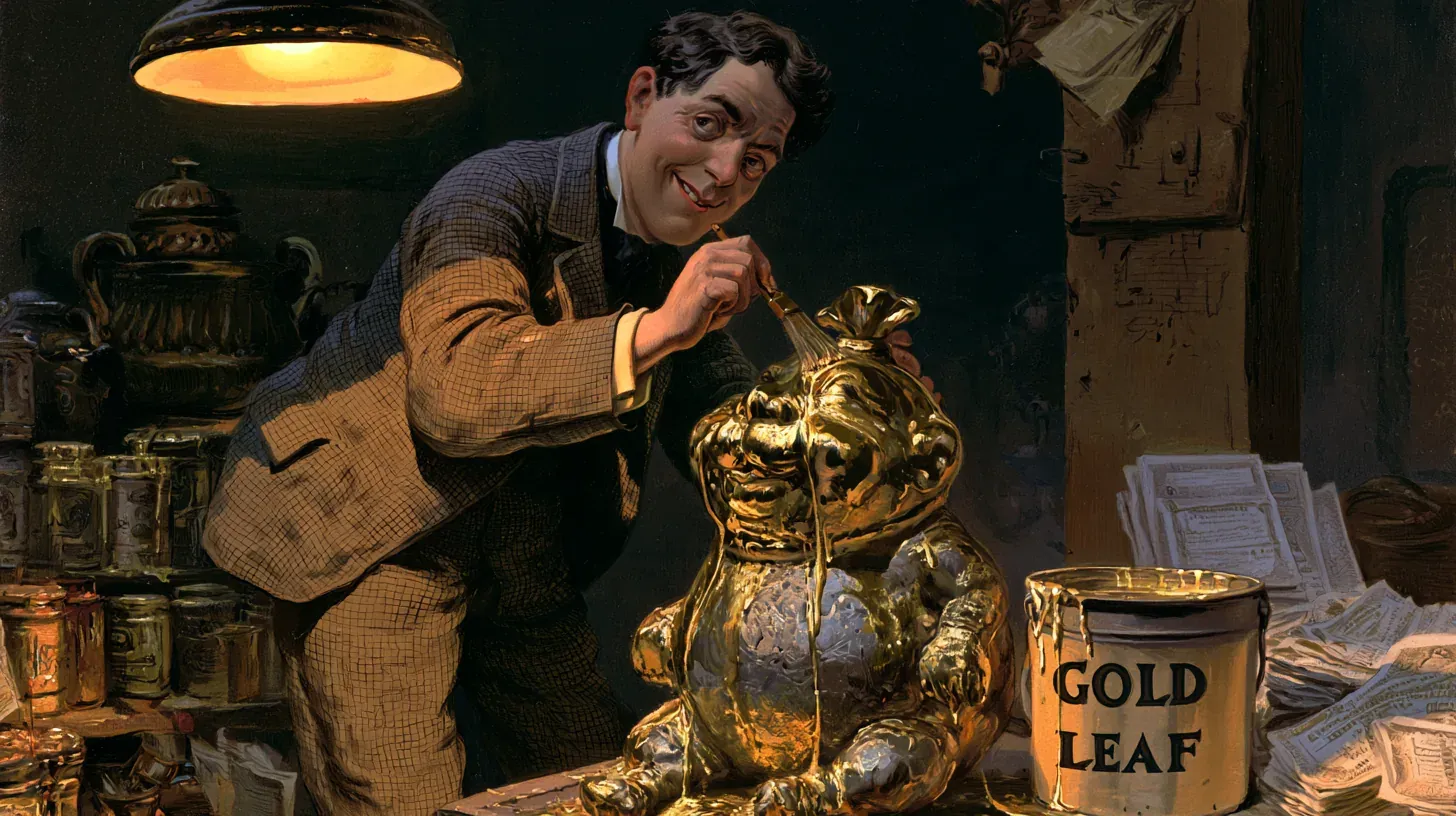
The Gilded Age takes its name from an 1873 novel that mocked the greed and political corruption of post-Civil War America. Which famous author co-wrote it?
See all answers & explanations
1. The Gilded Age takes its name from an 1873 novel that mocked the greed and political corruption of post-Civil War America. Which famous author co-wrote it?
Answer: Mark Twain. Mark Twain wrote The Gilded Age: A Tale of Today with the essayist Charles Dudley Warner. Gilding is a thin coat of gold over cheaper metal, and that was the joke: a shiny surface on a rotten age. Historians did not attach the label to the whole era until the 1920s. Edith Wharton, the tempting wrong answer, wrote about the same New York society decades later.
2. Thomas Nast's cartoons in Harper's Weekly are credited with helping bring down which New York political boss in 1871?
Answer: William "Boss" Tweed. William M. Tweed ran Tammany Hall, the Democratic machine that controlled New York City, and his ring stole millions from the city. The New York Times printed the leaked account books in 1871, and Nast's cartoons gave the scandal a face. When Tweed escaped to Spain in 1876, he was identified there from Nast's drawings. Croker, Plunkitt and Wood were Tammany men too, before or after Tweed. Nast also drew the round, bearded Santa Claus Americans still picture. Go deeper: How Coca-Cola’s History With Santa Claus Shaped Christmas.
3. In 1881 a man who believed he was owed a government job shot President James Garfield. What did Congress pass in 1883, partly in response?
Answer: The Pendleton Civil Service Reform Act. Charles Guiteau had campaigned for Garfield and expected a diplomatic post as his reward. The press cast him as a disappointed office-seeker, and the shooting turned public anger on the spoils system. The Pendleton Act, signed by Chester Arthur in January 1883, required some federal jobs to be filled by merit and competitive exams. Garfield lingered for 11 weeks after the shooting, while Alexander Graham Bell tried to find the bullet with an early metal detector. Go deeper: Inventing the Impossible: The Most Famous Inventors Ever.
4. The first major U.S. law to bar immigrants because of their race or nationality was signed in 1882. Which group did it target?
Answer: Chinese immigrants. The Chinese Exclusion Act banned Chinese laborers from entering the country for 10 years and made Chinese immigrants already here ineligible for citizenship. Congress renewed it in 1892 and made it permanent in 1902. It was not repealed until 1943, when China was an American ally in World War II. Go deeper: Legalized Oppression: A Global History of Evil Laws.
5. Bedridden by caisson disease, chief engineer Washington Roebling watched the Brooklyn Bridge rise from his window. Who carried his instructions to the builders?
Answer: His wife, Emily Warren Roebling. Emily Warren Roebling relayed her husband's orders to his assistant engineers and reported their progress back to him, learning enough engineering along the way to field the crew's questions herself. When the bridge opened on May 24, 1883, she was the first to cross it by carriage. John Roebling, who designed the bridge, died of tetanus in 1869 after his foot was crushed at the site, before construction began. Go deeper: Beyond Gaps: 24 Famous Bridges That Transformed Landscapes.
6. The Statue of Liberty was dedicated in New York Harbor in 1886. The engineer who designed the iron skeleton inside her went on to build which landmark?
Answer: The Eiffel Tower. Gustave Eiffel took over the statue's internal structure in 1879, after the first engineer, Eugène Viollet-le-Duc, died. His design hangs the thin copper skin on an iron frame around a central pylon, so the skin does not have to hold itself up. Frédéric Auguste Bartholdi sculpted the figure in France, and Eiffel's tower opened in Paris three years after the statue's dedication, for the 1889 World's Fair. Go deeper: 23 Famous Sculptures That Shaped Our Cultural Identity.
7. Congress passed the first federal law against monopolies and trusts in 1890. What is it called?
Answer: The Sherman Antitrust Act. Named for Ohio senator John Sherman, the act outlawed contracts and combinations "in restraint of trade." For years it had little bite, and courts turned it against labor unions as well as companies. Its most famous use came in 1911, when the Supreme Court broke John D. Rockefeller's Standard Oil into 34 companies. The Clayton Act and the Federal Trade Commission Act both followed in 1914. Go deeper: A List of the Largest Antitrust Cases of All Time.
8. Milton Hershey was a caramel maker when he saw German chocolate-making machinery at a world's fair in 1893 and bought it. Which fair was it?
Answer: The World's Columbian Exposition in Chicago. The machines came from J. M. Lehmann of Dresden and went to Hershey's caramel works in Lancaster, Pennsylvania, where he first used them to coat caramels in chocolate. In 1900 he sold the caramel business to put everything into chocolate. The same Chicago fair saw the debut of Wrigley's Juicy Fruit gum. Philadelphia's Centennial was 17 years earlier, and Buffalo's fair came in 1901. Go deeper: Milton S Hershey: The Chocolate King who Founded Hershey.
9. Which labor leader's American Railway Union boycotted trains carrying Pullman sleeping cars in 1894, until federal troops broke the strike?
Answer: Eugene V. Debs. Pullman workers walked out in May 1894 after the company cut their wages without lowering the rents in its company town south of Chicago. Debs's union refused to handle trains carrying Pullman cars, and rail traffic across much of the country stopped. President Grover Cleveland sent federal troops into Chicago in July, over the Illinois governor's objection, and Debs went to jail for defying a court injunction. He later turned to socialism and ran for president five times.
10. In 1901 Andrew Carnegie sold his steel company for about $480 million. Who bought it and built U.S. Steel around it?
Answer: J. P. Morgan. J. P. Morgan merged Carnegie Steel with other steelmakers into United States Steel, capitalized at about $1.4 billion and usually called the first billion-dollar corporation. Carnegie's own share was roughly $226 million, and he spent his last years giving it away, much of it on public libraries. Frick, the tempting wrong answer, had been Carnegie's partner and ran the company during the Homestead Strike of 1892. Go deeper: U.S. Steel CEO History: From Gary to Burritt.
Gilded Age Quiz FAQ
Who was the richest person during the Gilded Age?
John D. Rockefeller, by most measures. His Standard Oil controlled about 90 percent of American oil refining by the early 1880s, and his fortune kept growing after the era ended. Guinness World Records puts his net worth at $900 million in 1913, two years after the Supreme Court broke Standard Oil into 34 companies. The breakup made him richer, because the separate companies' shares rose in value.
Andrew Carnegie ran him closest. Carnegie's share of the 1901 steel sale to J. P. Morgan, the deal in the last question of the quiz above, came to about $226 million. Cornelius Vanderbilt, the shipping and railroad magnate, was the richest American of the era's early years, and he left about $100 million when he died in 1877.
Putting any of them in today's money is guesswork. Estimates for Rockefeller run from about $30 billion to several hundred billion dollars, depending on whether you adjust for prices or measure his fortune against the size of the economy. That is why he so often tops lists of the richest Americans ever.
What did Mark Twain say about the Gilded Age?
He named it, in a way. In 1873 Twain and Charles Dudley Warner published The Gilded Age: A Tale of Today, a satire of land speculation, get-rich-quick schemes and bought votes in Washington. Something gilded is cheap metal under a thin layer of gold, so the title called the boom a shiny surface over rot.
The novel follows the Hawkins family's dream of getting rich from a large tract of Tennessee land, and Colonel Beriah Sellers, a cheerful promoter whose schemes never pay off. Its Washington chapters skewer a senator who tries to buy his re-election and a Congress that trades votes for favors.
Twain did not mean the title as a name for an entire era. Historians took up the phrase in the 1920s for the decades between Reconstruction and the Progressive Era, and it stuck. Twain's best-known novel of those years came later: Adventures of Huckleberry Finn, published in 1885 and one of the most often banned books in American history.
Are any Gilded Age families still wealthy today?
A few are, and the Rockefellers are the best-known example. Much of the family's money went into trusts and foundations that still exist, including the Rockefeller Foundation, set up in 1913, and descendants stayed prominent in banking, politics and philanthropy. John D.'s grandson Nelson Rockefeller became vice president in 1974.
The Vanderbilts are the classic counterexample. Cornelius Vanderbilt's heirs spent heavily on Fifth Avenue mansions and Newport "cottages" such as The Breakers. In his 1989 family history, Fortune's Children, Arthur T. Vanderbilt II wrote that when the Commodore's descendants held a reunion at Vanderbilt University in 1973, not one of those present was a millionaire. That account comes from a single author, and the richer branches may simply have stayed home, but the decline itself is not in doubt.
Other Gilded Age names live on mainly through what they built or gave away: Carnegie through Carnegie Hall and the public libraries he paid for, and Morgan through the bank that still carries his name, JPMorgan Chase.